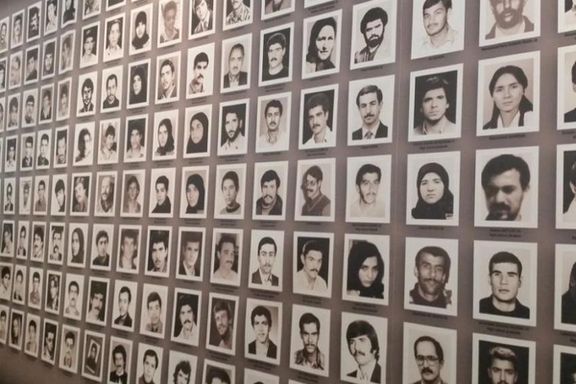
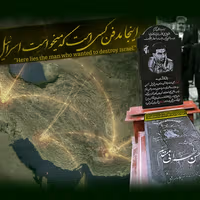
Some of the victims of prison massacre in Iran in 1988.
Evidence being given in the Stockholm trial of Hamid Nouri (Noury) implicates him as a judge and torturer in the 1988 wave of prison executions in Iran.
Twelve plaintiffs have since August 10 given testimony against Nouri (Noury), who has been charged under universal jurisdiction with “war crimes, crimes against humanity, torture, and participating in the continued crime of refusing to return the bodies of executed prisoners to their families.”
Plaintiffs and witnesses have said Nouri, known to prisoners as Hamid Abbasi, was directly involved in 1988 in torturing, executing and secretly burying thousands of prisoners, mostly members of the Mujahedin-e Khalq Organization (MEK), at Gohardasht prison in Karaj where they say Nouri, then 27, was a judge.
Nouri, who was arrested in 2019 at Stockholm airport when apparently arriving to visit relatives, denies any connection with the executions.
Nouri, now 60, interrogated the prisoners and mocked them, Fereydoun Najafi-Aria told the court Friday. Najafi-Aria, who lives in Australia, explained to the court that he was arrested in 1981, aged 18, and sentenced to 15 years in prison.
Hamid Nouri (Noury), former Iran judge implicated in prison killings of opponents in 1988
Nouri interviewed MEK prisoners in prayer halls at Gohardasht and Evin prisons, Najafi-Aria alleged: "We would sit three meters away from him, without blindfolds, and watch. He would ask prisoners if they still supported [the MEK]. He would mockingly tell them they would be arrested and killed if they were released and continued political activity.”
Najafi-Aria told the court he found out about mass executions of prisoners on August 9, 1988 when a prisoners informed others by tapping on the wall in Morse code: "Khomeini has sent a commission. They want to kill everyone."
An ad hoc judicial committee formed after a fatwa from then Iranian leader Ruhollah Khomeinicame to be known among prisoners as the ‘Death Commission.’ Khomeini used the word ‘hypocrites,’ a term widely used by Iranian officials and media to refer to the MEK, which carried out a wave of bombings in Iran and allied with Saddam Hussein during the 1980-88 war.
Amnesty International has analyzed evidence linking several Iranian officials to the massacre, including President Ebrahim Raisi (Raeesi), who was then deputy prosecutor in Tehran. When asked in June about the 1988 executions, Raisi told reporters he had always defended national security and cited acts of violence carried out by the MEK, which was delisted by the United States as a ‘foreign terrorist organization’ in 2012 and moved to a new base in Albania from Iraq by the US in 2016.
The MEK’s National Council of Resistance of Iran, which always highlights the executions, in 2019 named over 5,000 members as victims in a booklet ‘Crimes Against Humanity.’
Another plaintiff, Ahmad Ebrahimi, told the court Tuesday that he saw Nouri in 1988 at Gohardasht prison. Ebrahimi, who had been arrested in 1981 during a meeting with another MEK member, said he was ordered to denounce the MEK in writing.
"I was sat in the narrow corridor in front of the Commission's room to write. I wrote that I denounced 'the hypocrites'. Hamid Abbasi came and stood over my shoulder…I had pushed my blindfold up a little to write so I couldn't see Hamid Abbasi [over my shoulder] but I knew his voice well and recognized it.”
Ebrahimi told the court Nouri then addressed him. "You dirty hypocrite! By hypocrite you mean us! You must make it clear who you actually mean.”
Ebrahimi told the court that he had found out from other prisoners in the same corridor known as the ‘Death Corridor’ that those who did not repent were being executed, so the next time he wrote a denunciation letter in vague terms to save his life.
In the Economic Freedom of the World report by Canada’s Fraser Institute Iran has ranked among the ten worst countries, scoring 160 among 165 in the world.
The group of experts who compiled and supervised the report say that measures such as size of government, legal system and property rights, sound money, freedom to trade internationally and regulations were considered in deciding the rankings. The data used was from 2019, but the report was published last month. The report is issued every five years, with the previous one published in 2015.
“The index published in Economic Freedom of the World measures the degree to which the policies and institutions of countries are supportive of economic freedom. The cornerstones of economic freedom are personal choice, voluntary exchange, freedom to enter markets and compete, and security of the person and privately owned property,” Fraser Institute said.
Iran ranked at the very bottom of the scale in freedom to own foreign currency bank accounts, and most notably in freedom of foreigners to invest and even travel to Iran. This has been detrimental to Iran’s economy especially in its oil and gas sectors, where infusion of new capital and technologies are sorely needed. Iranian officials have said that more than $50 billion is needed immediately to upgrade decaying infrastructure.
While the Iranian government has been blaming international sanctions in early 2010s and US sanctions since 2018 for its economic problems, the report sheds light on the need to reform legal, banking and other regulations by the government to boost investments and productivity.
Data in the report show that Iran has a closed economic system with a big government sector and huge subsidies that limit the government’s ability to invest. What is not well reflected in the data is the size of state ownership, since Iran presents most of its large industries and companies as privately held, while they are in fact hybrid entities controlled by the government and owned by powerful insiders and state banks or “charities”.
The data in the report also show a high degree of “military interference in rule of law and politics,” over the years. In fact, the Islamic Revolutionary Guard Corps (IRGC) is one the largest business conglomerates in the country, stifling competition and any chance of foreign investments.
In the section about ‘Freedom to trade internationally’, Iran received low scores in tariff rates and the gap between official and black market currency exchange rates.
The regulatory landscape also received low marks, with credit market regulation, including interest rate controls, and labor laws hitting low scores.
An overall observation shows little change in economic freedom since the last report was issued in 2015. The bottom ten countries in the study were: Central African Republic, Democratic Republic of Congo, Syria, Republic of Congo, Iran, Zimbabwe, Algeria, Libya, Sudan, and Venezuela.
A Covid patient in a Tehran hospital receiving care in July.
An Iranian official has reiterated on Saturday that there are no plans to import Pfizer Covid vaccines, despite an earlier announcement.
Mohammad Hassan Qousian Moghaddam, spokesman for the Red Crescent Society, said the organization had no plans to import the Pfizer vaccine.
In September Iran announced that it would import two million doses of the vaccine produced in Belgium for pregnant women, but the health ministry backtracked on September 26, cancelling the decision.
Iran's Supreme Leader Ali Khamenei banned the purchase of American and British Covid vaccines in January, which led to a costly delay in vaccinations. His decision was based on political reasons and conspiracy theories that the US and the UK might try to alter the "Iranian gene".
A fifth wave of the pandemic hit Iran hard in July and August causing tens of thousands of additional deaths. In recent weeks imports of Chinese vaccines have been accelerated.
First Iranian tanker beginning its journey to deliver fuel to Hezbollah in Lebanon. Undated
The third Iranian tanker carrying fuel for Hezbollah in Lebanon, has reappeared on a satellite tracking system in the Gulf of Suez, TankerTrackers has reported.
The tanker Fortune has been identified through the Automatic Identification System (AIS) that uses transceivers on ships and is used by vessel traffic services. TankerTruckers.com tweeted the news on Friday.
The Lebanese Hezbollah announced in August that Iran will be sending diesel and gasoil to energy-starved Lebanon, in a challenge to the United States that has sanctioned both Iran and Hezbollah.
The first tanker anchored at the Syrian port of Baniyas and some of its fuel has already been shipped to Lebanon by tanker trucks.
While Hezbollah insists that the some of the fuel will be distributed among hospitals and other public services, the rest will be sold. This would generate money for the Shiite militant organization, which has always depended on Iran for financial support.
Photo issued by Iran's military showing drills near the Azerbaijani border. October 1, 201
Iran-Azerbaijan tension grew Friday as Iranian officials continued to criticize Baku’s links with Israel as the Iran military conducted exercises near the Azeri border.
In an interview on the side-lines of the maneuvers, Brigadier-General Kiumars Heidari said Iran would not tolerate any change in Armenia’s borders. Some weeks ago Azerbaijan arrested Iranian truck drivers using a land corridor that emerged from the Azerbaijan-Armenia war of 2020 when Azerbaijan acquired Nagorno-Karabakh.
Tehran was also alarmed at Azerbaijan’s military drills with Turkey and Pakistan beginning September 12 in Baku, about 250km from the Iranian border.
Abdollah Ganji, managing director of Javan newspaper, which is affiliated to the Revolutionary Guards (IRGC), in a tweet Friday alluded to Azerbaijan being historically Iranian territory. He said Iran had "showed respect and recognized the rulers of Azerbaijan" but warned that they should not use "borrowed power to threaten" Iran.
People living on the two sides of the Aras River, which separates Iran and Azerbaijan, "have had Iranian identity for several thousand years," Ganji continued. The territory was acquired by the Russian empire from the Qajar dynasty after the Russo-Persian War of 1826-28, dividing Azeri speakers between northwest Iran and the Russian empire.
Attending the Iranian military exercises, Mohammad-Ali Ale-Hashem, Supreme Leader Ali Khamenei's representative to the northwestern province of Ardabil, accused Israel of "seeking to create disruption and tension in good relations between Muslim countries."
Interior Minister Ahmad Vahidi said Thursday evening during a visit to the northwestern province of Ardabil that Israel and the "enemies of the friendship between Iran and Azerbaijan" had been trying to sabotage their relations.
Iran's ambassador to Azerbaijan, Seyed-Abbas Mousavi, took to Twitter Friday to respond to the Israeli ambassador's tweet claiming that unlike Iran, Israel, the United States and Azerbaijan invested in "diversity and tolerance."
"We have special respect for all Jews, Christians and other followers of the divine religions, " Mousavi tweeted. “But we are sure that the Republic of Azerbaijan and Palestine will remain Islamic countries forever. The dreams of Zionism for this region will never be interpreted.”
In an interview with Anadolou, a Turkish state news agency, published Monday, the first anniversary of the 2020 war, the president of Azerbaijan, Ilham Aliyev, said he was "very surprised" that Iran was holding military exercises in a border region and questioned whether they were linked to Azerbaijan acquisition of territory from Armenia.
Many border issues between Azerbaijan and Armenia remain unresolved, and there have been intermittent clashes since May.
US troops conducting drills in Syria, June 14, 2021
A recent pledge by US president Joe Biden that the US would not abandon Kurdish allies in Syria has gone a long way to allay their fears, according to Reuters.
In meetings held in August and September between US officials and the Kurdish-led Syrian Democratic Forces (SDF), Biden’s pledge was conveyed to the Kurds who have played a pivotal role in the fight against the Islamic State group. They are supported by around 2,000 US troops stationed in Syria.
The US military presence in Syria is also needed to curb Iran’s influence in both Iraq and Syria and address the security concerns many US allies – particularly Israel – in the region feel as a result.
The hasty and badly organized US withdrawal from Afghanistan in August prompted fears among Washington’s other allies about the durability of US friendship. Kurdish troops in northeastern Syria, facing multi-pronged opposition from Islamic State fighters as well as the Assad regime and the prospect of Turkish incursion, have felt particularly vulnerable.
The election of Joe Biden in November 2020 raised the hopes that the US would adopt a steadier approach in its dealings with the Kurds in Syria. And it seems that, on appearances at least, the US is willing to do so.