Fluent in death: Tehran repeats 1988, at scale
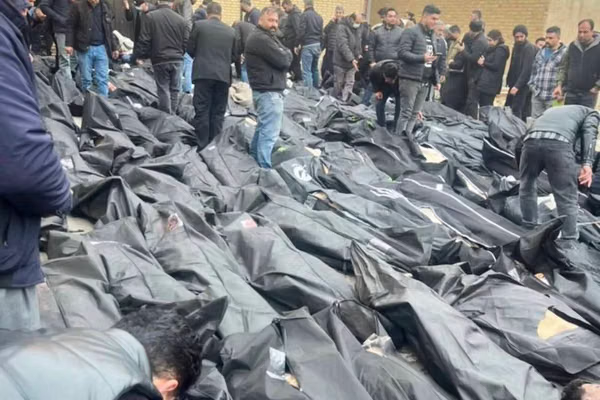
The killings that swept Iran last month revived memories of 1988, when the Islamic Republic erased thousands of political prisoners in silence—my brother, Bijan, among them.

The killings that swept Iran last month revived memories of 1988, when the Islamic Republic erased thousands of political prisoners in silence—my brother, Bijan, among them.

The Islamic Republic was bad news in 1979 and it is bad news in 2026, sending security forces to beat and murder peaceful protesters. Deporting Iranians to a country gripped by violent repression is hardly the ‘help’ the United States promised.
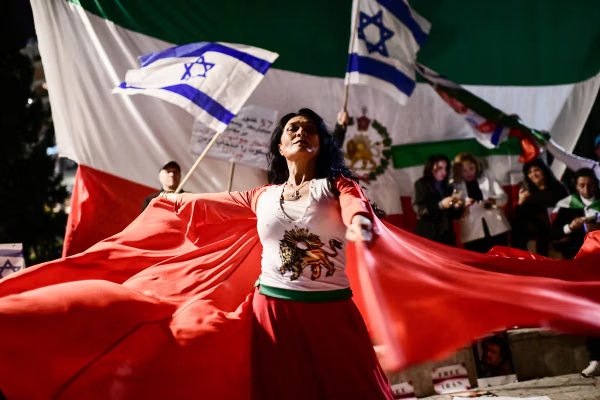
Israelis and Iranians have been cast as enemies for so long, but during Iran’s uprisings their voices tell a different story as Iranians drew a line between themselves and the Islamic Republic.
As Iran’s authorities impose silence through violence and disconnection, what the world is witnessing is not unrest but defiance at its most basic—people refusing to disappear, to be reduced to numbers, or to surrender their names.

Iran’s near-total internet blackout since January 8 did not only shut down social media but collapsed the country’s last channels to the outside world, isolating families and sharply limiting what evidence of the crackdown could escape.

The latest wave of protests in Iran once more demonstrated both the depth of popular opposition to the Islamic Republic and the limits of mass mobilization in the absence of a decisive breakdown in the regime’s coercive capacity.

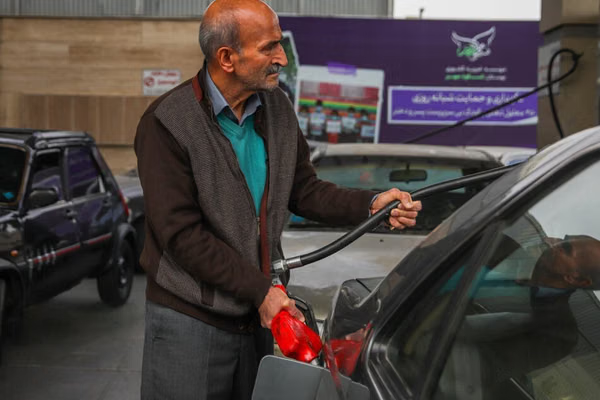
Tehran’s newly announced fuel price changes have been presented as a long-overdue reform of an unsustainable subsidy system, but they amount to an undeclared form of austerity aimed at rolling back subsidies with minimal political exposure.

Power politics in Tehran has reached a stage where even the most routine public affairs—a film festival, an environmental report or the World Cup draw—spiral into controversy, as if the system cannot tolerate anything resembling normalcy.

The privileged children of Iran’s ruling elite are building futures overseas that their parents have withheld from millions of Iranians for almost half a century.

Six years after Iran’s blackout and mass killings, two women keep alive the month the Islamic Republic tried to bury.

It begins with a sound. A hiss, then silence. A man in Tehran holds his phone to a dry faucet at midnight; you can hear the air whistling through the pipes. “It’s 11:40 p.m. and there’s a smell of fire,” he says.

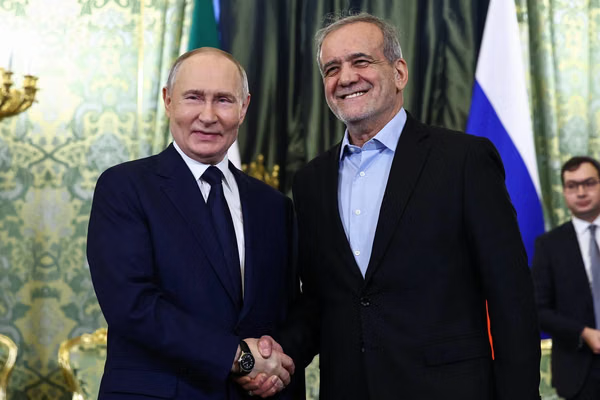
While relations between Moscow and Tehran have generally been good, ties between former Iranian Foreign Minister Mohammad Javad Zarif and the seemingly perpetual Russian Foreign Minister Sergei Lavrov are decidedly not.

Authorities in Iran are increasingly targeting businesses rather than individuals who refuse to observe the theocracy’s strict social laws around veiling and gender mixing, several café owners and citizens told Iran International.

Iran today stands at a crossroads between decay and renewal: the old order has not yet collapsed, and any new society has yet to fully emerge.

An Iranian remake of Love Island has exploded online, sparking fierce debate about taboos, personal freedom and the responsibilities of new media.

Viral videos of women dancing unveiled in Iranian concerts have reignited debate over whether the apparent social opening is genuine or contrived by a ruling system facing external military pressure and domestic discontent.

Five years after Iran executed champion wrestler Navid Afkari, the Islamic Republic continues to silence athletes and protesters alike—making action against its repressive sports authorities imperative.

We Iranians need a national conversation — an ongoing, daily dialogue to see the dark and bright sides of the challenges our country faces and, hopefully, find practical solutions.

A resilient anti-sanctions consensus dominated major Western policy circles and media narratives for a decade, but this stance risks undermining international law by normalizing Iran’s sustained nuclear defiance.

Watching Iran burn from afar creates a unique kind of anguish—a sense of guilt that you’re free and safe while your homeland is in pain.

So much has happened since Israel began striking Iran that the killing of IRGC aerospace chief Amir Ali Hajizadeh already feels half-buried—but not to those who lost loved ones on Flight PS752, shot down by the forces under his command.

After five rounds of talks, Tehran and Washington project cautious optimism while persisting on their shared red line: Uranium enrichment inside Iran. But is the program worth the price it has exacted from ordinary Iranians?