• العربية
  • فارسی
Brand
  • Iran Insight
  • Politics
  • Economy
  • Analysis
  • Special Report
  • Opinion
  • Podcast
  • Iran Insight
  • Politics
  • Economy
  • Analysis
  • Special Report
  • Opinion
  • Podcast
  • Theme
  • Language
    • العربية
    • فارسی
  • Iran Insight
  • Politics
  • Economy
  • Analysis
  • Special Report
  • Opinion
  • Podcast
All rights reserved for Volant Media UK Limited
volant media logo

ANALYSIS

US blockade enters murky phase as tankers spoof signals and buyers hesitate

US blockade enters murky phase as tankers spoof signals and buyers hesitate

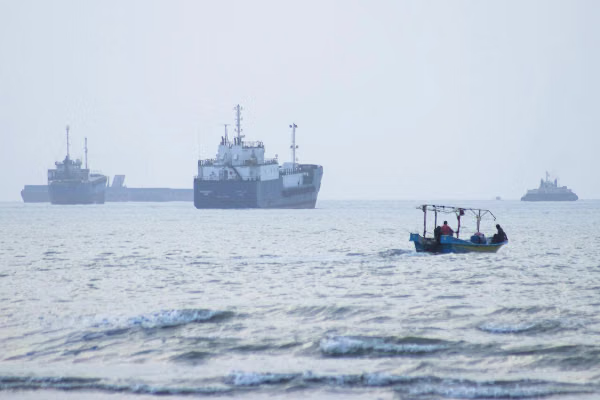
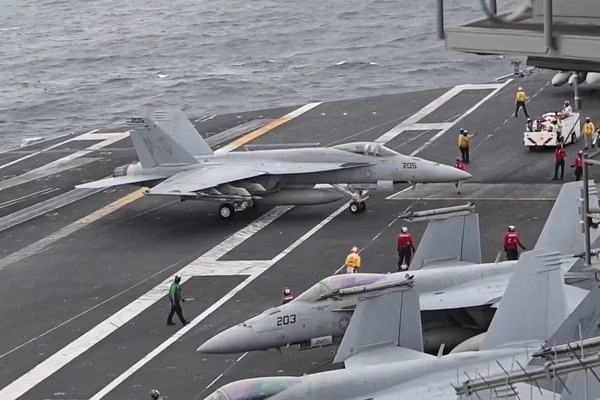
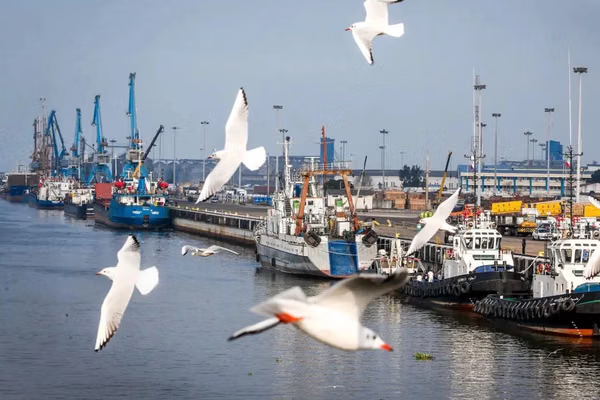
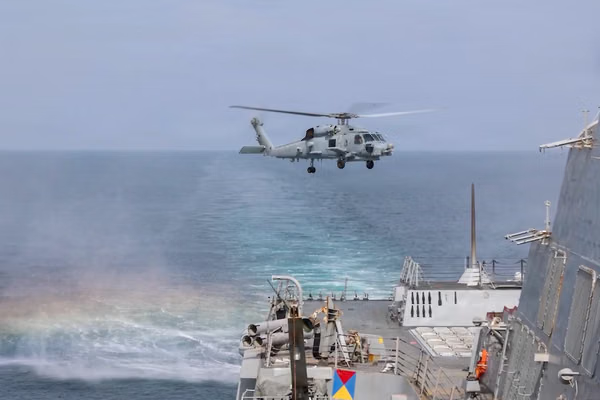
The US naval blockade of Iran is entering an opaque phase, with early signs of impact emerging through both buyer hesitation and deceptive shipping practices, rather than direct naval confrontations.

Why the $100 billion Hormuz toll revenue is a myth

Why the $100 billion Hormuz toll revenue is a myth

The idea that Iran could generate tens of billions of dollars annually by charging ships to pass through the Strait of Hormuz has gained traction in media commentary, but the claim does not withstand scrutiny.

US blockade targets Iran oil boom amid regional disruption

The United States moved to impose a naval blockade on Iran just as the country’s oil exports were surging to their highest levels in years, underscoring Washington’s effort to halt a wartime boom in Tehran’s energy revenues.

Iran brings unusually broad team to US talks to blunt future blame

Iran has sent a negotiating team to the Islamabad talks with the United States spanning an unusually broad political spectrum—suggesting a possibly calculated effort to pre-empt future hardline backlash while pursuing negotiations.

Why the Iran-US truce is more likely to buy time than peace

Why the Iran-US truce is more likely to buy time than peace

As US and Iranian envoys prepare to meet in Pakistan this weekend, the truce between the two sides appears less a step toward peace than a fragile intermission in a war whose central disputes remain unresolved.

Engaged but uncommitted: China watches Iran and US fight and talk

Engaged but uncommitted: China watches Iran and US fight and talk

As US and Iranian envoys prepare to meet in Pakistan to explore a path out of the war, China is watching from further east—an influential but cautious actor that helped move diplomacy forward but is unlikely to become the guarantor Tehran would like.

A truce for the world, a reckoning for Iran’s economy

A truce for the world, a reckoning for Iran’s economy

The ceasefire in the US-Israeli war on Iran eased global oil markets and may finally reopen the Strait of Hormuz. But for Iran, the truce exposes an economic crisis the war had temporarily masked, with weaker fundamentals and fewer tools to respond.

Why the world failed to bypass the Strait of Hormuz

Why the world failed to bypass the Strait of Hormuz

In 2019, while working on the energy desk at Reuters, I began reporting on a question that has shadowed global oil markets for decades: what would happen if the Strait of Hormuz were closed?

War reaches Iran’s petrochemical heartland

War reaches Iran’s petrochemical heartland

Iran’s petrochemical sector is now openly under threat, marking a significant escalation in the conflict and raising the prospect of far-reaching economic consequences for the country and potentially the wider region.

US rescue inside Iran opens debate over war's next phase

US rescue inside Iran opens debate over war's next phase

The mission to rescue an American pilot downed in Iran showed how a tactical success can open wider strategic possibilities, sharpening debate over how far the United States may expand its footprint inside Iran.

What Trump’s threat to strike Iran’s power grid could unleash

What Trump’s threat to strike Iran’s power grid could unleash

President Donald Trump’s threat to strike Iran’s power plants, if carried out, could trigger widespread economic disruption inside Iran while sending shockwaves through global energy markets.

Striking the veil: dual-use targets and the calculus of Iranian support

Striking the veil: dual-use targets and the calculus of Iranian support

In these fateful weeks, strikes thunder against steel plants at Mobarakeh and Khuzestan, sites tied to the Pasteur Institute, vital transport arteries, and facilities of Shahid Beheshti University—formerly Melli University.

For Washington and Tehran, negotiations are still part of the war

For Washington and Tehran, negotiations are still part of the war

Iran and the United States may prefer an end to the war, but the gap between the minimum terms each side could accept is so wide that a deal remains unlikely for now.

War tests Iran’s Dubai trade lifeline

War tests Iran’s Dubai trade lifeline

The war pitting the United States and Israel against Iran is being fought across airspace and shipping lanes, but one of its most consequential economic effects may be unfolding elsewhere: the fragile commercial relationship between Tehran and the United Arab Emirates.

Child recruit’s death shows Iran prioritizing regime survival over civilians

Child recruit’s death shows Iran prioritizing regime survival over civilians

The death of 11-year-old Alireza Jafari, the first known child recruit killed during the Iran war, underscores what rights advocates describe as a governing doctrine that places regime survival above civilian protection amid mounting wartime pressure.

Khameneism after Khamenei- why Mojtaba represents continuity, not change

Khameneism after Khamenei- why Mojtaba represents continuity, not change

The rise of Mojtaba Khamenei is not an unexpected deviation within the Islamic Republic—it is the logical outcome of a system carefully engineered over nearly four decades by Ali Khamenei.

US waiver on Iran sanctions redirects oil flows from China toward India

US waiver on Iran sanctions redirects oil flows from China toward India

Washington’s sanctions waiver, introduced during the Iran war to ease oil supply pressure, is channeling discounted crude away from China and toward India, strengthening energy ties with New Delhi.

Why Iran war may not follow the region’s familiar script

Why Iran war may not follow the region’s familiar script

It may be too early to issue verdicts on the war unfolding around Iran since conflicts of this scale rarely follow the scripts imagined in their first weeks and early judgments often prove premature.

Iran still depends on Hormuz despite years of workarounds

Iran still depends on Hormuz despite years of workarounds

Iran’s plans to reduce its reliance on the Strait of Hormuz appear to have delivered little practical change so far, according to tanker-tracking data from Kpler obtained by Iran International.

Iran’s reported gas halt to Turkey exposes limits of its energy power

Iran’s reported gas halt to Turkey exposes limits of its energy power

Brief concern in Turkey this week over a halt in Iranian gas flows quickly gave way to official reassurances, but the episode exposes deeper limits in Iran’s ability to sustain exports even to key regional partners.

Dollar-pegged pizza in Tehran points to a different kind of regime change

Dollar-pegged pizza in Tehran points to a different kind of regime change

Iran’s economy is no longer merely experiencing high inflation; it is exhibiting the structural symptoms of a nation losing faith in its own currency and facing a shift in its monetary regime.

Is Trump testing Iran’s power core through Ghalibaf?

Is Trump testing Iran’s power core through Ghalibaf?

Reports that the United States is considering Iran’s parliament speaker as a potential negotiating channel, alongside a proposal for high-level talks, have brought into focus a deeper question: is Washington probing who truly holds power inside Iran?