• العربية
  • فارسی
Brand
  • Iran Insight
  • Politics
  • Economy
  • Analysis
  • Special Report
  • Opinion
  • Podcast
  • Iran Insight
  • Politics
  • Economy
  • Analysis
  • Special Report
  • Opinion
  • Podcast
  • Theme
  • Language
    • العربية
    • فارسی
  • Iran Insight
  • Politics
  • Economy
  • Analysis
  • Special Report
  • Opinion
  • Podcast
All rights reserved for Volant Media UK Limited
volant media logo

Many Iranians Critical Of Long-Term China, Russia Deals

Maryam Sinaiee
Maryam Sinaiee

Iran International

Jan 16, 2022, 16:25 GMT+0Updated: 17:26 GMT+1
Iran's former foreign minister Javad Zarif and his Chinese counterpart exchanging copied of the 25-year agreement.

Many Iranian have been expressing resentment over a 25-year cooperation agreement with China and a proposed 20-year deal with Russia, saying it is a sell-out.

Although Iran has not revealed the details of the agreement with China and what it will entail in political, economic and military terms, some social media users go as far as claiming that the Islamic Republic is "selling out the country and its people" to China and Russia.

Not only politicians and the reformist media, but also many ordinary Iranians are wary of the consequences of too much reliance on the two powers, without simultaneously improving relations with the West to create a balance.

Others are wary of Russia's proactive role in the ongoing nuclear talks in Vienna and insist that Iran should directly negotiate with the US instead of allowing the interference of mediators like Russia.

"It is true that striking a deal with China is not a problem, but such agreements should not be limited to China and Russia. There should be long-term agreements with China and Russia as well as the United States and Europe to create a balance in foreign relations and reap the political and economic benefits of such balance for the nation," one Twitterati opined Sunday.

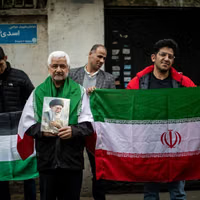
A man holding a sign in Iran that says, "Iran not for sale - China, Russia get lost".

Many also say they do not believe that China and Russia can be considered as Iran's strategic allies and partners. As permanent members of the UN Security Council, Russia and China did not block punitive UN sanctions resolutions over Iran's nuclear program a decade ago. "A sanctioned Iran is a gold mine for them," another Twitterati wroteSunday.

Some ordinary Iranians who are opposed to long-term deals with the two Eastern powers have been posting photos of themselves with posters expressing their disapproval. Some have taken their photos in front of government buildings and other landmark buildings to prove that they are posting from inside Iran, not from foreign countries as officials often claim, to discredit domestic critics.

Hardliners claim that closer economic and political relations with the East and Asian countries, which Iran's Supreme Leader Ali Khamenei has promulgated with the catchphrase "Looking East", will help Iran's development and strengthen it against Western powers, particularly the United States. Since 2018, and Khamenei's advocation of the policy, "Looking East" has become one of the centerpieces of a 'revolutionary economy' which hardliners have been hard at work to theorize.

Although Iranian officials for months said a 20-year strategic agreement with Russia had entered the final stages of drafting and even been almost finalized, the spokesman of the parliament's National Security and Foreign Policy Committee said Sunday that signing an agreement will not be on the agenda of President Ebrahim Raisi's visit to Moscow this month.Such an agreement requires further investigation and preparations, Mahmoud Abbaszadeh-Meshkini told Fars news agency, and added that the two sides will discuss the preliminaries of the agreement during the visit.

The Russian side has not shown any enthusiasm about the deal sought by Iran's hardliners although the two countries had a 20-year agreement which expired.

According to an opinion survey by Gamaan polling agency in the Netherlands with a sample population of over 20,000 Iranians living inside Iran that was published October 27, 65 percent of respondents had a negative view of China and Russia. In the same survey 40 percent said they viewed the United States negatively.
Most Viewed

US blockade enters murky phase as tankers spoof signals and buyers hesitate
1
ANALYSIS

US blockade enters murky phase as tankers spoof signals and buyers hesitate

2
INSIGHT

Ideology may be fading in Iran, but not in Kashmir's ‘Mini Iran'

3
INSIGHT

Hardliners push Hormuz ‘red line’ as US blockade tests Iran’s leverage

4
VOICES FROM IRAN

Hope and anger in Iran as fragile ceasefire persists

5

US sanctions oil network tied to Iranian tycoon Shamkhani

Banner
Banner

Spotlight

  • Hardliners push Hormuz ‘red line’ as US blockade tests Iran’s leverage
    INSIGHT

    Hardliners push Hormuz ‘red line’ as US blockade tests Iran’s leverage

  • Ideology may be fading in Iran, but not in Kashmir's ‘Mini Iran'
    INSIGHT

    Ideology may be fading in Iran, but not in Kashmir's ‘Mini Iran'

  • War damage amounts to $3,000 per Iranian, with blockade set to add to losses
    INSIGHT

    War damage amounts to $3,000 per Iranian, with blockade set to add to losses

  • Why the $100 billion Hormuz toll revenue is a myth
    ANALYSIS

    Why the $100 billion Hormuz toll revenue is a myth

  • US blockade targets Iran oil boom amid regional disruption
    ANALYSIS

    US blockade targets Iran oil boom amid regional disruption

  • Iran's digital economy battered by prolonged blackout
    INSIGHT

    Iran's digital economy battered by prolonged blackout

•
•
•

More Stories

Russian Lead-Tainted Wheat Gets License For Consumption In Iran

Jan 16, 2022, 16:07 GMT+0

Iran's health ministry has issued a license for human consumption of contaminated wheat from Russia, despite tests that showed high levels of lead.

Head of Iran’s Food Industries Associations Mohammad Reza Mortazavi said on Sunday that the health ministry has determined that the amount of lead in the wheat is “standard and natural”.

He noted a health ministry letter that was sent last week had warned the wheats were contaminated with a hazardous amount of lead but now the ministry has approved the necessary licenses for human consumption based on results of new tests.

Mojgan Pourmoghim, the head of the Food and Drug Administration's quality control laboratory, had earlier confirmed the contamination, saying, "The clearance permit for the wheat shipments is temporary and it is issued only because the country's wheat silos are empty”.

These contaminated wheats have not yet entered the consumption cycle, she added.

Gholamhossein Shafei, the chairman of Iran’s Chamber of Commerce, had warned of the shortage of wheat in March last year due to the severe drought that hit domestic production.

According to an October report by Reuters, Iran needed to buy a record 8 million tons of wheat in the current season to be able to provide its population with bread that is an important food staple in the country.

Contradictory Remarks Continue On Sound Of Explosions In Western Iran

Jan 16, 2022, 14:20 GMT+0
•
Iran International Newsroom

One day after residents heard a series of loud explosions in Western Iran, authorities continue to offer contradictory explanations, with no clear conclusion.

The explosions were heard in many cities across the provinces of Kermanshah, Hamedan and Kordestan Saturday night, causing numerous speculations and rumors by residents of the region as well as officials.

Soon after the blasts, Saeed Ketabi, the governor of Asadabad city in the Hamadan province – which is reportedly the epicenter of the explosions -- confirmed that a loud noise was heard and rejected earlier reports about the noise coming from thunders and storms.

At the same time some sources claimed that the sounds were part of an air defense exercise by the Islamic Republic's Armed Forces and some reports quoted Iran's Revolutionary Guard as saying that they launched air defense drills in the region.

Social media reports said that there was anti-aircraft activities with some twitter users saying an anti-aircraft missile was fired and then there was one explosion near or at a military base.

However, Khatam al-Anbia Air Defense Base rejected the news, stating that no military training, exercise, or operations took place in the country Saturday night.

Iran's aviation authorities added to the mystery by confirming that flights were cancelled in Western Iran at the time the explosions were heard, but say it was just because of weather conditions, not any explosion.

After a series of contradictory and failed explanations, the authorities are apparently back to the older version they had put forward, to give off a vibe of being in control. Officials from the interior ministry said on Sunday that the loud sounds heard in several western cities were the result of lightning.

Some unnamed “informed source” is quoted by Tasnim – a news agency with links to IRGC – that the sounds were actually “thunder and lightning”, as if the inhabitants of the Zagros Mountains region are new to the phenomenon.

The source also denied reports attributing the sounds to acts of sabotage or foreign attack. Similar sounds of explosion were heard in early December around Natanz nuclear facility in central Iran, which officials said came from military drills.

Earlier this month, the sound of aloud explosion was heard in a town near Tehran, prompting IRGC to announce it as the result of a “controlled rocket launch”.

Tensions are high in the region amid Iran’s nuclear talks with world powers. Israel has repeatedly said it will not tolerate Iran reaching a nuclear breakout point, while Tehran has threatened severe retaliation in case of any attack.

Iran has held several military exercises in recent months.

After the downing of the Ukrainian flight PS752 with two missiles in January 2020, the Iranian government and the IRGC tried to hide the true cause for three days, and only came forth to admit the tragic incident was not an ordinary plane crash, after amateur video footage emerged showing the plane exploding.

Iran Says Long-Term Agreement With China Is A 'Win-Win'

Jan 16, 2022, 13:24 GMT+0

Amid widespread criticism of Iran’s 25-year agreement with China, foreign minister Hossein Amir-Abdollahian told Chinese television that the deal is a “win-win” for both countries.

In a meeting on Friday, Iranian and Chinese foreign ministers announced the launch of the long-term strategic agreement, the details of which is kept secret. Iranians on social media called the agreement a sell-out of national interests and the country’s independence.

Amir-Abdollahian in his interview with CGTN television insisted that “We have included all aspects related to the interests of the two nations in the agreement.”

Earlier, Hossein Nushabadi, a senior member of Iran’s parliament had said that with the agreement Iran can facilitate its trade and banking relation to defeat United States’ sanctions.

Iran’s minister of economy, Ehsan Khandouzi has said that various government ministries have begun consultations with Chinese counterparts for specific agreement in different fields.

In December, Iran authorized the opening of a Chinese consulate in Iran’s Persian Gulf port of Bandar Abbas, signaling the launch of a foothold for Beijing in one of the most strategic regions in the world.

Iran’s anti-Western Supreme Leader Ali Khamenei insists on foreign and economic policy relying on the East, meaning China and Russia, but until 2021 Beijing was cautious about expanding ties with Iran because of US sanctions.

Lawmaker Says Iran-China Deal Can Prompt US Return To JCPOA

Jan 16, 2022, 12:22 GMT+0

A senior Iranian lawmaker says the 25-year strategic agreement with China will worry the United States and may push Washington to compromise in the ongoing nuclear talks.

Ahmad Amirabadi Farahani, who is the chairman of Iran-China parliamentary friendship group, said on Sunday that the deal can convince the US to expedite efforts to return to the 2015 nuclear deal and lift Iran sanctions.

On Saturday, Iranian Foreign Minister Hossein Amir-Abdollahian and Chinese Foreign Minister Wang Yi announced the official commencement of the agreement's implementation.

Farahani described the agreement as an important step to increase Chinese investments in Iranthat will expand Tehran’s ties with the entire region.

He criticized the former president Hassan Rouhani’s administration for trying to mend ties with the Western countries, saying that the strategy of the incumbent government is focusing on relations with regional states.

Farahani said negotiations are underway now so that Tehran can increase collaboration with Saudi Arabia, Qatar, and Oman, while the country’s membership in the Shanghai Cooperation Organization can further boost relations with Turkmenistan and Pakistan.

He noted that Washington seeks to weaken the economies of Iran and China, therefore this common enemy can help strengthen relations between Tehran and Beijing, and the 25-year deal is a good step in this direction.

Creator Of Iran's 'Uncle Napoleon' Passes Away In California Exile

Jan 16, 2022, 08:51 GMT+0
•
Maryam Sinaiee

Iraj Pezeshkzad who immortalized the phrase, "It's the work of the British" in the most popular satirical Persian novel of the 20th century, passed away this week in California at the age of 94.

The highly acclaimed work, My Uncle Napoleon, was published in the early 1970s and was made into an extremely successful TV series. It was banned after the Islamic Revolution of 1979 but is still among the most sought after underground works of literature and film in Iran.

In Pezeshkad's novel set at the onset of the Second World War in Tehran, the small local wars that the main character of the book, a low-ranking officer once fought, gradually evolve into great wars against the British on par with the Napoleonic Wars. Uncle Napoleon's orderly, the simple and uneducated Mash Ghasem, not only begins to believe, or pretend to believe in the stories of Uncle Napoleon's heroic wars against the British, but also increasingly attempts to weave stories of his own heroism into it but the imaginary adventures only make the delusional patriarch the laughingstock of the family.

Pezeshkzad, a former French-educated judge and diplomat, captured the imagination of Iranian readers with his most vivid characters in a manner that no other contemporary author has. There is almost no one in Iran who is not familiar with his characters and its many famous catchphrases including, "It's the work of the British."

'Uncle Napoleon' in a TV series. Undated
100%
'Uncle Napoleon' in a TV series

The main character of My Uncle Napoleon has gradually come into believing his own stories, identifying himself with Napoleon, and living in constant fear of British plots to kill, or failing that, to dishonor and discredit him. "It's the work of the British", the old man will say in the face of any mishap that befalls him or his family. Even a sex scandal involving a niece of the family in Uncle Napoleon's delusional mind, is cited as proof that there is a British conspiracy against him.

The fame of the book and its catchphrase is such that British diplomats in Iran in the years following the publication of the book came to know about it probably within the first few days from their arrival. Former British Foreign Secretary Jack Straw even took inspiration from it to write a book entitled "The English Job: Understanding Iran and Why It Distrusts Britain".

Amongst British diplomats, there’s a poignant joke that ‘Iran is the only country in the world which still regards the United Kingdom as a superpower’. For many Iranians, it’s not a joke at all," an introduction to Straw's book said.

Nearly two centuries of Iranian politics, particularly the 19th century, was deeply influenced by the British-Russian embassies and their rivalries. Many Iranians still see the hand of the British in everything. Probably with the historical fear of the Iranians toward the British in mind, Iran's Supreme Leader Ali Khamenei in 2009 cast the blame for nationwide unrest following a disputed election on the British government. Hardliners claimed the British were behind the "sedition" against the Islamic

Pezeshkzad never singled out a real-life inspiration for the pathetic, delusional and bullying character who the children of the family including the narrator always called Uncle Napoleon amongst themselves. In a speech at the University of California, Los Angeles, Pezeshkad said the character originated in his memories of his childhood when grownups would indiscriminately label most politicians as "British lackeys".

Pezeshkzad made every episode of love or feud in Uncle Napoleon's family into funny, yet often very tender, narratives. His book, he told BBC Persian years ago, was inspired by the story of his own naive teenage love and memories from his own extended family. Pezeshkzad's book has been translated into several European languages including English.