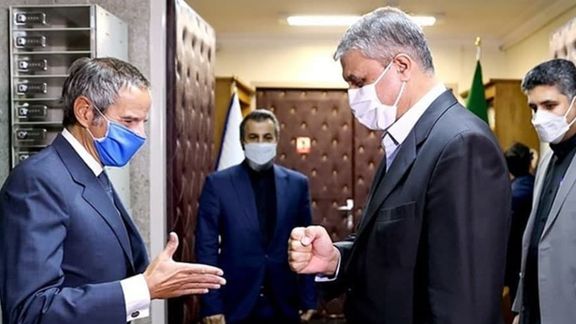
Rafael Grossi and Iran's nuclear chief Mohammad Eslami in Tehran. March 5, 2022
IAEA head Rafael Grossi met Iran’s nuclear chief Saturday morning during his trip to Tehran to resolve safeguards issues that could impact a new nuclear deal.
Iran’s nuclear head Mohammad Eslami Iran would resolve “outstanding matters” by June 21 with the UN atomic watchdog. It was unclear if the watchdog chief backed the timeline.
Eslami announced the timeframe in Tehran at a press conference alongside Rafael Mariano Grossi, visiting chief of the United Nations’ International Atomic Energy Agency.
It was unclear how the three-month timetable would fit with nuclear talks between Tehran and world powers in Vienna, where many participants over the past week have stressed that efforts to revive the 2015 Iran nuclear deal are reaching a conclusion.
"We have agreed to provide the IAEA by the end of [the Iranian month of] Khordad [June 21] with documents related to outstanding questions between Tehran and the agency," Eslami told the news conference, which was televised in Iran.
"It is important to have this understanding ... to work together, to work very intensively," Grossi said. But the IAEA chief, who was due to return to Vienna Saturday, added: "There are still matters that need to be addressed by Iran."
Complex interplay
The interplay between the Vienna talks and the IAEA role is a complex one. As a signatory of the Nuclear Non-Proliferation treaty (NPT), Iran is subject to IAEA inspections and monitoring under its NPT ‘safeguards’ agreement.
But the agency’s role was enhanced under the 2015 deal, the JCPOA (Joint Comprehensive Plan of Action), which limited Iran’s nuclear program in scale and nature. Since 2019, a year after the United States left the JCPOA and began ‘maximum pressure’ sanctions, Iran has both expanded its nuclear program and limited IAEA access almost to the lower level required under safeguards.
But in addition to negotiating a temporary arrangement to maintain access beyond safeguards, Grossi has continued to request information on Iran’s nuclear work prior to 2003, including the agency’s finding of uranium traces it says are unexplained. This IAEA line of enquiry comes under safeguards.
It was reported over the past week that Iran had demanded in Vienna, as part of an agreement over reviving the JCPOA, that this IAEA enquiry be dropped. But in Tehran, Grossi appeared to suggest Saturday that it might be other parties to the talks – presumably the United States or the three western European JCPOA signatories – who were insisting the probe continues.
Resolving ‘outstanding issues’
"Without resolving these (outstanding) issues, efforts to revive the JCPOA (the Joint Comprehensive Plan of Action) may not be possible,” Grossi told Saturday’s press conference. The IAEA chief did not explain whether these ‘outstanding issues’ might be long-standing questions, future agency work in monitoring the reimplementation of the JCPOA, or both.
Aside from any issues directly within the IAEA remit, the Vienna talks have faced challenges in agreeing which US sanctions contravene the JCPOA and exactly how the refined and expanded Iranian nuclear program should be brought back within JCPOA limits.
Iran's current parliament is dominated by hardliners, with a core of ultra-conservatives.
Iranian lawmakers appear to be not equally informed about Tehran's nuclear negotiations with world powers aimed at restoring the 2015 agreement known as JCPOA.
While one lawmaker was certain that "Iran has reached an agreement better than before with the United States," another member of the Iranian parliament says that the Majles has been kept in the dark about the negotiations in Vienna.
Another Iranian lawmaker was quoted by local media as saying that he is less concerned about the initiatives and positions of the other side than about the plots being hatched by regime insiders in Iran to derail the negotiations.
Hardliner lawmaker Hossein Naghavi-Hosseini told Nameh News in Tehran that he is certain the negotiations will bear fruit and an agreement is at hand, although there are still issues that have not been tackled by the negotiators.
Naghavi-Hosseini said that Iran will announce its final verdict on the deal within a few days. He said Iran is adamant to reach a deal, adding that everything has been agreed upon except the guarantees that Iran demands that the next US President will not pull out of the nuclear agreement with Iran.
Iranian lawmaker Hossein Naghavi-Hosseini
The hardliner lawmaker went on to say that the two sides have agreed all the sanctions imposed on Iran after President Donald Trump's pull-out from the JCPOA in 2018 will be lifted. What Iran and America have agreed upon is not much different from the JCPOA, he said and explained that Westerners are concerned about Iran's ability to enrich uranium beyond the 60-percent level.
Although Naghavi-Hosseini appeared or claimed to be well-informed about the deal, his colleague Jabbar Kouchakinejad told reporters on Thursday that the parliament has not been informed of the government's views about the talks. He also said that there are still problems about the impact of US sanctions on Iran's economy, insurance and oil industry and international trade which have not been resolved.
Kouchakinejad said there are a lot of ambiguities about a possible deal with America as Majles Speaker Mohammad Bagher Ghalibaf has offered minimal explanations to lawmakers. He added that it is important for the Majles to make sure that any possible agreement does not undermine previous laws passed by the Majles.
Kouchakinejad added that the Majles is also concerned that problems in the United States' domestic politics could prompt any US government to withdraw from a deal with Iran. That is why Iran insists on getting guarantees from the US side, although so far Washington has refused to give any such guarantee.
Meanwhile, he said that as far as safeguard regulations of the JCPOA are concerned, Iran has red lines that cannot allow IAEA inspectors to visit some of its nuclear sites.
At the same time, former Iranian lawmaker Jalal Mirzaee told Asr-e Ma in Tehran that some political elements in Tehran are pushing hard to derail the nuclear talks. Mirzaee, a professor of political science, said that he is more concerned about the adverse impact of these moves than he is concerned about the decisions being made in other capitals.
He said moves opposing an agreement have intensified following the Russian invasion of Ukraine. He warned that such moves which are motivated by factional interests have led to wasting of a lot of time and opportunities for Iran and could lead to further costs. "We should seize the opportunity and relieve the country of its tremendous financial difficulties while President Biden urgently needs a deal with Iran," Mirzaee said.
Grossi speaking with Iran's Kamalvandi after his arrival in Tehran. March 5, 2022
Rafael Grossi, the head of the the UN nuclear agency, theIAEA arrived in Iran's capital Tehran early Saturday, as talks to revive a 2015 Iran nuclear deal have reached a crucial stage.
Tasnim news agency in Tehran said Grossi was welcomed at the airport by Behrouz Kamalvandi, spokesperson for the Atomic Energy Organization of Iran.
In a separate report, Tasnim, affiliated with the Revolutionary Guard said that contrary to Western statements, issues related to IAEA and nuclear inspection were not the only outstanding hurdles to an agreement in Vienna. The agency said three other issues unresolved and the ball is in the court of Western parties to the talks.
Western and Russian negotiators have repeatedly said in recent days that an agreement is almost complete and could be sign at any moment.
Iranian President Ebrahim Raisi said in televised remarks late on Friday that he placed hope in God and the Iranian people, and not any "economic miracle" from talks in Vienna to revive Iran's 2015 nuclear deal with world powers.
"Regarding the talks, we place our hope in God first and then... in the capacities of the people of this country, and not at all in any economic miracle that might arise from Vienna," Raisi said. "We do seek and will continue to work towards the lifting of sanctions, more importantly neutralizing them."
Russian and Iranian delegation meet in Vienna on March 3, 2022
Nuclear talks with Iran are close to reaching a deal, the chief British envoy said on Friday as she and her French and German colleagues flew home to brief ministers.
"We are close. E3 negotiators leaving Vienna briefly to update Ministers on state of play. Ready to return soon," Stephanie Al-Qaq said on Twitter, referring to the chief British, French and German diplomats involved in the talks.
Despite the British diplomat's teasing Twitter post, two sources with direct knowledge said there was still no deal and European and Iranian officials said that Iran's lead negotiator, nuclear negotiator, Ali Bagheri Kani was staying in Vienna.
Negotiators have worked for 11 months to try to revive the 2015 deal, known as JCPOA, under which Iran limited its nuclear program to make it harder to obtain fissile material for a bomb - an ambition Tehran denies - in return for relief from economic sanctions.
Then-US President Donald Trump reneged on the pact in 2018, restoring US sanctions that have slashed Iran's oil exports. Iran followed suit by increasing the level of its uranium enrichment violating the deal's nuclear limitations.
It is not clear what exactly the remaining issues are in the talks, but the head of the International Atomic Energy Agency is flying to Iran on Saturday to iron out past issues of suspected clandestine nuclear activities.
Despite participants tweeting guarded optimism over the looming renewal of the 2015 Iran nuclear deal, sticking-points remained Friday.
On Friday morning the lead British negotiator, Stephanie Al-Qaq, tweeted with the hashtag #EndgameViennaTalks that the ‘E3’ (France, Britain, and Germany) were meeting to take stock. In another tweet Al-Qaq wrote that a deal was "possible…but not guaranteed” and needed to be reached “before the diplomatic window closes.”
Fars news agency tweeted Friday a statement from Hossein Amir-Abdollahian, Iranian foreign minister, that the “haste of the western side cannot prevent the need to protect Iran’s red lines” even though Iran was “ready for a good agreement.” Amir-Abdollahian said that foreign ministers would not be able to gather in Vienna, for a signing ceremony, unless Iran was given “effective economic guarantees.”
Iran has sought in the talks guarantees both that the United States would not again leave the 2015 deal, as it did in 2018, and that parties to the deal would take other measures – including sanctions levied on other grounds, including ‘terrorism’ – ‘interfering’ with Iran’s ability to access overseas markets and attract inward investment.
Premature good news?
"Premature good news does not substitute good agreement,” Iran Foreign Ministry Spokesman Saeed Khatibzadeh tweeted Thursday evening.“Nobody can say the deal is done, until all the outstanding remaining issues are resolved. Extra efforts needed…Everybody is now focused on the final critical steps.”
"We are close to a possible deal," Jalina Porter, a US State Department's spokesperson, told a press briefing Thursday evening. "If Iran shows seriousness, we can and should reach an understanding on mutual return to full implementation of the JCPOA within days." Having left the 2015 nuclear deal, the JCPOA (Joint Comprehensive Plan of Action) and imposed ‘maximum pressure’ sanctions in 2018, prompting Iran to expand its nuclear program after 2019, the US takes part in Vienna indirectly.
‘Not there yet’
Enrique Mora, the European Union official chairing the talks tweeted Thursdaythat the talks, while in their "final stages", still faced challenges: "Some relevant issues are still open and success is never guaranteed in such a complex negotiation. Doing our best in the coordinator's team. But we are definitely not there yet."
Mikhail Ulyanov, the lead Russian negotiator in the talks, said Thursday evening said he had met with Iran's top negotiator Ali Bagheri Kani to discuss steps "to finalize" the talks.
Oil analysts say international markets are expecting more Iranian oil to flow into the market with an agreement in Vienna to restore the JCPOA and lift the sanctions. With the Ukraine crisis oil prices have soared to unprecedented heights of above $115 per barrel in a decade. While Russia's oil and gas exports have not been sanctioned, Iran has around 100 million barrels of oil in storage.
Under a restored JCPOA, Iran would severely cut back stocks of enriched uranium. The latest report from the International Atomic Energy Agency (IAEA) showed Iran had 33.2 kg (110 pounds) of uranium enriched to 60 percent. The Reuters news agency cited a “senior diplomat” that this was around three-quarters of the amount needed, assuming it was further enriched to 90 percent, for a nuclear bomb.
Palais Coburg hotel, the venue of Iran nuclear talks in Vienna
While negotiators in Vienna discuss the final details of a nuclear agreement, politicians and pundits in Tehran are still not sure whether there will be a deal.
An ultraconservative lawmaker even insisted on Thursday that Iranian negotiators should leave Vienna at once as he believes there is nothing to be gained in the talks.
International relations expert Ali Bigdeli told Didban Iran website in Tehran that if there is no agreement between Iran and world powers, the rate of exchange for the US dollar will rise to 400,000 rials as opposed to the current rate of around 260,000 rials in less than a week.
The analyst added that if negotiators fail to reach an agreement, Iran's case might be sent to the UN Security council, where more sanctions are likely to be imposed on Tehran even if Russia and China back the Islamic Republic.
Bigdeli said that concern over the implications of not reaching an agreement on Iran's already ailing economy could lead to growing concerns about the eruption of riots in Iran.
He sounded almost certain that the negotiations in Vienna are doomed to fail. He said Iran's support of Russia has affected the fate of the nuclear talks and it looks like the talks are ending in a deadlock as Iran's demands from the West are not rooted in reality.
Iranian political commentator Ali Bigdeli
Bigdeli went on to say that in the new Iranian year which starts in late March, prices will rise even further, and without an agreement, Iran's international isolation as a result of its support for Russia will lead to an unprecedented level of public dissatisfaction which will end in major riots.
Meanwhile, former lawmaker Mansour Haghighatpour told reporters in Tehran that those who are against a nuclear deal with the United States are no more than 20 lawmakers in the Iranian parliament and they cannot decide for the entire nation and impose their hardliner views.
He criticized hardliner lawmakers who say Iran should not make an agreement with the United States, adding that it is Supreme Leader Ali Khamenei who makes the final decision about steering the negotiations.
In another development, firebrand member of parliament Mahmoud Nabavian, a staunch opponent of any deal with the West, particularly with the United States, told reporters in Tehran that Iran's problems have nothing to do with the sanctions and insisted that Iranian negotiators should leave Vienna at once.
Nabavian, a member of the ultraconservative Paydari Party, boasted that in spite of sanctions Iran has had a lot of progress particularly in the area of developing military hardware. He added that creating relative welfare for the nation is feasible regardless of the economic pressures, only if the government has the right roadmap.
This has been a constant argument of hardliners, while many former officials and economists keep saying that the country would be doomed if sanctions continue.
He said the conditions set for Iran by the other side is unfair and will cause losses for Tehran. He said while 980 Iranians are sanctioned by the United States, Washington is prepared to lift the sanction on only 20 individuals.
Nonetheless, he claimed that sanctions affect only 20 percent of Iran's economy, and the other 80 percent should be attributed to poor management.