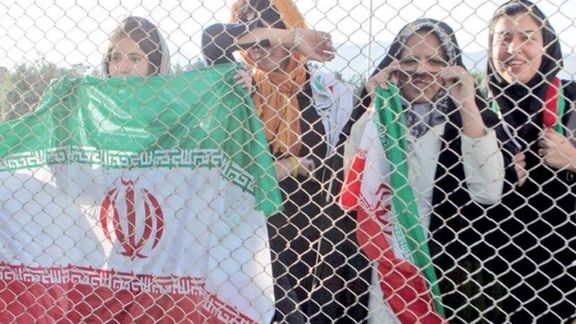
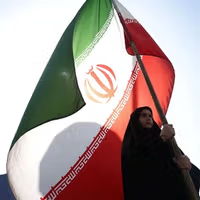
Women who were denied entry gathered outside the Emam Reza Stadium in the city of Mashhad.
Iran's government and football federation officials are blaming each other for an incident in Mashhad during which women who wanted to watch a soccer game were pepper sprayed.
In a statement Wednesday, the football federation of the Islamic Republic blamed time constraints for failing to properly organize ticket sales and organizing women's presence at the Emam Reza Stadium in the religious city of Mashhad and argued that federation officials had not "invited" women to purchase tickets to watch the game.
Without offering any apologies, the federation also said that there had been no plans to allow spectators to watch the game at until 72 hours before the game and claimed that the tickets held by women had been sold by "ticket forgers" or the women who purchase tickets online had lied about their gender. "Only nine women had purchased tickets for men's section of the stadium who will be reimbursed with 48 hours," the statement said.
"Doubtlessly the bitter episodes during this game were the result of mischief and profiteering of individuals who jeopardized the order and security of the stadium by printing and selling fake tickets," the federation alleged.
Many Iranians on social media have slammed the federation for suggesting that women should have been "invited" to watch the game by the federation authorities, but men could do so without being granted a special permission. "This statement is clear evidence of gender discrimination," a tweet by an Iran journalist who also called for a FIFA ban on Iran's football federation said.
President Ebrahim Raisi on Wednesday ordered an investigation into the incident which occurred in his hometown of Mashhad. The incident may mar Raisi's scheduled provincial tour to Mashhad where he headed with some cabinet ministers on Wednesday.
Iran's state media which are controlled by hardliners completely ignored the news about the incident in Mashhad. The state broadcaster (IRIB) did not report the violence against women and even censored a remark by Alireza Jahanbakhsh, one of the players for Iran's national team, who after the game said in an interview that he hoped women could watch the team's games at stadiums in the future.
The official news agency IRNA also censored the violence against female soccer fans in its reports. IRNA said Wednesday that Raisi has ordered the interior minister to investigate the "ticket sales process, failure to abide by the Covid protocols … regarding the maximum number of those allowed to attend the game," as well as "the violation of the rights of some citizens who had purchased tickets".
FIFA has been insisting for years that the Islamic Republic should relax the ban on women's presence at soccer stadiums and allow female spectators to its stadiums.
"FIFA should be held accountable for participating in Iran's human rights violation because it has not enforced its clear regulations and disciplinary rules on Iran codes all these years," Mehdi Rostampour, journalist and former presenter of sports program for the state-run broadcaster (IRIB), told Iran International TV on Wednesday.
The hands of the bride are decorated with henna or hina (Lawsonia inermis) in some wedding ceremonies in Iran, especially in southern regions
As many as 131,365 girls under the age of 15 have been married in Iran over the last five years, according to official data quoted by local media.
Tejarat News on Tuesday cited data from the Statistical Center of Iran (SCI) as showing that more than 7,500 of the marriages took place during the summer of 2021.
The numbers do not include unregistered marriages, which are common in the country’s rural areas.
Under the Islamic law, or Sharia, the minimum age at marriage for girls is 13 and 15 for boys.
Since the Iranian year of 1396, which started in March 2017, an average of about 30,000 girls under the age of 15 have been married every year.
During the same period, an average of 123 boys under that age have been married in the country.
ISNA earlier reported that 791 children were born to mothers aged between 10 and 14 in the first six months of the previous Iranian year beginning in March 2021. The semi-official news agency said that most of these births took place in the southeastern province of Sistan-Baluchestan.
Earlier in March, a married teenage girl who had experienced "domestic violence" set herself on fire in Sistan-Baluchestan, according local media reports.
It was the second reported case of self-immolation by a married Baluch girl in the past few months.
Iranian President Ebrahim Raisi in a cabinet meeting
Political analysts in Iran say President Ebrahim Raisi has not carried out any economic reforms and has simply surrendered to vested interests of regime insiders.
Alimohammad Namazi, a political analyst said in an interview with the conservative news website Nameh News that people's purchasing power has shrunk because of no change in the country's economic structure.
Iran has an economy dominated by the state, the Revolutionary Guard and religious entities.
Namazi said that the Raisi administration is facing numerous challenges including a major economic crisis, protests by labor groups across the country and a long-standing nuclear problem with the West that has remained unresolved.
The analyst stopped short of attributing the economic crisis to the nuclear issue and Iran's anti-West foreign policy, however, he stressed that Raisi's government is under pressure by the economic and foreign policy impasses more than its predecessors ever were.
He said Raisi was expected to meet the promises he made to those who voted for him, but none of his pledges have come true. The people understand the existing difficulties but expect to see Raisi delivering at least on some of his promises.
"Raisi had promised a non-partisan government which would not favor only one faction. But everyone in the government comes from the same 'principlist' camp," Namazi complained.
Prices continue to rise and there is no change in the country's problematic economic structure. Namazi did not mention the negative impact of insiders controlling large chunks of the economy, as most Iranian pundits exercise self-censorship when speaking to the media.
Namazi also blamed Raisi for the delay last year in resuming nuclear negotiations with the West, although he mentioned recent obstructions by Russia which complicated an agreement at the last minute. Meanwhile, he pointed out that even if there is a nuclear agreement, Iran may still not be able to conduct foreign trade as it has not yet accepted financial reforms to ban financing of terrorism.
In another development, a Reformist pundit and a critic of the administration, Ali Soufi, charged that Raisi has surrendered to the pressures of those who wanted a share of political power in Iran. He also accused the administration of being overwhelmed by its daily business rather than planning to deal with problems.
He added that Raisi has never presented a plan to the nation, let alone changing the make-up of his cabinet to carry it out.
Soufi said that he and other Iranian analysts agree that Raisi's honeymoon has ended as he has started his 8th month in office. "It is now time for him to be accountable," Soufi added. He further said, "So far, he has simply occupied the presidential seat and has not done anything in particular."
The reformist activist said that talks about impeaching some of Raisi's cabinet ministers have been continuing during the first days of the new Iranian year which started on March 21.
During the past months many Iranian lawmakers and political commentators have pointed out the weak performance of some of Raisi's economic team members, including his Labor Minister Hojjat Abdolmalei, Economy Minister Ehsan Khandouzi and Industry Minister Reza Fatemi Amin and called for their impeachment by the parliament.
Soufi said that Raisi, contrary to promises, surrendered to demands of different factions and gave a big share of posts to Majles Speaker Mohammad Bagher Ghalibaf and the Paydari Party.
Meanwhile Soufi warned that Raisi's claims about his success in boosting revenues and economic growth are not true because even if there is more money, it is simply the outcome of a sudden rise in oil prices which cannot last long.
A map from Kuwait's oil ministry showing the Dorra gas field near the tip of the Persian Gulf.
Kuwait says the disputed Arash/Durra gas field in the Persian Gulf is “exclusively owned” by the Persian Gulf nation and its neighbor Saudi Arabia.
Iran “is not part of the gas field” and is not a party to development projects related to it, Kuwait’s official news agency Kuna quoted Foreign Minister Sheikh Ahmad Nasser al-Mohammad al-Sabah as saying in a tweet on Tuesday.
The comments came hours after the minister said that the gas field, located on maritime borders of Iran, Kuwait and Saudi Arabia, was a tripartite issue between these countries.
He later explained that these remarks meant Iran could be involved in talks on the demarcation of the continental shelf where the gas field is located.
Iran has branded "illegal" an agreement reached between Kuwait and Saudi Arabia on March 21 to develop the gas field, insisting on its right to also exploit it.
The Kuwaiti-Saudi move came amid soaring energy prices on world markets following Russia's invasion of Ukraine.
Iranian Oil Minister Javad Owji said Monday that Tehran would soon begin drilling in the area after having completed “comprehensive studies…by drilling exploration wells and conducting seismic surveys”.
The Arash/Durra field, discovered in 1967 where maritime borders are unclear, has reserves of around 20 trillion cubic feet (ft3) of gas, enabling a potential daily output of 1 billion ft3 and 84,000 barrels of condensates.
“Even if the border is not demarcated, the field can be developed jointly using internationally tested models,” Iran’s Deputy Oil Minister for International Affairs Ahmad Asadzadeh said Sunday.
Iran had delayed its development pending a decision on maritime borders, he added.
A photo taken by a mobile phone showing the impact of a missile on Erbil. March 13, 2022
An Iranian website has denied a claim that Iran's March 13 missile attack on Erbil was meant to derail a plan to pump Kurdish gas to Turkey and Europe.
The influential Nour News argued Thursday that Iraqi Kurdish officials had come up with the explanation to divert attention from Israeli intelligence operating in the autonomous Kurdish region in northern Iraq.
"The disinformation campaign…stage-managed by Reuters, is not only devoid of truth but also aimed at covering up the scandal of anti-security cooperation of a section of the ruling group in Iraqi Kurdistan with the Zionist regime and the United States," Nour News wroteunder the headline "Generous Betrayal Of Iraqi People's Interests To Absolve Mossad."
A Reuters report Monday cited anonymous Iraqi and Turkish officials that while Iran's attack carried several messages, a key trigger was a plan to pump Kurdish gas into Turkey and Europe to take advantage of uncertainties over Russia supplies after the Ukraine crisis.
Iran’s 12-missile attack, which hit a villa near the US consulate, was claimed by Tehran as hitting an Israeli intelligence center and variously seen as a response to an Israeli airstrike in Syria that killed two Iranian soldiers or to an Israeli attack February on drones at an airfield in Kermanshah province.
Many were surprised that the attack took place amid Iran's nuclear talks with world powers.
The villa damaged in the arch 13 Iranian attack on Erbil.
Pipeline project
"There had been two recent meetings between Israeli and US energy officials and specialists at the villa to discuss shipping Kurdistan gas to Turkey via a new pipeline," an Iraqi security official told Reuters. The agency claimed two Turkish officials had confirmed talks involving US and Israeli officials to discuss Iraq supplying Turkey and Europe with natural gas.
The office of Iraqi Kurdish President Nechirvan Barzani denied that the Erbil villa, owned by a Kurdish businessman involved in the Kurdistan energy sector, had been used by US and Israeli officials to discuss a pipeline project.
In response to the Reuters report, Kurdish Prime Minister Masrour Barzani denied claims Tuesday that Kurdish officials had held talks with Israelis over gas and accused Iran of launching the attack on Erbil to influencethe choice of Iraqi prime minister in fear that “the influence it has gained in recent years in this country will go away.” Barzani’s Kurdistan Democratic Party is allied with the Shia bloc of cleric Moqtada Sadr, and the Arab Sunni Taqadum, led by house speaker Mohammed al-Halbousi.
But a Reuters report Tuesday noted Barzani had also told the World Government Forum in Dubai that developing oil and gas in Iraq's Kurdish region might not be in Iran's interest, presumably as Tehran also eyes European markets.
While Iran's foreign ministry and state media have not commented on Reuters’ claims over the Erbil attack, Nour News is affiliated to the Secretary of Iran's Supreme National Security Council (SNSC), Ali Shamkhani.
As the Saudi-led coalition in Yemen has announced a ceasefire, Iran-backed Houthis have called the measure “meaningless” if the siege against the rebels is in full effect.
Mohammed al-Bukhaiti, a senior member of Ansarullah's political bureau made the comment in a post on his Twitter pageon Wednesday, a few hours after the coalition halted military operations for the holy Muslim month of Ramadan.
“The Yemen blockade is considered a military action because it was imposed by force of arms. If the siege is not lifted, the coalition’s announcement of the cessation of military operations will be meaningless”, he said.
The cessation of military operations coincides with the launch of Yemeni-Yemeni consultations that began at the GCC headquarters in Saudi Arabia on Wednesday and are expected to run until April 7.
The US special envoy for Yemen, Tim Lenderking, appreciated the Arab Coalition’s decision to start a ceasefire, saying that Washington encourages the recent announcement.
“A peaceful solution is the only way to end the crisis in Yemen,” the Secretary General of the GCC Nayef al-Hajraf said during a speech at the opening session, noting “the Riyadh Agreement constitutes a road map in Yemen and the completion of its provisions is a Yemeni demand.”
The United States, its Western allies and others blame Iran’s drones and missiles for attacks by Houthis on Saudi and Emirati energy facilities.