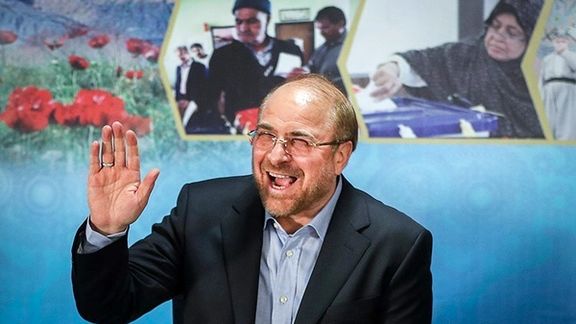
Mohammad Bagher Ghalibaf, speaker of Iran parliament
Supporters of Iran's parliament speaker claim that rivals in intelligence agencies were behind his family's scandal that led to calls for his resignation.
A fake news began circulating Friday that the speaker had resigned, quoting Tasnim news agency, which prompted a quick denial by the agency, which is affiliated with the Revolutionary Guard.
Overall, by Saturday the scandal showed signs of dying down, specially with a long religious holiday, when newspapers shut down and news websites focus on urgent news.
In a long series of tweets Thursday, Mahmoud Razavi, an advisor to the Parliament Speaker Mohammad-Bagher Ghalibaf, claimed that he had fallen victims to a plot by political rivals in intelligence and security bodies.
Razavi alleged that certain "political-security circles whose interests are in danger" were behind the circulation of a photo of Ghalibaf's family upon returning from Turkey which sparked a scandal quickly dubbed as "Layette-Gate" and that they used the whistleblower, journalist Vahid Ashtari, to carry out their plot against Ghalibaf.
On Tuesday, the photo of a family circulated on social, apparently after an alleged argument with airline staff over unauthorized extra luggage at Istanbul airport. The family who arrived in Tehran with apparently a large layette set they bought in Turkey were quickly identified as Ghalibaf's wife, daughter and son-in-law who are expecting a baby.
Razavi said taking the trip, as Ghalibaf's son said in a statement after the revelation, was an "unforgivable mistake". But he argued that passengers on the flight could not have recognized the speaker's family members who were wearing covid masks, nobody knew of Ghalibaf's daughter's pregnancy, there had been no argument over extra luggage, and that airline officials would not give passengers' details to anyone so the journalist who blew the whistle must have been fed information by people with influence in intelligence bodies.
"Are the country's security and justice bodies, the intelligence ministry, and the Revolutionary Guards (IRGC) Intelligence Organization going to sit and watch, like previous instances, as political-security circles damage the country and disturb public's mind in order to eliminate their political rivals?" he wrote.
Another Ghalibaf supporter, former political editor of hardline Mashregh News website, also claimed the involvement of security and intelligence bodies. It's naïve to see one person, the whistle-blower, behind the plan to destroy Ghalibaf's reputation, Ali-Akbar Gholami said Thursday. "It seems that a security team was monitoring the family's departure and return," he said.
Arguing that the whistle-blower, Ashtari, is a known hardliner and that he has ties with former nuclear negotiator Saeed Jalili, some hardliners claimthat Jalili and the ultra-hardliner Paydari Front were behind the scandal. They also say that these political rivals want to oust the speaker and takeover the Parliament's presidium.
Political commentator Sadegh Zibakalam told Iranian media that the incident is a symptom of the post-revolution generation forsaking their fathers’ slogans of a revolutionary lifestyle and want to live a normal life. He explained that the younger generation wants to live in comfort, travel, get a good education and enjoy life. But when it comes to the children of Islamic Republic officials, this creates a strong contradiction between what fathers are preaching and what their children seek.
Iran's president Ebrahim Raisi during a religious mourning ceremony.
Tehran's hardliner Friday Prayer leader Ahmad Khatami has criticized President Ebrahim Raisi for failing to address economic hardships Iranians currently face.
Speaking in Tehran on Friday, Khatami warnedthat "the people cannot plan for their future as they do not know what may happen tomorrow and this could lead to unrest."
Also on Friday, a leading conservative politician said that the current government led by Raisi is incompetent and that it is the outcome of the non-competitive presidential election in 2021.
According to Khabarovsk Online, Abolghassem Raoufian, the Leader of the Iran Zamin Party said that "now the supporters of Raisi's administration should also be held accountable for establishing a government that lacks the potential, experience and knowledge needed to run the affairs of the state."
Political observers in media have said on various occasions that Supreme Leader Ali Khamenei was the main supporter of Raisi’s candidacy and the Guardian Council under his jurisdiction disqualified capable candidates from other political factions to facilitate Raisi's victory in the election.
Raoufian charged that the Raisi refuses to work with reformists, independents and even conservative politicians who are not a member of his camp. His insistence on working only with "young revolutionaries" has been costly for the country, said Raoufian. As a result the president has failed to deliver on his campaign promises.
Raoufian said that public opinion and reformist activists were right to be against the widespread disqualification of candidates in the 2021 election. He called for a major reshuffling of the government to give a chance to others to come forward and contribute to solving the country's problems.
Iranian reformist politician Ali Soufi
Meanwhile, Reformist politician Ali Sufi told Khabar Onlinethat parts of Iran's conservatives have now turned into staunch critics of Raisi. This marks the failure of the conservative's "consolidated government" policy advocated by conservative figureheads in Iran.
Sufi said that the Iranian state television fabricates statistics to show Raisi in a good light, adding that some of his ministers are actively involved in fabricating "positive" statistics.
Confirming Sufi's remark of fabricated statistics, Lawmaker Gholamali Jafarzadeh Imanabadi added in an interview with Rouydad24 that "the people are suffering because of the poor performance of the Raisi administration.” Like Raoufian, Imanabadi also said that "Those who have engineered the 2021 presidential election should be held accountable for the poor performance of the Raisi administration.
Imanabadi asked: "How can you hand over the affairs of the state to a President who is just beginning to understand the economy?"
Khabar Online on Friday carried an article that asked: "Who gives these distorted figures to the President?" The article pointed out that for instance, the inflation figures Raisi has recently announced are far from the truth. The article added that because the president is not fully familiar with economic terms, sometimes his comments damage public confidence.
The report also argued that the problem of inflation cannot be solved by shouting orders at officials, and added that it is impossible to bring prices down by punishing a few shopkeepers.
The report quoted the Aftab News website as saying that since most of Raisi's experience was in the judiciary, he should have sought assistance from economic experts, but his economic team is damaging the people's trust in the government by offering baseless figures.
The report stressed that Raisi's economic team should at least be able to explain why the inflation rate in Iran has been constantly on the rise since 2018.
Female students at the gate of a university in Iran
In an unprecedented move, morality guards began patrolling campuses of Iranian universities to force students comply with hijab and other Islamic regulations.
Ensaf News, a reformist website, on Friday reported that students of Amirkabir University in Tehran, one of the largest and most prestigious universities in the country, have said that morality guard patrols have also been issuing warnings to male and female students who talk to each other and confiscated their student cards or written down their details, presumably to keep a record of their "infringements".
Other guards who are stationed at the gates of the university and its dormitories have also been unprecedently strict since universities opened recently after a two-year hiatus due to the pandemic, students say, denying access to those whose appearance is not deemed "appropriate".
"Everybody gets scared of getting into trouble when there is a sound of motorbikes," one of the students at Amirkabir University told Ensaf. She said she had been told off by one of the guards who took her student card number for the record because the front of her short hair showed from under her headscarf. "It was never like this at this university before the pandemic," she said.
According to Ensaf News, students say after the re-opening of higher education institutions this year, the atmosphere has greatly changed. Authorities appointed after hardline President Ebrahim Raisi was elected, they say, are apparently finding it a good time to enforce an aggressive approach to Islamic discipline on students.
According to Ensaf News, the morality guards have in some cases forced girls to return to their dormitories and change into more "modest" coats. The new strict measures to which they are not accustomed, students say, have affected their attendance in classes because even one's color of socks can get them into trouble.
Students use social media to share experiences. They write that in some universities, including Tehran University, they are now required to wear at least veils similar to nuns instead of ordinary headscarves to cover their shoulders and that they are prevented from entering if they don't.
Since hijab became compulsory in Iran, within a couple of years from the Islamic Revolution of 1979, all government offices and universities have had special officers monitoring women's abidance by the rules of compulsory hijab and preventing those failing to meet their standards of modesty from entering the premises.
Men whose clothing looked "too western", too tight, or those who wore short-sleeve shirts would also be turned away at the gates.
In larger cities most universities in the past two decades only required women to wear regular headscarves and long coats in black or other modest colors such as brown, beige or gray, and trousers coming down to ankles but not the long black veil (chador) that completely covers the body from head to toe.
Universities in some smaller, more conservative towns, however, have always required girls to wear the veil. Many students, particularly those from large cities studying in smaller towns, would bring the veil with them to campus and only wear it when they were close to the gate.
Authorities have always promoted the long black veil as "the optimum (or best) type of hijab" but only a fraction of Iranian women wear it on a regular basis.
In some universities even the Islamic Student Unions have protested to the new strict measures. "Universities are not military barracks and dormitories are not prisons," the Islamic Union of Science and Technology University in Tehran said in a statement on Wednesday.
Iran's parliament speaker Mohammad Bagher Ghalibaf
Mohammad Bagher Ghalibaf's future as speaker of Iran’s parliament (Majles) may not be guaranteed following the scandal of his family's luxury shopping in Turkey.
Although Ghalibaf has already left behind bigger scandals including one involving an 8,000 trillion rial corruption case as the mayor of Tehran (2005-2017) and using drug smugglers' money in his presidential campaign as revealed by former President Hassan Rouhani, this smaller "error" might cost him his position as the speaker of parliament.
Speculations in Tehran indicate that the shopping spree by his family may have not been revealed if it were not for the under-cover photography and filming by elements close to the ultraconservative Paydari Party whose members are Ghalibaf's political rivals in the Majles.
Azarpeik wrote in another tweet: "Even if the disclosure about Ghalibaf's family is part of a Paydari Party project, we should not ignore this scandal. Our collective knowledge can challenge Ghalibaf about corruption and at the same time criticize the Paydari cult for its Taliban-like ideology." She wrote in a third tweet: "If he cannot control his own family, he should tell us about it. Perhaps the country's officials should think again about handing over the affairs of the nation to him."
Meanwhile, another Iranian journalist Sadeq Hosseini wrote that the scandal is an indication of political rivalries in the conservative camp as hardliners are trying to take revenge for Ghalibaf's lack of support for the bill to restrict social media access among other things. Khabar Online has characterized the episode as Paydari Party leading member Saeed Jalili's project to target Ghalibaf.
Khabar Online observed that "except Ghalibaf's son Elias who has defended his father, many including university students, business activists, workers, academics, clerics and political elites have criticized him for his family's shopping spree, reminding that he has always pretended to be an advocate of ‘Jihadist Economy’ and austerity measures.
All this is happening against the backdrop of a major election at the Majles next week to choose the parliament's next speaker. Until last week, despite all the manoeuvres of his political rivals, Ghalibaf was almost sure that he was going to win and start a second term as Majles Speaker, an extremely high position equal in rank with the judiciary chief and the president of the state.
Iranian conservative politician and Deputy Parliament Speaker Ali Nikzad
Some of his staunch rivals including current Tehran Mayor Alireza Zakani have effectively ended their bid for the post. But there is one heavyweight rival who is eyeing the position. He is Deputy Speaker Ali Nikzad, who is a key member of Paydari Party.
Nikzad, born in 1965 in Ardabil was the governor General of Ardabil Province under former President Mahmoud Ahmadinejad and later become his minister of roads and urban planning and acting minister of housing. Like most Ahmadinejad aides, he distanced himself from him in public after 2011 when the former president fell out with Supreme Leader Ali Khamenei.
Although Nikzad has a good chance of being elected as the parliament's next speaker, Iranian lawmakers know from history, somebody might whisper a message from Khamenei's office a few minutes before voting and demand a vote for Ghalibaf.
Iran's parliament speaker Mohammad Bagher Ghalibaf. April 18, 2022
A scandal over a foreign trip by family of Iran’s conservative parliament speaker has turned into one of the hottest topics on Persian-language social media.
"Layette-gate" and "Ghalibaf" rose to the top five hottest Persian Twitter hashtags on Wednesday and have remained there since it was revealed that Mohammad Bagher Ghalibaf’s wife, daughter and son-in-law had returned from a "layette-shopping" trip to Turkey with massive extra luggage including a baby bed and stroller which they could easily find in Tehran.
Critics accuse Ghalibaf of hypocrisy for admonishing others for luxury and telling Iranians they should support domestically made products, and telling those who are suffering economic hardships to be patient, when his own family travels abroad to buy luxury products.
In a tweet Wednesday, Mohammad Parsi, journalist, said those like Ghalibaf who promote domestic production, particularly of cars -- despite their very low safety standards resuting in thousands of deaths every year -- are not even prepared to buy their grandchildren's strollers in Iran.
Others have asked Ghalibaf how his family could afford luxury layette-shopping abroad if all that he and his family members own is the very modest assets he declaredwhen running for president in 2017.
Ghalibaf’s son and allies argue that he should not be held responsible for his daughter's "mistake". One of the Twitterati reminded them that this was not the case when hardliners of the Guardian Council excluded former Parliament Speaker Ali Larijani from the presidential elections because his daughter had lived and studied abroad.
Mostafa Faghihi, the editor of Entekhab, a news website close to Rouhani, in a tweet Wednesday referred to the rumors apparently propagated by Ghalibaf allies that his ultra-hardliner rivals in the parliament, the Paydari Front, may be using the scandal to oust him as speaker to drown "the people's voice". "It makes me laugh! One asks what good these imaginary voices have done for people?"
The news of the scandal has spread far and wide among Iranians. On Thursday teachers chanted against Ghalibaf in rallies they held in cities and towns across the country in protest to their low salaries. "One layette set less could solve our problems," teachers chanted in Isfahan.
Media controlled by the Revolutionary Guard, IRGC rushed to Ghalibaf’s defense. Javan newspaper on Thursday claimed that such allegations were "cowardly" attempts to "destroy" the parliament speaker's reputation and influence the outcome of upcoming elections of the Parliament's presidium.
Fars news agency, another IRGC-linked media outlet, also denied the truth of "layette-shopping" and said it had made enquiries from the airline and confirmed that the Ghalibaf family had had no extra luggage upon their return to Tehran.
Relatively independent media, however, strongly criticized Ghalibaf and even called for his resignation. The reformist Aftab newspaper on Thursday ran three separate articles on the "layette-gate" story including one with the headline, "Mr. Ghalibaf, Resignation Please".
"It will be written in history books that the wife and daughter of this country's parliament speaker went layette-shopping in Turkey when Iranian people were struggling to feed themselves," Aftab said in one article and reminded Ghalibaf of his own attacks on rival politicians in the past for similar luxury.
Maghsoudi and a scene from confrontation with police.
A video posted to social media of Fatemeh Maghsoudi has made the Iranian parliamentarian the target of online fury.
The footage of Maghsoudi showed her apparently resisting the arrest of her brother, Hamid-Reza Maghsoudi, who was in her car at a gas station in Boroujerd, Lorestan province, on April 16.
The clip shows Fatemeh Maghsoudi, the city’s parliamentary representative, calling for help and attempting to free her brother from three police officers trying to take him into custody. Hamid-Reza Maghsoudi had been on the run since sentenced to five years in prison in January for selling a property he did not own.
Maghsoudi later claimed the officers had not introduced themselves, making her think he was the victim of an attempted kidnap. But some social media users were outraged and argued that she had not been complying with the law.
In an interview with the Iranian Labour News Agency published Wednesday, Maghsoudi, who is secretary of the women’s faction in parliament, took issue with Tasnim News for describing her as a reformist. She insisted she was a principlist and “completely a follower” of the Supreme Leader Ali Khamenei.