• العربية
  • فارسی
Brand
  • Iran Insight
  • Politics
  • Economy
  • Analysis
  • Special Report
  • Opinion
  • Podcast
  • Iran Insight
  • Politics
  • Economy
  • Analysis
  • Special Report
  • Opinion
  • Podcast
  • Theme
  • Language
    • العربية
    • فارسی
  • Iran Insight
  • Politics
  • Economy
  • Analysis
  • Special Report
  • Opinion
  • Podcast
All rights reserved for Volant Media UK Limited
volant media logo

Family Of American-Iranian Dual Citizen Appeals To Biden For His Release

Jun 4, 2022, 10:56 GMT+1
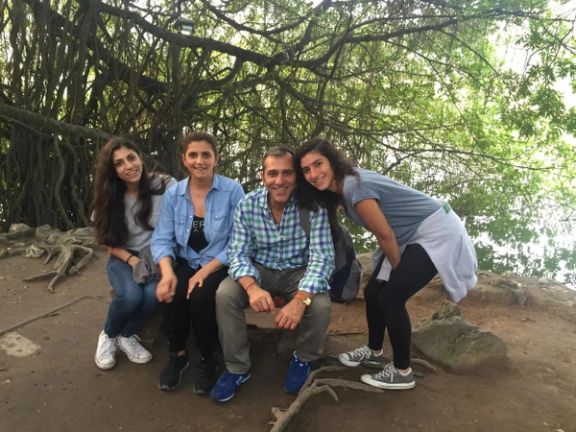
American-Iranian dual citizen Emad Sharghi with his wife and two daughters

The family of Emad Sharghi (Shargi), an American-Iranian dual citizen jailed in Iran since 2018, made an appeal to the US president to "do anything" in his power to bring him home.

In an exclusive interview with CBS News on Friday, Sharghi’s wife and two daughters said they have requested a meeting with Joe Biden "numerous times," including as recently as ten days ago, but has so far not received a response from the White House.

"Really what we would like is to sit in front of the president and tell our story and beg him — because he is the only one that can make the decision to bring Emad and the other hostages home," said Bahareh, Emad's wife.

"We really hope that the administration puts patriotism over politics and brings these Americans home," said Emad's 25-year-old daughter Ariana. 

In April, which marked four years since Sharghi’s detention, US Secretary of State Antony Blinken and Special Envoy for Iran Robert Malley called on Iran to release Sharghi and stop its policy of holding people as political pawns.

The 56-year-old businessman has been sentenced to ten years in prison on charges of espionage and collecting military intelligence but had attempted to flee while on bail awaiting the result of an appeal.

Foreign governments and human rights organizations have accused Iran of detaining foreigners and dual nationals on trumped up charges to use them for getting concessions from Western countries.

Most Viewed

US blockade enters murky phase as tankers spoof signals and buyers hesitate
1
ANALYSIS

US blockade enters murky phase as tankers spoof signals and buyers hesitate

2
INSIGHT

Ideology may be fading in Iran, but not in Kashmir's ‘Mini Iran'

3
INSIGHT

Hardliners push Hormuz ‘red line’ as US blockade tests Iran’s leverage

4
VOICES FROM IRAN

Hope and anger in Iran as fragile ceasefire persists

5

US sanctions oil network tied to Iranian tycoon Shamkhani

Banner
Banner

Spotlight

  • Hardliners push Hormuz ‘red line’ as US blockade tests Iran’s leverage
    INSIGHT

    Hardliners push Hormuz ‘red line’ as US blockade tests Iran’s leverage

  • Ideology may be fading in Iran, but not in Kashmir's ‘Mini Iran'
    INSIGHT

    Ideology may be fading in Iran, but not in Kashmir's ‘Mini Iran'

  • War damage amounts to $3,000 per Iranian, with blockade set to add to losses
    INSIGHT

    War damage amounts to $3,000 per Iranian, with blockade set to add to losses

  • Why the $100 billion Hormuz toll revenue is a myth
    ANALYSIS

    Why the $100 billion Hormuz toll revenue is a myth

  • US blockade targets Iran oil boom amid regional disruption
    ANALYSIS

    US blockade targets Iran oil boom amid regional disruption

  • Iran's digital economy battered by prolonged blackout
    INSIGHT

    Iran's digital economy battered by prolonged blackout

•
•
•

More Stories

Fingers Of Iranian Prisoner Cut Off With New Guillotine

Jun 4, 2022, 01:29 GMT+1

Four fingers of an Iranian prisoner who was sentenced to amputation for robbery were cut off in Tehran’s Evin Prison with a guillotine-like device that the prison has recently acquired. 

A former political prisoner and civil rights activist, Arash Sadeghi, said in a tweet on Thursday that the guillotine machine arrived at the prison about a month ago and was installed at the infirmary to carry out such sentences. 

According to Sadeghi, the man whose fingers were cut off on Tuesday had been transferred from the Kermanshah prison to carry out the sentence.

He added that three other prisoners convicted of robbery, namely Hadi Rostami, Mehdi Sharafian, and Mehdi Shahivand, have been transferred from the Orumiyeh prison in the northwestern province of West Azarbaijan to Evin to carry out their amputation sentences. 

According to Islamic Sharia law, punishment for theft can be amputation of fingers or hands.

The three prisoners have spent five years waiting for their sentence to be carried out.

Human rights organization Amnesty International had previously condemned the move to “deliberately mutilate and traumatize prisoners through unspeakably cruel judicial corporal punishments.”

Their trial was grossly unfair and relied on “confessions” which the men have said were obtained under torture and other ill-treatment while they were detained, without access to their lawyers, Amnesty said in December 2020. 

Kylie Moore-Gilbert, an Australian-British academic previously jailed in Iran for over two years, deplored the move, describing the procedure as “barbaric and medieval.”
Young Man Assaults Top Cleric In Esfahan After Friday Prayers

Jun 3, 2022, 20:35 GMT+1

The representative of Iran’s Supreme Leader in the central city of Esfahan, Yousef Tabatabaei-Nejad, was attacked Friday by a young man carrying a knife.

The hardliner cleric, who is the Friday prayer Imam of the city, said on Friday that a troubled young man in his 20s ambushed him from behind after the prayers, adding that he was hit on the neck, but it was nothing serious and he was not hurt.

Tabatabai-Nejad said the assailant, whose identity was not announced, was arrested immediately and his motives are being investigated. Iranian media say that the cleric suffered minor injuries.

People on social media said the man attacked the cleric with a metal object.

In 2020, Tabatabai-Nejad said society must become unsafe for women with loose-fitting hijabs. Similar calls for crackdown on those who fail to comply with compulsory hijab sparked a series of acid attacks on women in Esfahan in 2014.

Earlier in the year, a member of the Assembly of the Qom Seminary Scholars and Researchers, Mohammad Taghi Fazel Meybodi, said that clerics and seminary students are avoiding their usual garb for fear of being insulted in public, adding that the people in Iran have a negative view of the clergy, and blame them for the current hardships they experience, including high prices and corruption.

Another well-known cleric, Mohammad-Reza Zaeri, also talked about the growing hatred and grudge towards the clergy in January, warning of a crisis unfolding in society.

Iran Facing Water, Power Shortages This Summer

Jun 3, 2022, 14:33 GMT+1

Water inflow into Tehran dams has decreased by about 21 percent since March compared with last year, while reports say the country will also face severe power shortages this year.

Mohammad-Reza Bakhtiari, the managing director of Tehran province Water and Wastewater Company, said on Friday with about 179 millimeters of rain since the beginning of the current Iranian year, (March 21), the reserves of water supply dams in Tehran province is at 636 million cubic meters, down from 815 million cubic meters compared to last year.

Iran has been suffering from drought for at least a decade and this year officials have been warning of a further decrease in precipitation.

As drought persists, more underground water is exploited for irrigation, depleting natural reservoirs formed during thousands of years. The drought has also led to a reduction in hydroelectric power generation.

On Thursday, a member of parliament’s energy committee, Parviz Mohammadnejad, said that the country faces a deficit of about 14,000 megawatts in electricity production, adding that the deficit will lead to regular blackouts during the summer when consumption is at its peaks.

Electricity consumption has been increasing in Iran because of extremely low prices, considered a subsidy in the state-controlled economy. While both power plant capacity and their fuel supply remain inadequate, Iran exports electricity to Iraq. 

President Raisi Pays Quiet Visit To Restive Abadan

Jun 3, 2022, 12:22 GMT+1

Following days of anti-government protests and a heavy-handed crackdown in Iran’s province of Khuzestan, following the deadly collapse of a building, President Ebrahim Raisi paid a visit to Abadan. 

Unlike normal visits by the president to other cities, which are usually announced beforehand so local authorities can organize state-sponsored welcoming ceremonies, the Friday junket was without the presence of people except for his security detail and a couple of city officials. 

Protests began last week, when the 10-story Metropol building collapsed, leaving nearly 40 people dead and dozens missing. It quickly became apparent that the owner and builder was a powerful and well-connected businessman who had disregarded regulations and building codes, being backed by officials, who might have had their own financial interests.

He also visited homes of some families of the victims of the disaster that triggered protests in Abadan as well as in several other cities across the oil-rich Khuzestan province who have been taking to the streets to demand accountability.

During the visit, Raisi said people have the right to expect investigation into corruption and some businessmen's connections with authorities that led to the Abadan incident, adding that they should be dealt with quickly.

Iran Says GCC Members Are In No Position To Comment On Its Military Policies

Jun 3, 2022, 11:16 GMT+1

Iran says the members of the Persian Gulf Cooperation Council (GCC) are in no position to comment about Iran’s military policies, particularly its missile program. 

Iranian Foreign Ministry spokesman Saeed Khatibzadeh on Thursday rejected remarks in a statement issued at the end of the 152nd session of GCC's Ministerial Council in Saudi Arabia's capital Riyadh on Wednesday. 

In their statement, the GCC described Iran’s nuclear and missile programs and regional strategies as the main “challenge” facing the member states, criticizing the Islamic Republic’s support for “terrorism” as well as its “destabilizing behavior” across the region.

Khatibzadeh said such a "threadbare and destructive” statement indicates a “completely wrong approach” adopted by some member states and their “strategic confusion” vis-à-vis the Islamic Republic.

Iran and Saudi Arabia have held several rounds of talks since 2021 to improve their ties, severed since 2016, with no major results so far.

Commenting on the request by some GCC member states to be part of the Vienna talks to revive the 2015 Iran nuclear deal, JCPOA, Khatibzadeh said raising such issues demonstrates the depth of the council’s failure to see the realities as the JCPOA and the UN Resolution 2231 have made it clear which countries are the signatories to the international treaty and can take part in the negotiations.