• العربية
  • فارسی
Brand
  • Iran Insight
  • Politics
  • Economy
  • Analysis
  • Special Report
  • Opinion
  • Podcast
  • Iran Insight
  • Politics
  • Economy
  • Analysis
  • Special Report
  • Opinion
  • Podcast
  • Theme
  • Language
    • العربية
    • فارسی
  • Iran Insight
  • Politics
  • Economy
  • Analysis
  • Special Report
  • Opinion
  • Podcast
All rights reserved for Volant Media UK Limited
volant media logo

Mohammad Eslami’s Role In Iran’s Secret Nuclear Projects

Mojtaba Pourmohsen
Mojtaba Pourmohsen

Iran International

Aug 14, 2022, 16:40 GMT+1Updated: 17:46 GMT+1
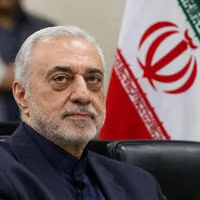
Mohammad Esmami, Iran's nuclear cheif at his office

Mohammad Eslami, Iran's current nuclear chief, played a key role in the secret part of the country’s nuclear program, according to a confidential source. 

President Ebrahim Raisi appointed Eslami to his current position in 2021 amid pressure by the International Atomic Energy Agency (IAEA) regarding uranium traces found at three nuclear facilities used prior to 2003 when Iran’s nuclear program was secret.

The source who is familiar with the inner workings of AEOI told Iran International that Eslami has the task of erasing the traces of suspicious nuclear activities of the Islamic Republic.

There is reason to believe that the three sites were not only used prior to 2003, but also much later.

Eslami had served as Minister of Roads and Urban Development in the former government and his appointment as nuclear chief surprised many. For the younger generation, the former official’s background seemed unrelated to his nuclear post. 

However, a look at Eslami’s resume shows that he played a crucial role in the most critical stages of Tehran’s secret nuclear projects. 

Between 1987 and 1989, an envoy from the Ministry of Defense traveled to Dubai to meet Abdul Qadeer Khan, a Pakistani scientist who sold nuclear knowledge and enrichment equipment to the Islamic Republic. 

Pakistani nuclear scientist and proliferator, Abdul Qadeer Khan
100%
Pakistani nuclear scientist and proliferator, Abdul Qadeer Khan

Years later, Abdul Qadeer Khan confirmed the deal with the Islamic Republic in a television interview. 

The source with links to the Iranian Organization of the Defensive Innovation and Research (SPND) said, that the mission to Khan was carried out under the supervision of an office headed by Mohammad Eslami.  

In a chart leaked from nuclear documents stolen from Iran by Israel, the role of Mohammad Eslami is prominent. As the head of the Defense Industries Educational and Research Institute, he was involved in all aspects of Iran's secret nuclear program that grew into various branches over the years. 

One of the most important of these was the Amad project, the Islamic Republic's plan to build an atomic warhead that was pursued under the supervision of Mohsen Fakhrizadeh, Iran's prominent nuclear figure and was stopped in 2003 when it was revealed or leaked. 

Fakhrizadeh was assassinated in November 2020, reportedly by Israel in a complicated operation resembling Hollywood thrillers.

The source in SPND said the supervisor of this project was Eslami, and the funds allocated to these programs were spent directly in line with Mohammad Eslami's discretion. 

With the closure of the "Amad" project, Iran's secret nuclear projects continued in a new organization, the SPND. 

For two years after the signing of the JCPOA, Eslami was the deputy of industrial and research affairs of the Ministry of Defense and a member of Iran's nuclear program. 

Chart of Iranian entities involved in nuclear projects
100%
Chart of Iranian entities involved in nuclear projects

 An office mentioned in the nuclear administrative chart of the Islamic Republic is of particular interest. The Orchid Office is an important center in Iran's program to acquire nuclear weapons, according to our source. A building on Orchid Street in Pasdaran district, Tehran, is where major contracts are signed was managed until two years ago by Eslami until Fakhrizadeh was assassinated. 

SPND was the center where Fakhrizadeh was pursuing his unfinished plan for the Amad project on a separate budget line.

The United States has sanctioned SPND exactly for its secretive nuclear work.

The two nuclear sites of Sorkh-eh-hesar, [Tehran], and Marivan near Abadeh, Fars Province, were given to SPND so that Fakhrizadeh could pursue his plan to produce nuclear weapons with the cooperation of Saeed Borji, an expert in atomic explosions. 

IAEA chief Raael Grssi with Mohammad Eslami in Tehran, March 5, 2022
100%
IAEA chief Raael Grssi with Mohammad Eslami in Tehran, March 5, 2022

However, by looking at the history of the Atomic Energy Organization of Iran, each of the heads of this organization was appointed out of a specific necessity. 

During the years when the secret nuclear program was pursued in the Ministry of Defense, Reza Amralahi was the head of the organization. 

With the development of this program and the need to build and equip extensive facilities such as Natanz, in Esfahan Province, Gholamreza Aghazadeh became the head of the organization. This former oil minister had the power to inject cash into Iran's nuclear program. 

His strong disagreement with then-president Mahmoud Ahmadinejad led Ali Akbar Salehi to become the head of the organization. Salehi who was Iran’s former representative at the IAEA took the helm of the Atomic Energy Organization when the negotiating team when the UN Security Council was issuing sanction after sanction against Iran in early 2010s. 

With the assassination of nuclear scientists and under the pressure of the Revolutionary Guards, Fereydoun Abbasi became the head of the Atomic Energy Organization, who himself had survived an assassination. 

Although years later, in an interview with the Ensaf News website, which was deleted after publication, a security official considered his assassination suspicious and raised the possibility that he was a spy. Abbasi was one of Fakhrizadeh's colleagues and one of his vociferous opponents and rivals. 

When the JCPOA’s time arrived, Salehi returned to the AEOI as a scientific figure. 

With the election of Raisi in the most engineered election in the history of the Islamic Republic, Eslami is the repository of Islamic Republic’s nuclear secrets and was appointed as the best suited person in the post of nuclear chief to eradicate all traces. 

He announced August 1 that the Islamic Republic had achieved the ability to build nuclear weapons.

During his one-year tenure, Iran has hardened its position not to provide further explanations to the IAEA on past nuclear work and Eslami has turned off most of the international watchdog’s monitoring equipment in Iran’s nuclear facilities. 

He seems to be a man who has returned to Iran’s Atomic Energy Organization to clear his and his colleagues’ footprints on the secret part of Iran’s nuclear program. 
Most Viewed

US blockade enters murky phase as tankers spoof signals and buyers hesitate
1
ANALYSIS

US blockade enters murky phase as tankers spoof signals and buyers hesitate

2

US tightens financial squeeze on Iran, warns banks over oil money flows

3
INSIGHT

Ideology may be fading in Iran, but not in Kashmir's ‘Mini Iran'

4
INSIGHT

Hardliners push Hormuz ‘red line’ as US blockade tests Iran’s leverage

5
VOICES FROM IRAN

Hope and anger in Iran as fragile ceasefire persists

Banner
Banner

Spotlight

  • Hardliners push Hormuz ‘red line’ as US blockade tests Iran’s leverage
    INSIGHT

    Hardliners push Hormuz ‘red line’ as US blockade tests Iran’s leverage

  • Ideology may be fading in Iran, but not in Kashmir's ‘Mini Iran'
    INSIGHT

    Ideology may be fading in Iran, but not in Kashmir's ‘Mini Iran'

  • War damage amounts to $3,000 per Iranian, with blockade set to add to losses
    INSIGHT

    War damage amounts to $3,000 per Iranian, with blockade set to add to losses

  • Why the $100 billion Hormuz toll revenue is a myth
    ANALYSIS

    Why the $100 billion Hormuz toll revenue is a myth

  • US blockade targets Iran oil boom amid regional disruption
    ANALYSIS

    US blockade targets Iran oil boom amid regional disruption

  • Iran's digital economy battered by prolonged blackout
    INSIGHT

    Iran's digital economy battered by prolonged blackout

•
•
•

More Stories

Commentators In Iran Pessimistic Over A Nuclear Deal

Aug 13, 2022, 17:56 GMT+1
•
Iran International Newsroom

A former senior lawmaker in Iran says the chance of reaching a comprehensive agreement between Iran and the United States has been lost.

Meanwhile, a prominent academic and ‘reformist’ analyst in Tehran said, "Iran's hardliners do not want an agreement, they simply want a respectful exit from the JCPOA." As though confirming this view, Noor News, a website close to Iran's Supreme Council of National Security, dismissed optimism in Europe and America about an imminent agreement.

Heshmatollah Falahatpisheh, the former head of the Iranian Parliament's Foreign Policy and national Security Committee wrote in a commentary on Didban Iran [Iran Monitor] website that "Tehran and Washington are trying to blame each other for the failure of the nuclear negotiations and declare an end to diplomacy."

The conservative politician added that the only possibility for the revival of the 2015 nuclear deal depends on whether Iran and the United States are committed to a long-term understanding in their relations.

In a rare clarity from a commentator in Iran over the nuclear issue, Falahatpisheh maintained that Iran should create a meaningful distance between its nuclear capabilities and the time when it can make a bomb. This will help the United States to convince its regional allies including Israel about the usefulness of an agreement. At the same time, Washington should undertake to protect Iran’s economic and trade ties once a deal is signed.

Falahatpisheh speaking in parlaiment in 2018
100%
Falahatpisheh speaking in parlaiment in 2018

Falahatpisheh added that even Raisi's opponents in Iran do not agree with a deal that would compromise Iran's nuclear achievements, meaning its Uranium enrichment capability.

The commentator said, however, that the Supreme Council of National Security, which is reviewing EU's proposal for a deal, should not accept it if it cannot be practically implemented. "Iran should not compromise its achievements and should only accept a comprehensive deal," he said. Falahatpisheh added that even if Iran rules out the EU proposal, Tehran and Washington can still work out an "oil for inspection deal" with the purpose of confidence building. He said such a deal would be based on a partial lifting of US sanctions.

Meanwhile, in an interview with the government-owned semi-official news agency ISNA, hardliner commentator Abbas Salimi Namin claimed that nuclear accusations against Iran that hinder an agreement are mainly fabricated by Israel and some Iranian opposition groups.

Salimi Namin also repeated Iran’s demand that the new agreement should contain a mechanism that would prevent a US withdrawal in the future. Without that mechanism, naturally, Iran will not welcome the proposal," he said.

Salimi Namin tried to reassure JCPOA member states that ultimately once the highest authority in Iran agrees to a deal, it will be final. He pointed out that "despite the harsh criticism of the JCPOA in Iran in 2015, no one tried to put an end to the deal. "

Sadegh Zibakalam, a frequent citic of hardliners in Iran
100%
Sadegh Zibakalam, a frequent citic of hardliners in Iran

Reformist analyst Sadeq Zibakalam told Khabar Online website that Iran's hardliners want a decent exit from the JCPOA rather than an agreement with the United States. He said Iranian negotiators and officials set meaningless and impossible conditions for an agreement hoping that no deal would be reached.

One such instance is Iran’s demand for the West to guarantee an economic windfall from a nuclear deal, Zibakalam said. This depends not only on the JCPOA but also Tehran’s change of behavior and relations with its neighbors, otherwise not many companies would be willing to deal with Iran.

Malley Rules Out ‘Lowering Standards’ Over Iran Sanctions

Aug 13, 2022, 14:47 GMT+1
•
Iran International Newsroom

Rob Malley, lead American negotiator in the Iran nuclear talks, told NPR Friday that United States officials were reviewing proposals from the European Union.

Last Monday Enrique Mora, the EU official coordinating talks, presented a text aimed at overcoming obstacles to renewing the 2015 Iran nuclear deal, the JCPOA (Joint Comprehensive Plan of Action). Iranian officials have said the text is under review in Tehran.

Malley, the White House special Iran envoy, acknowledged to NPR that EU mediators, who have chaired talks for over a year, believe negotiations have “exhausted their usefulness.”

“We’re considering the text very carefully to make sure it lives up to the president’s very clear guidance that he would only sign up to a deal…consistent with US national security interests,” Malley said.

Malley was pressed over reports the US has signaled willingness to rule out punitive action against non-US companies dealing with Iranian entities linked to Iran’s Revolutionary Guards (IRGC). This has been reported as a potential compromise consistent with President Joe Biden’s insistence he will not unilaterally remove the IRGC from the US list of ‘foreign terrorist organizations.’

“We have not, and will not negotiate any lowering of our standards,” Malley said. “If they [non-US entities] want to do business with Iran they have to respect our sanctions…any reports to the contrary…are flat-out wrong.”

Uranium traces – ‘no short-cut’

Malley also denied reports the US would agree, as part of JCPOArevival, to pressure the International Atomic Energy Agency to drop enquiries into uranium traces found in 2019 at Iranian sites used before 2003 but not declared as nuclear-linked. He reiterated the US position that, regardless of JCPOA talks, Tehran should satisfy the agency over the traces as part of its ‘safeguards’ commitment under the Nuclear Non-Proliferation Treaty.

“Really what the agency is interested is not so much pre-historical, or historical, explanation,” Malley said. “They want to know where is that uranium today, that it’s accounted for, that it’s under what is called ‘safeguards’… There’s no short-cut.”

Malley refused to put forward any figure for assets Iran might access with JCPOA restoration – with the release of money frozen worldwide in banks fearing US secondary sanctions – or for what Tehran might net from higher oil sales, currently facing US ‘maximum pressure.’

He said a restored nuclear deal would be better than Iran “with an unconstrained nuclear program and with more aggressive regional behavior” as had occurred since President Donald Trump withdrew the US from the JCPOA in 2018, prompting Iran by 2019 to expand its atomic work beyond JCPOA limits.

Sunset clauses

Questioned over ‘sunset clauses’ under which JCPOA limits expire, Malley stressed the deal’s constraints. “In 2023 they can do more research and development on some advanced centrifuges, they cannot install them. The main constraint…[which] puts Iran several months away from having enough fissile material for one bomb… would last until 2031…The situation we’re in today, as a result of the decision to withdraw from the deal, is Iran is only a handful of weeks away from having enough fissile material for a bomb…”

JCPOA critics in Tehran and Washington have seized on the current negotiations pause. Veteran newspaper editor Hossein Shariatmadari wrote Wednesday that further talks were “futile.” In the US, Republicans and other deal opponents have cited an alleged Iranian plot to kill former national security advisor John Boltonand Friday’s attack on writer Salman Rushdie in arguing for an end to nuclear talks or expelling Iran’s diplomats at the United Nations in New York.

Iran News Agency Cagey Over EU ‘New Concession’ In Nuclear Talks

Aug 12, 2022, 12:12 GMT+1
•
Iran International Newsroom

The official Iranian news agency IRNA suggested Friday Iran would accept European proposals to revive the 2015 nuclear deal only on several conditions.

IRNA quoted “an Iranian diplomat familiar with the process of negotiations” that a text circulated by Enrique Mora, the European Union coordinator of 14-month nuclear talks, would be “acceptable” if Iran had “confidence in various issues, including political claims related to security, sanctions, and guarantees.”

The IRNA story referred to a story published in the Wall Street Journal “a few hours ago” Friday reporting that the text, which the Journal had seen, had offered “a significant new concession to Tehran” over a probe into uranium traces found in Iran in 2019 by the International Atomic Energy Agency (IAEA).

According to the Journal, the Mora text suggests Iran would need to agree to address the IAEA concerns over the uranium traces before the revival of the 2015 nuclear agreement, the JCPOA (Joint Comprehensive Plan of Action).

While the IRNA story says other issues remain to be resolved – including ‘guarantees’ Iran has sought that the United States honor a revived agreement – it has been widely reported in recent weeks that the IAEA probe, which relates to work Iran carried out before 2003, is a major obstacle.

‘Settled and closed’

IRNA quoted a tweet from a senior official in the presidential office repeating the insistence of President Ebrahim Raisi, made in conversations with the presidents of France, Russia and China, that Iran would not agree to JCPOA restoration without “security claims…settled and closed.”

The US, France, Germany, and the United Kingdom have all argued the IAEA probe, under the agency’s review of Iran’s ‘safeguards’ commitments under the Nuclear Non-Proliferation Treaty, is unrelated to the JCPOA. But while the Journal’s account says the Mora draft envisages Iran having to satisfy the agency before a renewed JCPOA took effect, it says “other parties in the talks” would then “urge the IAEA Board of member states to close the investigation.”

In 2015, shortly after the JCPOA was agreed by Iran and six world powers, the IAEA published a report, Final Assessment on Past and Present Outstanding Issues Regarding Iran’s Nuclear Programme [sic]. The report both assessed Iran’s pre-2003 work and welcomed the JCPOA, which gave the agency wide powers of inspection that Iran withdrew in 2021 after it began breaching the JCPOA in 2019, the year after the US left the agreement and imposed stringent sanctions.

Uranium traces

The 35-member IAEA board in June passed a resolution, moved by the US and three European states, critical of Iran over its explanations of the uranium traces, which were found by inspectors in 2019 following allegations made by Israel. But while the Journal raised the prospect of the board referring Iran to the United Nations Security Council should it fail to satisfy the IAEA probe, it did not mention Russia and China, who have UNSC vetoes, voting against the June resolution in the IAEA board.

The IRNA story reiterated that Iran continues to review the Mora document. While EU foreign policy chief Josep Borrell described it as a “final text,” Iranian officials have said the document is being studied by technical experts before any ‘political’ decision is taken.

The Wall Street Journal quoted a “senior US official” that Washington expected “Iran to provide the agency the information they need… regardless of whether it’s expressed in the text of an understanding or elsewhere.” Mikhail Ulyanov, Russia’s IAEA ambassador, said in comments published Friday in Izvestia, that with Iran questioning “literally a few lines” he expected the fate of the JCPOA to become clear next week.

Iranian Drones For Russia Add To Biden's Policy Dilemma

Aug 12, 2022, 08:59 GMT+1
•
Mardo Soghom

Washington will enforce all sanctions on Russia and Iran, the State Department said Thursday referring to the potential transfer of Iranian drones to Moscow.

A State Department spokesperson reiterated during a briefing that “Iran is preparing to provide Russia with several hundred UAVs, including weapons-capable UAVs,” warning that the US will enforce its sanctions.

Iran did not immediately respond to the statement, but it has never explicitly denied US accusations that it plans to sell military drones to Russia, limiting itself to general expressions of neutrality in the Ukraine war.

Responding to US calls not to provide drones to Russia, Iranian foreign ministry’s spokesman on July 20 said “technical cooperation” with Moscow predated the Ukraine war. “Iranian and Russian technological cooperation predates developments in Ukraine. Any linkage between our cooperation with Russia with developments in Ukraine is intentionally biased.”

But the State Department's warning about enforcing sanctions showed a stiffening of American and possibly European positions on the issue, as an overt supply of Iranian weapons in the Russian invasion would mark the first regular involvement of a country in the conflict on the side of Russia, except Belarus.

“Let me be clear: We will vigorously enforce all US sanctions on both the Russian and Iranian arms trades...including but not limited to Russia-specific authorities and our worldwide nonproliferation sanctions.,” the US spokesperson underlined.

The Biden administration faces a dilemma stemming from Iran’s actions as it tries to revive the 2015 nuclear agreement (JCPOA) by indirect talks with Tehran. If it intensifies its rhetoric and resorts to more sanctions, a new nuclear agreement, already proving to be very hard to achieve, will become even more complicated. If it ignores Iran’s actions, it will come under fire by domestic critics for signing deals with a country behaving aggressively against US interests.

Another complicating factor is Iran’s apparent plots to assassinate former US officials on American soil, which was once again highlighted by the Department of Justice indicting an IRGC operative for trying to hire a hitman to kill former national security adviser John Bolton and possibly former Secretary of State Mike Pompeo.

The Biden administration has strongly condemned Iran’s actions and issued warnings, but it still keeps the nuclear deal on track, separating the issue of Tehran’s malign behavior from its goal of restoring the JCPOA.

At the same time, Iran is driving a hard bargain, slowing the negotiations and extracting concessions.

This policy will make any new nuclear deal achieved with Iran even shakier, inviting rejection by all Republicans and even many Democrats.

In the meantime, Tehran is glorifying its closer relations with Russia, with Supreme Leader Ali Khamenei in July clearly praising Vladimir Putin’s decision to attack Ukraine.

The quandary the Biden administration faces in trying to deal with Iranian threats and at the same time negotiate for a nuclear deal that would release billions of dollars for Tehran, is apparent from another comment by the State Department spokesperson.

“We remain incredibly concerned about Iran’s use and proliferation of UAVs. They have been used to attack U.S. forces, our partners in the region, and international shipping entities. We will continue to use all available tools, including but not limited to sanctions, to prevent, deter, and dismantle the procurement network that supply UAV-related material and technology to Iran.”

Spokesman Says Iran Got ‘Many Concessions' In Nuclear Talks

Aug 11, 2022, 18:54 GMT+1
•
Iran International Newsroom

The advisor for Iran’s negotiators was reported Thursday saying Tehran had won “many concessions” in talks to revive the 2015 Iran nuclear deal.

Mohammad Marandi, who acts as de facto spokesman on the talks, referred both to the four-day round of meetings in Vienna that concluded Monday and to earlier rounds. “Iran was able to make significant progress in all fields, which of course will be announced in due course,” Marandi told the Young Journalists Club, a state-owned news agency.

Marandi claimed western journalist had told him that “many government elites of Western countries, as well as Persian-language media people based abroad” also regarded the talks as a success for Iran.

The Vienna talks – largely indirect contacts between the United States and Iran mediated by the European Union – ended with senior EU official Enrique Mora circulating a document designed to bridge remaining gaps. While the EU foreign policy chief Josep Borrell called this a “final text,” Iranian officials treated it as a set of proposals needing further review.

Awaiting ‘high-level meeting’

Nour News, affiliated to Iran’s Supreme National Security Council, reported late Wednesday that the text was being analyzed “at the experts’ level,” but had not yet been discussed by a “high-level meeting.” The SNSC, made up of 24 of Iran’s leading politicians and military commanders, shapes policy on the nuclear issue, although crucial decisions may come in informal discussions around Supreme Leader Ali Khamenei.

Rafael Grossi of IAEA (L) meeting Iran's nuclear chief Mohammad Eslami in Tehran on March 5, 2022
100%
Rafael Grossi of IAEA (L) meeting Iran's nuclear chief Mohammad Eslami in Tehran on March 5, 2022

The nuclear talks, beginning in April 2021 in an effort to revive the 2015 agreement (the JCPOA), have wrestled with intertwined political and technical issues – essentially over which US sanctions introduced after Washington left the JCPOA in 2018 contravene the 2015 agreement and how Iran’s atomic program, expanded since 2019, should be returned to JCPOA limits.

Marandi reiterated that Tehran expects the dropping of “false accusations against Iran in the agency,” a reference to enquiries by the International Atomic Energy Agency (IAEA) into Iranian nuclear work before 2003. The US and three European JCPOA signatories argue these enquiries arise under Tehran’s basic obligations as a signatory of the Nuclear Non-Proliferation Treaty and have nothing to do with renewing the JCPOA.

Iran, on the other hand, argues that the IAEA concluded investigations into Iran’s past nuclear work in 2015, the year the JCPOA was agreed, and revived them only after allegations made by Israel in 2018, the year the US left the JCPOA.

“Let's not forget that before the previous meeting of the Board of Governors [in June, which passed a resolution critical of Iran], the head of the agency, [Rafael Mariano] Grossi, travelled to Israel,” Marandi said.

Iran had promised earlier this year to provide satisfactory answers to the IAEA regarding questions around its past secret nuclear work, but in late May the agency said it had not received convincing explanations.

Guarded comments

In remarks published Thursday on the Rouydad news website, Hossein Maliki, of the Iranian parliament’s security and foreign policy committee, warned that negotiations could be facing a “dead end…because we see less flexibility in the Americans.”

Maliki said he had not seen the Mora text, but his guarded comments – noting Iran’s “positive opinion” on “some provisions” of a “previous text”, an apparent reference to a document circulated by Borrell in late July – suggested he was hedging while long-term JCPOA opponents argued the talks had failed.

The official news agency IRNA reported that Foreign Minister Hossein Amir-Abdollahian, in a telephone conversation with Turkish Foreign Minister Mevlut Cavusoglu, expressed hope that “the American side, with a realistic and pragmatic view…will provide the ground for an agreement on the final text.”