• العربية
  • فارسی
Brand
  • Iran Insight
  • Politics
  • Economy
  • Analysis
  • Special Report
  • Opinion
  • Podcast
  • Iran Insight
  • Politics
  • Economy
  • Analysis
  • Special Report
  • Opinion
  • Podcast
  • Theme
  • Language
    • العربية
    • فارسی
  • Iran Insight
  • Politics
  • Economy
  • Analysis
  • Special Report
  • Opinion
  • Podcast
All rights reserved for Volant Media UK Limited
volant media logo

Another Schoolgirl Beaten By Iranian Security In Critical Condition

Oct 19, 2022, 15:27 GMT+1
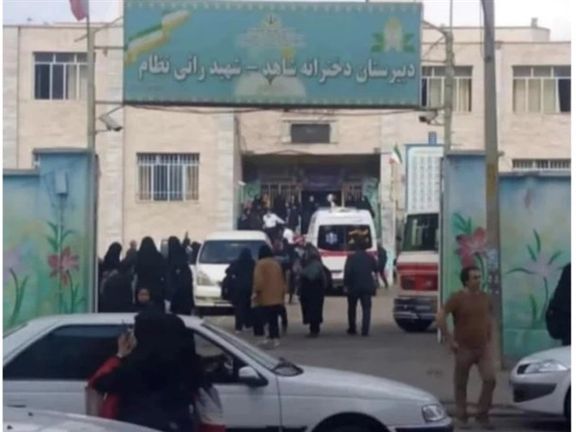
The school in Ardabil in northwestern Iran where security forces have beaten schoolgirls to death

Another girl from the ‘Shahed’ school in the city of Ardabil, where security agents beat students killing one last week, is in critical condition due to a head trauma, Iran International has learned. 

According to reports obtained by Iran International, Iranian plainclothes agents raided a girls' high school in Ardabil, northwest of Iran and an Azari speaking city October 12, injuring at least 10 students and arresting seven others. 

One schoolgirl, identified as Asra Panahi, died of internal bleeding. Reportedly, the government was trying to force the schoolgirls to participate in a pro-regime rally to force the students to sing the propaganda song “Hello Commander” in praise of Iran’s ruler Ali Khamenei, but when some students refused, Basij militias showed up, beating and assaulting the girls. 

Human rights activist Yashar Hakkakpour has told VOA that in addition to Asra Panahi, two other students, identified as Aytak Mikaili and Hana Dourdouzani, were also killed during the clampdown on the schoolgirls. He claimed that the girl who is now hospitalized in ICU is Anita Khojasteh. He added that 80 students were taken to hospital in 11 ambulances following the attack by the regime’s agents.

Hardliner news agencies published video of an interview with the uncle of the dead girl, who said she had died of a congenital heart condition at home.

School children have been also protesting forced hijab after Mahsa Amini was killed in ‘morality’ police custody in mid-September. An unknown number of school students have been arrested and sent to what the government says are “psychological” rehabilitation centers, which no one has ever heard about.

On Sunday, October 16, the Coordination Council of Iranian Teachers’ Trade Associations called for the resignation of the Islamic Republic’s Education Minister Yousef Nouri amid arrests and killings of many students across the country.

Amid nationwide protests that have even mobilized Iranian high school students, the Islamic Republic authorities are removing photos of the Supreme Leader from classrooms in fear of students damaging the portraits. 


Most Viewed

US blockade enters murky phase as tankers spoof signals and buyers hesitate
1
ANALYSIS

US blockade enters murky phase as tankers spoof signals and buyers hesitate

2
INSIGHT

Ideology may be fading in Iran, but not in Kashmir's ‘Mini Iran'

3
INSIGHT

Hardliners push Hormuz ‘red line’ as US blockade tests Iran’s leverage

4
VOICES FROM IRAN

Hope and anger in Iran as fragile ceasefire persists

5

US sanctions oil network tied to Iranian tycoon Shamkhani

Banner
Banner

Spotlight

  • Hardliners push Hormuz ‘red line’ as US blockade tests Iran’s leverage
    INSIGHT

    Hardliners push Hormuz ‘red line’ as US blockade tests Iran’s leverage

  • Ideology may be fading in Iran, but not in Kashmir's ‘Mini Iran'
    INSIGHT

    Ideology may be fading in Iran, but not in Kashmir's ‘Mini Iran'

  • War damage amounts to $3,000 per Iranian, with blockade set to add to losses
    INSIGHT

    War damage amounts to $3,000 per Iranian, with blockade set to add to losses

  • Why the $100 billion Hormuz toll revenue is a myth
    ANALYSIS

    Why the $100 billion Hormuz toll revenue is a myth

  • US blockade targets Iran oil boom amid regional disruption
    ANALYSIS

    US blockade targets Iran oil boom amid regional disruption

  • Iran's digital economy battered by prolonged blackout
    INSIGHT

    Iran's digital economy battered by prolonged blackout

•
•
•

More Stories

Iran's Exiled Prince Urges UN Inquiry Into Islamic Republic’s Atrocities

Oct 19, 2022, 13:15 GMT+1

Prince Reza Pahlavi of Iran living in exile has called on the United Nations to investigate the Islamic Republic’s widespread and systematic human rights abuses and atrocities committed against protesters. 

In a letter addressed to the United Nations Secretary-General António Guterres released to the media October 18, Pahlavi requested his support for the establishment of a commission of inquiry at the UN human Rights Council for investigating the responsibility of officials. 

He noted that the world has witnessed in recent days the disturbing crimes being committed against protesters whose movement began “demanding justice for the brutal murder of Mahsa "Zhina" Amini by the so-called morality police for having allegedly failed to observe misogynistic regulations on compulsory observance of the hijab head covering.”

The UN’s failure to establish such a commission to hold accountable “those who order and instigate such abuses... will only perpetuate the culture of impunity,” he said, adding “The Iranian people deserve no less than other victims in the world who have had the benefit of a proper investigation of atrocities committed against them.”

He highlighted that “The Iranian courts can hardly deliver justice when they themselves are an instrument of repression, prosecuting the innocent while allowing those committing atrocities to escape accountability.”

“The day will soon come when the perpetrators of these crimes will be prosecuted either before the impartial courts of a democratic Iran, or the International Criminal Court," Pahlavi said, noting that a UN Commission of Inquiry “would help set the stage for that day.”

Iranian Climber Who Ditched Hijab Receives Hero’s Welcome

Oct 19, 2022, 11:40 GMT+1
•
Iran International Newsroom

Elnaz Rekabi, the Iranian climber who appeared without hijab in the finals of competitions in South Korea was greeted by a welcoming crowd as she returned home.

However, the vehicle carrying her didn’t stop and passed through the large crowd of well-wishers who were shouting her name.

Shortly after, state media published a video interview of Rekabi in the airport arrival hall, in which the athlete called her move to appear without hijab “inadvertent,” but many believe she has made the statements under the pressure of regime agents.

People on social media say the regime tried “to break this brave woman,” force her “to repudiate her own convictions, and discredit” her among hundreds of thousands of young girls who admire her but as always, “they failed.”

It was on Sunday that Rekabi participated in the finals of the Asian Championship without the mandatory hijab, and her action quickly made headlines as she had already broken the taboo very publicly.

She disobeyed the Islamic Republic's restrictions for female athletes, she made history by representing Iran unveiled, in what was seen as support of anti-hijab and antigovernment protests that have been raging across the country since mid-September, when 22-year-old Mahsa Amini was killed in the custody of hijab police.

After the coverage of Elnaz Rekabi's move, a story was published on her Instagram page, in which she apologized for what happened and said her hijab had “unintentionally caused a problem.”

Before publishing this story there were many reports about her “disappearance”, and after the publication, many called it a “forced confession.”

In the past days, some media reported the arrest of Davoud Rekabi, the rock climber's brother, as well as her sister by the Revolutionary Guard.

On the other hand, based on information received by Iran International, Rakabi's cell phone is not in her possession any longer.

Rekabi’s move was widely covered by the international media. The Guardian and the Financial Times published photos of Elnaz Rekabi on their front pages and wrote about her uncertain fate.

Various international figures also praised the action of the Iranian athlete. Chris DeBerg, the famous British-Irish singer, republished Iran International's news about Rekabi's action, and wrote in her support, “Well-done Elnaz!”

Jessica Chastain, a famous Hollywood actress, also reposted a post about Rakabi and wrote, “Iranian athlete Elnaz participated in an international competition without the mandatory hijab as a sign of protest and solidarity with the women of her country.”

About 30 Iranian athletes in recent years have defected from national teams and sought asylum in other countries due to a lack of attention, threats, and corruption in their federations as well as Iran’s policy of not allowing athletes to compete against Israelis. For women, mandatory hijab is also an issue.

In 2019, boxer Sadaf Khadem attended a boxing match with the Iranian flag and without a headscarf. She had to cancel her return flight to Tehran after a warrant was issued for her arrest.

Earlier this week, Iran’s Supreme Leader Ali Khamenei called on sports people to adhere to “religious beliefs,” reiterating that not competing with Israeli athletes is a victory.

Who Are The Plainclothesmen Attacking Protesters In Iran?

Oct 19, 2022, 09:37 GMT+1
•
Iran International Newsroom

Many Iranians taking part in nationwide protests in the past month have complained that they have been beaten, shot at, or arrested by thuggish plainclothesmen.

Others have complained about unknown non-uniformed agents in the streets carrying shotguns who sometimes even boss around uniformed officers.

During the past decades, Iranian activists have called them Hezbollahis, thugs, or simply Lebas-shakhsi [plainclothesmen]. Whatever their name, it is obvious that despite their appearance, they are well-organized, are linked to uniformed security forces or sometimes their members who have put on ordinary outfits in the interest of anonymity.

Most are members of the Basij paramilitary forces under the command of the Revolutionary Guard, the IRGC.

Whoever they are, the Iranian government assumes no responsibility for their crimes, claiming they are protesters engaging in provocations.

Sometimes when they cannot deny the facts, Officials claim that these elements are not armed and do not attack anyone unless they come under attack by protesters. However, people have often photographed or filmed them carrying weapons and attacking and arresting individuals in the streets.

Plainclothes agents assaulting a woman trying to make an arrest

Iranian lawmaker Hossein Noushabadi told reporters on October 17, that "Plainclothes officers have nothing to do with women or protesters in general unless they come under attack." However, he did not say why these officers do not wear uniforms so that everyone recognizes them as official agents. Noushabadi, however, did not rule out the presence of "rouge elements" among the plainclothes officers and acknowledged that some of the protesters have been killed or wounded by these rouge elements.

During the protest that followed the disputed presidential election in 2009, IRGC General Hossein Hamadani organized thousands of prisoners and street thugs to attack protesters and suppress a movement that demanded a fair counting of votes.

"We identified around 5,000 thugs who were present in the riots but were not linked to political parties. We usually controlled them by not allowing them to come out of their homes in sensitive junctures. I recruited them and organized them in three battalions. I knew that we need to train and use individuals who were familiar with knives and daggers and swords," Hamadani told reporters.

Plainclothesmen attacking protesters in Mashhad, second largest city in Iran

During the recent round of protest that started in mid-September social media reports and victim’s families revealed how the plainclothes elements operate. BBC Persian interviewed a Kurdish woman who said that thugs stormed her son's house and arrested him. She said that the incident led to her daughter-in-law's miscarriage.

According to a report posted on the Twitter account of Iran Human Rights (IHR NGO) aTehran University Student in late September revealed that plainclothes officers had wounded him because of assault and battery.

In fact, some of the officers involved in the death of Mahsa Amini were plainclothes elements. Her death after being arrested by the ‘morality police’ triggered the current protests.

In another development, Iranian journalist Milad Pour Isa tweeted on Tuesday that plainclothes officers arrested around 20 Mazandaran University students.

According to Rouydad24 news website in Tehran, when people produce evidence that they were beaten or arrested by plainclothes individuals or even when videos of plainclothes officers arresting, beating or shooting at protesters emerge, the government always claims that they were "rogue elements."

As long as all law enforcement officers in Iran do not wear uniforms, the government can always get away with criminal acts committed by them. Since 1999, when plainclothes officers violently suppressed a student uprising in Tehran killing several students, some regime insiders have been trying to convince the security forces to issue uniforms to all law enforcers, to no avail. Security forces are under the command of Iran’s ruler Ali Khamenei who needs the plainclothes agents to save the regime from the people.

As Unrest, Strikes Continue Iran Activists Call For New Protests

Oct 18, 2022, 23:27 GMT+1
•
Iran International Newsroom

The five-week-old antigovernment protests in Iran continued Tuesday with university students staging demonstrations across the country.

Students at various universities in Tehran, Shiraz, Gilan and Mazandaran gathered and chanted slogans against the Islamic Republic.

Reports say in Tehran's Kharazmi University, officials prevented male and female students from eating together at the canteen, but the students took their food to the courtyard to show their anger at gender discrimination.

Students at Beheshti University in northern Tehran also defied the Islamic Republic's rules and ate lunch together. Gender segregation in many public places has been a hallmark of the clerical regime’s enforcement of its interpretation of Islamic rules.

A video received by Iran International shows that the students of Allameh University in northern Tehran chanted “Shameless, Shameless” against the government spokesman Ali Bahadori Jahromi who was there to give a speech.

In Gilan University, students gathered and chanted “No headscarves, No discrimination, Freedom and Equality.”

Similar protests were also reported in Shiraz and Mazandaran provinces.

Meanwhile, the school students kept up with their routine protests on Tuesday. A video from a school in Tehran shows the students ask drivers in the streets to chant their slogans instead.

Reports said oil and petrochemical sector workers continued their strikes in Assaluyeh, Bandar Abbas, Abadan, Bushehr, and South Pars Petrochemical Companies as well as Haft-Tappeh Sugar Company, Kangan refinery, and Neyriz Ghadir Steel Complex in Fars province.

Despite regime threats of more clampdown on protesters on Tuesday, young anonymous activists defied the government and called for mass demonstrations on Wednesday.

“We ask businessmen, workers, and older generations to accompany us and stop the oppression and killing of young people,” reads one of these announcements calling on people to show up everywhere they can in their neighborhoods at 6 P.M. on Wednesday.

The youth committees of Mahabad, Sanandaj and Kermanshah in western Iran have supported the call for street protests on Wednesday.

In the northwestern city of Tabriz activists have called for protests on Thursday, which coincides with the birth anniversary of Sattar Khan who is considered a national hero by the Iranians and revered in his birthplace, East Azarbaijan province. Sattar Khan was a military hero of Iran’s constitutional movement in early 1900s.

Reports on social media suggest that the government has deployed additional forces in great numbers to Tabriz to be prepared for a brutal crackdown.

Deputy Commander of Police Force Qassem Rezaie said on Tuesday that “chaos, unrest and damage to the people” is a redline for the police and law enforcement agents will no longer show restraint against “norm breakers, rioters and the dissent.”

According to the Oslo-based NGO Iran Human Rights Organization, at least 230 people, including 27 children have been killed with excessive and lethal force during the current protests.

Rezaie repeated the cliché remarks of the clerical regime's officials, especially Supreme Leader Ali Khamenei, blaming the protests on the “sworn enemies.” He said they are after creating “sedition” in the country by “exaggerating the problems” to “deceive” some people.

However, Interior Minister Ahmad Vahidi claimed on Tuesday that the regime is open to criticism and protesters can express their views.

During his trip to the southern province of Bushehr, the Iranian hardliner minister, who is wanted by the Interpol in connection with the murder of 85 people at a Jewish center in Argentina back in 1994, linked the current protests to “enemies” and their “calculation errors”.

He once again blamed the riots on “the adversary news channels”, referring to Persian speaking foreign-based television stations beaming programs into Iran, claiming they are trying “to create chaos, but to no avail.”

Shutting down the Internet, jamming satellite signals of foreign TV channels, and many other tactics suggest that Iranian regime is desperately afraid of media and social media impact.

In a similar statement, Commander of Tehran Revolutionary Guard Ahmad Zolghadr also said Tuesday that now “instead of bombs and mortars, signals enter through cyberspace and deceive some people.”
Amnesty Calls For Prompt Probe Into Evin Prison’s Deadly Fire

Oct 18, 2022, 21:44 GMT+1

Rights group Amnesty International has called on the Islamic Republic to immediately allow independent international monitors unhindered access to Iranian prisons. 

In a statement on Tuesday, Amnesty International urged a probe into “the harrowing use of unlawful force by security forces at Tehran’s Evin prison on 15 October 2022,” when a mysterious fire broke out at the prison, killing at least eight inmates and injuring over 60.

Calling for protection of prisoners from further unlawful killings, torture and other ill-treatment, the group said, “This latest deadly incident once again brings into sharp focus the urgent need to address the litany of crimes being committed by the Iranian authorities through an independent investigative, reporting and accountability mechanism.”

The group condemned the government who blamed prisoners for the fire that engulfed areas of Evin prison, saying “evidence gathered by Amnesty International raises serious concerns that the authorities sought to justify their bloody crackdown on prisoners under the guise of battling the fire and preventing prisoner escapes.”

According to testimonies obtained by Amnesty International from prisoners, victims’ relatives, journalists and human rights defenders with contacts inside Evin, prison officials fired teargas and metal pellets at hundreds of prisoners, and subjected many to brutal beatings with batons, particularly on their heads and faces. 

The group also expressed grave concern about eyewitness accounts indicating that security forces pointed guns to the heads of several women prisoners and may have also fired live ammunition towards some male prisoners.

Following the massive blaze, some journalists and people on social media accused the Islamic Republic of setting the prison on fire intentionally.