• العربية
  • فارسی
Brand
  • Iran Insight
  • Politics
  • Economy
  • Analysis
  • Special Report
  • Opinion
  • Podcast
  • Iran Insight
  • Politics
  • Economy
  • Analysis
  • Special Report
  • Opinion
  • Podcast
  • Theme
  • Language
    • العربية
    • فارسی
  • Iran Insight
  • Politics
  • Economy
  • Analysis
  • Special Report
  • Opinion
  • Podcast
All rights reserved for Volant Media UK Limited
volant media logo

UK Suggests Russia Will Look For More Iran Drones
Iran International Newsroom
Nov 23, 2022, 16:37 GMT+0Updated: 17:37 GMT+1
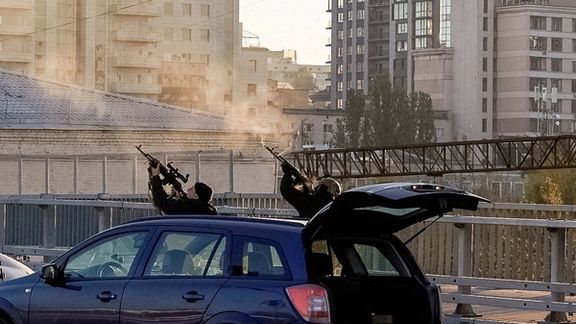
Ukrainian policemen use their assault rifles to fire at drones over Kyiv. October 17, 2022

The United Kingdom defense ministry said Wednesday that Russia had used hundreds of Iranian-made drones in Ukraine but none since around November 17.

The Ministry of Defence in London tweeted that Russia had “likely conceived of the UAV [unmanned aerial vehicles] campaign to make up for its severe shortage of cruise missiles.” Reports of the Russian forces using Iranian drones, mainly Shaheed-136, surfaced in September, but were until November denied by Tehran.

Although the use of Iranian-made drones had met with “limited success” with most of those launched neutralized, the British ministry said Moscow would “probably seek resupply” as “Russia can probably procure UAVs from overseas more rapidly than it can manufacture new cruise missiles domestically.” The drones had been both one-way or ‘kamikaze’ and reusable UAVs, the ministry said.

Some former Iranian military sources were quoted elsewhere as saying that the country can produce around 20 drones a month, which is well short of Russian’s needs.

Both sides in the Ukraine war have deployed drones, with Ukraine utilizing Turkish-made Bayraktars along with US-supplied Switchblade drones. The Russian-backed governor of Crimea province said Tuesday that five attacks, including one targeting the Balaklava power station and three on Russian naval ships, had been repelled.

The British Ministry of Defence in its tweets Wednesday said Moscow had used Iranian-made drones “largely…against tactical military targets and the Ukrainian electricity grid.” France, Germany, the United Kingdom, and the United States have condemned Russia’s deployment of Iranian drones as an alleged violation of arms-trade provisions in the 2015 Iran nuclear deal.

The aftermath of a drone hit on buildings in Kyiv on October 17, 2022
100%
The aftermath of a drone hit on buildings in Kyiv on October 17, 2022

Iran ‘Sticking to its positions’

Iranian foreign minister Hossein Amir-Abdollahian said Tuesday that Tehran had “sold very few Iranian drones in the framework of defense cooperation with Russia 11 months before the start of the Ukraine war.” Amir-Abdollahian said Iran and Ukrainian military officials had met in a third country to discuss the issue, and that “we are continuing our investigations.”

Amir-Abdollahian appeared to suggest that the Ukrainian foreign minister Dmytro Kuleba had told him by telephone that a drone captured by Ukrainian forces had Russian markings but “looks like an Iranian witness drone,” a model rendered in English as ‘Witness-136.’ This, Amir-Abdollahian argued, was “proof that Iran is sticking to its positions.”

The foreign minister said Iran was committed to diplomatic solutions both to the Ukraine war and the current stand-off in talks aimed at restoring the 2015 nuclear agreement, the JCPOA (Joint Comprehensive Plan of Action). Amir-Abdollahian reiterated Iran’s view than the International Atomic Energy Agency (IAEA) should shelve its enquiry into unexplained uranium traces found in sites not declared as nuclear-related.

‘Exchange of messages should continue’

Amir-Abdollahian suggested that while efforts continued to revive the JCPOA, differences with the US remained on three issues, on which the three European JCPOA signatories were lining up with Washington. “One of these issues is solving the remaining issues of the agency [over the uranium traces], and the other issue is related to economic guarantee,” he said, referring to Iran’s expectation of being cushioned against the economic effects of the US again leaving the JCPOA and imposing sanctions, as it did in 2018 under previous president Donald Trump.

The foreign minister said that “the exchange of messages [with the US] should continue.” American officials have in recent weeks suggested that their focus is no longer on JCPOA restoration, and along with the three European states and the European Union have imposed new sanctions on Iran over military links with Russia and its response to domestic unrest.

Most Viewed

US blockade enters murky phase as tankers spoof signals and buyers hesitate
1
ANALYSIS

US blockade enters murky phase as tankers spoof signals and buyers hesitate

2
INSIGHT

Ideology may be fading in Iran, but not in Kashmir's ‘Mini Iran'

3
INSIGHT

Hardliners push Hormuz ‘red line’ as US blockade tests Iran’s leverage

4
VOICES FROM IRAN

Hope and anger in Iran as fragile ceasefire persists

5

US sanctions oil network tied to Iranian tycoon Shamkhani

Banner
Banner

Spotlight

  • Hardliners push Hormuz ‘red line’ as US blockade tests Iran’s leverage
    INSIGHT

    Hardliners push Hormuz ‘red line’ as US blockade tests Iran’s leverage

  • Ideology may be fading in Iran, but not in Kashmir's ‘Mini Iran'
    INSIGHT

    Ideology may be fading in Iran, but not in Kashmir's ‘Mini Iran'

  • War damage amounts to $3,000 per Iranian, with blockade set to add to losses
    INSIGHT

    War damage amounts to $3,000 per Iranian, with blockade set to add to losses

  • Why the $100 billion Hormuz toll revenue is a myth
    ANALYSIS

    Why the $100 billion Hormuz toll revenue is a myth

  • US blockade targets Iran oil boom amid regional disruption
    ANALYSIS

    US blockade targets Iran oil boom amid regional disruption

  • Iran's digital economy battered by prolonged blackout
    INSIGHT

    Iran's digital economy battered by prolonged blackout

•
•
•

More Stories

IRGC Confirms Sending Ground Forces To Kurdish Regions

Nov 23, 2022, 14:33 GMT+0
•
Iran International Newsroom

A hardliner Iranian lawmaker has confirmed that the Revolutionary Guard’s Ground Forces have been deployed to Kurdish areas to crack down on protesters.

Mohammad Esmail Kowsari representing Tehran in the parliament who was a commander of the IRGC’s Sarallah Headquarters tasked with the capital’s security, claimed in an interview Wednesday that “Kurdish separatist groups, especially the Democratic Party of Iranian Kurdistan (PDKI), Komala, and Pejak (the Free Life Party of Kurdistan)” have been stationed in the Iraqi Kurdistan region and sought to take control over some areas in Iran’s Kordestan province.

Kowsari claimed that the presence of Kurdish groups is the reason behind the deployment of ground force to the western parts of the country, so that they can overcome them and establish security at the borders.

Tuesday night, an officer from the Border Guard Force of the Iraqi Kurdistan Region confirmed to Iran International that the IRGC ground forces have closed the Haj Omran Border Crossing, stationed a large number of troops equipped with heavy weapons there, and were preparing for ground operations inside Iraqi Kurdistan.

The Islamic Republic calls Iranian Kurdish armed groups in sheltering in Iraq, "terrorist groups" or "anti-revolutionary" but these groups say that the goal of their armed campaign is "defending the rights of the Kurds".

Generally, the Kurdish parties − including Komala and the Kurdistan Democratic Party of Iran (KDPI) − favor Kurdish autonomy within a federal Iran. Pejak (the Free Life Party of Kurdistan), an affiliate of the Kurdistan Workers’ Party, or PKK, formed in Turkey but also based in northern Iraq, has generally favored a unified, independent Kurdistan uniting Kurds in Syria, Iraq, Turkey, and Iran.

Mohammad Esmail Kowsari, who is one of many IRGC officers in Iran's parliament
100%
Mohammad Esmail Kowsari, who is one of many IRGC officers in Iran's parliament

Since last week, the Islamic Republic has intensified its repression of Kurdish-majority cities and towns in western provinces of the country following reports that parts of some small towns have fallen into the people’s hands. The majority of Iran's 10 million Kurds live in the western parts of the country. On Tuesday, the IRGC again hit a base that it claimed belonged to "separatist terrorists" in Iraq using missiles and kamikaze drones.

The regime stepped up attacks against Iranian Kurds sheltering in Iraqi Kurdistan on the pretext that “separatist” Kurdish groups are fanning the flames of conflict in Iranian Kurdish cities by supporting the protesters, leading to a global outcry that is gaining a new momentum following the European Parliament’s announcement on Monday that it would not keep direct contact with the Islamic Republic authorities.

In a statement on Tuesday, US State Department Spokesperson Ned Price condemned the Islamic Republic’s “repeated and brazen violations of Iraq’s territorial integrity,” adding that “Iran’s violations of Iraqi territorial integrity continue with lethal attacks carried out against the Iraqi Kurdistan Region from November 20 through 22.” The US also called on Tehran to refrain from further threats and violence.

Meanwhile, Turkey has also renewed its attacks on Kurdish targets in Iraq and Syria, a week after a bombing in Istanbul which it blamed on Kurdistan Workers’ Party, or PKK, as well as Syrian Kurdish groups affiliated with it, an allegation denied by those groups.

Iranian Interior Minister Ahmad Vahidi, himself an IRGC commander, held a conversation with his Turkish counterpart earlier in the month, voicing support for “a stable and strong Turkey.” He said that Iran and Turkey have common enemies, calling for more serious cooperation in dealing with “those who make the two countries unsafe.”

Also on Tuesday, Iraqi Prime Minister Mohammed Shia' Al Sudani also denounced the Turkish and Iranian attacks, saying “The attacks were launched without taking Iraq’s permission, that’s why we decry these attacks whether carried out by Turkey or Iran.”

A member of the Iraqi Parliament told Iran International Wednesday that the Parliament will once again hold a session on Thursday to discuss the missile and drone attacks of Iran and Turkey. The parliament has held at least two sessions on the issue in the past three days.

Israel Informed MI5 Of Threats Against Iranians In UK: Media

Nov 23, 2022, 11:08 GMT+0

Israeli media say the Mossad informed Britain’s spy agency about threats against Iranian citizens in Britain, especially journalists.

Israel’s Channel 11 reported Monday that the information was about the threat facing two journalists working for Iran International TV channel in London.

In early November, Iran International in a statement said that two of its British-Iranian journalists have been notified of serious threats against them.

“The Metropolitan Police have now formally notified both journalists that these threats represent an imminent, credible and significant risk to their lives and those of their families. Other members of our staff have also been informed directly by the Metropolitan Police of separate threats,” added the statement.

The network blamed the IRGC saying, “These lethal threats to British citizens on British soil come after several weeks of warnings from the IRGC and Iranian government about the work of a free and uncensored Farsi-language media working in London.”

Last week, the Scotland Yard positioned armed vehicles outside the Iran International building in London.

Britain’s MI5 said on November 16 that UK authorities have discovered at least 10 “potential threats” since January to “kidnap or even kill British or UK-based individuals perceived as enemies of the regime.”

Faced with nationwide antigovernment protests since mid-September, the Islamic Republic has blamed foreign-based Persian broadcasters such as BBC Persian and Iran International of “fomenting unrest”, while all media in the country are under tight government control and present protesters as “rioters” and “terrorists”.

US Navy Says Debris Analysis Shows Iranian Drone Hit Tanker

Nov 22, 2022, 20:53 GMT+0

The US military on Tuesday said debris analysis has concluded that the same type of Iranian drone that Tehran has supplied to Russia for its invasion of Ukraine was used to attack a commercial tanker off the coast of Oman a week ago.

The US Navy's Bahrain-based 5th Fleet published photos and details of its investigation into the attack on the Liberian-flagged Pacific Zircon tanker, including debris from the Shahed-136 drone itself.

In a statement, the Navy said the drone ripped a 30-inch-wide (76 cm) hole into the back of the ship, and the explosive impact damaged a shipboard boiler, potable water tank and life raft.

"The Iranian attack on a commercial tanker transiting international waters was deliberate, flagrant and dangerous, endangering the lives of the ship's crew and destabilizing maritime security in the Middle East," Vice Adm. Brad Cooper, the top U.S. Navy commander in the Middle East, said in a statement.

Persian Gulf waters have in recent years seen attacks on tankers that have come at times of heightened regional tensions with Iran. In July 2021, a suspected drone attack hit a petroleum product tanker managed by an Israeli firm off Oman's coast. Iran denied accusations it was responsible.

Iran's supply of drones to Russia and popular antigovernment protests in the country have brought about more Western criticism of Tehran and have put any nuclear negotiations on the back burner for the time being.

With reporting by Reuters

US Condemns Iran Upping Nuclear Enrichment At Fordow Plant

Nov 22, 2022, 20:26 GMT+0
•
Iran International Newsroom

A White House official said Tuesday the United States was watching “with deep concern” as Iran stated it was enriching uranium to 60 precent at a second atomic site.

“We certainly have not changed our view that we will not allow Iran to achieve a nuclear weapons capability,” National Security Council spokesman John Kirby told reporters. “All options” were being prepared for US President Joe Biden, Kirby said.

Mohammad Eslami, chief of the Atomic Energy Organization of Iran, had announced earlier Tuesday that enrichment to 60 percent had begun Monday at the Fordow underground facility, which is around 110 miles (190km) south of Tehran. Iran in April 2021 began enriching to 60 percent at the Natanz site after an attack on the facility it blamed on Israel.

The ISNA news agency reported Iran had informed the IAEA over its decision to use relatively advanced IR-6 centrifuges to enrich to 60 precent at Fordow.

Britain, France and Germany also condemned Iran's plans to expand its nuclear program after the UN nuclear watchdog IAEA said Iran was enriching uranium, with plans to further expand enrichment at two plants.

"Iran’s step is a challenge to the global non-proliferation system," the three nations said in a joint statement provided by the British government. "This step, which carries significant proliferation-related risks, has no credible civilian justification."

"We will continue to consult, alongside international partners, on how best to address Iran’s continued nuclear escalation."

Eslami said the move had come after Iran had warned it would “seriously react to any resolution and political pressure.” Last Thursday the 35-nation governing board of the International Atomic Energy Agency (IAEA) passed a resolution drafted by the US and European allies censuring Iran over an alleged lack of co-operation over uranium traces found by agency inspectors at sites not declared as nuclear-related.

Tehran has demanded that an IAEA enquiry into the uranium traces be shelved as a condition for reviving the 2015 Iran nuclear agreement, the JCPOA (Joint Comprehensive Plan of Action). Iran has now responded to the IAEA resolution with its latest nuclear expansion beyond the caps set by the JCPOA, which set enrichment at a 3.67 percent maximum and limited centrifuges to the first-generation, less efficient IR-1. The 2015 agreement banned any enrichment at Fordow.

Prospects for reviving the JPCPOA, which former US president Donald Trump abandoned 2018 while imposing ‘maximum pressure’ sanctions on Iran, have dimmed since 18-month-long talks floundered earlier this year. The US and the three western European JCPOA signatories – France, Germany, and the United Kingdom – have slapped new sanctions on Iran on a variety of grounds including its response to a wave of protests and supply of military drones to Russia.

Tehran’s installation of more efficient advanced centrifuges, its enrichment to 60 percent, and stockpiling of enriched uranium have together drastically reduced the time it would take Iran to assemble sufficient ‘weapons grade’ uranium,’ enriched to 90 percent, for an explosive device. Iran denies it has any intention of building a nuclear bomb.

Iran Targets Iraqi Kurdish People Using Missiles, Drones

Nov 22, 2022, 17:49 GMT+0

Iran's Revolutionary Guard has once again launched attacks on Iraq’s Kurdistan region amid continuing protests in Iran’s Kurdish regions and several deaths.

IRGC targeted a base that it called "separatist terrorists" using missiles and kamikaze drones, the semi-official Tasnim news agency affiliated with the Guards said on Tuesday.

Iran accuses Kurdish groups taking refuge in Iraq's Kurdistan of fueling countrywide demonstrations that have gripped Iran since September.

“In today's operation, the base of a separatist terrorist group near Kirkuk, known as the Free Kurdistan Party, was targeted by missiles and kamikaze drones,” Tasnim added.

The news agency added that since Nov. 14 the Revolutionary Guard launched a new round of attacks against "separatist terrorists" in response to the group's alleged anti-security actions in Iranian cities bordering Iraq.

Iranian Kurdish dissident armed groups in Iraq have not taken any action during the protest and made no provocative statements.

Last week, two people were killed and 10 were wounded when rockets and drones hit the headquarters of Iranian Kurdish parties in the autonomous Kurdish region of Iraq.

Since the current wave of protests began in Iran following the death in custody of young Iranian Kurdish woman Mahsa Amini, the Islamic Republic has intensified its attacks on Kurdish dissident groups based in Iraqi Kurdistan, apparently aimed at intimidating the Kurds.

Iran’s barrage of missile and drone strikes against the groups in September led to the death of 14 people, including women and children, and wounding of 58 others near Erbil and Sulaymaniyah.