• العربية
  • فارسی
Brand
  • Iran Insight
  • Politics
  • Economy
  • Analysis
  • Special Report
  • Opinion
  • Podcast
  • Iran Insight
  • Politics
  • Economy
  • Analysis
  • Special Report
  • Opinion
  • Podcast
  • Theme
  • Language
    • العربية
    • فارسی
  • Iran Insight
  • Politics
  • Economy
  • Analysis
  • Special Report
  • Opinion
  • Podcast
All rights reserved for Volant Media UK Limited
volant media logo

China Uses 25-Year-Deal With Iran To Get More From Saudis – Ex-Diplomat
Iran International Newsroom
Jan 17, 2023, 23:31 GMT+0Updated: 17:38 GMT+1
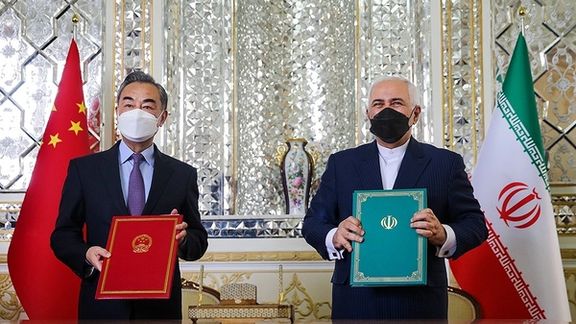
Iran’s former foreign minister Mohammad Javad Zarif (right) and China’s foreign minister Wang Yi  during the signing ceremony of Iran-China strategic cooperation agreement in Tehran on March 27, 2021
Iran’s former foreign minister Mohammad Javad Zarif (right) and China’s foreign minister Wang Yi during the signing ceremony of Iran-China strategic cooperation agreement in Tehran on March 27, 2021

A former Iranian ambassador to China says the Tehran-Beijing 25-year agreement is overestimated and only worked as a bargaining chip for China to secure deals with Saudi Arabia.

Mohammad-Hossein Malaek, who served as Tehran’s envoy for four years under former president Mohammad Khatami, told the Iranian Labour News Agency on Tuesday that the 25-year strategic agreement is a document without any value, especially following the visit by Chinese President Xi Jinping to Saudi Arabia in December. 

He noted that the visit has opened a new chapter in Iran-China relations, therefore the agreement should be revised as Tehran and Beijing had different agendas at the time the document was signed.

Malaek claimed that the agreement -- which is wrapped in mystery and so far has had little practical results – made China more interesting for Arab countries and incentivized them to give Beijing many economic and political benefits, as it was seen during the Chinese president’s recent visit to the region. W

When the document was signed, then-foreign-minister Mohammad Javad Zarif was accused of being reluctant to cooperate with China, so with signing an agreement, which does not include any practical measures and is not a binding contract, Zarif managed to exonerate himself from those accusations. “Therefore, this document is no longer the document for which they wrote stories [in Iranian media]," he said, noting that at the beginning, they made a lot of noise about the deal, but no progress has been made and “we are still at the same point.”

Former Iran ambassador to China Mohammad-Hossein Malaek (file photo)
100%
Former Iran ambassador to China Mohammad-Hossein Malaek

Zarif and his Chinese counterpart Wang Yi on March 27, 2021, signed the controversial 25-year deal at a ceremony at the Iranian Foreign Ministry in Tehran. The deal was first proposed by Iran's Supreme Leader Ali Khamenei during President Xi’s visit to Tehran in 2016.

The pact has been very controversial in Iran because its details have never been disclosed. A leaked copy of the final text only outlines the general terms of the agreement, but Tehran officials, beleaguered by economic crisis they cannot solve, hoped it will bring billions in investment and make Iran part of China' Belt and Road Initiative, a multi-trillion-dollar infrastructure scheme intended to stretch from East Asia to Europe. The project aims to significantly expand China's economic and political influence and has raised concerns in the United States and elsewhere.

Malaek added that the Islamic Republic needs foreign investors in the field of oil and gas, and it has nothing to do with signing the document or not. Sanctions have stopped Iran's cooperation with Western companies, and only Russian and Chinese companies may invest in the country. However, he said that China abides by the sanctions and does not violate any of them at all when it feels any threat to its own interests. 

Iran has indicated its intention to rely more on Asian countries, particularly China for trade relations as talks with the United States and Europe to resolve differences over Tehran’s nuclear program have not succeeded so far and US sanctions remain in place. However, Beijing has so far has not seriously challenged US sanctions, as it has cultivated closer ties with the Persian Gulf Arab countries and Israel.

Many Iranians have expressed resentment over the 25-year cooperation agreement with China and a proposed 20-year deal with Russia, saying it is a sell-out. Although Iran has not revealed the details of the agreement with China and what it will entail in political, economic and military terms, some social media users go as far as claiming that the Islamic Republic is "selling out the country and its people" to China and Russia.
Most Viewed

US blockade enters murky phase as tankers spoof signals and buyers hesitate
1
ANALYSIS

US blockade enters murky phase as tankers spoof signals and buyers hesitate

2
INSIGHT

Ideology may be fading in Iran, but not in Kashmir's ‘Mini Iran'

3
INSIGHT

Hardliners push Hormuz ‘red line’ as US blockade tests Iran’s leverage

4
VOICES FROM IRAN

Hope and anger in Iran as fragile ceasefire persists

5

US sanctions oil network tied to Iranian tycoon Shamkhani

Banner
Banner

Spotlight

  • Hardliners push Hormuz ‘red line’ as US blockade tests Iran’s leverage
    INSIGHT

    Hardliners push Hormuz ‘red line’ as US blockade tests Iran’s leverage

  • Ideology may be fading in Iran, but not in Kashmir's ‘Mini Iran'
    INSIGHT

    Ideology may be fading in Iran, but not in Kashmir's ‘Mini Iran'

  • War damage amounts to $3,000 per Iranian, with blockade set to add to losses
    INSIGHT

    War damage amounts to $3,000 per Iranian, with blockade set to add to losses

  • Why the $100 billion Hormuz toll revenue is a myth
    ANALYSIS

    Why the $100 billion Hormuz toll revenue is a myth

  • US blockade targets Iran oil boom amid regional disruption
    ANALYSIS

    US blockade targets Iran oil boom amid regional disruption

  • Iran's digital economy battered by prolonged blackout
    INSIGHT

    Iran's digital economy battered by prolonged blackout

•
•
•

More Stories

Oil Industry Workers Stage New Round Of Strikes In Iran

Jan 17, 2023, 22:30 GMT+0

Amid natural gas shortage in Iran due to the government inability to invest in production, a new wave of strikes by oil and gas industry workers has kicked off in the country.

Reports say permanently employed workers in the industry held protest gatherings in Ahvaz, Asaluyeh, Dehloran, Shiraz, Ilam, Bandar Lengeh and Aghajari in the south and southwest of Iran.

In previous months, contract workers also held sporadic protests and strikes along with anti-government demonstrations in the country.

Videos published on social media show employees working at the Ilam Gas Refinery held a protest gathering on Tuesday.

In the meantime, permanent workers at Pars Oil and Gas Company in Asaluyeh stopped working and organized a gathering to show anger at low wages.

Similar events were also staged in Aghajari, Shiraz, Qeshm island, Jam, Dehloran, and Ahvaz.

These strikes are at a time when people are also protesting the incompetency of the government to supply natural gas to households in some regions.

Monday evening, residents in Torbat-e Jam, a town in the northeast gathered outside the governor's office to protest the gas cut off. They chanted slogans like "Death to the governor".

On Monday, people in Torbat-e Jam also rushed to the Red Crescent building to get oil heaters. Videos show some agents prevented people from breaking into the facility.

In order to resolve the gas crisis in Tehran and other cities, the Islamic Republic has shut down schools and offices.

Iran Protests To Iraq Over PM’s Use Of ‘Arabian Gulf’

Jan 17, 2023, 20:19 GMT+0
•
Maryam Sinaiee

Iran's foreign ministry spokesman says Tehran has protested to Iraq over once again using “a fake misnomer” for the Persian Gulf.

Iran's foreign ministry spokesman says Tehran has protested to Iraq over once again using “a fake misnomer” for the Persian Gulf.

Responding during his press briefing Tuesday to a question over the Iraqi Prime Minister Mohammed Shia’ al-Sudani’s insistence on calling the Persian Gulf as the “Arabian” Gulf, Naser Kanaani said the foreign ministry has sent a letter of protest to the government of Iraq.

The name Persian Gulf is “a historical, permanent, documented and undeniable fact,” he said and added that “repeating the fake name does not change facts and brings no legitimacy to it.” He also alleged that Iraq was using the controversial term to appeal to “others”, presumably Iran's Arab rival Saudi Arabia.

Iran's foreign ministry usually protests if foreign officials use alternative names to refer to the Persian Gulf in view of strong feelings among Iranians over the matter who have launched petitions on various occasions to protest to the use of “Gulf” instead of “Persian Gulf” by foreign officials and media such as former US President Barack Obama and the BBC.

“Despite having strategic, fraternal, and deep relations with Iraq, we have openly conveyed our protest with regards to the issue, summoned the Iraqi ambassador and reminded the Iraqi side of the great Iranian nation’s sensitivities about the use of the precise and full term, the Persian Gulf,” Foreign Minister Hossein Amir Abdollahian said January 11 but also claimed that Al-Sudani had “corrected the matter on social media.”

Iranian Foreign Minister Hossein Amir-Abdollahian (file photo)
100%
Iranian Foreign Minister Hossein Amir-Abdollahian

Tehran summoned the Iraqi ambassador Nasir Abdul Mohsen Abdullah to the foreign ministry on January 11 to voice its strong protest over the use of the misnomer.

At the opening ceremony of a regional football tournament, the 25th Arabian Gulf Cup, in Basra on January 6, Al-Sudani referred to the body of water separating Iran from its several Arab neighbors as the “Arabian Gulf” and despite Iran's protest, in an interview with Deutsche Welle Saturday defended his use of the controversial term and said he would not apologize to Iran for using what Kanaani referred to as a “misnomer” and “fake title”.

The historic waterway has been referred to as the Persian Gulf since ancient times including in historical Greek sources and is still referred to as such in official documents of the United Nations. Since 1960s, Arab governments have increasingly been using The Gulf or Arabian Gulf and officials of other countries and some international organizations have followed suit.

“Using the fake label for the Persian Gulf is seen in Iran as a futile attempt by the Arab neighbors to distort the region’s ancient history,” the IRGC-linked Fars news agency wrote Tuesday.

For Iraq’s prime minister using the term “Arabian Gulf” is seen by many Iranians as another sign of the Iranian regime’s costly efforts to gain influence in its neighboring country, relying on Shia proxy forces and clerics.

Some Iranian media and pundits say Al-Sudani’s insistence on using a name that he knew would irritate Iranians may be a sign that the Shia-majority Iraq is increasingly restoring its ‘Arab’ identity and getting closer to other Arab nations which are Sunnis, despite their seemingly better relations with Shia Iran over much of the past two decades.

Abdolreza Farajirad, diplomatic relations analyst, told the Iranian Labour News Agency (ILNA) Tuesday that all Iraqi premiers after Nouri al-Maleki have tried to mend their relations with the Arab world and go back to their Arab identity and culture. “For them the Arabic identity has priority and the [Shia] religious identity comes second,” he said.

Frequent School Closures In Iran Hurt Education - Report

Jan 17, 2023, 18:40 GMT+0

An Iranian newspaper in Tehran says four months into the academic year in Iran, students have attended school for only 38 days.

Farhikhtegan newspaper reported Tuesday that one of the reasons for school closures has been the nationwide protests following the death of Mahsa Amini in police custody in mid-September.

The protests were extended to schools, and not only did a large number of students support it, but also many were subjected to violence by the security forces and arrested.

The newspaper also mentioned air pollution, unprecedented cold snap, snowfall and heavy rain, and the national football team's matches in the World Cup in Qatar as other reasons for school closures.

Farhikhtegan warned that "If it continues like this, that would be the end of public education in the country."

Meanwhile, Iran’s Parliament Research Center reported a 17% increase in the number of students who are left out of school compared to the previous six years.

According to the report, the number of students who missed school this year is more than 900 thousand.

The children are left out of schools are those who come from poorer families.

The five provinces of Sistan and Baluchestan, Razavi Khorasan, Tehran, oil-rich Khuzestan and West Azerbaijan have the highest number of students deprived of education.

Saudi FM Says Riyadh Trying To Find Path To Dialogue With Iran

Jan 17, 2023, 18:00 GMT+0

Saudi Foreign Minister Prince Faisal bin Farhan Al Saud said the kingdom was trying to find a path to dialogue with Iran as the best way to resolve differences.

He said a decision by Saudi Arabia and other Gulf states to focus on their economies and development was a "strong signal to Iran and others in the region that there is a pathway beyond traditional arguments and disputes towards joint prosperity".

Tensions spiked between Saudi Arabia and Iran after Tehran got involved in Syria’s civil war in 2011 and began building a network of proxy forces in the region.

Riyadh and Tehran cut ties in 2016 but officials from the two countries have held five rounds of direct talks hosted by Iraq since last year without achieving any diplomatic breakthroughs.

Arab states around the Persian Gulf are concerned about Iran's nuclear and ballistic missile programs and network of regional proxies but want to contain tensions as they focus on economic priorities.

"This is complex question, but we will have to talk about how we find a pathway to ending the conflict," he said.

Prince Faisal said attention on the Middle East was also needed, citing Syria as well as regional concerns over "provocative policies" by Israel's new government headed by Benjamin Netanyahu in an alliance with ultra-nationalists.

Netanyahu has pledged to pursue formal Israeli ties with Riyadh to build on normalization pacts signed with the United Arab Emirates and Bahrain in 2020 under his leadership.

Saudi Arabia blessed the US-brokered pacts but stopped short of formally recognizing Israel in the absence of a resolution to Palestinian statehood goals.

Reporting by Reuters

Iranian, Belgian FMs Hold Phone Calls Reportedly For Prisoner Swap

Jan 17, 2023, 16:20 GMT+0
•
Iran International Newsroom

Amid simmering tensions over the fate of a Belgian aid worker sentenced to 40 years in prison in Iran, the foreign ministers of the two countries are in constant contact.

Belgium's Foreign Minister Hadja Lahbib and her Iranian counterpart Hossein Amir-Abdollahian held two phone conversations on Saturday and Monday – January 14 and 16. In the readout of both calls, the Islamic Republic’s foreign ministry did not mention the case of the aid worker and only said the two diplomats discussed bilateral ties and ways to expand cooperation as well as latest state of consular cooperation between the two countries. 

Earlier in the month, the Islamic Republic’s judiciary sentenced Olivier Vandecasteele, who was detained in 2022, to 40 years in prison and 74 lashes for alleged “spying and cooperation with the United States, money laundering and currency smuggling $500,000 out of Iran.”

Vandecasteele, 41, has served in various international humanitarian organizations since at least 2006, including, Médecins du Monde, Norwegian Refugee Council (NRC), and Relief International. He worked in Iran for humanitarian organizations for more than six years and left the country. Later, he was lured back by “a girlfriend” and was detained in February 2022. A spokesman for Vandecasteele’s family announced in December that he has been sentenced to 28 years in prison.

Belgian aid worker Olivier Vandecasteele (file photo)
100%
Belgian aid worker Olivier Vandecasteele

However, according to French daily Libération, Tehran has explicitly informed Belgium that Vandecasteele will only return to his country only if Asadollah Asadi -- an Iranian diplomat imprisoned in Belgium, returns to Iran. Assadi, 50, a former attaché at the Iranian embassy in Austria, was convicted of plotting to bomb a gathering of the exiled opposition group Mujahedin-e Khalq Organization (MEK) near Paris on June 30, 2018. He is currently serving a 20-year sentence in Belgium for “attempted murder and involvement in terrorism.”

Earlier in the year, the Belgian parliament passed a law proposed by the government about a prisoner exchange treaty between Tehran and Brussels, creating an uproar in the international community since it could lead to the release of Assadi, and potentially turning Belgium to a safe haven for the agents of the Islamic Republic to operate in Europe. Numerous people and groups from around the world warned about the imminent perilous consequences of the prisoner exchange treaty, calling it “the green light to state terrorism” that only emboldens the Islamic Republic.

The phone conversations between Lahbib and Amir-Abdollahian took place a few days after the Belgian minister vowed at the parliament that her ministry would do its best to improve the conditions of Vandecasteele in prison and work for his release. She said her ministry is doing everything it can for the release of Vandecasteele noting that they have stepped up diplomatic efforts and are exhausting all possible leads. 

Asadollah Asadi, an Iranian diplomat imprisoned in Belgium
100%
Asadollah Asadi, an Iranian diplomat imprisoned in Belgium

However, according to the Brussels Times, the liberal party in the parliament deemed such promises insufficient and called on Lahbib to travel to Iran and increase the political pressure on the Islamic Republic’s authorities about his case. 

Belgium and Vandecasteele’s family believe he is innocent and a victim of hostage taking by the Iranian regime.

In the past years, 49 European citizens have been arrested in Iran. Eighteen of them are still in prison, including the Belgian citizens. Two of them have been killed: one has been executed and one died due to lack of medical access.

There were speculations that the prisoner swap agreement would lead to Asadi’s exchange with Swedish-Iranian professor Ahmadreza Djalali (Jalali), who was arrested during a working visit to Iran about seven years ago. He was sentenced to death in October 2017 on charges of spying for Israel.

Amnesty International released a detailed research and analysis paper in May to prove that Iranian authorities were threatening to execute Djalali to compel Belgium and Sweden to hand over Asadi and Hamid Nouri who is in prison in Sweden for involvement in mass execution of prisoners in 1980s, and “to deter them and others from future prosecutions of Iranian officials”.

UN experts and international human rights organizations say that the Islamic Republic takes foreigners hostage to extract concessions from the West.