• العربية
  • فارسی
Brand
  • Iran Insight
  • Politics
  • Economy
  • Analysis
  • Special Report
  • Opinion
  • Podcast
  • Iran Insight
  • Politics
  • Economy
  • Analysis
  • Special Report
  • Opinion
  • Podcast
  • Theme
  • Language
    • العربية
    • فارسی
  • Iran Insight
  • Politics
  • Economy
  • Analysis
  • Special Report
  • Opinion
  • Podcast
All rights reserved for Volant Media UK Limited
volant media logo

Reports Say Iranian Regime Continues Arrests, Torture Of Dissidents
Iran International Newsroom
Feb 1, 2023, 16:33 GMT+0Updated: 17:37 GMT+1
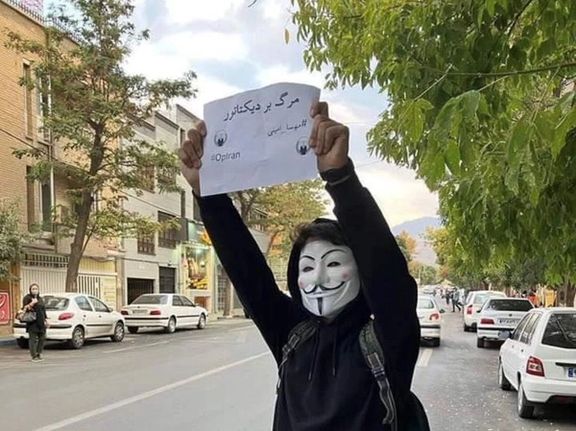
A protester in Tehran holding up a sign that says, "Death to the dictator". October 2022

While mass arrests and heavy sentences against protesters continue in Iran, reports say some detainees are being tortured behind bars.

According to information received by Iran International, Ashkan Baluch, a kickboxing athlete, who was sentenced to five years in prison, attempted suicide in a prison in Tehran and been taken to hospital, where he jumped off the third floor in a second attempt to kill himself. He remains in hospital in serious condition.

Jalal Pirdayeh, a master's student at Sharif University, has been sentenced by a revolutionary court to two years of imprisonment, two years of a ban on leaving the country, and two years of ban on activities in cyberspace.

Maryam Shokrani, a journalist at Shargh newspaper, also announced in a tweet Tuesday that after she was charged with "propaganda against the regime" she has been set free on bail, but she received another notice from the revolutionary court that her charge is changed to "acting against national security".

Meanwhile, Hengaw Human Rights Organization said Mohammad Abbaszadeh, an artist from southwestern Ilam province, has received a two-year prison sentence, a two-year ban on leaving the country, and the payment of a fine.

The US-based Human Rights Activists News Agency (HRANA) reported that Saman Seidi, a rapper arrested during recent protests, was transferred from a prison in Karaj to an unknown location on January 28.

A protester hit with 'birdshots' - small shotgun pellets that can injure eyes or even kill
100%
A protester hit with 'birdshots' - small shotgun pellets that can injure eyes or even kill

In the meantime, the case of Shiva Musazadeh, a master's student in dramatic literature at Tehran University of Arts, who was arrested twice during the nationwide uprising has been referred to the Khorramabad Criminal Court.

The campaign of Baluch activists also announced the arrest of eight students of Badr al-Uloom seminary in Zahedan saying that at least six of them are from Afghanistan.

In another development, Abdol-Mahdi Mousavi, the Chief Justice of Markazi Province, said several people have been detained and five others were summoned as they planned to "cut off the Internet and electronic surveillance after obtaining weapons."

Iranian intelligence and security agencies often bring unsubstantiated charges against dissidents, who are then tried behind closed doors without a lawyer.

Information received by Iran International also indicatess that Hawri Qaderi, a 22-year-old from Marivan in Kordestan province, was arrested on January 2 by security agents and taken to an unknown location. Since his arrest, he has talked only once to his family, and efforts to find out his whereabouts have failed.

More details have also emerged about regime security forces resorting to violence against citizens.

Mahmoud Alizadeh Tabatabai, a lawyer, told Jamaran website that "doctors at an eye Hospital in Tehran have said that they had removed several hundred eyeballs."

Security forces use shotguns to fire shells filled with small steel balls at protesters. The shells are known as ‘bird shots’ and are indiscriminate in nature as they spread among a crowd and often injure eyes.

The lawyer added that heavy sentences have also been handed out to teenage students and high school girls.

Furthermore, Ashkan Marovati, an Iranian Kurdish boxer, who was shot during a fight with security agents, told the CNN that there were about 200 birdshots in his body and the officers fired at him from a close range.

The Kurdish boxer also added that the officers took him to the hospital because they were sure he would die.
Most Viewed

US blockade enters murky phase as tankers spoof signals and buyers hesitate
1
ANALYSIS

US blockade enters murky phase as tankers spoof signals and buyers hesitate

2
INSIGHT

Ideology may be fading in Iran, but not in Kashmir's ‘Mini Iran'

3
INSIGHT

Hardliners push Hormuz ‘red line’ as US blockade tests Iran’s leverage

4
VOICES FROM IRAN

Hope and anger in Iran as fragile ceasefire persists

5

US sanctions oil network tied to Iranian tycoon Shamkhani

Banner
Banner

Spotlight

  • Hardliners push Hormuz ‘red line’ as US blockade tests Iran’s leverage
    INSIGHT

    Hardliners push Hormuz ‘red line’ as US blockade tests Iran’s leverage

  • Ideology may be fading in Iran, but not in Kashmir's ‘Mini Iran'
    INSIGHT

    Ideology may be fading in Iran, but not in Kashmir's ‘Mini Iran'

  • War damage amounts to $3,000 per Iranian, with blockade set to add to losses
    INSIGHT

    War damage amounts to $3,000 per Iranian, with blockade set to add to losses

  • Why the $100 billion Hormuz toll revenue is a myth
    ANALYSIS

    Why the $100 billion Hormuz toll revenue is a myth

  • US blockade targets Iran oil boom amid regional disruption
    ANALYSIS

    US blockade targets Iran oil boom amid regional disruption

  • Iran's digital economy battered by prolonged blackout
    INSIGHT

    Iran's digital economy battered by prolonged blackout

•
•
•

More Stories

Iranian Regime Marks Anniversary As People Adapt Protests

Feb 1, 2023, 13:20 GMT+0
•
Iran International Newsroom

As the Islamic Republic has started its 10-day celebrations to mark the establishment of the regime, grassroot groups have called on people to chant antigovernment slogans every night. 

As the Islamic Republic has started its 10-day celebrations to mark the establishment of the regime, grassroot groups have called on people to chant antigovernment slogans every night. 

The state-sponsored ceremonies of Fajr – which literally means dawn – mark the 44th anniversary of the Islamic Revolution and will be held from February 1 to 11. The group dubbed Youth of Tehran Neighborhoods (or Tehran Youth), which has managed to mobilize numerous successful protests in several towns and cities, has issued a statement to ask people to chant anti-regime slogans every night during the 10-day ceremonies from their rooftops, balconies or windows.

Describing the Fajr ceremonies as a reminder of “the beginning of suffering and gloom for Iranians," the group called on people to chant that “We swear on the blood of our comrades, we will stand until the end." Since the antigovernment protests began across the country following the death in custody of Iranian Kurdish woman Mahsa Amini, more than 500 people have been killed by the regime’s security forces. 

The new call for chanting slogans and political graffiti on walls in cities, as well as other moves of civil disobedience herald a new phase in the uprising of the Iranians against the regime. The grassroot group added that “the most salient feature of this new phase is the internalization of the motivation for the fight against the regime through finding new methods of protests, which are effective but have lower costs for the protesters."

The group went on to describe street protests as the most important and the main method of the revolt that will eventually "bring down the gods of oppression, murder, rape and destruction from their thrones" but emphasized that protests should not dwindle until the day comes when millions of people conquer the streets. 

The new spirit of the protests is felt by many Iranians who are continuing their defiance with acts of civil disobedience such as appearing in public without the mandatory dress code. Posting photos and videos of themselves without hijab in public places, some women claim that they do not even carry headscarves with themselves when leaving home. 

Protests in Iran (file photo)
100%
Protests in Iran

The new zeitgeist of the country is also echoed in Iranian and foreign media, such as an article in the Wall Street Journal that said organized protests have largely tapered off but those still willing to demonstrate gather in small groups, scattered around Tehran and other cities with little to no coordination.

Except for Kurdish-majority areas in the western part of the country and Baluch-majority areas in the southeastern province of Sistan-Baluchestan, whose residents are dominantly Sunni Muslim, the rebellion of the people has become quieter but is still fierce and ongoing. Thousands of women in Tehran now walk outdoors without the compulsory hijab, noting that this new form of civil disobedience is unlikely to topple the regime but also seems too difficult to contain in the future.

The WSJ cited Peyman Jafari, a historian of Iran’s social history and assistant professor at The College of William & Mary in Williamsburg in Virginia, as saying that “Many Iranians have come to the conclusion that the regime isn’t viable, but they have not come to the conclusion that this revolt is viable.”

Mohsen Sazegara, journalist and pro-democracy political activist, told Iran International that the people have acquired new methods of protests in order to avoid being hurt by “this predatory animal," referring to the regime’s oppression machine. 

Iran Special Police Commander Denies Killing, Injuring Protesters

Jan 31, 2023, 21:13 GMT+0

The commander of Iranian special police units has denied “deliberate” shooting at sensitive parts of the protestors' bodies such as their eyes and heads.

Hassan Karami in an interview with Hamshahri daily on Tuesday claimed that "The performance of the special unit has shown it is not their intention to deal unprofessionally with people."

"I have so much confidence in the ability of the special forces that I have said many times if anyone can prove that even one person was killed due to a mistake by our staff, I will offer them a reward."

While the suppression of the nationwide protests against the Islamic Republic has so far left more than 500 citizens dead and thousands injured, Karami claimed, "The special unit forces have the ability and expertise to restore peace with the least cost and damage."

He also rejected the use of ambulances to transport security forces saying that "our units do not have covert and secret missions" and "this could be a propaganda by the enemy."

Karami's statements come as over 100 doctors in a letter to the head of the Iranian Ophthalmology Association announced that a large number of citizens lost the vision of one or both eyes as bullets and paintballs were fired at them at close range during the protesters.

In the past weeks, many videos and photos on social media have shown young protesters who have lost one or both eyes to police gunfire.

Ghazal Ranjkesh is one of those who lost her right eye when shot by the security forces in Bandar Abbas south of Iran.

Crackdown Looming In Iran’s Sunni Majority Region

Jan 31, 2023, 21:03 GMT+0
•
Maryam Sinaiee

Monday’s arrest of a top advisor to the popular Sunni leader Mowlavi Abdolhamid has led to more tensions in Zahedan, capital of Iran's southeastern Sistan-Baluchestan.

Mowlavi Abdolmajid Morad-Zehi was arrested on the way home in Zahedan by security forces Monday and taken away to an unknown location. The arrest followed reports of increased surveillance of the Sunni Makki Mosque recently where the dissident Abdelhamid’s office is located.

The official news agency IRNA reported that Morad-Zehi was arrested on charges of “disturbing the public’s peace of mind, numerous contacts with foreign individuals and media, and misleading public opinion. State media have also said that Morad-Zehi refused to present himself to security and intelligence bodies that had summoned him several times.

Sunni leader Mowlavi Abdolhamid (left) and his aide Mowlavi Abdolmajid Morad-Zehi (file photo)
100%
Sunni leader Mowlavi Abdolhamid (left) and his aide Mowlavi Abdolmajid Morad-Zehi

Morad-Zehi’s arrest has given rise to fears of Abdolhamid’s impending arrest for his sermons regularly criticizing Supreme Leader Ali Khamenei and the government for crackdown on protests.

Serious unrest began in Iran more than four months ago over the death in custody of the 22-year-old Mahsa Amini for failing to wear her hijab “properly”.

Abdolhamid has also criticized the regime for not addressing the problems of poverty, corruption, as well as discrimination against religious minorities, and ethnic groups. He has even opposed execution which is a very sensitive topic for the regime and reiterated that Iranian people have said ‘no’ to execution as a punishment. He also defended the rights of the followers of the Baha’i faith who are considered heretics by some Shiites and Sunnis.

On Tuesday the ultra-hardline Kayhan newspaper which is funded by Khamenei’s office fiercely attacked Abdolhamid for his defense of the Baha’is rights and for demanding peace between Israel and Palestinians.

Mowlavi Abdolmajid Morad-Zehi (file photo)
100%
Mowlavi Abdolmajid Morad-Zehi

“What authority does the occupying Zionist regime represent to a Muslim to consider it as legitimate and invite it to peace?” Kayhan’s firebrand chief editor Hossein Shariatmadari wrote referring to Abdolhamid’s latest Friday sermon in which he said Iranians believe that the government of Israel and people of Palestine should make peace so that the Palestinians can have their own government alongside and separate from the government of Israel.

Abdolhamid has delivered fiery sermons every week since September 30 when over eighty of his congregation were shot death after leaving the mosque. Since then, every Friday thousands of his followers have taken to the streets in Zahedan and other cities to protest. Last Friday security forces fired bullets and tear gas at them.

According to local rights groups, hundreds of protesters have been arrested often violently during this time and the atmosphere in the city has continuously been tense with stop and search checkpoints erected in various districts. Security forces have also been flying drones over the city on the days of the protests.

In late December the government appointed Mohammad Karami, the former commander of IRGC Ground Forces in southeastern Iran, as the new governor of Sistan-Baluchistan following the escalation of protests in the Sunni majority areas, particularly Zahedan. Local sources say the atmosphere has become more tense following Karami’s appointment, locals chanting against him in their protests.

A Baluch website said Monday security forces arrested Morad-Zehi to intimidate the leading figures of the Sunni community and gauge the reaction of locals to crackdowns before taking direct action against Abdolhamid himself.

“Silence over the arrest of individuals such as Mowlavi Abdolmajid will normally embolden the government to engage in more crackdown, extensive arrests, and imposing a more severe atmosphere of fear. The only way to counter this is people’s swift and timely reaction,” the website wrote.

Zoroastrian Fest Keeps Fire Of Protests Burning In Iran

Jan 31, 2023, 17:18 GMT+0
•
Iran International Newsroom

Iranians marked an ancient tradition and protested against the government Monday night concurrent with the Sadeh festivities, an ancient Persian gala always frowned upon by the Islamic regime.

In the past two weeks, grassroot groups had called for gatherings on the occasion of Sadeh festival that has its roots in Zoroastrianism and dates back to before the Achaemenid Empire for at least 3 millennia. The mid-winter festival was celebrated with grandeur and magnificence in ancient Persia to honor fire and to defeat the forces of darkness, frost, and cold. Iranians used the symbolism to protest against the oppressions of the clerical regime. 

On Monday, in several cities across the country, people held gatherings around big bonfires and chanted slogans against the regime. The festival used to be celebrated mainly in cities such as Yazd and Kerman with a population of Zoroastrians, the followers of the pre-Islamic Iranian religion and one of the world's oldest organized faiths. However, this year the event was tied to the uprising that has been ongoing since mid-September, when 22-year-old Mahsa Amini was killed in custody of the hijab police. 

According to social media videos, Sadeh celebrations were held in Tehran, Tabriz, Izeh, Ahvaz, Shiraz, Kerman, Sanandaj, some regions in Hormozgan province, Esfahan (Isfahan), Malayer, Mashhad, and many other cities and towns.

Sade festival in Kerman on January 30, 2023
100%
Sade festival in Kerman on January 30, 2023

In several neighborhoods of Tehran, people set up fires, singing protest songs and chanting slogans against the regime and its ruler Ali Khamenei. In some cities, such as Izeh, people gathered at the graves of the protesters who were killed during the regime’s crackdown in rallies or in detention. 

The ceremonies were held despite intensified pressure on the Zoroastrian associations to keep the event as small and limited as possible but people who gathered Monday night were mostly non-Zoroastrians.

Since the beginning of the current wave of protests, the regime has tried to avoid every possible gathering, including funeral services or wakes, as they tend to morph into antigovernment demonstrations. Among Zoroastrian Iranians, the Sadeh celebration is as important as Nowruz, which marks the new year. 

In the Kurdish-majority city of Sanandaj, Sadeh celebrations were accompanied with rallies in protest against the arrest of two Sunni clerics in the city. Mamosta Loghman Amini and Mamosta Ebrahim Karimi Nanleh were arrested by the security forces earlier in the week. The two were the prayer imams of two Sunni mosques and had criticized the regime in support of the protests. Hengaw Organization for Human Rights, a Norway-based Kurdish rights group, said the two Sunni clerics were "arrested by the security forces on Marivan Road without a court order and taken to an unknown place."

The Islamic Republic has recently stepped up itscrackdown on Sunni clerics and Sunni majority areas, where the protests have been going on regularly and in large numbers, unlike some other parts of the country where protesters hold sporadic and small gatherings. In Sunni-majority province of Sistan-Baluchestan, Mowlavi Abdolmajid Moradzehi, a cleric close to the outspoken Sunni Imam of Zahedan, Mowlavi Abdolhamid, was also detained in recent days. Rallies by Iranian Sunni Muslims in the city of Galikash, in the northern Golestan province, are also being held regularly outside the home of the city’s Sunni cleric Mowlavi Mohammad Hossein Gorgij, the deposed Friday Imam of Azadshahr.

Iranian Police Seal Restaurant After Woman Sings In Opening Ceremony

Jan 31, 2023, 14:09 GMT+0

The police chief in Mahshahr, a city in Iran’s oil-rich Khuzestan province, says a new restaurant has been shut down because "a woman was singing at the opening ceremony".

Fars News Agency, which is affiliated with the Islamic Revolutionary Guard Corps (IRGC), quoted Farshad Kazemi, the police chief as saying that "following the circulation of a video on social media which showed a woman singing “illegally” in a restaurant in Sarbandar, Mahshahr, an investigation was launched."

Singing by women in public is forbidden according to Iran’s Islamic laws.

"Police officers closed the restaurant after investigating the issue" and "a judicial case has been filed," added Kazemi.

In the last few weeks, numerous reports have been published about police sealing off businesses, restaurants, cafes and even in some cases pharmacies for not observing the mandatory hijab rules wither by employees.

Mohammad Sadegh Akbari, the Chief Justice of Mazandaran north of Iran, announced Sunday that "a pharmacy in the city of Amol was shut down due to improper hijab of a pharmacist."

In a video published on social media, a regime agent warns the pharmacist for not complying with the "mandatory hijab" and the pharmacist in return asks him to leave the premises.

Iranian regime has increased pressure on women for non-compliance with the mandatory hijab in a situation that the country has been the scene of nationwide protests since September 16, following the death of Mahsa Amini in police custody for not wearing ‘proper hijab’.