• العربية
  • فارسی
Brand
  • Iran Insight
  • Politics
  • Economy
  • Analysis
  • Special Report
  • Opinion
  • Podcast
  • Iran Insight
  • Politics
  • Economy
  • Analysis
  • Special Report
  • Opinion
  • Podcast
  • Theme
  • Language
    • العربية
    • فارسی
  • Iran Insight
  • Politics
  • Economy
  • Analysis
  • Special Report
  • Opinion
  • Podcast
All rights reserved for Volant Media UK Limited
volant media logo

Dancing Is The New Protest In Iran
Iran International Newsroom
Mar 14, 2023, 14:13 GMT+0Updated: 17:28 GMT+1
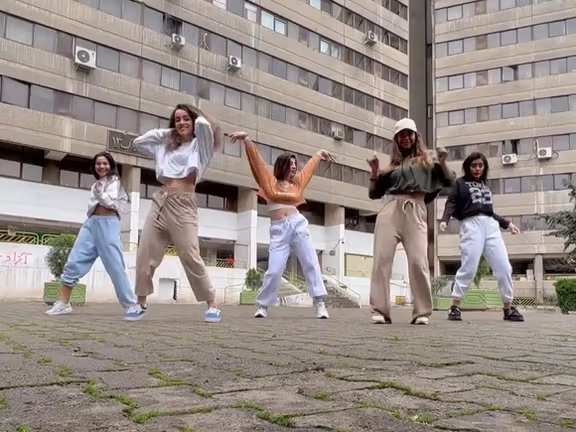
A screengrab of the video of five girls dancing on International Women's Day in the Iranian capital Tehran

The Islamic Republic has always frowned upon dance but recently even a simple choreographed or ‘synchronized movement’ – as the regime calls it – has become an act of protest.

Last week on International Women’s Day, a 40-second video of five young women in loose clothing and without the mandatory headscarf dancing in Tehran’s Ekbatan neighborhood to the song “Calm Down” by Selena Gomez and Nigerian singer Rema went viral, prompting the regime’s security forces to start a hunt for the teen girls. 

The video was published on Instagram by the trainer of the troupe, who was the first victim to be identified and forced to remove the video and deactivate her page. The following day, Shahrak Ekbatan Twitter account, which covers news about the neighborhood, warned that police were looking for the teenagers. The neighborhood has been an epicenter of ongoing protests ignited by the death of Mahsa Amini, the 22-year-old woman who died in September 2022 while in police custody following her arrest for not wearing her headscarf “properly.”

"They looked for CCTV footage of Block 13 [apartment building] to identify the girls who were only dancing and were not involved in any political activity. Police were seen checking the footage and questioning the guards," it said. 

The account later reported that the five girls were initially summoned and received a warning, and later, called in again and detained for two days before being pressured into making a video of forced confessions and expressing remorse.

A shot from the video of forced confessions by teenage girls who had danced in public (March 2023)
100%
A shot from the video of forced confessions by teenage girls who had danced in public

After news of the manhunt for the teenagers broke out, people from Iran and other countries started releasing videos of themselves dancing to the same tune to express solidarity and support for the Iranian girls.

Prominent Iranian human rights defender and currently a political prisoner, Narges Mohammadi, republished the video of the dance on social media on Tuesday, saying women's singing and dancing is a form of feminine presence in the streets. This is a right which should not be suppressed, she noted. Earlier in the week, actor-cum-activist Golshifteh Farahani also published the video of the dance, with the caption, "Nothing can stop the freedom of Iranian women. Nothing can stop the freedom of all human beings."

The simple act of dancing on streets is construed as “defiance” against the Islamic Republic, so are many other simple things in Iran since the regime tends to label anything it deems “critical” or “improper” as a security threat. 

The five teenagers are not the only victims of the Islamic Republic’s opposition to dancing and singing. Islamic laws in Iran forbid dancing, although many people dance during family gatherings in their homes. Even using the word “dance” is forbidden in all media platforms and publications in all sorts in Iran. A state-TV host was banned in 2021 after a guest on her program mentioned the word “dancing.” Several Iranian university professors were sacked late in 2022 over participating in the graduation ceremony of their students because some people danced in the celebrations. And most recently, a court sentenced two bloggers to ten and a half years in prison each for dancing in the streets. They were charged with “encouraging corruption and public prostitution”.

The Academy of Persian Language and Literature, the regulatory body for the Persian language currently led by hardliner politician Gholam-Ali Haddad-Adel, has proposed the word “synchronized movements” as a replacement for “dance” in all the literature published in Iran. Ironically, the regime is also against any synchronized movement by the people as it views any form of popular unity as an existential threat.

However, people in Iran are in sync more than ever to defy the regime. Iranians inside and outside the country keep singing the Grammy Award-winning protest song “Baraye” in their rallies and events. Shervin Hajipour’s revolution song, which is composed of a collection of tweets by Iranians bemoaning the situation in their country and has become the unofficial anthem of the women-led uprising in Iran, opens with “For dancing in the streets.”

In the past six months, many parts of Iran witnessed the largest protests since the 1979 revolution. More than 520 people have been killed.
An artwork created in support of the dancers  (March 2023)
100%
An artwork created in support of the dancers

Most Viewed

US blockade enters murky phase as tankers spoof signals and buyers hesitate
1
ANALYSIS

US blockade enters murky phase as tankers spoof signals and buyers hesitate

2
INSIGHT

Ideology may be fading in Iran, but not in Kashmir's ‘Mini Iran'

3
INSIGHT

Hardliners push Hormuz ‘red line’ as US blockade tests Iran’s leverage

4
VOICES FROM IRAN

Hope and anger in Iran as fragile ceasefire persists

5

US sanctions oil network tied to Iranian tycoon Shamkhani

Banner
Banner

Spotlight

  • Hardliners push Hormuz ‘red line’ as US blockade tests Iran’s leverage
    INSIGHT

    Hardliners push Hormuz ‘red line’ as US blockade tests Iran’s leverage

  • Ideology may be fading in Iran, but not in Kashmir's ‘Mini Iran'
    INSIGHT

    Ideology may be fading in Iran, but not in Kashmir's ‘Mini Iran'

  • War damage amounts to $3,000 per Iranian, with blockade set to add to losses
    INSIGHT

    War damage amounts to $3,000 per Iranian, with blockade set to add to losses

  • Why the $100 billion Hormuz toll revenue is a myth
    ANALYSIS

    Why the $100 billion Hormuz toll revenue is a myth

  • US blockade targets Iran oil boom amid regional disruption
    ANALYSIS

    US blockade targets Iran oil boom amid regional disruption

  • Iran's digital economy battered by prolonged blackout
    INSIGHT

    Iran's digital economy battered by prolonged blackout

•
•
•

More Stories

Iranian Exiled Prince Calls For More Protests On Tuesday

Mar 14, 2023, 12:43 GMT+0

Exiled Prince Reza Pahlavi has called on Iranians to stage anti-regime rallies on the the ancient fire festival Tuesday to show that the protest movement is strong.

In a tweet on Monday, Reza Pahlavi said “the fire lit up in our hearts will never die”, asking people to take to streets to show anger at the clerical rulers once again.

Young activists' groups had called since late February for three nights of protests, including the Charshanbeh Suri fire festival on Tuesday, preceding the Iranian New Year next week.

“In the year that is coming to an end, hundreds of brave Iranians sacrificed their lives for the liberation of Iran. We are obliged to keep up on the path,” he added.

His statements come after young Iranians took to the streets in several cities Monday as the first night of protests. Young people use fire crackers and lit bonfires to mark the festival.

Abbas Ali Mohammadian, the police commander of Tehran has warned that "the police will use the capacity of mosques and public groups" to prevent the celebrations in the streets.

The fire festival is celebrated on the eve of the last Wednesday of the year, just before the New Year (Nowruz), which marks the day of the Spring Equinox. The festival dates to pre-Islamic times and for the same reason, its celebration is considered as a pagan practice by the clerics running the country since the Islamic Revolution in 1979.

Celebration of ancient festivals such as Nowruz and Charshanbeh Suri have persevered despite the many efforts of religious fundamentalists who tried to obliterate and replace them with Islamic feasts.

Iran Witnessed Unprecedented Inflation In Past Nine Months: Statistics

Mar 14, 2023, 11:12 GMT+0

Official figures show there was a sharp increase in food prices in Iran in the past nine months and most items witnessed a more-than 50 price inflation.

The Islamic Republic has been struggling with high inflation since 2019, but the raging inflation in the past Iranian year which ends on March 20, was seriously different from previous years.

Last May the government eliminated an annual food import subsidy of at least $10 billion, that immediately led to steep price increases. This was followed by a fall in the value of the national currency, making imports more expensive for the population.

According to Dideban website, the Raisi administration's refusal to provide cheap dollars for food imports had a serious impact, while the country was already witnessing an annual inflation rate above 40%.

However, the authorities emphasized that part of the galloping inflation was due to the subsidy that was a strain on government subsidies.

The government called its decision to scrap the food subsidy “economic surgery,” but it had no other plans to control prices.

Immediately following the announcement food prices jumped, with some items doubling or tripling in a matter of hours. Pasta is 137 percent more expensive than 12 months ago, while meat prices went up by 76 percent and milk by 80 percent.

Food prices continue to climb as the national currency declined by 50 percent in the past six months. According to the report of Statistical Center of Iran (SCI), in some months, the food and beverages inflation hit 87%.

US Pursues Diplomacy With Iran But Not On Restoring Nuclear Deal

Mar 14, 2023, 09:25 GMT+0
•
Iran International Newsroom

US State Department refused Monday to comment on the possible release of Iran’s frozen funds in exchange for three Americans held by Iran.

The State Department’s outgoing spokesperson Ned Price however, signaled that efforts are underway for their release. He also sounded positive about a deal last week between Iran and Saudi Arabia to restore relations, brokered by China.

There have long been signs that a US agreement to free $7 billion frozen by South Korean banks would be the price to pay for the release of three dual-nationals considered in effect hostages held by Iran. But after Iran’s deadly crackdown on popular protests and its supply of weapons to Russia, the proposition has become politically costly for the Biden administration.

At the same time, Price once again reiterated that restoring the 2015 nuclear deal (JCPOA) with Iran “is not on the agenda.” He said the Biden administration thought it was “on the precipice of it, only for the Iranians to once again prove that their word was unreliable and to pull back what they had agreed to.”

Talks that began in April 2021 reached a deadlock in early September 2022 when Washington blamed Tehran for presenting “extraneous demands.”

“So that’s not on the agenda. What is always going to be on our agenda as a first resort is diplomacy. We continue to believe that diplomacy is the only permanent, durable, verifiable means by which to address Iran’s nuclear program. We’re not giving up our ambitions and our hope on that, even as we’re preparing for all potential contingencies,” Price said.

It is not clear if JCPOA talks are not on the agenda then what is US diplomacy pursuing? In the past months, both Washington and the European powers involved in talks with Tehran have raised the issue of Iranian weapons supplies to Russia and its gross violations of human rights.

It seems that the West is pursuing either a more comprehensive deal beyond the nuclear issue or perhaps piecemeal agreements on specific issues.

An Iranian analyst in Tehran told ILNA news website Tuesday that the US might be pursuing a limited and temporary agreement to address some dangerous aspects of Iran’s nuclear program. Khosrow Shahin said that Washington might also be aiming for partial agreements on various issues, such as the release of prisoners to reduce the final cost of a full nuclear deal.

Some reprieve from oil sanctions could be one of the incentives for a cap on Iran’s uranium enrichment, similar to the 1990s Iraqi ‘oil for food’ UN program, although Iran needs hard currencies to deal with its worsening economic situation. In February NBC News reported that if Iran’s frozen funds are released in exchange for prisoners, limitations on how to spend the money might apply.

Regarding the Chinese brokered agreement between Riyadh and Tehran, Price said the United States supports “dialogue, we support direct diplomacy, we support anything that would serve to de-escalate tensions in the region and potentially help to prevent conflict.”

Price also tried to dismiss suggestions that China can supplant the US role in the region, emphasizing that the Biden administration has accomplished a lot in enhancing cooperation between regional countries.

“So, I think in any way you look at it, America is deeply engaged with the Middle East. We have, I think, demonstrated results in those efforts to leave a region that is more stable, is more integrated, is more prosperous. We have a long way to go…,” Price, who will soon be leaving as spokesman said.

Iran’s Regime Harasses Activists Who Support Call For Referendum

Mar 14, 2023, 03:28 GMT+0
•
Iran International Newsroom

Jailed reformist activist Mostafa Tajzadeh says his cell was raided by prison guards because he is supporting a referendum to change the constitution in Iran. 

In an open letter from prison addressed to Supreme Leader Ali Khamenei, Tajzadeh said that his cell, which he shares with two other political prisoners – Saeed Madani and Hossein Razzagh -- was attacked because all three expressed support for the proposal by opposition figure Mir-Hossein Mousavi for the referendum. Tajzadeh, a former deputy minister, protested that during “the unusual and long search” security forces confiscated some of his and Madani's personal notes. 

Tajzadeh and his cellmates, as well as a few other political prisoners, including Faezeh Hashemi, the daughter of Iran former president Akbar Hashemi Rafsanjani, issued a statement in February, saying, "they will do their best to advance this proposal and a peaceful and non-violent transition to a completely democratic and developed Iranian structure." “The only way out of the impasse for the government is to surrender to the right of the people to determine their own destiny,” read the statement.

In his letter to Khamenei, Tajzadeh said, "You repeatedly claim that your opponents have the right to criticize you,” but "I have been sentenced to a total of 15 years in prison in two cases for criticizing your performance.” "Why are you so afraid of a referendum”, he asked Khamenei, underlining that confiscation of personal notes is a clear violation of laws and regulations of the country’s Prisons Organization.

Mousavi and his wife Zahra Rahnavard casting their votes in June 2009
100%
Mousavi and his wife Zahra Rahnavard casting their votes in June 2009

In a statement early in February, Mousavi, a presidential candidate in 2009 who became an opposition figure and was put under house arrest, said Iran needs “fundamental change” based on “Woman, Life, Freedom” and a referendum on the constitution. Since he published the statement, his house arrest has become stricter. Mousavi was put under house arrest in 2011 because he challenged the highly suspicious presidential re-election of Mahmoud Ahmadinejad in 2009.

Referring to government violence against protesters, Mousavi said the rulers of the Islamic Republic are not willing “to take the smallest step to meet the demands of the people.”

Mousavi implicitly repeated what exiled Prince Reza Pahlavi and other opposition figures have been demanding since last September, when the ‘Women, Life, Freedom movement’ started following the death in custody of 22-year-old Mahsa Amini – transition from the Islamic Republic. Pahlavi has acknowledged Mousavi’s call for a referendum

Iranians have been hotly debating the need to form an opposition council to manage the protest movement and plan for transition to a new form of government. After months of unorganized opposition to the regime concurrent with protests and strikes, prominent activists abroad united and established a framework of coordination. Inside the country no such move is possible because of repression. The group, which calls itself the Alliance for Democracy and Freedom in Iran, announced its existence in February.

Alliance for Democracy and Freedom in Iran-Masih Alinejad-Nazanin Boniadi-Shirin Ebadi-Hamed Esmaeilion-Abdulla Mohtadi-Reza Pahlavi (file)
100%

Earlier in March, they issued a Charter of Solidarity and Alliance for Freedom, also called the Mahsa Charter. 

Exiled Prince Reza Pahlavi, Nobel peace prize laureate Shirin Ebadi and Canada-based activist Hamed Esmaeilion, as well as US-based author, journalist and women’s rights activist Masih Alinejad, actress and activist Nazanin Boniadi and Secretary General of Komala Iranian Kurdish party Abdullah Mohtadi say the charter would lay the foundations for realizing the aspirations of protesters in Iran and gain international support for isolating the Islamic Republic.

The charter has been met with admiration and support as well as antipathy and criticism. Some people have denounced the charter saying it is not patriotic enough. However, the prominent opposition figures have called on people to put differences aside, saying that the charter is only a framework and a starting point for cooperation.

Nighttime Protests Resume In Iran As New Year Approaches

Mar 13, 2023, 21:29 GMT+0
•
Maryam Sinaiee

Young Iranians took to the streets in several cities Monday after a call for three nights of protests, including the celebration of the ancient fire festival Tuesday.

Videos posted on social media show small groups of youth marching and chanting anti-government slogans in some neighborhoods of the capital Tehran, Mashhad, Qazvin, and Malayer. A few videos show burning trash bins and car tires on the streets and youth throwing firebombs at government buildings and banks.

Youth groups had called since late February for three nights of protests, including the Charshanbeh Souri fire festival on Tuesday. In its social media posts, the United Youth of Iran, an alliance of various “neighborhood youth” groups from around the country fighting to overthrow the regime, urged everyone to form “neighborhood-centered” groups and take to the streets to protest.

The group vowed in a statement to turn the fire festival into a “symbol” of battling the “suppressive and criminal regime” and “the reactionary Islamic culture” that “has eliminated or harshly suppressed individuals for their different beliefs for many years.”

Protesters in Malayer in Hamedan Province chanting “Death to the Dictator” and “Death to Khamenei”

The fire festival is celebrated on the eve of the last Wednesday of the year, just before the New Year (Nowruz), which marks the day of the Spring Equinox. The festival dates to pre-Islamic times and for the same reason, its celebration is considered as a pagan practice by the clerics running the country since the Islamic Revolution in 1979.

Celebration of ancient festivals such as Nowruz and Charshanbeh Souri have persevered despite the many efforts of religious fundamentalists who tried to obliterate and replace them with Islamic feasts.

An artwork created in support of protests in the last week of the Iranian year (Charshanbeh Souri) showing a police car on fire  (March 2023)
100%
An artwork created in support of protests in the last week of the Iranian year showing a police car on fire

Nowruz is still the most important calendar event of the year and celebrated as always, but Charshanbeh Souri has taken a quite different character. Authorities resorted to harsh measures to suppress its celebration in the streets, often bringing out the police, Basij militia, and vigilante groups who clashed with the youth and even arrested them for lighting bonfires.

Protesters in west Tehran chanting a slogan against Supreme Leader Ali Khamenei

Ancient Iranians lit fires on their rooftops during the last five days of the year to help the spirits of the dead to find their way and reunite with their families.

In more recent times, people made several small brushwood fires in their courtyards or outside the house and jumped over the flames chanting, “Take away my sickly pallor and give me your red glow! ” Firecrackers were also popular with the children and youth.

Jumping over fire was followed by a host of traditions including lighting candles, singing, dancing, poetry recitation, going door to door and banging on bowls with spoons to get treats, and sharing food.

Small firebomb thrown at a university campus entrance in west Tehran for housing security forces and providing them with a place for keeping detainees in previous protests as “warning”.

Over the years, massive bonfires and small homemade bombs have largely taken the place of brushwood fires and firecrackers. Streets often turn into battlegrounds between the dancing and merrymaking youth and the police on the last Tuesday of the year.

In a statement Tuesday, the ministry of intelligence said it had arrested members of terrorist teams” across the country including twenty-one members of a group linked with the Mujahedin-e Khalq Organization (MEK) in Tehran and confiscated a variety of explosives from them.

Those arrested were planning to set fire to public property such as buses, the ministry claimed and vowed to take decisive action against “terrorists” who, it said, aim to harm people and “cast the blame for their criminal actions on the security forces.”