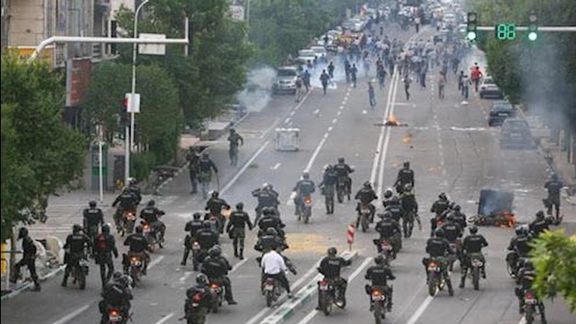
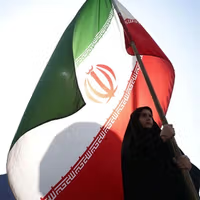
Riot police against protesters in Tehran during 2019 protests
Iran's strategic gasoline reserves have dropped to five-days’ supply, forcing the government to consider a new fuel management plan and precautions to prevent possible unrest.
Iran International has acquired a classified document outlining the proceedings of a meeting of various government officials from different departments at the presidential office in late February according to which strategic fuel reserves have dropped to a dangerously low level, forcing major repairs at refineries to be delayed to allow maximum production for the time being.
The document sent to the president and a host of other officials including the chief justice and parliament speaker, as well as heads of the military and law enforcement forces refers to the imbalance in gasoline production-usage levels as a “serious issue”.
Participants in the meeting decided that the oil ministry, which is apparently drawing up the new plan, should offer assurances to the public that it will help maintain the supply of fuel at normal levels. The meeting decided to advise officials to avoid any public remarks or suggestions that could be interpreted as an intention to raise current fuel prices.
Riot police against protesters in Tehran during 2019 protests
Details of the new fuel usage management plan have not been mentioned in the document.
There have been several reports in recent months that Iran’s refineries face technical problems and they operate below normal levels. Lack of foreign currency, US sanctions and insufficient natural gas supplies are all reasons impeding full operational capacity.
The report also includes several suggested measures, including controlling domestic media reporting on the issue and containing the consequences of enforcing the plan amid the many economic troubles that Iranians are currently facing.
In November 2019, the announcement of the government’s decision to increase fuel prices by 50–200 percent triggered a cycle of protests and unrest across the country that lasted for over two weeks. During this time, angry protesters torched hundreds of gas stations, banks, and government buildings.
Gas station torched by protesters in Eslamshahr to the south of the capital Tehran, November 2019.
Security forces heavy-handedly suppressed the protests amid a week-long internet shutdown. The crackdown was the most violent since the Islamic Revolution of 1979. The month of Aban in the Iranian calendar during which the protests occurred is now often referred to as “Bloody Aban”.
Thousands including journalists were arrested. The government never officially reported the death toll but as many as 1500 were killed according to unofficial reports.
Daily gasoline consumption has risen to 104 million liters from 82m liters before the pandemic, the report says, adding that usage is expected to rise to between 120m and 130m during the New Year holidays (late March and early April).
While the representative of the Central Bank of Iran in the meeting attributed the increased fuel use to smuggling to neighboring countries, a representative of the Economic Security Police blamed high fuel use of domestically produced vehicles and recommended an increase in production.
The meeting focused on the fuel supply issue but some other economic topics such as controlling the foreign exchange market were also discussed. According to the report, the meeting tasked security and judiciary bodies with controlling the media coverage of these issues.
Iraqi Prime Minister Mohammed Shia al-Sudani looks on as Iraq's National Security Adviser Qasim al-Araji and Iran's Supreme National Security Council secretary Ali Shamkhani sign the security agreement that includes coordination in protecting the common borders between the two countries, in Baghdad, Iraq, March 19, 2023.
Iran’s top security official signed an agreement with his Iraqi counterpart Sunday in a deal aimed at curbing activities of Kurdish militants.
The secretary of Iran’s Supreme National Security Council (SNSC) Ali Shamkhani and his Iraqi counterpart, Qassim al-Araji inked the joint security cooperation document during a ceremony also attended by Prime Minister Mohammed Shia' Al Sudani in Baghdad.
A statement from the Iraqi prime minister's office said that the joint security agreement includes coordination in "protecting the common borders between the two countries and consolidating cooperation in several security fields."
A spokesperson said, "Under the signed security deal, Iraq pledges it will not allow armed groups to use its territory in the Iraqi Kurdish region to launch any border-crossing attacks on neighbor Iran."
Iraqi Prime Minister Mohammed Shia al-Sudani meets with Iran's Supreme National Security Council secretary Ali Shamkhani, in Baghdad, Iraq, March 19, 2023.
The frontier came into renewed focus last year when Iran's Revolutionary Guards launched missile and drone attacks against Iranian Kurdish groups based in northern Iraq, accusing them of fomenting protests that were sparked by the death of an Iranian Kurdish woman, Mahsa Amini, while she was being held in morality police custody.
Nour News, a media outlet close to the SNSC, said earlier in the day that the deal would facilitate efforts to deal with problematic Kurdish groups that coordinate measures against the Islamic Republic along with Israeli agents and armed insurgents.
The Islamic Republic calls Iranian Kurdish armed groups sheltering in Iraq, "terrorist groups" but these groups say that the goal of their armed campaign is "defending the rights of the Kurds".
Generally, the Kurdish parties − including Komala and the Kurdistan Democratic Party of Iran (KDPI) − favor Kurdish autonomy within a federal Iran. Pejak (the Free Life Party of Kurdistan), an affiliate of the Kurdistan Workers’ Party, or PKK, formed in Turkey but also based in northern Iraq, has generally favored a unified, independent Kurdistan uniting Kurds in Syria, Iraq, Turkey, and Iran.
Shamkhani is also scheduled to hold talks with Masrour Barzani, the Prime Minister of the Iraqi Kurdistan Region, on the issue of border security.
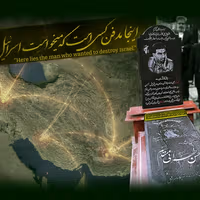
Shamkhani and the Iranian delegation also paid a visit to the site where IRGC’s Quds (Qods) force commander Qassem Soleimani and Abu Mahdi al-Muhandis, the second-in-command of Iraq’s Popular Mobilization Units, were killed by a US drone attack three years ago.
Iran claims that US interference in the region has been creating regional unrest, its sanctions driving a domestic crisis. Shamkhani said this "can no longer be tolerated".
During the meeting with his counterpart, Shamkhani acknowledge the role played by the Iraqi negotiating team which, along with Oman and China, brokered a détente between Tehran and Riyadh.
Shamkhani's trip to Baghdad follows his landmark trips to China and the United Arab Emirates earlier this month as part of the Islamic Republic’s renewed zeal to revive ties with regional neighbors and deepen relations with its global allies, indicating that Supreme Leader Ali Khamenei is relying more on his representative for high-profile missions than the country’s Foreign Minister Hossein Amir-Abdollahian. The Secretary of the Supreme National Security Council is nominally appointed by the president, but he also serves as Khamenei’s representative in the Council.
Iraq's National Security Adviser Qasim al-Araji looks on as Iraqi Prime Minister Mohammed Shia al-Sudani greets Iran's Supreme National Security Council secretary Ali Shamkhani during a signing of the security agreement that includes coordination in protecting the common borders between the two countries, in Baghdad, Iraq, March 19, 2023.
Khamenei’s decision to send Shamkhani to Beijing showed that in serious matters he needs a more qualified official than hardliners populating the current presidential administration. In fact, Rouydad24, a reformist news website in Tehran pointed out Saturday that hardliners have been trying to tarnish Shamkhani’s image, by leaking information that one of his former aides, Alireza Akbari, was executed in January for espionage. Rumors also circulated in February and March that he was about to be dismissed following the news about his aide. As a close ally of former President Hassan Rouhani, hardliners would like to see an ultra-conservative take over the key role which critics say he retained due to his being a member of Khameini's trusted circle.
Although the 83-year old dictator made sure ultra-conservatives loyal to him take the absolute majority in parliament and the presidency in 2020 and 2021 respectively, he knows there are few qualified people among them, and at least in the realm of key foreign policy issues he makes sure his direct representatives are more balanced and experienced officials. This also brings up the question of why he entrusted the nuclear negotiations to people more associated with the ultra-conservatives.
In a move to assert his role, Amir-Abdollahian said on Sunday he will soon meet his Saudi counterpart Faisal bin Farhan Al Saud as negotiations to reopen embassies and consulates in the two countries, continue.
Bank Markazi Tower, the headquarters of the Central Bank of Iran, in the capital Tehran
Iran's central bank claims that recent agreements with Saudi Arabia and the United Arab Emirates are already reaping financial rewards for the cash-strapped economy.
In a statement released Sunday, the Central Bank of Iran (CBI) said the growth in foreign currency availability made it possible to exchange about 630 million [UAE] dirhams, a huge boost to the country in the midst of a biting recession.
In a statement released at the weekend, the CBI said, “Tehran’s success in foreign policy and prioritizing relations with its neighbors, including the agreements with Arab countries, especially Riyadh and Abu Dhabi, has resulted in the foreign currency availability.
Renewed ties with Saudi Arabia and the UAE brokered this month, in addition to deals with other Persian Gulf Arab countries, have boosted interbank communication and produced tangible results that will complement the foreign exchange policies of the central bank.
The claims by the CBI come in the midst of a situation in which the rial lost further value against the US dollar on Sunday, reaching 500,000, raising doubts from skeptics that its claims of diplomatic and economic success may well be an attempt to simply prop up the rial.
Iran’s exiled queen has expressed hope that Iran will be free in the coming year in a message on the occasion of Iranian new year, Nowruz.
Farah Pahlavi expressed sympathy with the families of the dead protesters, prisoners and people under pressure in Iran, saying that the essence of Nowruz heralds the victory of truth over lies.
"Nowruz, which always brings joy and hope, will be celebrated this year in a situation in which our nation is mourning its lost ones," she said.
The exiled queen further noted that hundreds of young men and women died with the slogan ‘Women, Life, Freedom’ in confrontation with brutality and darkness, but “their names and memories will be eternal in the history of Iran”.
She further underlined that “my thoughts are with the bereaved mothers and fathers, thousands of Iranians who are imprisoned, and teenagers who have been poisoned in Iranian schools”.
Elsewhere in her remarks, Pahlavi expressed concern over the situation of millions of Iranians who are struggling to earn a living and are victims of the brutality and incompetence of the regime.
She also congratulated the arrival of the ancient Iranian tradition Nowruz which is a “sign of stability, continuity and national identity.”
Iran has been witnessing nationwide protests within the past six months, during which time, regime agents have killed over 500 people so far and executed several who were arrested during demonstrations. Thousands more have been arrested arbitrarily.
Iranian employers have threatened mass layoffs if the minimum wage is increased beyond their expectation.
The decision is expected to be made this week, with contract workers most vulnerable.
A 15-hour session of the Supreme Labor Council, the body responsible for determining the minimum wage, ended without reaching a final agreement Saturday, leaving millions of workers in doubt of their future.
The government has already decided to give its employees both in the administrative bureaucracy and its business enterprises a mere 20-percent raise when annual inflation tops 50 percent.
The government’s administrative bureaucracy, including education but not the armed forces employs around 2.5 million people.
Workers say due to the high cost of living and economic problems, they cannot agree with the government’s current proposals, which barely allow them to survive.
The minimum needed for an average family is around $310 to $390 a month. Even if the government manages to double the current minimum salary of around $100, it will fall way short of the amount needed.
Labor representatives insist that next year’s minimum wage in the non-governmental sector should be on par with the inflation of over 50 percent, but government representatives are of the idea that salaries should increase at about the same rate of public-sector employees.
There are no reliable figures about the unemployment rate in Iran because the government is known to manipulate economic data for political reasons. The labor ministry, for example considers one hour of work per week as employment, but experts believe well over 20 percent are unemployed and many more have unstable employment.
Ali Shamkhani, the secretary of Iran's Supreme National Security Council (SNSC)
The secretary of Iran's Supreme National Security Council (SNSC) will sign a deal on border security with Iraq.
Ali Shamkhani traveled to Baghdad on Sunday as head of a delegation including the governor of the central bank and the assistant foreign minister for the Persian Gulf countries.
The trip is part of Iran’s renewed zeal to revive ties with regional neighbors and deepen relations with its global allies.
Shamkhani has visited China and the UAE in the last eight days, much needed in the face of a collapsing economy and growing political isolation on the world stage.
According to IRNA, the Iranian state news agency, the Secretary of SNSC will hold negotiations with Masrour Barzani, the Prime Minister of the Kurdistan Region, and Qassim al-Araji, the Iraqi National Security Advisor on the issue of border security.
Shamkhani signed a pact with the Saudis earlier this month to resume bilateral political ties with the mediation of China.
Shamkhani also visited Abu Dhabi and Dubai last week, meeting senior officials of the United Arab Emirates.
Iraq has played an important role in the recent negotiations between Tehran and Riyadh.
Face-to-face negotiations between delegations from Iran and Saudi Arabia, with the mediation of Iraq, began in Baghdad in 2021, and Oman also played a role in the talks.