• العربية
  • فارسی
Brand
  • Iran Insight
  • Politics
  • Economy
  • Analysis
  • Special Report
  • Opinion
  • Podcast
  • Iran Insight
  • Politics
  • Economy
  • Analysis
  • Special Report
  • Opinion
  • Podcast
  • Theme
  • Language
    • العربية
    • فارسی
  • Iran Insight
  • Politics
  • Economy
  • Analysis
  • Special Report
  • Opinion
  • Podcast
All rights reserved for Volant Media UK Limited
volant media logo

Top US General's Remark About Iran Nuclear Weapon Raises Eyebrows
Iran International Newsroom
Mar 24, 2023, 17:53 GMT+0Updated: 17:37 GMT+1
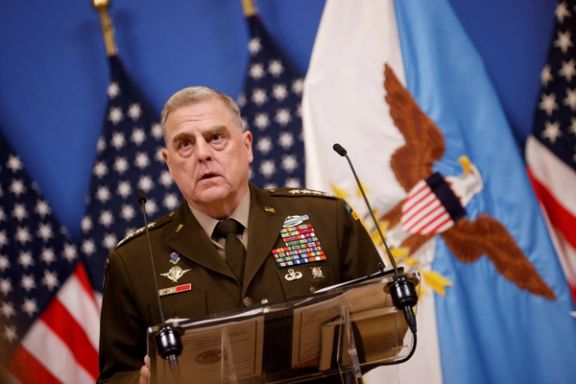
Gen. Mark Milley, Chairman of the US Joint Staff, February 14, 2023

A statement by Gen. Mark Milley, Chairman of the US Joint Staff, about Iran’s development of nuclear weapons has raised eyebrows of experts and observers.

During a Congressional testimony on Thursday, warning about the dangers Iran poses Gen. Milley said, “The United States remains committed as a matter of policy that Iran will not have a fielded nuclear weapon.”

The term “fielded” has led to questions about what the Biden administration’s policy exactly is regarding Iran becoming a nuclear power. Previously, President Joe Biden and all top officials had repeatedly said that US policy is not to allow the Islamic Republic to acquire a nuclear weapon, threatening that all options are on the table.

Now, with the Pentagon chief saying that the US would not allow a “fielded” nuclear weapon, some ask if the administration would allow Iran to build a bomb but not “field” it, which in essence is a vague concept.

Being a nuclear threshold state is a familiar concept, meaning that a country has the fissile material and the knowhow to build a nuclear bomb but has not decided to do so, but once a bomb is produced, it is not clear what the difference is between a bomb in the basement and one “fielded.”

Former senior US diplomat and Middle East expert Dennis Ross tweeted that “Did General Milley misspeak or is US policy now to respond only if Iran deploys a nuclear weapon or in the General’s words has a “fielded nuclear weapon.” That implies that Iran can develop a bomb but we would respond only if they deployed it. If true, Iran will develop a bomb.”

Milley also said during his testimony that Iran can have enough fissile material for a bomb in two weeks and it would need just a few months to build a bomb. The timeline he mentioned about fissile material was in line with what Under Secretary of Defense for Policy Colin Kahl said last month, but the estimate of just a few months needed to build a bomb was more alarming than previous US predictions.

Gabriel Noronha, a former Trump administration official tweeted, “It implies that Iran has started to conduct weaponization activities, something US intelligence officials have not publicly stated before this point - even as recently as a couple weeks ago.”

Milley also said, “We, the United States military, have developed multiple options for our national leadership to consider if or when Iran ever decides to develop an actual nuclear weapon.”

This last comment seems to be different from the earlier one and more in line with declared administration policy. As Ross said in his tweet, did Gen. Milley misspeak?

The administration will be most probably asked about this, but the Islamic Republic will surely take notice of the general's remark about a "fielded" nuclear weapon, even if later it is explained away.

So far, government media in Iran have not mentioned Milley’s statement, but it could simply be that the country is in the midst of Nowruz holidays.

The Biden administration has adopted a tougher tone toward the Iranian regime since September when nuclear negotiations reached a deadlock and antigovernment protests in Iran changed the agenda. In addition, the US and its allies are outraged by Iran’s delivery of killer drones to Russia.
Iran-linked forces conducted two attacks on US forces in Syria on Thursday and Friday, and some observers noted that such attacks in Iraq and Syria have noticeably increased since the Biden administration came to office and began nuclear talks with Iran.

Most Viewed

US blockade enters murky phase as tankers spoof signals and buyers hesitate
1
ANALYSIS

US blockade enters murky phase as tankers spoof signals and buyers hesitate

2
INSIGHT

Ideology may be fading in Iran, but not in Kashmir's ‘Mini Iran'

3
INSIGHT

Hardliners push Hormuz ‘red line’ as US blockade tests Iran’s leverage

4
VOICES FROM IRAN

Hope and anger in Iran as fragile ceasefire persists

5

US sanctions oil network tied to Iranian tycoon Shamkhani

Banner
Banner

Spotlight

  • Hardliners push Hormuz ‘red line’ as US blockade tests Iran’s leverage
    INSIGHT

    Hardliners push Hormuz ‘red line’ as US blockade tests Iran’s leverage

  • Ideology may be fading in Iran, but not in Kashmir's ‘Mini Iran'
    INSIGHT

    Ideology may be fading in Iran, but not in Kashmir's ‘Mini Iran'

  • War damage amounts to $3,000 per Iranian, with blockade set to add to losses
    INSIGHT

    War damage amounts to $3,000 per Iranian, with blockade set to add to losses

  • Why the $100 billion Hormuz toll revenue is a myth
    ANALYSIS

    Why the $100 billion Hormuz toll revenue is a myth

  • US blockade targets Iran oil boom amid regional disruption
    ANALYSIS

    US blockade targets Iran oil boom amid regional disruption

  • Iran's digital economy battered by prolonged blackout
    INSIGHT

    Iran's digital economy battered by prolonged blackout

•
•
•

More Stories

Large Crowd In Brussels Renews Call On EU To Designate IRGC

Mar 23, 2023, 23:17 GMT+0
•
Iran International Newsroom

A large crowd of Iranian expatriates held a big rally in Brussels to once again urge the EU countries to designate Iran’s Revolutionary Guard as a terrorist organization.

The Belgian capital hosted the European foreign ministers at the Council of Europe on Thursday, a good opportunity for Iranian activists who want European countries to designate the IRGC as a first step, followed by the expulsion of the Islamic Republic’s envoys, towards the fall of the regime. 

Several European politicians, including Danial Ilkhanipour and Alireza Akhondi, were among the speakers of the events that were held during the demonstrations. 

Ilkhanipour, a German-Iranian member of the Hamburg city parliament, told the crowd that in the past few months, Iranians have shown they can achieve what they want if they unite, referring to several rounds of sanctions by EU and a resolution by the European Parliament asking the EU to list the IRGC as a terrorist entity for its role in the repression of popular protests and the supply of drones to Russia.

The poster for the gathering of Iranians in Brussels
100%
The poster for the gathering of Iranians in Brussels

Akhondi, a Swedish-Iranian member of the Swedish Parliament, said that “The Islamic Republic has killed people in Europe and kidnapped people such as Iranian-German national Jamshid Sharmahd,” who faces a death sentence in Iran on charge of "corruption on earth". Sharmahd, who is also a US resident, is held by Tehran for allegedly heading a pro-monarchist group accused of a deadly 2008 bombing and planning other attacks in the country. Akhondi claimed that a large number of agents of the Islamic Republic are here in Brussels. 

Vahid Beheshti, the British-Iranian activist who is on hunger strike outside the UK Foreign Office for the same cause, also sent a video message to the gathering, telling the European foreign ministers that as Lebanon’s Hezbollah is blacklisted as a terror group, Iran’s Guards should also be designated.

Most of the speakers of the event asked EU members how they can ignore such a large amount of evidence on human rights violations and terrorist acts perpetrated by the IRGC. 

Earlier in the day, the block's foreign policy chief Josep Borrell tweeted that “Ukraine has been attacked again by Russia with Iranian drones, targeting educational facilities and a missile attack on a residential building in Zaporizhzhia. Just when Putin expressed need for peaceful settlement to President Xi, Russian again commits war crimes.”

EU foreign policy chief Josep Borrell (L) with Iran's Foreign Minister Amir-Abdollahian in Tehran in June 2022
100%
EU foreign policy chief Josep Borrell (L) with Iran's Foreign Minister Amir-Abdollahian in Tehran in June 2022

In January, Borrell said that the European Union cannot list the IRGC as a terrorist entity until an European court has determined that they are, noting "Ministers adopted a new package of sanctions against Iran, targeting those driving the repression.” “The EU strongly condemns the brutal and disproportionate use of force by the Iranian authorities against peaceful protesters," he said but no action was taken to designate the IRGC. 

The IRGC was set up shortly after the 1979 Islamic Revolution to protect the Shiite clerical ruling establishment and provide a counterweight to the regular armed forces. It has an estimated 125,000-strong military with army, navy and air units. It also commands the Basij religious militia, a volunteer paramilitary force loyal to the clerical establishment which is often used to crack down on anti-government protests.

There have been numerous Iranian terror acts in Europe, where courts have indicted top officials. In addition, IRGC’s record in organizing attacks elsewhere are well-documented. Critics say that Borrell and many of the European diplomats are focused on re-starting nuclear talks with Iran after the previous long round of negotiations in 2021-2022 ended last September without success.

The current round of antiregime protests engulfed the country in September when 22-year-old Kurdish Iranian woman Mahsa Amini was on a trip to capital Tehran where she was beaten to death by the ‘morality police’ for “improper hijab.” 

Israeli Premier Due In London To Push For United Front Against Iran

Mar 23, 2023, 18:10 GMT+0
•
Iran International Newsroom

Israeli Prime Minister Benjamin Netanyahu is due in London to discuss solutions to Iran’s continued nuclear armament.

The Israeli premier, scheduled to meet with British Prime Minister Rishi Sunak and Home Secretary Suella Braverman on Friday, is slated to depart on Thursday evening.

According to a statement from Netanyahu’s office, his meetings in London will focus on the need to formulate a “united international front” against Iran in order to stop its nuclear program.

The leaders will also discuss strengthening strategic ties between Israel and the United Kingdom, including increasing security and intelligence cooperation and the war in Ukraine as well as broad developments in the Middle East.

Earlier in the week, Israeli Foreign Minister Eli Cohen was in London to press Jerusalem’s position about the Islamic Republic’s threat and bolster bilateral economic ties.

The Israeli diplomat signed an agreement called the 2030 Roadmap for UK-Israeli Bilateral Relations, which according to the British Foreign Office “contains detailed commitments for deepening cooperation across the breadth of the Israel-UK relationship, including on trade, cyber, science and tech, research and development, security, health, etc.”

Demonstrators face members of the security forces during the "Day of Shutdown", as Israeli Prime Minister Benjamin Netanyahu's nationalist coalition government presses on with its judicial overhaul, in Tel Aviv, Israel March 23, 2023.
100%
Demonstrators face members of the security forces during the "Day of Shutdown", as Israeli Prime Minister Benjamin Netanyahu's nationalist coalition government presses on with its judicial overhaul, in Tel Aviv, Israel March 23, 2023.

Netanyahu’s trip to London comes on the heels of his visit last week to Berlin, where he met with German Chancellor Olaf Scholz, and other senior German officials. As he stood with Scholz at the Holocaust memorial Platform 17 in Berlin, Netanyahu appeared to compare Iran with the Nazis.

Seemingly alluding to the Islamic Republic rhetoric which calls for the end of the ‘Zionist regime’, he said: “The calls to destroy the Jewish people have not ended. The main lesson we have learned is that when we are faced with such evil, we must stop the evil plans early to prevent a disaster."

A senior Israeli official, who spoke to Iran International on condition of anonymity, said Netanyahu's recent visits to Europe aim to convey a strong message that Israel would act alone against Iran and would do whatever it deems necessary against the Islamic Republic’s nuclear program.

“Recent trips to some European countries and meetings with the leaders of these countries are both a message for Europe and a direct message for the Iranian government," the source said, noting that Tehran has "received" this message.

Earlier in the month, Netanyahu met with Italian premier Giorgia Meloni when both called for bolstering bilateral ties. His meeting with Meloni came just after Iran and Saudi Arabia announced a resumption of diplomatic ties, a development that Netanyahu was widely criticized at home for failing to prevent.

On Wednesday, a senior Israeli diplomatic official told Axios that the Israeli government sees the recent agreement between Saudi Arabia and Iran not as a threat, but as an opportunity for Israel’s efforts to normalize relations with the Saudi kingdom.

The official who is directly involved in the efforts said that the war in Yemen has been a major "irritant" in US-Saudi relations in recent years, hampering efforts for Israel-Saudi normalization steps. ”The more relations between the US and Saudi Arabia improve, the easier it will be to work on promoting normalization between Saudi Arabia and Israel,” the official said.

On Wednesday, Israel warned the Biden administration and several European countries that Tehran would be entering dangerous territory that could trigger an Israeli military strike if it enriches uranium above the 60-percent level.

According to an International Atomic Energy Agency report from late February, Iran has amassed 87.5 kilograms of 60% enriched uranium. Experts say if uranium is enriched to 90% weapons grade, it would be a sufficient quantity to produce at least one nuclear bomb. 

Netanyahu has time and again threatened military action against the Islamic Republic’s nuclear program as it enriches uranium closer to weapons-grade levels.

On March 9, Netanyahu told Iran International that Tehran is “dangerously moving forward” in its nuclear program, claiming that he returned to the government primarily to make sure that Iran cannot become a nuclear “threshold power”.

The PM’s whirlwind of foreign trips is seen by some as a distraction from the civil uprising happening at home as Israelis protest against proposed legal reforms which would make Netanyahu largely unaccountable. It would also give him a clear way out of criminal charges he faces, though he denies all counts.

The exact time and location of his departure is not yet known even to reporters who will be accompanying Netanyahu during the diplomatic visit to London because protesters have vowed to gather at the site and prevent him from boarding the plane.


Biden Administration Showing 'Weakness On Iran': US Senator

Mar 23, 2023, 12:27 GMT+0
•
Iran International Newsroom

Pressure is mounting on the Biden administration to take harsher action on Iran as senators claim Iran’s oil wealth is helping fund Russia’s war on Ukraine.

At a review of the 2024 State Department Budget Request on Wednesday, Republican Senator Ted Cruz called the Biden administration “weak”, claiming its weakness on Iran is indirectly supporting Russia’s war efforts, in addition to boosting its nuclear capacity.

In a scathing attack, Cruz told Secretary of State Antony Blinken a walking back of the previous administration’s oil sanctions on Iran has led to empowering the regime's nuclear program and helped it support Russia’s military capacity through drone sales.

“I'm deeply concerned, however, that no matter how much you may want to help Ukraine there is something the Biden administration wants more, which is to re-enter a nuclear agreement with Iran,” he said.

“This administration has shown weakness on Iran since day one, and continues to do so. Just in the last few weeks there have been reports that you again waived congressional sanctions to allow Iraq to move money to the Central Bank of Iran, which the Ayatollah uses for terrorism, for ballistic missile development, and nuclear weapons work.”

The outspoken Senator went on to discuss the oil revenues which Iran is capitalizing on in addition to claiming that Russia’s use of Iranian oil tankers violates US energy sanctions.

“You've allowed that ghost fleet to grow dramatically,” Cruz said, claiming the number of tankers Iran was using at the start of the administration has risen from 70 to 300.

“The administration [has] allowed Iran to restore its energy exports, getting above one million barrels a day, which is funding the regime and funding the war on Ukraine.”

Last month was the highest oil exports Iran has had since 2018, not only great news for a beleaguered Iranian economy, but a boost to Russia which is now using an enormous Iranian fleet to bypass international sanctions.

Iranian oil exports started hitting new highs in the last two months of 2022 despite US sanctions, with higher shipments to China and Venezuela, countries bypassing international sanctions.

Tehran's oil exports were limited under former President Donald Trump when in 2018 he exited a 2015 nuclear accord and reimposed sanctions aimed at curbing oil exports and the associated revenue to Iran's government.

However, exports have risen during the term of his successor President Joe Biden, who had sought to revive the nuclear deal, and hit the highest since 2019 on some estimates. This comes despite headwinds such as a stall in those talks and competition from discounted Russian crude.

Sen. Bob Menendez speaking on Iran's nuclear program in the US Senate in February 2022
100%
Sen. Bob Menendez speaking on Iran's nuclear program in the US Senate in February 2022

Energy consultant SVB International said Iran's crude exports in December averaged 1.137 million barrels per day, up 42,000 bpd from November and the highest 2022 figure SVB has reported based on estimates given earlier.

Blinken sheepishly defended the administration’s position, standing by the desire to return to the nuclear deal, known as JCPOA, talks which broke down last year after Iranian intransigence.

He said the US is “actively and aggressively working to break up” the alliance between Russia and Iran, claiming there are moves underway to reimpose the oil sanctions. Though the administration has imposed sanctions across Iran’s UAV network, which it is supplying to Russia for its invasion on Ukraine, a position the regime firmly denies, it is no nearer quelling the million barrels of oil Iran is selling which in turn, funds its global network of terror.

“We’re working every day to enforce the existing sanctions on Iran even as we're looking at imposing new ones,” said Blinken, though Cruz refuted the claims, accusing him of it being a simple political decision not to enforce the oil sanctions.

Russia’s support for Iran’s nuclear program was also a major point of contention, Cruz citing President Vladimir Zolensky’s claims that Russia is compensating Iran for weapons through nuclear cooperation. “Under this administration, you have allowed Iran to get to the brink of a nuclear weapon,” Cruz blasted, while Blinken blamed the failure of nuclear talks on Iran’s pulling out.

Senator Bob Menendez (D-NJ), Chair of the Senate Foreign Relations Committee, signaled the exasperation felt among Republicans and some Democrats at the lack of action from the Democrat administration to curb Iran’s growth. Rather than calling on a return to the JCPOA, the sentiment is that the moment has long passed.

“The Europeans have not joined us in multilateralizing our sanctions which at this time to Iran would have a huge consequence,” Menendez said. “It's time to come to the conclusion that we want Iran to move in a different course, so others have to join us as well.”

His sentiments were echoed by Senator James E. Risch, who, with Menendez, recently met with the International Atomic Energy Agency to discuss the matter of Iran.

Concurring, Risch added: “We need to encourage our European allies to join us in what we're trying to do as far as Iran is concerned.”

Saudi, Iranian Foreign Ministers To Meet Over Re-opening Embassies

Mar 23, 2023, 07:45 GMT+0

Iran’s and Saudi Arabia’s foreign ministers have agreed to meet soon to discuss the reopening of embassies under a deal earlier this month to restore ties.

Diplomatic relations were severed in January 2016 after pro-regime mobs attacked the Saudi embassy in Tehran following the execution of a Shiite cleric in Saudi Arabia. Years of hostility followed that had threatened stability and security in the Persian Gulf and the Middle East.

Saudi Foreign Minister Prince Faisal bin Farhan Al Saud and his Iranian counterpart Hossein Amir-Abdollahian spoke by phone to mark the occasion of the Muslim holy month of Ramadan, Saudi state news agency SPA said.

Amir-Abdollahian emphasized during the call Iran's readiness to strengthen relations, Iran's official news agency IRNA reported.

The deal between the regional powers, Sunni Muslim Saudi Arabia and long-time rival Shi'ite Iran, brokered by China, was announced March 10 after previously undisclosed talks in Beijing between top security officials from the two countries.

Analysts say both sides stand to benefit from de-escalation, as Iran seeks to undercut US efforts to isolate it in the region and Saudi Arabia tries to focus on economic development.

The kingdom also has blamed Iran for missile and drone attacks on its oil facilities in 2019 as well as attacks on tankers in Gulf waters. Iran denied those allegations.

Yemen’s Iran-aligned Houthi movement has also carried out cross-border missile and drone attacks into Saudi Arabia, which leads a coalition fighting the Houthis, and in 2022 extended the strikes to the United Arab Emirates.

Iran Reports Meeting Held With European Diplomats

Mar 22, 2023, 18:13 GMT+0
•
Iran International Newsroom

Iran’s nuclear negotiator Ali Bagheri-Kani met European diplomats last week in Oslo, the official news agency IRNA reported Wednesday without details about the talks.

Quoting “several well-informed sources” IRNA said Bagheri-Kani, who is also deputy foreign minister met with foreign ministry directors of the United Kingdom, France and Germany, three signatories of the 2015 nuclear accord known as the JCPOA.

An official from the German foreign ministry confirmed Wednesday afternoon that a meeting had taken place, but said the purpose was "to make our positions very clear in the face of the Iranian escalation in many areas. No, there are still no negotiations, not even on the JCPoA."

The three countries are known as the E3 and participated in long but unsuccessful negotiations with Iran in Vienna, together with Russia and China from April 2021 to March 2022. The European Union that has been coordinating the talks continued discussion with Iran in the following months hoping to bring about a deal to revive the JCPOA, abandoned by the United States in 2018.

These attempts reached a deadlock last September followed by US declarations that reviving the JCPOA is no longer on its agenda.

Europe has also adopted a sharply critical position toward the Islamic Republic on its gross violations of human rights by a deadly crackdown on protesters. Several rounds of sanctions by the EU and the UK have been announced against entities and officials involved in violence against civilians and mass arrests.

IRNA quoting a senior official said that Enrique Mora, deputy to EU foreign policy chief Josep Borrell was also present at the meeting. But Amwaj.media, which also reported about the meeting, later quoted a diplomatic source as saying that Mora was not present.

IRNA also said that there is no information about the agenda of the meeting, but quoted a senior Iranian official as saying that the event was supposed to be a “brain storming” session. IRNA quoted another source who said the meeting was “secret”, which the agency said shows there are still obstacles to renewed negotiations.

The report went on to say, “Although such meetings rarely take place in Norway, but this was not the first time this Scandinavian country, which is not an EU member, hosted talks between Iran and Europe.” It added that a similar meeting also took place a few months ago.

IRNA's report is full of positive references to recent Iranian diplomatic efforts. It seems that Iranian government wants to reinforce positive news about its attempts aimed at ending its international isolation.

IRNA also claimed that the are “signs” about a possible release of US citizens held in Iran, a claim recently repeated by Iranian officials and dismissed by Washington.

IRNA’s report seems more as an attempt to reinforce optimist about Iran breaking out of isolation with mentioning a vague deal achieved with the International Atomic Energy Agency earlier this month when the agency’s chief Rafael Grossi paid a two-day visit to Tehran.

Iran’s economic situation has sharply deteriorated in recent weeks, amid continuing US sanctions, with the national currency falling to historic lows, signaling much higher inflation in the coming months. Tehran seems anxious to make some sort of improvement in its foreign relations and to open the door to more talks with Washington.