• العربية
  • فارسی
Brand
  • Iran Insight
  • Politics
  • Economy
  • Analysis
  • Special Report
  • Opinion
  • Podcast
  • Iran Insight
  • Politics
  • Economy
  • Analysis
  • Special Report
  • Opinion
  • Podcast
  • Theme
  • Language
    • العربية
    • فارسی
  • Iran Insight
  • Politics
  • Economy
  • Analysis
  • Special Report
  • Opinion
  • Podcast
All rights reserved for Volant Media UK Limited
volant media logo

Can Tensions Between Azerbaijan And Iran End In War?

Maryam Sinaiee
Maryam Sinaiee

Iran International

Apr 15, 2023, 14:28 GMT+1Updated: 17:40 GMT+1
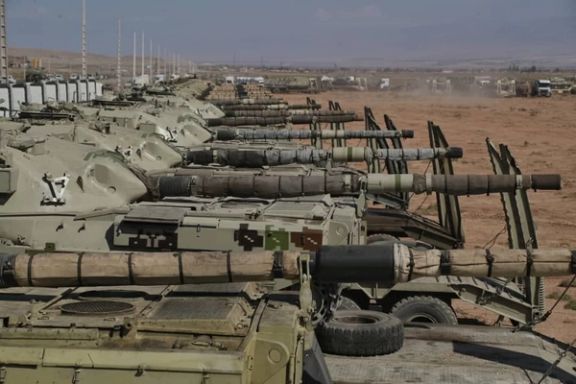
Iranian tanks during a drill near Azerbaijan's border in 2021

The likelihood of war between Iran and Azerbaijan has increased with escalation between Yerevan and Baku, but pundits in Tehran are optimistic war can be avoided.

Tensions have been high between Iran and Azerbaijan since November 2022 when both sides accused each other of engaging in terrorism and espionage. Iran has also suggested Azerbaijani involvement in the October 26 attack in Shiraz claimed by the Islamic State group (Isis-Daesh).

While some pundits allege that Tehran is awaiting a wrong move by Azerbaijan to attack the country, international relations expert Ali Bigdeli in Tehran told Rouydad 24 news website that the possibility of military conflict between Tehran and Baku is “nil” while criticizing Russia for “silence” over the situation given its close relations with both.

Tehran has also accused Baku of harboring Israeli intelligence and military elements that plan to use its territory in a possible attack against Iran’s nuclear facilities. “The [Azerbaijani] soil is a base for Israel from where it can threaten Iran's security,” Bigdeli said.

He pointed out that Israel has succeeded in “infiltrating” not only Azerbaijan but also other countries including Iran's neighbor Turkmenistan and Central Asian states. At the same time, Shia Iran's attempts to create “centers of resistance” in Azerbaijan where, unlike its Sunni rulers, 60 percent of the population are Shiites irritates Baku.

Around a quarter of Iran’s population is Azari, with analysts and activists disagreeing over the closeness of their cultural-linguistic links to their neighbors to the north.

Iranian troops near Azerbaijan's border during the Nagorno Karabagh war in 2020
100%
Iranian troops near Azerbaijan's border during the Nagorno Karabagh war in 2020

Hamed Khosroshahi, a Caucasus region researcher in Tehran, expressed a similar view about the possibility of war between Tehran and Baku in an interview with Donya-ye Eghtesad daily. The possibility of war is near zero because both Iran and Azerbaijan are aware that that they have ties that cannot be altered.

Azerbaijan’s Nakhichevan enclave bordering Iran needs to procure gas and oil through Iran on the one hand and Iran's dependence on transit to Russia through Azerbaijan, are important factors he said. “The two sides know that they should not allow tensions rise beyond a certain level.”

While saying that the two countries are currently “appraising” their military power, Vali Khalaji, Caucasus region and Central Asia analyst in Tehran, said escalation of tensions would not necessarily end in war and could instead result in “relaxation of tensions” given factors including interdependent transit needs.

Current tensions are closely tied to the recent escalation between Azerbaijan and Armenia. Secretary of the Security Council of Armenia, Armen Grigoryan on Friday accused Azerbaijan of preparing for military escalation. Baku vehemently denies the charge while accusing Yerevan of violating the Prague and Sochi agreements.

A transit corridor through Syunik province of Armenia which Azerbaijan is demanding to secure access to its Nakhichevan Autonomous region without Armenian checkpoints will disconnect Iran from its de facto ally and trade partner Armenia.

Russia’s Minister of Foreign Affairs Sergey Lavrov met with Armenian Minister of Foreign Affairs Ararat Mirzoyan in Samarkand, Uzbekistan, Friday and among other topics, according to Armen Press, discussed “unblocking of all economic and transport links in the region” and the Nagorno Karabakh issue.

Azerbaijan closed its embassy in Tehran afteran armed attack on Azerbaijan’s embassy in Tehran in January and earlier this month expelled four Iranian diplomats over what it called “provocative actions” which may refer to Iran's several military drills along the border with Azerbaijan in the past year including the latest in October.

Fresh skirmishes at Armenian-Azerbaijani border earlier this week left a total of seven deaths from both sides in one day around the contested Nagarno-Karabakh region. The Islamic Republic says it is neutral in the conflict, but it apparently backs its de facto ally Armenia and has warned it would not tolerate changes to international borders.
Most Viewed

US blockade enters murky phase as tankers spoof signals and buyers hesitate
1
ANALYSIS

US blockade enters murky phase as tankers spoof signals and buyers hesitate

2
INSIGHT

Ideology may be fading in Iran, but not in Kashmir's ‘Mini Iran'

3
INSIGHT

Hardliners push Hormuz ‘red line’ as US blockade tests Iran’s leverage

4
VOICES FROM IRAN

Hope and anger in Iran as fragile ceasefire persists

5

US sanctions oil network tied to Iranian tycoon Shamkhani

Banner
Banner

Spotlight

  • Hardliners push Hormuz ‘red line’ as US blockade tests Iran’s leverage
    INSIGHT

    Hardliners push Hormuz ‘red line’ as US blockade tests Iran’s leverage

  • Ideology may be fading in Iran, but not in Kashmir's ‘Mini Iran'
    INSIGHT

    Ideology may be fading in Iran, but not in Kashmir's ‘Mini Iran'

  • War damage amounts to $3,000 per Iranian, with blockade set to add to losses
    INSIGHT

    War damage amounts to $3,000 per Iranian, with blockade set to add to losses

  • Why the $100 billion Hormuz toll revenue is a myth
    ANALYSIS

    Why the $100 billion Hormuz toll revenue is a myth

  • US blockade targets Iran oil boom amid regional disruption
    ANALYSIS

    US blockade targets Iran oil boom amid regional disruption

  • Iran's digital economy battered by prolonged blackout
    INSIGHT

    Iran's digital economy battered by prolonged blackout

•
•
•

More Stories

Medicine Shortage Worsens In Iran Amid Financial Crisis

Apr 15, 2023, 13:12 GMT+1

An Iranian official has warned about shortage of antidepressants saying that even IV fluids and cold syrups are also in the list of "urgently needed supplies".

Ali Fatemi, Vice President of Iranian Pharmacists Association told semi-official ISNA news agency Saturday that there is shortage of neuroleptics, antidepressants, and medicines for patients with special diseases.

According to him, the government still imports IV fluid from abroad and even cold syrups are on the list of imported medications.

Meanwhile, Hossein-Ali Shahriari, Head of the Health Commission of Iranian Parliament said Wednesday that if subsidies are not paid to pharmaceutical companies, "the country will face a 40-50% price rise for medicines.”

The government struggles with a shortage of foreign currencies while it claims its oil exports to China have increased despite US sanctions.

Despite the warnings, Minister of Health Bahram Einollahi claims that “most medicines are available, and there will be no problem regarding the supply of pharmaceuticals this year.”

In the previous Iranian year, the medicine crisis intensified as people suffered from multifold price increases while many items were not available at all, pushing people to the black market and smuggled medicines.

The Islamic Republic has been claiming that United States sanctions prevent procurement of medicines, while Washington insists that humanitarian aid is exempt from sanctions and in fact, food, health and humanitarian products are not sanctioned.

Iran has been importing more than $1.5 billion of medicines a year. The country imported around 100 million euros of medicines a month just from Europe in 2022 and also large quantities from China and India.

Iran Says IRGC Test-Fired Latest Anti-Tank Missile

Apr 15, 2023, 10:59 GMT+1

The Islamic Republic says the ground forces of the Revolutionary Guard Corps (IRGC) has successfully test-fired its newest missile Sadid 365.

Ali Kouhestani, Head of IRGC Ground Forces Research and Self-Sufficiency Jihad Organization, said in an interview with Tasnim news agency on Saturday that "Sadid 365 is a guided anti-armor missile with a range of 8 kilometers, which is capable of destroying all kinds of armored equipment."

“This optically guided missile is highly accurate in hitting the target, and with the ability to attack from above, it can also pass through the active defense systems and destroy them,” added Kouhestani.

The description is similar to the capabilities of the US Javelin anti-tank weapon.

In the top attack mode, the missile is required to climb sharply after launch and travel at a certain altitude, then plunge on top of the target. In this method, unlike the conventional methods, the missile travels a ballistic path to hit the target.

The method is more effective because usually the top armor of the tank is the weakest part, and it is easier to penetrate it.

Last week, Kouhestani claimed that the IRGC has developed its latest suicide drone known as the Meraj 532, that will be used by the ground forces with a one-way range of 450km.

Iran’s provision of drones to Russia in its war against Ukraine - a claim it denies - has led to a host of new sanctions on from Western countries including the US and Australia, and the European Union.

Iran's Guards Say US Too Weak In Region To Militarily Support Israel

Apr 15, 2023, 10:33 GMT+1
•
Iran International Newsroom

The United States is not in a position to support Israel, spokesman of the Revolutionary Guard said in reaction to statements that Israel can act alone against Iran.

Ramezan Sharif was quoted by IRGC-affiliated Fars news website Saturday said Israel has repeatedly issued similar statements, but he has one message and that is: The situation of the Americans in the region is such that they cannot support the Zionists.

Israel has long threatened that if the Islamic Republic gets close to obtaining a nuclear weapon it will use all methods including a direct military attack to prevent it. President Joe Biden has also vowed not to allow the Iranian regime to produce nuclear weapons, with “all options on the table.”

But Tehran has been emboldened by a recent agreement with Saudi Arabia to restore diplomatic relations, mediated by China. It sees itself as not so isolated in the region and believes that a possible threat of an Israeli-Arab military alliance has receded.

China brokering a deal between two regional rivals has been widely seen as a defeat for the United States in the region and the ascendance of Chinese influence in the Middle East.

Sharif also said that “The Americans seem to be trying not to fall into the lap of the Zionists, because they know that if Zionists take action against us our in-kind retaliation will engulf the bases of those supporting them.”

However, the United States has continued to pledge its readiness to support Israel and held large joint military drills in January.

An IRGC missile system on display during drills in October 2022
100%
An IRGC missile system on display during drills in October 2022

The US Navy also announced April 8 the deployment of a guided-missile submarine capable of carrying up to 154 Tomahawk missiles to the Middle East, in what appeared to be a show of force toward Iran following recent tensions in Syria and rocket attacks on Israel.

IRGC’s spokesman went on to say that Israeli statements about attacking Iran without American help stem from US messages that they are not able to assist Israel as the case was in the past and “are not ready to enter a battle [knowing] where it would end.”

After the agreement to restore ties with Saudi Arabia was announced March 10 in Beijing, Iran has become more aggressive against Israel, openly calling on its allies and militant proxies to attack the Jewish state. The new belligerent policy was reinforced by massive anti-government protests in Israel against Prime Minister Benjamin Netanyahu’s plans to overhaul the country’s judiciary.

The Wall Street Journal reported Friday that the commander of IRGC’s extraterritorial Quds Force, Esmail Qaani has held a series of secret meetings with leaders of Iran’s armed proxy groups in recent weeks to plan attacks against Israel.

The Journal said that to coordinate a rocket a rocket attack from Lebanon on Israel in early April Qaani met in Beirut, with Hamas leader Ismail Haniyeh and his deputy Saleh al-Arouri and Hezbollah chief Hassan Nasrallah.

IRGC’s chief commander Gen. Hossein Salami on Friday boasted that “The Zionist regime is the target of military attacks by all countries and does not even know from where the attacks are coming.” Salami was speaking at a ceremony marking the anti-Israeli Quds Day in Esfahan, central Iran. He took credit for the attacks saying that the Islamic Republic is now a source of legitimacy for regional countries, while just a few months ago they had distanced themselves from Tehran.

Iran’s president Ebrahim Raisi speaking in Tehran on the Quds Day reiterated that the liberation of Quds (Jerusalem) is imminent; “Closer than you can imagine,” adding that “the normalization of relations with regional states [such as the United Arab Emirates and Bahrain] has not brought and will not bring security for the Zionist regime.”

Iran’s Police Kick Off Camera Surveillance To Catch Women Without Hijab

Apr 15, 2023, 09:17 GMT+1

Iranian police has begun its new plan of using "smart" technology in public places to identify and then prosecute women who do not wear hijab.

As previously announced, law enforcement forces Saturday intensified their efforts to track teenage girls and women who do not wear ‘proper’ hijab in streets, shopping centers and cars.

In a statement last week, police threatened that they would take action to identify those breaching the regime laws by using tools and smart cameras in public places and thoroughfares.

According to the statement, the move is aimed at “preventing resistance against the hijab law,” adding that such resistance against the strict Islamic dress code tarnishes Iran's “spiritual image” and spreads insecurity.

Meanwhile, Ahmad-Reza Radan, the chief commander of Iran’s police, said that the forces under his command will use advanced technology and equipment to identify people who do not observe the mandatory hijab in public places. Women and girls who do not wear scarves in "public places, cars or commercial centers" will be prosecuted, he added.

The uprising that was sparked by the death in ‘hijab police’ custody of 22-year-old Mahsa Amini has made it increasingly difficult to enforce the mandatory Islamic dress code. Appearing in public without a full veil has become a common sight even in small and more conservative towns.

The Islamic Republic, founded in 1979, is the only Muslim country other than the Taliban-ruled Afghanistan with such a strict interpretation of hijab and nationwide coercive measures for its observance.

Pundits Say Loss Of Hope In Future Drove Iran Protests

Apr 15, 2023, 05:49 GMT+1
•
Iran International Newsroom

Many Iran watchers believe that one of the main reasons for the nationwide protests was that people have lost their hope and confidence in the future of their country.

The former head of the Tehran City Council Mohsen Hashemi has said this week that lack of hope and trust in the future was a factor in the ferocity of the protests.

Prominent sociologist Mohammad Fazeli has also said that hope in the future of Iran has weakened among the public and this casts a shadow of doubt on any solution that the government might offer for long-standing problems.

Former head of the Tehran City Council Mohsen Hashemi (undated)
100%
Former head of the Tehran City Council Mohsen Hashemi

Pundits from the two extremes in the Iranian political landscape, reformist commentator Abbas Abdi and conservative pundit Mohammad Mohajeri spoke to Tejarat Farda magazine’s issue published in late March about the outlook of Iran's political landscape as the new Iranian year began. The magazine's editor Sadaf Samimi concluded that their views about the future of Iran and what happened last year are strikingly similar.

Abdi opined that the Islamic Republic was under pressure from the protests and the foreign-based opposition.

"I believe the next two years will definitely bring about major changes in Iran." He did not expand on the nature of those changes but said, "Iran has many potentials for improvement, but this does not mean that today's official policies can continue."

Mohajeri said that last year's protests created a very good opportunity for the Iranian regime. Although the protests were threatening the regime, they also signalled dangers that alerted the regime. Mohajeri added that Iranian officials attributed the protests to the intervention of foreign countries, but they realized that the protests have their roots inside the country.

He observed that previous protests in Iran were motivated by economic problems, but this time there was no talk of the economic grievances among the protesters.

"Although everyone knew that there were problems relating to the people's livelihood, and nearly all of those arrested during the protests were coming from the lower strata…the main problems the protesters were concerned about were political and cultural issues.”

Conservative pundit Mohammad Mohajeri (left) and reformist commentator Abbas Abdi (right) (undated)
100%
Conservative pundit Mohammad Mohajeri (left) and reformist commentator Abbas Abdi (right)

The two pundits however agreed that the receding of street protests did not mean that the movement is over. Anything can re-ignite the protests, they said.

Abdi said it is essential that major changes take place in Iran during the next two years, but the Iranian government seems incapable of problem solving. This is a government that does not accept even clear facts such as rising meat prices and in one instance banned a newspaper that published the news. The first thing that should be reformed in Iran is the media, he said that even do not cover recent gas attacks on girls' schools.

On the other hand, the government is not aware of the impact of international reporting, such as CNN's report on torture in Iranian prisons, Abdi said. More competitive election and equality before the law are essential to restore a semblance of normality.

Mohajeri said the people have lost their trust in the government so that even if it disseminated factual news, still people would not believe the government. This trust has been lost over many years.

He said, When the officials promise that the rate of exchange and market prices will come down but the opposite happens, the people have every right not to believe them again. He added: Although I believe the officials have realized the truth following the protests, I still have not received a signal that would indicate the likelihood of an improvement in the next year.