• العربية
  • فارسی
Brand
  • Iran Insight
  • Politics
  • Economy
  • Analysis
  • Special Report
  • Opinion
  • Podcast
  • Iran Insight
  • Politics
  • Economy
  • Analysis
  • Special Report
  • Opinion
  • Podcast
  • Theme
  • Language
    • العربية
    • فارسی
  • Iran Insight
  • Politics
  • Economy
  • Analysis
  • Special Report
  • Opinion
  • Podcast
All rights reserved for Volant Media UK Limited
volant media logo

Iran’s Exiled Prince Meets Netanyahu Amid Tensions With Tehran
Iran International Newsroom
Apr 17, 2023, 22:44 GMT+1Updated: 17:37 GMT+1
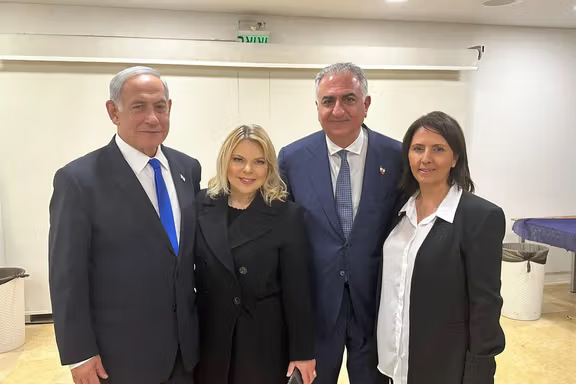
Israeli Prime Minister Benjamin Netanyahu (left), his wife Sarah (2nd left), Iran’s exiled prince Reza Pahlavi (3rd left), and Israeli Intelligence Minister Gila Gamliel

Prince Reza Pahlavi, a leading opposition figure visiting Israel, held a brief meeting with Prime Minister Benjamin Netanyahu Monday as he made a historic visit to Israel.

Pahlavi attended a ceremony held at the National Holocaust Memorial and Museum, Yad Vashem, as part of the Holocaust Remembrance Day. He stood alongside Netanyahu and Israel's President Isaac Herzog but did not deliver a speech. Later he held a meeting with Netanyahu in the presence of Israel’s intelligence minister Gila Gamliel.

This is the first time a prominent Iranian political figure has paid a public visit to Israel. Before leaving for Israel on Sunday, Prince Pahlavi tweeted that he wanted, “to deliver a message of friendship from the Iranian people…and pay respects to the victims of the Holocaust on Yom HaShoah.”

There are no reports so far about what Netanyahu and Pahlavi discussed during their brief meeting, but a photo showed the two deeply engaged in conversation.

The visit comes as Israeli officials and media commentators have raised increasing concern over Iran’s intensified efforts to create instability in and around Israel.

Speaking on Sunday at a memorial service, Israeli Defense Minister Yoav Gallant warned, “Iran is waging a multi-front war of attrition against the State of Israel,” adding that it was “continuing its attempts to establish itself on the northern front and at the same time sending its proxies to Judea, Samaria and Gaza.”

However, Gallant said that Israeli Defense Forces (IDF) have “acted and will continue to act in all arenas, in overt and covert operations along the border, across the border, and even far from the border.”

Israeli Defence Minister Yoav Gallant attends a news conference with U.S. Secretary of Defense Lloyd Austin at Ben Gurion Airport in Lod, Israel, March 9, 2023.
100%
Israeli Defence Minister Yoav Gallant attends a news conference with U.S. Secretary of Defense Lloyd Austin at Ben Gurion Airport in Lod, Israel, March 9, 2023.

IDF is braced for possible attacks by Iran-backed militias, which launched several rounds of strikes earlier this month on Israel’s southern and northern borders. In an unprecedented development in recent times, the attacks originated from Syria and Lebanon as well as the Gaza Strip.

Flames rise above Gaza City, during an Israeli air strike on April 7, 2023.
100%
Flames rise above Gaza City, during an Israeli air strike on April 7, 2023.

Analysts believe that the Islamic Republic intensified attacks by its allies and proxies in the belief that Israel is at a weak point, due to internal political unrest caused by Benjamin Netanyahu’s plans to overhaul the country’s judicial system.

On Sunday, the Jerusalem Institute for Strategic Studies published a statement, warning of the prospect of a war with Iran, and urging Netanyahu to suspend his judicial overhaul plan considering the intensified threats by Tehran.

“Israel is seen from the outside as a torn society, gradually losing its ability to function,” the think tank said, echoing last week’s remarks by former National Security Advisor and former Maj.-Gen. Yaakov Amidror.

“Israel’s enemies are gaining confidence and expect the internal conditions in the Jewish state to lead to self-destruction,” it added, warning, “The chances of a deterioration into a wider conflict are more significant today than before... Israel needs to prepare for the tangible possibility of war.”

Netanyahu, also speaking at Sunday’s memorial service, said that Israel must always be able to defend itself, adding that if other powers such as the US want to mobilize to help, that is good, “but we cannot build our national security on the foundations of others.”

His statement is indicative of Israeli concerns over Washington’s hesitation to help Israel militarily in case of a confrontation with Iran, especially considering the Islamic Republic’s recent détente with Saudi Arabia.

Also on Monday, Israeli Foreign Minister Eli Cohen held a meeting with American senior Republican Senator Lindsey Graham, who arrived in Israel from a visit to Saudi Arabia, stressing the need for strong Washington-Jerusalem coordination to prevent a nuclear Iran.

Netanyahu met with Graham on Monday and talked about Israel normalizing relations with Saudi Arabia, saying it would be a "giant leap" towards ending the Arab-Israeli conflict.

Netanyahu said, "We want normalization and peace with Saudi Arabia...This agreement could have monumental consequences, historic consequences both for Israel, for Saudi Arabia, for the region and for the world."

Cohen said, "Cooperation between Israel and the United States is necessary to stop the Iranian nuclear program, which is a global threat.

“The way to change Iranian behavior is through massive economic and political pressure, in every sector of Iranian interest,” coupled with a credible “military threat against it.”

Tehran turned to Lebanon’s Hezbollah to initiate the latest episode of its proxy war against Israel, during which Hezbollah fired a surveillance drone toward the Galilee on April 1 that was shot down by Israel. From April 5-7, Palestinians affiliated with Hamas and based in Lebanon fired fired 34 rockets at Israel. On April 8 and April 9, six rockets were launched from the Syrian side of the Golan Heights.

According to a report in The Wall Street Journal, prior to the most recent coordinated attacks, Esmail Ghaani, the leader of IRGC’s Quds Force, hosted representatives of Hezbollah, Hamas and Islamic Jihad – all of which designated as terrorist groups by the US and several other countries – at the Iranian embassy in Beirut in March and April.

On Saturday, spokesman of Iran’s Revolutionary Guard Ramezan Sharif said that the US is too weak to be able to militarily support Israel in the region.
Most Viewed

US blockade enters murky phase as tankers spoof signals and buyers hesitate
1
ANALYSIS

US blockade enters murky phase as tankers spoof signals and buyers hesitate

2
INSIGHT

Ideology may be fading in Iran, but not in Kashmir's ‘Mini Iran'

3
INSIGHT

Hardliners push Hormuz ‘red line’ as US blockade tests Iran’s leverage

4
VOICES FROM IRAN

Hope and anger in Iran as fragile ceasefire persists

5

US sanctions oil network tied to Iranian tycoon Shamkhani

Banner
Banner

Spotlight

  • Hardliners push Hormuz ‘red line’ as US blockade tests Iran’s leverage
    INSIGHT

    Hardliners push Hormuz ‘red line’ as US blockade tests Iran’s leverage

  • Ideology may be fading in Iran, but not in Kashmir's ‘Mini Iran'
    INSIGHT

    Ideology may be fading in Iran, but not in Kashmir's ‘Mini Iran'

  • War damage amounts to $3,000 per Iranian, with blockade set to add to losses
    INSIGHT

    War damage amounts to $3,000 per Iranian, with blockade set to add to losses

  • Why the $100 billion Hormuz toll revenue is a myth
    ANALYSIS

    Why the $100 billion Hormuz toll revenue is a myth

  • US blockade targets Iran oil boom amid regional disruption
    ANALYSIS

    US blockade targets Iran oil boom amid regional disruption

  • Iran's digital economy battered by prolonged blackout
    INSIGHT

    Iran's digital economy battered by prolonged blackout

•
•
•

More Stories

Chemical Attacks On Schools: Parents Urge Govt. To Hold Classes Virtually

Apr 17, 2023, 20:40 GMT+1

School students at schools across Iran have been targeted in a new wave of attacks using an unknown chemical substance, according to reports.

Videos seen by Iran International show the latest apparent poisonings have taken place in Alborz, Kermanshah, Kordestan, East Azarbaijan, West Azarbaijan, and Khuzestan provinces.

Families of students have staged protest rallies urging officials to hold classes virtually rather than in school to protect children from further attacks.

Hengaw Human Rights Organization said over 30 female pupils were admitted to hospital in the city of Kermanshah after the chemical attack, adding that the physical condition of some of them is critical.

Meanwhile, people in the southern city of Ahvaz gathered in front of the governor's office to protest against the serial poisoning of students.

The majority of the victims of the apparent poisonings are girls. The identity of the perpetrators is unknown.

Critics of the regime say the attacks are part of a crackdown on protests, a claim denied by government officials who have claimed the symptoms are the result of mass hysteria.

The current wave of chemical attacks began after the new year holidays.
Close to 300 schools were targeted in the past Iranian year ending on March 20 without any apparent serious effort by the government to identify and pursue the perpetrators, nor to explain to terrified parents and students what was happening.

Thousands of students have been affected, mostly girls, with hundreds hospitalized with symptoms including respiratory distress, numbness in their limbs, heart palpitations, headaches, nausea, and vomiting.

The Ministry of Islamic Guidance has sent a notice to the local media to censor the news related to the attacks.

Israel Reveals Efforts By Iran To Recruit Terrorists In West Bank

Apr 17, 2023, 19:37 GMT+1

Israel’s internal security agency has exposed attempts by Hezbollah and IRGC’s Quds Force to recruit Palestinians in the West Bank to conduct terrorist operations.

The Shin Bet was quoted as saying that a Hezbollah terrorist cell was identified trying to smuggle weapons into Israel. The weapons were meant to assist different criminal and terrorists' activities in the country.

Tel-Aviv-based i24 website reported Monday that according to the information the Iranian and Hezbollah officials transferred funds to two brothers named Yosef Mansour and Marsil Mansour who were arrested in the West Bank in recent months.

Shin Bet says the operation is a serious attempt by the Islamic Republic and its affiliates to infiltrate and establish cells in Israel to carry out terrorist attacks against citizens.

Earlier in March, Israel’s National Security Council released a statement, cautioning Passover travelers over the possibility of being harmed in Iranian plots abroad.

This year, the holidays – starting on April 5 – coincided with the Muslim fasting month of Ramadan, which usually sees a surge in terrorist attacks by extremist Islamists.

Israel’s National Security Council claims that Tehran will continue its attempts to harm Israelis around the world, especially in the countries near Iran in broader West Asia. It emphasized that Iran and its proxies present a particular threat in the United Arab Emirates, Georgia, Azerbaijan, Turkey and Bahrain, as well as Iraq’s Kurdistan region, where Israelis are prohibited to enter according to Israel’s own laws.

Raisi Should Resign If He Cares About Iran – Lawmaker

Apr 17, 2023, 18:34 GMT+1
•
Iran International Newsroom

President Ebrahim Raisi should resign over his government’s failure to deal with calamitously high inflation, an Iranian lawmaker has urged.

Mostafa Reza Hosseini Ghotbabadi said: “Unfortunately, there is no will on the part of Raisi’s government to curb inflation, and basically they are not able to handle the situation.”

Speaking on Monday, he added: “Secondly, the head of government and his first deputy do not have the necessary expertise to make the right decisions regarding inflation and economic issues.”

Inflation is currently running at about 50%, with disastrous effects on the economy and leaving families struggling to survive.

Conservative lawmaker Ghotbabadi, an Iraq-Iran war veteran, said that the two years since Raisi came to power had shown his administration is incapable of getting to grips with the out-of-control inflation rate.

He said: "With the current procedures and functioning of the government and officials, we have to wait for worse things to happen in the economy.

Lawmaker Mostafa Reza Hosseini Ghotbabadi (undatd)
100%
Lawmaker Mostafa Reza Hosseini Ghotbabadi

“Both government officials and MPs aligned with the administration ask us to give hope to the people and not tell them that the situation is bad, but we took an oath and according to the constitution we should speak up about the issues.”

He said that as soon as lawmakers warn about incompetent officials and ineffective management in projects and plans, hardliner supporters of the administration try to stop them via lawsuits and threats.

Ghotbabadi, a member of the parliamentary Industries and Mines Committee, said that the government has declined to cooperate with parliament since its early days in office. His remarks may seem surprising, given that many members of Iran's hardliner-dominated parliament are former members of the IRGC and would be expected to support the administration. But criticism of Raisi has been on the rise even among conservatives as the economic crisis worsens.

Echoing the Iraq-Iran war, when young volunteers walked through minefields to pave the way for other soldiers, the lawmaker said that if Raisi truly cares for the country, he should step on “the resignation mine” and step down along with his cabinet so that “a capable person with a strong team” could take charge.

Ghotbabadi said: “We are losing time and opportunities... We need a strong, powerful, wise and capable government.”

In July 2022, Ghotbabadi for the first time called on parliament to table a motion to unseat the President for incompetence, saying at the time that the Majles had been mulling the idea of Raisi's incompetence at least twice in recent months.

Earlier this month, Raisi replaced the head of the Planning and Budget Organization and the agriculture minister, after a year of calls by lawmakers and critics and amid skyrocketing inflation. The move came several days after Education Minister Yousef Nouri resigned following widespread discontent at a delay in the payment of salaries for teachers. However, pundits believe the changes are too little and too late.

On Monday, a motion to impeach Reza Fatemi Amin, minister of industry, mine and trade was registered at the parliament’s presidium after garnering 40 signatures.

However, the president seems unwilling to reshuffle the cabinet, according to statements he made during a meeting with a group of students on Sunday evening. This administration would not seek to replace managers unless it is absolutely necessary, Raisi said, adding that the government does not plan to make major changes in its roster.

The growing criticism of Raisi’s administration has gone far beyond the expected opponents of the regime to reach even media outlets affiliated with the Revolutionary Guard. IRGC’s mouthpiece Tasnim news -- which has been an adamant supporter of Raisi’s policies -- published an article on Sunday, questioning the government’s decision last year to eliminate food subsidies, saying that it boosted inflation.

Raisi’s administration moved to stop offering cheap dollars to importers of food and medicine in May 2022 to save more than $10 billion annually. Analysts say removing the indirect subsidy resulted in a massive hike in prices for most commodities including basic foods, medicine and medical equipment, animal feed and many other commodities.

Iran Home To Over 120,000 Working Children: Official

Apr 17, 2023, 17:07 GMT+1

The Iranian regime has admitted that at least 120,000 minors are working as child labourers, although the real figure may be far higher.

An official at Iran’s Welfare Organization, Mohammad Reza Heydarhaie, revealed the figure of workers aged under 18 speaking to semi-official news agency ISNA on Monday.

Tens of thousands of children have had to drop out of school and try and scrimp a living to help their family survive amid the continuing economic crisis with sky-rocketing inflation of nearly 50 per cent.

Heydarhaie also admitted there has been a surge in the number of children living on garbage dumps.

Many also sell goods in the streets, clean cars or are exploited by adults as professional beggars.

Heydarhaie said: “According to the latest figures, there are a total of 120,000 minors in the country who are in child labor.”

He added: "Last year, 14,500 street children were identified, of which about 10,500 used the services of the welfare organization, and the rest did not want to receive such services."

It is believed that more than 5% of construction work in Iran is being done by children, despite the dangers.

Those employing children benefit from greater profits thanks to their lower wages.

Campaigners say that government institutions are not only reluctant to solve this problem, but are the main culprits.

Heydarhaie claimed it is against the interest of children for them to be forced off the streets by officials, saying: “It does not solve their problem,” and would put them out of reach of help from welfare organisations.

Iran Invites Saudi King, Says US No Longer A Superpower

Apr 17, 2023, 14:49 GMT+1
•
Iran International Newsroom

Iran said Monday it has officially invited Saudi Arabia's king for a visit, after the two countries agreed to restore relations in a China-brokered deal in March.

"Iranian President (Ebrahim Raisi) has sent an invitation to the Saudi king in return for an invitation by Riyadh for him," Nasser Kanaani, spokesman of Iran’s foreign ministry told a news conference.

After years of bad relations that fueled proxy conflicts across the Middle East, where Tehran and Riyadh backed opposite sides from Yemen to Syria, the Shi'ite revolutionary Iran and the Sunni-led Kingdom reached an agreement to end a seven-year diplomatic rift.

Technical delegations from both countries are preparing to officially reopen their missions, and Tehran said these missions would restart their activities by May 9, Iran's semi-official Tasnim News agency reported.

The Chinese brokered deal is seen as a sign of Beijing’s growing influence in the region at the expense of Washington that for decades has protected rich Arab oil exporters and tried to contain threats from the Islamic Republic of Iran.

Kanaani in his briefing claimed that the United States is no longer a superpower and “international circumstances have changed.” The era of “America as a superpower has come to an end,” he said and the Islamic Republic took advantage of the change, opting ‘for regional convergence to secure common interests.”

Analysts say that Saudi Arabia was interested to end the conflict in Yemen where for eight years it has been involved in a war against Iran-backed Houthis.

Iran in turn faces a serious economic crisis partly triggered by crippling US sanctions since 2018, when former President Donald Trump withdrew from the Obama-era JCPOA nuclear deal demanding tough concessions from Tehran.

The Biden administration launched indirect talks with Iran to revive the JCPOA, but after 18 months of negotiations the process reached a deadlock last September, leaving the sanctions in place.

Kanaani speaking about the nuclear issue Monday insisted that Tehran never left the negotiating table with the West. He maintained that Tehran is ready to continue talks based on a draft agreement that was presented by the European Union last August.

Iran has continued high-level uranium enrichment since early 2021 when it began talks to revive the JCPOA, and has amassed enough fissile material to reach the stage of weapons development in a few weeks, according to most estimates.

Meanwhile, there is an ongoing dispute with the International Atomic Energy Agency (IAEA) over Iran’s secret nuclear activities prior to 2003.

IAEA chief Rafael Grossi paid a visit to Tehran in early March, just before a meeting of the Agency’s board to iron out differences.

After his visit he claimed that an agreement was reached with Tehran to resolve differences and boost IAEA’s monitoring of Iran’s nuclear activities.

However, follow-up meetings announced by Grossi never took place and there has been no news of any progress.

The result of his trip was that IAEA’s board never censured Iran for its violation in its March meeting, in what appeared to be another diplomatic maneuver by Tehran to buy time.

Kanaani claimed Monday that contacts with IAEA continue, without providing any details. Grossi has been largely silent since his trip to Tehran.