• العربية
  • فارسی
Brand
  • Iran Insight
  • Politics
  • Economy
  • Analysis
  • Special Report
  • Opinion
  • Podcast
  • Iran Insight
  • Politics
  • Economy
  • Analysis
  • Special Report
  • Opinion
  • Podcast
  • Theme
  • Language
    • العربية
    • فارسی
  • Iran Insight
  • Politics
  • Economy
  • Analysis
  • Special Report
  • Opinion
  • Podcast
All rights reserved for Volant Media UK Limited
volant media logo

Hamas Pushed Iran Into Inviting Leader To Garner Financial Aid
Iran International Newsroom
May 2, 2023, 23:03 GMT+1Updated: 17:38 GMT+1
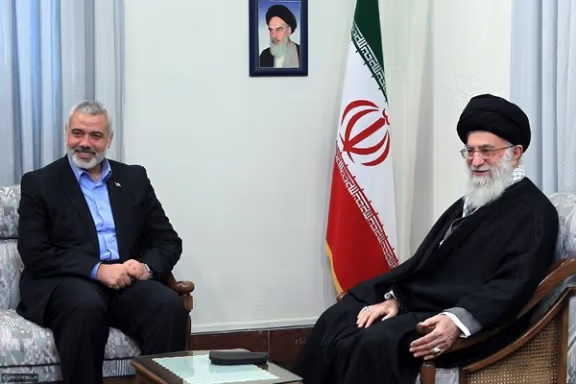
Hamas Leader Ismail Haniyeh and Iran's Supreme Leader Ali Khamenei in a meeting in Tehran

Iran International has learned that Palestinian militant group Hamas pressured the Islamic Republic into inviting its leader to Tehran hoping to get financial support.

According to our sources, the official invitation of Hamas leader Ismail Haniyeh was made following numerous requests because the Palestinian group is struggling with financial problems.

Haniyeh is expected to visit Iran in the near future, the Gaza-based terror group announced last Friday, April 28. Haniyeh's visit will be in relation to “political and field developments,” Hamas said, with Haniyeh expressing thanks and appreciation for the call, confirming his acceptance of the invitation and his intention to go to Tehran soon.

Iran International’s sources claimed that Hamas’ assets have been confiscated in several countries and currently the channels through which the group could receive aid in cryptocurrencies such as Bitcoin are also blocked. Therefore, the group sees the Islamic Republic as among its few sources of income.

Palestinian group Hamas' top leader Ismail Haniyeh talks after meeting with Lebanon's President Michel Aoun, in Baabda, Lebanon June 28, 2021
100%
Palestinian group Hamas' top leader Ismail Haniyeh talks after meeting with Lebanon's President Michel Aoun, in Baabda, Lebanon June 28, 2021

The sources added that although the Islamic Republic continues to provide financial aid to Hamas despite its own economic situation, Tehran is not satisfied with the performance of this group against Israel and is unlikely to give more aid to this group.

In December, Palestinian Arabic language daily newspaper Al-Quds cited informed sources in Lebanon as saying that the Islamic Republic had cut off its financial support for some Palestinian groups, without specifying which groups. General belief is that the Palestinian Islamic Jihad Movement, Hamas and the Popular Front for the Liberation of Palestine were the main recipients of financial aid from the Islamic Republic, among which Hamas and Islamic Jihad are known to be receiving the lion’s share of Tehran’s aid.

Hamas leader Ismail Haniyeh (L) and Iranian President Ebrahim Raisi at the latter's office on August 6, 2021
100%
Hamas leader Ismail Haniyeh (L) and Iranian President Ebrahim Raisi at the latter's office on August 6, 2021

According to Al-Quds sources, these groups depend on Iran's financial aid to pay the salaries of their leaders and members as well as the expenses for other activities. The Islamic Republic’s cutting off aid caused serious problems both in the Gaza Strip and outside the Palestinian territories, to the extent that in some cases, these groups and their leaders have not been able to pay their utility bills, the paper reported.

In March 2022, Haniyeh revealed that the Islamic Republic paid a total of $70 million to Hamas to help it develop missiles and defense systems.

During an interview with Al-Jazeera, Haniyeh said different countries help in financing the group, but Iran is the biggest donor. The head of Hamas political bureau added that thanks to the aid from Iran, his group managed to have a comprehensive defense strategy in its confrontation with the Israeli military in the Gaza Strip in 2021.

He was referring to the two-week outbreak of violence in May 2021 that was called operation “Sword of Jerusalem” by Hamas but dubbed operation “Guardian of the Walls” by Israel. Hamas reportedly fired more than 4,000 rockets and missiles at Israel, most of which were intercepted by the Israeli Iron Dome defense system.

Haniyeh added that Iran backs the Shiite groups within its framework of support for the “axis of resistance” in the region – a term used by Tehran for its aligned militia forces -- noting that Tehran also supports Sunni movements against Israel.

Following normalization of its ties with Iran and Syria, Saudi Arabia also invited a senior delegation of Hamas to the kingdom in April. With China's mediation, Saudi Arabia normalized ties with Iran on March 10 and returned its relations with Syria to the level before the Syrian war. The Saudi embassies in Iran and Syria are scheduled to reopen in the coming weeks.

The Hamas-affiliated al-Resalah newspaper wrote said at the time that Haniyeh, and the head of Hamas Diaspora Office Khaled Mashaal, who have been living in Qatar in the past years, traveled to Riyadh at the head of a high-level delegation. In recent years, relations between Hamas and Saudi Arabia have been tense, with the Kingdom detaining some members of the group, accusing them of supporting terrorism. The tensions mounted as Hamas drew closer to the Islamic Republic.

In December, Lebanese media reported that Hezbollah is also facing financial problems due to the situation in Iran, as it cannot import Iranian goods to sell at a discount to its supporters.

Israeli Foreign Minister Eli Cohen earlier in the year that “Iran is like a cancer. It finances Hamas, the Jihad, and Hezbollah.” Late in April, Iran’s Foreign Minister Hossein Amir-Abdollahian met with heads of two of the regime's terror proxies -- Hezbollah and Palestinian Islamic Jihad Movement -- during a visit to Lebanon.
Most Viewed

US blockade enters murky phase as tankers spoof signals and buyers hesitate
1
ANALYSIS

US blockade enters murky phase as tankers spoof signals and buyers hesitate

2
INSIGHT

Ideology may be fading in Iran, but not in Kashmir's ‘Mini Iran'

3
INSIGHT

Hardliners push Hormuz ‘red line’ as US blockade tests Iran’s leverage

4
VOICES FROM IRAN

Hope and anger in Iran as fragile ceasefire persists

5

US sanctions oil network tied to Iranian tycoon Shamkhani

Banner
Banner

Spotlight

  • Hardliners push Hormuz ‘red line’ as US blockade tests Iran’s leverage
    INSIGHT

    Hardliners push Hormuz ‘red line’ as US blockade tests Iran’s leverage

  • Ideology may be fading in Iran, but not in Kashmir's ‘Mini Iran'
    INSIGHT

    Ideology may be fading in Iran, but not in Kashmir's ‘Mini Iran'

  • War damage amounts to $3,000 per Iranian, with blockade set to add to losses
    INSIGHT

    War damage amounts to $3,000 per Iranian, with blockade set to add to losses

  • Why the $100 billion Hormuz toll revenue is a myth
    ANALYSIS

    Why the $100 billion Hormuz toll revenue is a myth

  • US blockade targets Iran oil boom amid regional disruption
    ANALYSIS

    US blockade targets Iran oil boom amid regional disruption

  • Iran's digital economy battered by prolonged blackout
    INSIGHT

    Iran's digital economy battered by prolonged blackout

•
•
•

More Stories

Iranian Regime Biggest Oppressor Of Media Freedom: Iranian Activist

May 2, 2023, 20:20 GMT+1

Iranian prominent activist Masih Alinejad said at the UN that the leaders of Iran are the biggest oppressors of media freedom in the world.

On the occasion of the World Press Freedom Day, Alinejad told the UN General Assembly that she comes from a country where being a journalist is considered a crime and causes people to be imprisoned.

UNESCO has planned two major events in New York, including a global conference at the United Nations headquarters, to commemorate the 30th edition of World Press Freedom Day.

She further talked about the threats of the Islamic Republic against Iran International and other Farsi-language London-based media, saying that she proposes a resolution in this regard to condemn the international repressions of the Iranian regime.

Speaking about the Islamic Republic's fear of social networks, she added that Supreme LeaderAli Khamenei has restricted social media for people, but the government officials have accounts on the networks.

“I held up a picture of Mahsa Amini‌ from the very same podium that butcher Ebrahim Raisi raised a picture of terrorist Qasem Soleimani in September. The picture of Mahsa Amini represents the real Iran. Raisi and Soleimani do not,” she said in a tweet.

The Islamic Republic through its propaganda tries to show ex-IRGC commander Qassem Soleimani as a national hero, but many people believe he was guilty of war crimes against civilians in Syria and spreading violence across the region.

She also slammed the imprisonment of Elaheh Mohammadi and Niloufar Hamedi, two journalists who reported the murder and funeral of Mahsa Amini, the 22-year-old Kurdish who was killed in police custody in September.

Large Swathes Of Iran Affected By Land Subsidence

May 2, 2023, 18:17 GMT+1
•
Iran International Newsroom

Iran International has obtained documents revealing that Iranian officials are aware of dangerous land subsidence but are unwilling to share it with the public.

On Saturday, Iran International television released its exclusive report about the issue, leaking a confidential letter from the country’s National Cartographic Center addressed to former agriculture minister Javad Sadatinejad, who was removed by President Ebrahim Raisi mid-April without announcing any concrete reasons.

In the letter, Ali Javidaneh an official at the center says that about 550 square kilometers of land in and around the capital Tehran (about the size of the UK city of Manchester or the US city of El Paso, Texas)is sinking an average of over 13 centimeters (about 5.12 inch) per year.

He said that parts of critical infrastructures in the area are affected by subsidence, adding that parts of the highway and the area’s power transmission lines as well as part of the railway pass through the affected areas.

According to another document with details about land subsidence across the country, 380 cities and towns and 9,200 villages are at risk of land subsidence and in some cases the entire area of the cities are located in the subsidence zones.

The confidential letter obtained by Iran International
100%
The confidential letter obtained by Iran International

According to the data in the report,which was not made available to the public either, almost all the provinces of the country are affected by the issue. Bahreman, a city in the central province of Kerman, is on top of the list with 42 centimeters (about 1.38 ft) subsidence per year. 

A day after the Iran International’s report, the National Cartographic Center unveiled a map of the country’s land subsidence during a geomatics event in Tehran.

Confirming our report, MasomehAmighpey, an official of the center, was cited by state media as saying that "In the assessments, we identified 245 subsidence prone areas, 30% of which have a high rate of subsidence." She added that 14 metropolises of the country are affected by land subsidence, and according to the statistics of the Energy Ministry, 70% of the country's plains are in crisis due to mismanagement.

Land subsidence is not limited to big cities with big construction projects. In many areas in Iran cracks and huge hollows that resemble meteor craters have appeared in the ground in recent years.

Experts say that over-extraction of ground water has led for cavities being formed underground which in turn lead to subsidence.

According to a report in March, the current level of land subsidence in Iran is “critical", with experts claiming it puts the lives of more than 39 million people at risk, about half of the country’s population.

Several factors have caused the situation to reach breaking point, including dam construction, climate change, inefficient water consumption by agriculture and industries, and the use of underground aquifers as sources for illegal agricultural water extraction wells.

Ali Beitollahi, heading the disaster task force on the issue at the Road, Housing and Urban Development Research Center of Iran, said the approximate area of subsidence zones in the country is now 18.5 million hectares, almost 11% of Iran's total area.

However, international reports claim the danger is even worse, nearing a humanitarian crisis. Science journal claims that more than 98% of Iran's 1.648 million km of land faces land subsidence.

Internationally, a rate of subsidence greater than 4mm (about 0.16 in) per year is considered a crisis and yet Iran's land is sinking at an astonishing rate of 6cm (about 2.36 in) per year in average as a result of 25 years of water level decline in the plains.

Ground subsidence in urban areas has resulted in power outages, bursting of gas pipes, deformation of rails, emergence of sinkholes, tilting of buildings, the appearance of cracks and ditches in roads and even loss of human life.Continued water level declines will reduce the ground's water permeability and turn fertile plains into barren deserts.

Official Says Iran Must Sell Southern Islands To Pay Pensioners' Arrears

May 2, 2023, 13:45 GMT+1

Iran is mulling the idea of selling the two southern islands of Kish and Qeshm and Khuzestan province to pay pensioners' arrears.

The director general of social insurance in Iran’s Ministry of Labor, Sajjad Padam, said: “Even if we sell two to three million barrels of oil with sanctions removed, we still cannot solve the pensioners' issues."

The Iranian government is facing a major challenge to pay pensioners arrears and raise minimum wage enough to meet the rising cost of living in a crippling financial crisis, leaving many elderly citizens without the money they need to survive.

The total amount of claims of pension funds by the end of 2020 was more than 501 thousand billion tomans (nearly 9 billion USD).

In recent months, protest rallies have been staged by workers and retirees in various cities to show anger at the regime's inability to address their issue.

According to the most recent census, there are nearly six million pensioners living in Iran. This number has been steadily increasing in recent years, as more and more people reach retirement age.

Iran’s retirement age is 60 for men and 55 for women but over half (55%) of senior citizens do not receive pensions and over one third (35%) of them live below the poverty line.

In 2021, The Supreme Audit Court of Iran said that 89% of retirees have a monthly salary of between 50 and 100 million rials (200 to 300 USD) which is believed to be much lower now since the rial tumbled to all time lows.

Iranian American Jewish Federation Censures Letter By Israeli MPs

May 2, 2023, 12:41 GMT+1
•
Iran International Newsroom

A US Jewish federation has slammed a letter by Israeli MPs to advocate for the separation of Iran’s Azarbaijan region, as most of the signatories rescinded their signatures.

In a joint open letter to Israeli foreign Minister Eli Cohen on Sunday, the Iranian American Jewish Federation of New York and Los Angeles called the letter signed by 32 members of the parliament (Knesset) “ill-advised”.

They have underlined that the authors of the letter are clearly misguided in thinking that such advocacy “will deliver a hard blow” to the regime in Tehran, which has been putting pressure on Azerbaijan since its opening of an embassy in Israel in March. 

“This could further destabilize the region, create additional threats to Israel, and damage the current security structure to an irreversible and irreparable degree,” warned the federation, which claimed to support Iran’s territorial integrity.

The parliamentarians’ letter is further advocacy to deal a blow to Tehran and show support to its ally Azerbaijan but such meddling in the country’s foreign affairs has not been welcomed by Iranian Jews in the US. 

The letter claims: “Any attempt, by any entity, foreign or domestic, to sever portions of the country will compel the Iranian people to rally around the flag. Any such entity will be considered an enemy of the Iranian nation, not just its government.”

In another part of the letter, it has been noted that although Iran has several ethnic regions, each with its own small separatist movement, any attempt towards the country’s fragmentation could result in the creation of radical and hostile states.

The US group asserted that the misplaced concern is not a matter for comment from the state of Israel, urging Cohen to publicly announce his stance on the matter.

Later on Tuesday, Israeli Intelligence Minister Gila Gamliel tweeted in Hebrew and Persian that she had “convinced most of the Israeli parliamentarians to rescind their signature from the letter.”

“Fighting against a religious extremist regime is the common desire of many nations, and we must always continue this way," Gamliel said, sharing a document with signatures of about 20 lawmakers who said they “express their disapproval of the establishment of a state in part of the territory of Iran for the Azeri minority.”

Earlier, Prince Reza Pahlavi and diaspora political group Solidarity for a Free Iran also slammed the letter.

The diaspora political group (7th Aban Front in Persian) said the Knesset members’ letter regarding “the Azeri minority” in Iran is “a clear case of action against Iran's existence”. “Solidarity for a Free Iran considers this letter a hostile act against the Iranian nation and strongly condemns it,” the statement said, adding that “the letter of these Knesset members is in sheer contradiction with the statements made by Israeli government officials regarding friendship between the two nations of Iran and Israel during the recent visit of Prince Reza Pahlavi,” Solidarity for Free Iran said.

“The verbal assault on Iran’s territorial integrity by 32 members of the Israeli parliament is completely unacceptable and a service to the interests of the anti-Iranian Islamic Republic regime,” Pahlavi said.

Following Cohen's recent state visit to Azerbaijan, the Knesset members asked the Israeli government to “pressure Iran to stop oppressing the Azeri minority in northwest Iran” and called for separation of what they called South Azerbaijan from Iran.

Iran Files Case Against Two Prominent Actresses Over Hijab Rebellion

May 2, 2023, 12:16 GMT+1

A case has been filed against two of Iran’s leading actresses who recently attended a ceremony without the mandatory hijab.

Tehran Police said Afsaneh Bayegan and Fatemeh Motamed Arya, legends of Iranian film and television, will now be investigated by the judiciary. If found guilty, the two women could face harsh prison sentences along with thousands of other protesters since September.

The case was filed after they appeared in public without the headscarf on Sunday night at a ceremony to honor actor Atila Pesyani.

At the ceremony, prominent Iranian cinema star Reza Kianian spoke of women’s right to refuse the headscarf, made mandatory since the Islamic Republic in 1979.

The government has refused to back down on its crackdown against the mass rebellion across the country, several businesses closed down for not enforcing rules imposed by the regime.

Celebrities and footballers supporting the protests have been singled out with businesses closed down, travel bans, bank accounts being frozen and restricting access to communications.

It comes after a wave of famous faces have used their social media accounts to voice their support for the protests that began in mid-September following the death of Mahsa Amini in police custody.

Many other artists and athletes, including popular Golab Adineh, Katayoun Riahi, and Pantea Bahram have also refused to wear the hijab in public and published photos of themselves casting off their headscarves on social media.