• العربية
  • فارسی
Brand
  • Iran Insight
  • Politics
  • Economy
  • Analysis
  • Special Report
  • Opinion
  • Podcast
  • Iran Insight
  • Politics
  • Economy
  • Analysis
  • Special Report
  • Opinion
  • Podcast
  • Theme
  • Language
    • العربية
    • فارسی
  • Iran Insight
  • Politics
  • Economy
  • Analysis
  • Special Report
  • Opinion
  • Podcast
All rights reserved for Volant Media UK Limited
volant media logo

New Congressional Resolution Declares A Nuclear Iran Unacceptable
Iran International Newsroom
Jun 27, 2023, 23:16 GMT+1Updated: 17:20 GMT+1
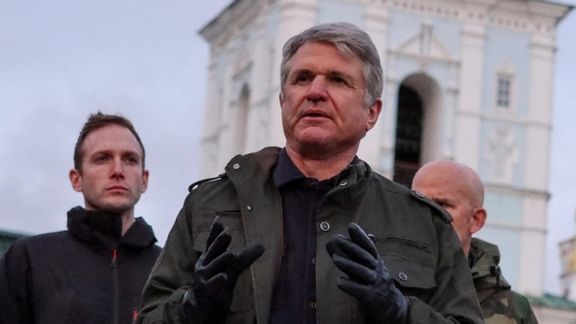
US Congressman Michael McCaul (R-TX), the chairman of the House Foreign Affairs Committee, during a news briefing

US House of Representatives Foreign Affairs Committee Chairman introduced a bipartisan resolution reaffirming the US commitment to preventing a nuclear Iran.

Committee Chairman Michael McCaul (R-TX) along with Congressmen Brad Schneider (D-IL), Doug Lamborn (R-CO), Jared Golden (D-ME), Joe Wilson (R-SC), Brad Sherman (D-CA), Rich McCormick (R-GA), and Kathy Manning (D-NC) introduced the resolution on Tuesday, June 27.

A flurry of media reports in recent weeks indicated that the Biden administration has been holding indirect and possibly direct talks with the Islamic Republic of Iran to hammer out an interim, limited nuclear deal that would offer financial rewards in exchange for some limits on Iran’s uranium enrichment.

Many members of Congress are concerned that the administration intends to reach an unwritten agreement with Tehran to avoid Congressional review. A 2015 law requires any deal with Iran that would result in sanctions reduction to be presented to Congress.

“In the face of unprecedented nuclear provocations from the Iranian regime, it is vital the United States make clear that a nuclear Iran is unacceptable,” said McCaul in an announcement about the bipartisan resolution. 

The United States Capitol building (file photo)
100%
The United States Capitol building

“I am proud to lead this bipartisan resolution declaring with no ambiguity that Iran must not be able to obtain a nuclear weapon, and that the United States is willing to use all means necessary to prevent a nuclear Iran. Nothing is off the table.”

The resolution also says that the US should “recognize and support the freedom of action of partners and allies, including Israel to prevent Iran from obtaining a nuclear weapon.”

Past and present Israeli governments have repeatedly threatened to launch a military attack against Iran if they see the imminent danger of nuclear weapons. Prime Minister Benjamin Netanyahu has said that his government will not recognize any international agreements, if it concludes that Israel faces the danger of a nuclear Iran.

A bipartisan group of 26 US senators last week asked President Joe Biden in a letter not to rush into a bad agreement.

Rep. McCaul had sent a letter to the President June 15 saying, “I am disturbed by recent revelations that the Administration has re-engaged in ‘proximity talks’ with the Iranian regime, and that the results of these discussions have included the apparent greenlighting of sizable payments to Iran.”

He was referring to the White House allowing Iraq to release more than $2.7 billion in Iran’s frozen funds earlier this month.

McCaul urged Biden to respect the Iran Nuclear Agreement Review Act of 2015 (INARA), which was enacted during the finalization of the Joint Comprehensive Plan of Action (JCPOA) in 2015 to allow Congress to oversee dealings with Tehran. The Obama administration decided not to make the JCPOA nuclear deal a treaty, given opposition in Congress at the time and agreed to INARA to neutralize opposition among lawmakers.

The administration has denied it has reached any new deals with Iran, including an interim unwritten agreement, but many media sources and Israeli politicians have indicated that some sort of an agreement has been discussed.


Most Viewed

US blockade enters murky phase as tankers spoof signals and buyers hesitate
1
ANALYSIS

US blockade enters murky phase as tankers spoof signals and buyers hesitate

2
INSIGHT

Ideology may be fading in Iran, but not in Kashmir's ‘Mini Iran'

3
INSIGHT

Hardliners push Hormuz ‘red line’ as US blockade tests Iran’s leverage

4
VOICES FROM IRAN

Hope and anger in Iran as fragile ceasefire persists

5

US sanctions oil network tied to Iranian tycoon Shamkhani

Banner
Banner

Spotlight

  • Hardliners push Hormuz ‘red line’ as US blockade tests Iran’s leverage
    INSIGHT

    Hardliners push Hormuz ‘red line’ as US blockade tests Iran’s leverage

  • Ideology may be fading in Iran, but not in Kashmir's ‘Mini Iran'
    INSIGHT

    Ideology may be fading in Iran, but not in Kashmir's ‘Mini Iran'

  • War damage amounts to $3,000 per Iranian, with blockade set to add to losses
    INSIGHT

    War damage amounts to $3,000 per Iranian, with blockade set to add to losses

  • Why the $100 billion Hormuz toll revenue is a myth
    ANALYSIS

    Why the $100 billion Hormuz toll revenue is a myth

  • US blockade targets Iran oil boom amid regional disruption
    ANALYSIS

    US blockade targets Iran oil boom amid regional disruption

  • Iran's digital economy battered by prolonged blackout
    INSIGHT

    Iran's digital economy battered by prolonged blackout

•
•
•

More Stories

Lawmakers Fight Back Against Biden’s Iran Plans

Jun 27, 2023, 15:27 GMT+1
•
Iran International Newsroom

Congresswoman Claudia Tenney has spoken out against a congressional letter calling for snapback sanctions on Iran only after the regime enriches uranium beyond 90 percent.

Those levels, which would be at least 24 times the limit allowed under the Joint Comprehensive Plan of Action (JCPOA), cause grave concern and Tenney has said “this would be too little, too late, and that snapback should be triggered immediately in response to Iran’s persistent non-compliance with its commitments”.

Her statement comes at a time when the Biden administration is growing closer to an interim agreement with Iran as the October deadline to the expiration of sanctions draws nearer.

“Signaling to the Islamic Republic of Iran that it should only face consequences for its reckless nuclear extortion if it reaches the dangerous threshold of 90 percent weapons-grade nuclear enrichment is deeply concerning,” said Tenney.

“Iran is already enriching uranium at 24 times the limit allowed by the JCPOA – the time for action is now, not after Iran blows past the critical benchmark of achieving weapons-grade enriched uranium.”

US Representative Claudia Tenney (R-NY) speaking at a Republican Study Committee (RSC) press conference (November 2021)
100%
US Representative Claudia Tenney (R-NY) speaking at a Republican Study Committee (RSC) press conference (November 2021)

Tenney recently led a bipartisan letter with Representative Josh Gottheimer encouraging the leaders of the United Kingdom, France, and Germany (E3) to initiate snapback sanctions on Iran under United Nations Security Council (UNSC) Resolution 2231.

“Threatening snapback only after Iran reaches the 90 percent threshold also creates a new and dangerous standard that Iranian enrichment up to 89.9 percent is somehow acceptable. Let me be clear: it is absolutely not acceptable. We need to stop moving the goalposts and start increasing the pressure. The time for snapback is now,” she said.

Her calls are being echoed across the spectrum. Presidential candidate, Senator Tim Scott, has also urged bipartisan action to intervene in the Biden moves to placate Iran.

“The Obama administration tried to bypass Congress in negotiating the deeply flawed JCPOA. We responded by passing bipartisan legislation to require them to submit any nuclear deal with Iran to Congress for review,” he said.

“Now the Biden Administration is using the same playbook. I joined my colleagues in introducing a backstop to require any deal that lifts sanctions on Iran be submitted to Congress. Now is not the time to weaken our stance against the Iranian regime.”

There is growing concern the Biden Administration will use unwritten informal agreements to circumvent the requirement for congressional review under US law. This week, Senators Jim Risch, ranking member of the Senate Foreign Relations Committee, and Bill Hagerty, a member of the Senate Foreign Relations Committee, led colleagues in reintroducing the Iran Sanctions Relief Review Act (ISRRA), a bill to ensure that the president submits any sanctions relief relating to Iran for congressional review.

The legislation would provide a backstop if the Executive Branch attempts to evade the legal requirements for congressional review of any agreement related to Iran’s nuclear program contained in the Iran Nuclear Agreement Review Act (Public Law 114-17).

“As the Biden Administration contemplates another enormous cash windfall to the Iranian regime in exchange for dubious non-proliferation promises, it is vitally important that Congress has a voice in any sanctions relief,” said Risch.

He stressed Iran’s ongoing support for Russia in its war on Ukraine, incidents which have led to deaths of US citizens and plots against former US officials, and the brutal suppression of protests since September, as reasons the regime is dangerous. “Congress has an obligation to ensure that sanctions relief does not fund these appalling activities,” he said.

Hagerty, one of 33 senators pushing for greater controls over the president in dealings with Iran, said checks and balances on any deal for sanctions relief, are a must. Warning of the consequences, he said: “As Iran’s terror-sponsoring regime continues to pursue nuclear weapons to harm Americans and our regional partners and allies, it is critical to provide insurance if President Biden keeps trying to run around Congress and relieve sanctions on Iran.”

Majority Of US House Calls On Biden For Stricter Measures Against Iran

Jun 26, 2023, 22:20 GMT+1
•
Iran International Newsroom

Over half of the US House of Representatives have written to President Joe Biden urging coordination with allies on stricter measures to deter Iran in pursuit of its nuclear program. 

In their letter released by the Jewish Insider on Monday, 249 lawmakers, including 133 Democrats and 116 Republicans, expressed concerns over the regime’s ability to enrich uranium to the weapons-grade level in a matter of days. 

They cited a March report by the International Atomic Energy Agency (IAEA) about particles of uranium enriched to the 83.7% level, just below the 90% level generally considered to be needed to produce nuclear weapons, and remarks by Under Secretary of Defense for Policy Colin Kahl about Iran being able to enrich enough weapons-grade uranium for a bomb in as little as 12 days.

“The United States must increase its efforts to prevent Iran from obtaining nuclear weapons capability and to communicate to Iran, without any ambiguity, that any further progress in its nuclear program will result in severe consequences,” the letter reads. 

Calling for coordination with US allies “to implement the snapback mechanism embedded in UN Security Council Resolution 2231 should Iran advance its uranium enrichment past the 90% weapons-grade threshold," they said such a coordination "would send a powerful message of our unified commitment to deterring Iran’s nuclear program” as well as the message that Iran “would not be able to reap the benefits of international sanctions relief if it operates outside of its nuclear commitments.

Chairman of the Joint Chiefs US Army General Mark Milley attends a hearing before a Senate Armed Services Committee, on Capitol Hill in Washington, DC, June 10, 2021.
100%
Chairman of the Joint Chiefs US Army General Mark Milley attends a hearing before a Senate Armed Services Committee, on Capitol Hill in Washington, DC, June 10, 2021.

They also voiced worries beyond Iran’s nuclear program, mentioning Tehran’s ever-closer ties with Russia and China, quoting US Chairman of the Joint Chiefs of Staff General Mark Milley as calling the China-Iran-Russia relationship a problem for the US “for many years to come.” “This strengthened alliance bolsters the Iranian regime's confidence and may make them more likely to challenge US allies and interests,” read the letter. 

Senator Mark Warner (D-VA) told Iran International’s Arash Alaei that “President Biden has made very clear that we cannot allow Iran... to have nuclear weapons.”

With the JCPOA, "at least we had better eyes, combined with Russia and China, on Iran's activities. We need to do all we can to prevent (Iran from getting nukes). This is a very dangerous part of the world," he added. 

Following reports that the Biden administration is working on an unwritten agreement with the Islamic Republic, US lawmakers at the House and the Senate have moved to further restrict the White House in its dealings with Iran, or at least force the administration to keep the Congress on the loop. 

Last week, the Foreign Affairs Committee of the US House of Representatives unanimously passed a resolution to make some punitive measures against Iran permanent. The bipartisan bill called Solidifying Iran Sanctions Act of 2023, has the potential to make the 1996 sanctions against Iran – or several other measures -- permanent by deleting the 'sunset clause' in any action against the Islamic Republic, a provision that provides an expiry date for a measure.

Iranian Media, Pundits Discuss Iran-US ‘Understanding’

Jun 26, 2023, 14:04 GMT+1
•
Iran International Newsroom

A foreign policy analyst in Tehran says that “an interim verbal nuclear agreement” with the United States cannot bring the long-term stability Iran needs.

Former Iranian diplomat and scholar Kourosh Ahmadi wrote in an article last week that “If the 2015 nuclear deal [JCPOA] has lost its non-proliferation value…the objective should be improving it” instead of aiming for an interim and limited deal “that cannot last more than one or two years.” 

Ahmadi called a possible interim deal a temporary fix that cannot overcome the chronic instability that disrupts and hinders Iran’s economic progress. Do we want just to patch things up for a short period of time, he asked, or put the country on the road to progress. 

Referring to media reports about “a new wave of negotiations between Iran and the United States over an “understanding” or “a verbal agreement,” Etemad Online website pointed out in an analysis that Iranian officials have not provided any information about such an agreement, although they have confirmed that negotiations have taken place in Muscat, New York and Doha. US officials have also made minimal statements about the talks to swap prisoners and release Iran’s assets in Iraq but ruled out any talks over the JCPOA.

Former Iranian diplomat Kourosh Ahmadi (Undated)
100%
Former Iranian diplomat Kourosh Ahmadi

According to Etemad Online, it appears that Iran and the United States have reached an understanding about “stabilizing the current situation” and about some kind of “political cease-fire.” This will prevent crises at the points of contact, such as in Syria and the Persian Gulf. Etemad added that Iran on the other hand might be aiming for a détente with the United States alongside the rapprochement with Saudi Arabia, which can give Tehran access to its hard currency funds frozen abroad.

Etemad Online also opined that restored relations with Saudi Arabia can help Tehran achieve an agreement or an understanding with Washington. Based on the new deal Iran might agree not to enrich Uranium beyond 60 percent and stop installing new modern centrifuges while also promising to boost its cooperation with the IAEA, Etemad Online said, based on reports in Western media.

Also on the agenda of the negotiations are Iran’s cooperation with Russia in the war against Ukraine and the attacks on the US forces by Iran’s proxy groups in Iraq and Syria. The United States, on the other hand, will promise not to intensify the sanctions and instead, release more of Iran’s frozen assets abroad and facilitate Iran’s oil sales.

Kambiz Mehdizadeh, an aide and son-in-law of former President Hassan Rouhani (Undated)
100%
Kambiz Mehdizadeh, an aide and son-in-law of former President Hassan Rouhani

According to Nameh News website, Kambiz Mehdizadeh, an aide and son-in-law of former President Hassan Rouhani wrote in a tweet about the possibility of talks between Iran and the US: “An interim agreement or whatever you might call it is like a painkiller pill that can alleviate the symptoms of a cold. It can stop a runny nose, but it cannot help us to bring in foreign investments or help us purchase aircraft.”

On social media, Afifeh Abdi, an Iranian journalist and a foreign policy researcher, wrote in a June 22 tweet: “The ongoing negotiations over the Joint Comprehensive Plan of Action (JCPOA) are being furthered not because of the skill of Iran’s current negotiating team, but because of the strong US motivation to buy time and to keep Iran away from Russia and China. For the United States, these negotiations mean giving small concessions for strategic achievements!” Ms. Abdi added: “But what can Iran do? Iran has limited choices.” 

In a comment under the post, a Twitter user wrote: “When Iran refuses to bring about essential economic reforms because its officials benefit from the ongoing corruption, and refuses to grant social liberties to the people, then the officials run the country on a day-to-day basis and try to get hold of hard currency to temporarily control the markets. Later, the United States will break its promises and the exchange rates will jump like a spring.”


EU Lands More Sanctions On Iranian Officials

Jun 26, 2023, 13:44 GMT+1

The European Union imposed additional restrictive measures on seven individuals responsible for serious human rights violations in Iran.

“The new listings include the Public and Revolutionary Prosecutor of (Esfahan) Isfahan province and the Deputy Judge of the Provincial Criminal Court of Isfahan province, who are responsible for the trials against the protestors Saleh Mirhashmi, Majid Kazemi and Saeid Yaqoubi, subsequently executed in May 2023,” said the European Council in a statement on Monday.

In addition, the sanctions target the commander of the IRGC in Isfahan province, who oversaw the IRGC's response to anti-government protests.

Also listed by the Council are the Governor of Gilan province and the head of the Rezvanshahr Security Council, who ordered police officers to fire at protesters during the nationwide protests, resulting in numerous deaths and injuries, including children. The Police Commander of Rezvanshahr was also targeted in the new batch of sanctions.

“Lastly, sanctions were imposed on the Governor of the city of Amol, responsible for the killing of at least two young Iranian protesters, and the commander of the Imam Hossein Guards Corps of Karaj over the detention and killing of Mohammad Reza Ghorbani and the detention and rape of Amrita Abbassi by the Karaj security forces,” the statement claimed.

The EU's restrictive measures now apply to a total of 223 individuals and 37 entities. They consist of an asset freeze, a travel ban to the EU and a prohibition to make funds or economic resources available to those listed.

The European Union member states also called on Iran to halt its violent crackdown on peaceful protests, cease its arbitrary detentions, and release all those wrongfully imprisoned.


Iran Tells US To Change ‘Hostile Behavior’ For A Shift In Relations

Jun 26, 2023, 11:23 GMT+1
•
Iran International Newsroom

Iran expects a “fundamental” change of behavior by the United States before a shift in relations can occur, the spokesman of foreign ministry said on Monday.

In his weekly media briefing, spokesman Nasser Kanaani repeated the Iranian regime’s narrative of “decades of crimes” by the United States.

“Iran’s approach to America emanates from their hostile behavior, and as long as America’s behavior does not fundamentally change, it is natural that Iran’s attitude toward America remains the same,” Kanaani announced.

He was speaking in the context of improving relations with neighboring countries and reports of secret talks and even an ‘understanding’ with the United States.

The reality that Tehran and Washington have been holding mediated talks in Oman, Qatar and even having direct contacts in New York is all but certain. Numerous media reports and statements by Israeli officials have pointed to a possible unwritten deal, whereby the US would allow the release of Iran’s frozen funds in exchange for some temporary restraint in uranium enrichment.

The Biden administration has denied any such “interim deal” but few believe that some kind negotiation is not taking place behind the scenes.

Kanaani also added that Tehran does not link its foreign policy and pursuit of national interests to relations with any one country or one issue, referring to the United States and the dispute over its nuclear program.

However, Kanaani also spoke about exchanging prisoners, an issue that Washington has hinted is a subject of talks and can reduce tensions and possibly open the way for more agreements.

The Iranian spokesman said that the United States should free Iranian citizens that “the American regime has jailed based on various false excuses related to violating sanctions.” Kanaani said that US sanctions in essence are illegal, and Iran has been trying for years to free these prisoners.

From left, Siamak Namazi, Emad Shargi and Morad Tahbaz-American-hostages
100%
From left, Siamak Namazi, Emad Shargi and Morad Tahbaz

The Iranian regime is currently holding three American dual-nationals hostage based on trumped-up charges of spying and after bogus trials without due process of law. On the other hand, individuals arrested in the US for violating sanctions have received the benefits of full and transparent trials.

Kanaani claimed that in the past and in different periods certain agreements were reached with Washington through intermediaries but when it came to implementation the US was not ready to make decisions. He confirmed that currently talks are taking place with the help of parties that have “goodwill” in this regard, but “we need to see if America is ready to make decisions or not.”

Earlier this month, the Biden administration allowed Iraq to release $2.7 billion it owed Iran for energy imports – part of a larger amount in Iraqi banks. This was seen as a gesture to reach a deal on prisoners, but so far nothing has been finalized.

It is not clear if the released funds will be made available to Tehran in cash US dollars or in credits that Iran can use to import food and medicine. No details were announced about the $2.7 billion released by Iraq. South Korea holds another $7 billion and apparently the unresolved issues in prisoner exchange revolves around these funds and how Iran can access the money.

At the same time, it is perhaps inevitable that release of the frozen funds and exchange of prisoners become entangled with the nuclear issue, especially if an interim deal is being discussed.