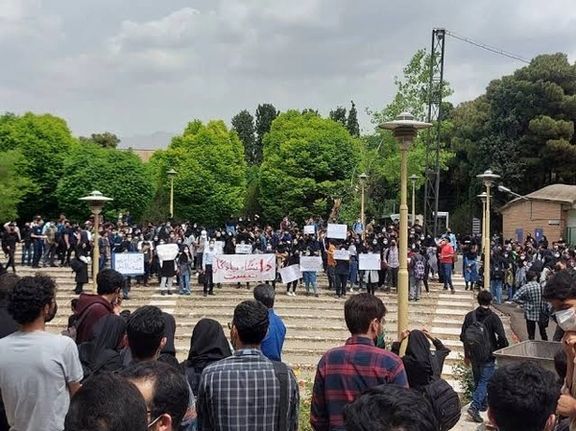
A protest by students at Iran University of Science and Technology in Tehran
Security forces in Iran have unleashed a fresh wave of crackdowns at universities employing both verbal and physical assault to suppress the student movement.
Iran International’s interviews with around 15 students showed an increase in harassment at public and private universities in various cities, raising concerns about the safety of students and freedom of expression within educational institutions in Iran.
The student movement played a significant role in the formation and continuation of last year's popular protests, sparked by the death of a 22-year-old woman, Mahsa Amini in hijab police custody.
With the September anniversary of the protests looming, students and student activists are concerned about a surge in violence from security forces to suppress any fresh protests in the universities before they gain momentum.
“Security personnel patrol the campus on motorcycles, and their warnings regarding hijab are highly insulting, using very offensive language,” a student from Beheshti University in Tehran told Iran International.
A screen grab from a video showing a student being beaten by a security personnel at Tehran’s Allameh Tabataba'i University
Iranian students have increasingly chosen not to wear the compulsory hijab, viewing it as a symbol of a patriarchal society that contradicts their pursuit of gender equality. Their refusal to comply with the government-imposed dress code also serves as a demonstration of their discontent with the prevailing Islamic state, and its policies.
On June 15, several students at Tehran’s College of Arts protesting stricter hijab rules were seriously injured by the head of campus security. Similar assaults have occurred in other instances.
While there is no precise statistic available on the number of students suspended or banned from universities for not wearing the compulsory hijab, students said dozens have been denied the opportunity to pursue their education due to this reason.
A student from Al-Zahra University mentioned on Twitter that security guards at the university contact the fathers of female students and by making baseless accusations, put pressure on both the students and their families.
“My family reluctantly agreed for me to come to Tehran. The security office [of the university] cancelled my accommodation due to the hijab issue last month,” said a student in Tehran.
Several students of Al-Zahra university without mandatory hijab in the capital Tehran
“The behavior of the security personnel was so annoying and ugly that I prefer not to talk about it. I practically have nowhere to stay, and it is not possible for me to afford rent and expenses for food in Tehran. I am forced to drop out and return to my hometown,” she said.
Students said activities of the Hijab and Dress Code Committee that oversees student compliance have expanded during the exam period in early summer. Security personnel were present in the exam halls and issued warnings to students. If they refused to comply, they were subsequently banned from entering the university without any prior notice.
University officials and teachers have tried to intervene and allow banned students to enter the university for exams, students said, but security forces have not allowed it.
The recent surge in suppression following last year's uprising signifies a systematic endeavor by the government, which perceives filing cases and expelling students from universities as the sole means of addressing the situation.
Student protesters outside Allameh Tabataba'i University in Tehran
Student protests also existed during the monarchy in 1960s and 70’s but for political reasons, not hijab, and many were punished, including arrests, but systematic or random violence on campuses did not exist. There were no vigilante or plainclothes agents to harass the students. Police showed up and used force to disperse campus protests.
At least a thousand protesting students have been suspended or academically banned from various universities in Iran since last September.
A student activist said university security, along with security forces, are attempting to suppress the spirit of freedom and student life after the Women, Life, Freedom uprising.
“Their assumption was that by mass arrest and suspension, they could break the spirit of the movement,” a student said, “but they fail to realize that 'the university is a smoldering fire beneath the ashes.”
An apartment building hit by an Iranian drone in Kyiv on May 30, 2023
Russian forces unleashed a barrage of kamikaze Iranian-made Shahed drones early Thursday morning, according to The Ukrainian military and the Kyiv city officials.
Nearly ten drones were identified and shot down, the municipal authorities wrote on Telegram.
Explosions were heard in different parts of the city, and debris from intercepted drones fell on five districts of the Ukrainian capital.
Some buildings were damaged, and two people hospitalized with shrapnel wounds.
Volodymyr Motus, a 22-year-old resident of an east Kyiv building hit by drone debris, carefully picked his way across the floor a destroyed apartment, his footsteps accompanied by the sound of shattered glass.
The mangled furniture was coated in a thick layer of dust.
“I was in my apartment and suddenly I heard a boom, that’s all. Then the alarm went off and I went down to the shelter.”
He said that some people were injured, but they were all alive.
Russia also launched 10 Iranian-made drones at other cities in the early morning, together with two Kalibr cruise missiles and one Iskander-M ballistic missiles.
Iran has supplied hundreds of Shahed drones to Russia since mid-2022, with NATO calling on Tehran to stop its military cooperation with Moscow.
Although Ukrainian forces have developed effective methods to shoot down most of the drones, Russia still uses them in swarms to overwhelm air defenses for its missiles to get through. The drones also force Ukraine to use precious anti-air missiles supplied by the West.
Iranian police shot a hospital emergency response staff member in the head on the road to city of Kashan after they tried to stop his car.
Esmail Dehqani, an employee of the emergency department of Beheshti Hospital in Kashan, was killed July 8 but the news reached the public on Wednesday.
It is not clear why the police wanted to stop his car and under what circumstances. It is also not clear why he did not comply.
Dehqani got married just two months ago and his funeral ceremony was held on Sunday in the presence of many plainclothes security agents.
According to information received by Iran International, immediately after his death, the security and law enforcement authorities of Kashan put pressure on his family to remain silent about the tragic event even four days after his burial.
This is not the only case of indiscriminate killing of citizens by the government agents setting up checkpoints in recent months.
Melika Borji was a 12-year-old child who was shot by police officers in March and died on July 4 after suffering for about four months.
In December, another child was shot dead in her family’s car in Hormozgan Province. Soha Etebari, 12, and her family were on the road to Ahvaz, the capital of Khuzestan Province, when plainclothes security forces started shooting at the car at a checkpoint. Soha died of her injuries on the way to the hospital.
Abu Moussa, one of the three Iranian islands in the Persian Gulf
Iran has shown a weak reaction toward its important ally Russia, which this week endorsed a demand by the United Arab Emirates over three Persian Gulf islands.
As Russia joined the Gulf Cooperation Council (GCC) members in support of the United Arab Emirates initiatives to look for “a peaceful settlement” over the ownership of Abu Musa, and the Greater and Lesser Tunb islands Tehran feels deeply annoyed, but it is too weak to show a serious response.
Britain, which maintained control of the three islands it had occupied in the 19th century, withdrew its forces from the Persian Gulf in 1971 and the United Arab Emirates was formed. However, Iran’s Imperial government at the time decided to reclaim what it believed were historical Iranian islands.
Mohammad Reza Shah sent the Iranian navy to secure all three in November of the same year. Iranian forces remain on the islands, with only Abu Musa having much of a civilian population of several thousand.
However, the UAE has maintained over the years that the islands belonged to littoral sheikdoms that joined to form the United Arab Emirates.
In fact, Iran’s foreign minister Hossein Amir-Abdollahian tweeted Wednesday as an apparent response to Russia, reiterating Iran’s sovereignty on the islands, but shied away from mentioning Russia by name.
Mohebali, who was once the director general of Middle East Affairs at the Iranian Foreign Ministry, also said in an interview with moderate news website Entekhab that "Iran's friends apparently pay more attention to the wishes of its rivals."
He added that the odd stance by Russia is an outcome of Tehran's imbalanced foreign policy. This was a reference to Supreme Leader Ali Khamenei's ‘Looking East’ foreign policy which totally ignores the West and pins all hopes on Russia and China.
Many critics however have pointed out in recent years that Russia is not a trustworthy partner for Iran, neither on the nuclear issue nor in any other foreign policy or trade issue.
Russia joined the GCC on July 11 to support the UAE's demand to refer the case of the three islands to the International Court of Justice based on international laws and the UN charter.
Mohebali also drew attention to a similar move by China in December 2022, during President XI Jinping’s visit to Saudi Arabia. He argued that unlike the United States, Russia and China are not keen to call the waterway The Persian Gulf as Iran does, and they refer to it as "The Gulf" to appease the waterway's littoral Arab countries.
The former diplomat said European states also have supported the Arab states as they pay more attention to the other side's demands rather than to Iran's.
He said because of Iran's imbalanced foreign policy, China and Russia have far more extensive trade relations with the Persian Gulf Arab states than Iran does, and it is natural for them to look after their interests.
Asked how Tehran will respond to Russia's stance on the issue, Mohebali said: "Iran should tell Russia that it might change its position on the Ukraine war and Crimea."
IRGC-linked Tasnim news agency reported quoted Foreign Ministry Spokesman Naser Kanani as rejecting the issues raised in a joint statement of the GCC and Russia about the three Iranian islands in the Persian Gulf. “These islands belong to Iran eternally and issuing such statements run counter to the friendly relations between Iran and the neighbors,” the spokesman noted.
Tasnim added, "The islands of the Greater Tunb, the Lesser Tunb, and Abu Musa have historically been part of Iran, proof of which can be found and corroborated by countless historical, legal, and geographical documents in Iran and other parts of the world."
Iranian President Ebrahim Raisi inspects the guard of honor during his official visit at the State House in Entebbe, Uganda, on July 12, 2023.
Iranian President Ebrahim Raisi's tour of three African countries is hailed by Tehran as a "new beginning" in relations with the continent.
Raisi received a red-carpet welcome from his Kenyan counterpart William Ruto on Wednesday as he arrived in the country on the first leg of his tour, a first by an Iranian president in more than a decade, presented as an effort to diversify economic ties in the face of crippling US sanctions. The last Iranian leader to visit Africa was Mahmoud Ahmadinejad in 2013.
Kenya's foreign ministry described Raisi’s trip as an opportunity “to review and re-energize bilateral relations for the mutual benefit of the people of the two countries."
According to Kenya’s President Ruto, “Iran agreed to boost Kenya’s pursuits in manufacturing, health and the blue economy through research and technology.” He added that his administration was “working closely with Tehran to facilitate the export of more tea, meat and other agricultural products to Iran, which will also act as a key entry point to Central Asian countries.”
As is customary in Raisi’s visits, Iranian and Kenyan ministers signed five memorandums of understanding covering information technology, fisheries, livestock products and investment promotion, with the Iranian president expressing hope that the bilateral ties would increase tenfold, without specifying a timeframe.
Iran’s President Ebrahim Raisi and his Kenyan counterpart William Ruto during oversee a signing ceremony in Nairobi on July 12, 2023.
Claiming that raising the volume of trade exchanges 10-fold is within the realm of possibility, Raisi stated, "None of us are satisfied with the current volume of trade and the current economic exchange between countries."
Iran's foreign ministry has said that it expects trade with African countries to increase to more than $2 billion this year, up from an estimated figure of about $500 million.
Even if the higher figure was feasible, it would still be insignificant compared to the UAE's $50 billion and Turkey's $35 billion trade with Africa, which has $600 billion global trade. Iran's target represents less than one percent of that.
Alan Tofighi, a Paris-based activist, told Iran International TV that such claims by Tehran are unrealistic due to its lack of financial resources and international access to invest in African countries.
He believes this is why former president Hassan Rouhani never wasted his time with trips to African countries, as such visits only serve the regime’s propaganda. According to the pundit, Iran’s ulterior motives to have a presence in the continent can be “terrorist activities and procuring materials for its nuclear program, such as uranium, as well as promoting the Shiite ideology.”
The Iranian president arrived at his second destination Uganda later on Wednesday and is scheduled to visit Zimbabwe next.
In Uganda, Raisi signed four agreements with President Yoweri Museveni at his presidential palace in the capital Kampala, also saying that Iran stood ready to share its experience regarding a planned 60,000-barrel-per-day oil refinery.
Iran’s President Ebrahim Raisi and his accompanying delegation visits Iran's House of Innovation and Technology in the Kenyan capital of Nairobi on July 12, 2023.
“The West and the global arrogance prefer that countries export oil and raw materials and turn such materials into value-added products. Therefore, all our efforts in Iran are focused on preventing sale of raw materials,” Raisi said.
“Global arrogance” is a term coined by the Islamic Republic to refer to the United States, which it claims wants to subjugate Iran. Anti-Americanism is the ideological cornerstone of Supreme Leader Ali Khamenei's regime during more than three decades of his authoritarian rule.
“Western colonialism is after exerting pressure on free and independent countries through human rights issues and, today, it is exploiting human rights as a political tool and is putting pressure on independent countries through double standards,” Raisi said in a press conference with Museveni.
Morteza Kazemian, another political analyst, told Iran International that Raisi’s visit will bear no results as all the three African destinations of his tour are grappling with numerous economic and social crises. Neither Iran nor these African countries have anything to offer to each other, he added.
Jaber Rajabi, a political analyst and activist, also told us that given the growing isolation of the regime Raisi’s track record of human rights violations related to the mass executions in the 1980s, he does not have many places to visit. “Such trips are only for show,” he noted.
A member of Islamic Republic's parliament has strongly criticized the performance of the government as the economic crisis worsens, with little hope on the horizon.
Jalal Mahmoudzadeh in a tweet on Wednesday slammed the failure of President Ebrahim Raisi and wrote: "We have reached the current situation while the president submitted seven thousand pages of plans during his election campaign.”
He then listed examples of hardships people face, such as " long queues for goods, chicken and bread, multifold increase in prices, and a nearly 100% inflation".
The member of parliament implicitly criticized the Islamic Republic's authorities for attributing many domestic problems to "foreign powers" adding that "If we do not destroy the dignity of our own people, no power outside is capable of doing so."
About two weeks ago, Mahmoudzadeh slammed the loss of 9 million jobs in cyberspace due to restrictions on social networks stating that the incumbent government "looks directly in the eyes of the people and lies".
The most recent official report by the Statistics Center of Iran shows the 'misery index' in eight provinces is above 60% and the rest of the provinces are above 55%.
The misery index is an economic indicator that is obtained by adding the unemployment rate to the inflation rate on an annual basis, and its upsurge also increases the risk of social harm.
Amid the high inflation, social welfare has deteriorated in Iran in the last five years. The official figures show that the misery index has increased from 19.3 in 2016 to 57.7 percent.
The Iranian regime, which is expanding its disputed nuclear program has failed to conclude a new agreement with the West to have US sanctions lifted, which could help reduce economic pressures.