• العربية
  • فارسی
Brand
  • Iran Insight
  • Politics
  • Economy
  • Analysis
  • Special Report
  • Opinion
  • Podcast
  • Iran Insight
  • Politics
  • Economy
  • Analysis
  • Special Report
  • Opinion
  • Podcast
  • Theme
  • Language
    • العربية
    • فارسی
  • Iran Insight
  • Politics
  • Economy
  • Analysis
  • Special Report
  • Opinion
  • Podcast
All rights reserved for Volant Media UK Limited
volant media logo

Iran Postpones Tighter Fuel Rationing Fearing Renewed Mass Protests
Iran International Newsroom
Jul 26, 2023, 16:08 GMT+1Updated: 17:45 GMT+1
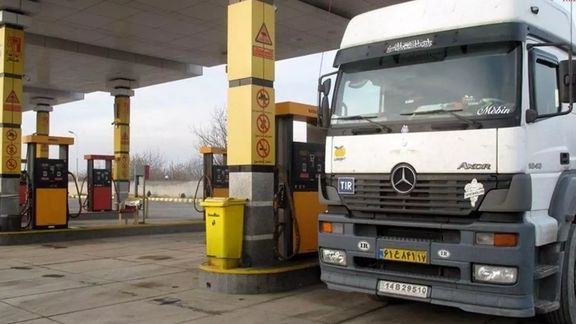
File photo of a truck at a diesel station in Iran

Iran's government has postponed the implementation of tighter diesel rationing as the anniversary of last year's anti-regime protests is approaching in September. 

Iran International has obtained information that the security organs have advised the government to delay the implementation of its plan to decrease the fuel quota for diesel-powered vehicles until after the death anniversary of Mahsa Amini, who was beaten to death by the hijab police in September 2022. The tragic event ignited months of protests that became the boldest uprising against the regime since its establishment in 1979.

Informed sources told us that the administration of Ebrahim Raisi planned to introduce a tight rationing system aimed at reducing diesel consumption by 25 percent, adding that security officials deemed the possible protests and strikes by truck drivers "dangerous" in the current situation. 

Truckers, who do the heavy lifting of transporting goods mainly to and from Iran’s border areas and ports across the country, have already held several rounds of weeks-long strikes that brought the flow of goods and the supply chain to a grinding halt. Prices of fuel and equipment are already among their numerous grievances amid high inflation, and the regime seems unable to cope with new rounds of union action that can take place. 

A strike by Iranian truck drivers in 2018
100%
A strike by Iranian truck drivers in 2018

Reza Gheibi, an economic journalist, told Iran International Tuesday that the Raisi administration’s plan to remove subsidies for essential goods last year has already taken its toll on the consumer market, with food prices recording the highest rate of inflation. Earlier in the day, the price of bread in Iran’s northeastern Razavi Khorasan province increased by 40 percent, triggering concerns that a similar price hike will be implemented across the country. 

The regime, which has one of the world's largest oil and gas reserves, sells gasoline and diesel at extremely low, subsidized prices, charging less than 10 US cents for gasoline per gallon, or less than 3 cents per liter, while that of diesel is even 50 percent lower. Second only to Venezuela, Iran has the world’s cheapest gasoline price. 

For years there has been talk of adjusting prices, but since 2018 Iran’s currency has dropped 12-fold and any increase needs to be huge to be meaningful in US dollars. However, fuel price hikes risk fanning the flames of further unrest. Before the regime dares to raise the prices in line with international market rates, it is inching towards decreasing its expenditures on fuel subsidies via curbing consumption, thus the policy of stricter rationing. 

According to Gheibi, changes in the prices or quotas of diesel are even more sensitive than gasoline because of its consequences for the country’s transportation fleet.

The managing director of the National Iranian Oil Refining and Distribution Company said earlier in July that a total of 220 million liters of liquid fuel (gasoline and diesel) are used by the transportation fleet per day in Iran. Jalil Salari added that “If only this consumption volume were to be reduced by 10%, it could be spent on replacing the aging transportation fleet and infrastructure as well as in the oil industry.”

Amid reports of imminent fuel price rises and stricter rationing, the regime has put an unknown number of fuel stations on security alert and is conducting security drills in the middle of the night. 

In November 2019, a government decision to increase fuel prices by 50–200 percent triggered a cycle of protests and unrest across the country that lasted for over two weeks. During this time, at least 1,500 civilians were killed by security forces.

Earlier this year, it started piloting a new plan in a number of small cities according to which citizens are still allowed to buy 60 liters (15.8 US gallons) of gasoline per month at the cheap price of 15,000 rials per liter, or less than 3 US cents. The new plan reportedly caps the premium gasoline at 150 liters (40 gallons) per individual per month. ‌

In addition to extremely low prices that do not encourage saving fuel, Iran also faces gasoline and diesel shortages due to a lack of refining capacity. The low prices also lead to millions of liters of fuel being smuggled out of Iran daily, part of a large-scale global smuggling network. Iran’s heavy subsidies for fuel and electricity cost the country at least $50 billion a year, while the government struggles to secure foreign currencies amid US economic sanctions.

While the country is hugely dependent on revenues from crude oil exports, due to sanctions and mismanagement, it has failed to modernize the energy sector in general, with power shortages most of the year. Systemic corruption also further cripples the weak system.

The situation has been grave in recent years but since the administration of Ebrahim Raisi assumed office in 2021, the entire energy management system is going haywire even faster, drawing backlash from not only the public but even regime officials.
Most Viewed

US blockade enters murky phase as tankers spoof signals and buyers hesitate
1
ANALYSIS

US blockade enters murky phase as tankers spoof signals and buyers hesitate

2
INSIGHT

Ideology may be fading in Iran, but not in Kashmir's ‘Mini Iran'

3
INSIGHT

Hardliners push Hormuz ‘red line’ as US blockade tests Iran’s leverage

4
VOICES FROM IRAN

Hope and anger in Iran as fragile ceasefire persists

5

US sanctions oil network tied to Iranian tycoon Shamkhani

Banner
Banner

Spotlight

  • Hardliners push Hormuz ‘red line’ as US blockade tests Iran’s leverage
    INSIGHT

    Hardliners push Hormuz ‘red line’ as US blockade tests Iran’s leverage

  • Ideology may be fading in Iran, but not in Kashmir's ‘Mini Iran'
    INSIGHT

    Ideology may be fading in Iran, but not in Kashmir's ‘Mini Iran'

  • War damage amounts to $3,000 per Iranian, with blockade set to add to losses
    INSIGHT

    War damage amounts to $3,000 per Iranian, with blockade set to add to losses

  • Why the $100 billion Hormuz toll revenue is a myth
    ANALYSIS

    Why the $100 billion Hormuz toll revenue is a myth

  • US blockade targets Iran oil boom amid regional disruption
    ANALYSIS

    US blockade targets Iran oil boom amid regional disruption

  • Iran's digital economy battered by prolonged blackout
    INSIGHT

    Iran's digital economy battered by prolonged blackout

•
•
•

More Stories

Amnesty Raises Concerns About Resurgence Of Iran’s Hijab Police

Jul 26, 2023, 14:30 GMT+1

In a recent report, Amnesty International has expressed concern over Iranian authorities' intensifying oppression of women and girls who defy compulsory hijab.

The human rights organization is calling for international communities to stand by Iranian women who choose not to wear headscarves in public and has published detailed analysis of police patrols enforcing the veiling and threatening legal action against those who defy it. They have said it signals a resurgence of Iran’s morality police. Agnès Callamard, Amnesty International’s Secretary General, commented, “Morality policing in Iran is back. The authorities are not fooling anyone by removing the insignia of the ‘morality’ police from uniforms and patrol vans… while emboldening the enforcers of the Islamic Republic’s oppression.”

The report coincided with videos circulating on social media showing women being violently assaulted in Tehran and Rasht and security forces using teargas against people trying to help women escape arrests.

Callamard added, “Today’s crackdown is intensified by mass surveillance technologies capable of identifying unveiled women in their cars and pedestrian spaces.”

According to official announcements from Iran's Police Force spokesman, since April 15, 2023, more than a million women have received text messages warning that their vehicles could be confiscated after being caught on camera without their headscarves. Additionally, numerous women have been suspended or expelled from universities, denied access to banking services and public transport, and hundreds of businesses have been forcibly closed for not enforcing compulsory veiling.

Amnesty International has repeatedly called for the abolition of compulsory hijab, the quashing of all convictions and sentences related to defying veiling laws, and the unconditional release of all detainees. Furthermore, the organization urges the international community to take strong action, including legal pathways, to hold Iranian officials accountable for the human rights violations perpetrated against women and girls.


Hike in Bread Prices In Iranian Province Triggers Nationwide Concerns

Jul 26, 2023, 13:14 GMT+1

Without prior announcement, the price of bread in Iran’s northeastern Razavi Khorasan province has increased by 40 percent.

The governors of the province took the decision to increase the prices suddenly leaving locals struggling to make ends meet for their basic provisions. For example, a subsidized traditional bread called Barbari weighing nearly 400 grams, which was previously sold at 8,500 rials or 1.7 USD cents, is now priced at 12,000 rials or 2.4 USD cents per piece.

Ahmad Reza Keshtgar, President of the Bakers' Union in the provincial capital of Mashhad, expressed concerns about the hike, stating that production costs are now too high for the industry to profit.

"While the 40% increase in prices has reduced production costs, bread production is still not profitable,” he said.

He added that even providing bakers with free flour would not render bread production profitable under current circumstances. As sales decline due to higher prices, the industry faces reduced revenue, potentially leading to job losses in bakeries.

The bread industry has been grappling with challenges since last year when the government withdrew subsidies for imported wheat, flour, and other essential items. The higher cost of flour is affecting a wide range of baked goods, including children's snacks, fast food like hamburgers and sandwiches, and traditional noodles.

Keshtgar revealed that the decision to raise bread prices is set to be gradually applied nationwide. There is further concern that this potentially spark another round of anti-regime protests across the country.

Millions Of Iranians Sinking Into Poverty As Social Risks Loom

Jul 26, 2023, 07:52 GMT+1
•
Iran International Newsroom

Experts predict that an expected hike in inflation will sink millions of Iranians deeper into poverty with food prices being the most acutely affected.

Currently the official annual inflation rate is 47.5 percent – the highest rate in Iran for more than 30 years -- but prices for foodstuff are most affected, with the price of cooking oil rising by more than three times annual inflation at 145 percent, and the price of meat also rising by 78 percent over a one year period (point-to-point).

Economist Peyman Molavi told Iranian news website Rouydad24 on Tuesday that if the current status quo persists, the country will face an exponential rise in inflation rates and millions will be affected.

“If the economic growth rate in Iran approaches zero and the money supply (also known as market liquidity) increases more than 36%, the inflation rate will be between 55 to 60 percent,” he said.

He also warned that “if the money supply grows by more than 40 percent per month, and the economic growth is around one to two percent, we may witness an inflation rate of 70 percent.” However, the World Bank estimated Iran’s annual growth rate at 2.7 percent in 2022, mostly based on information it receives from official Iranian sources..

Economist Peyman Molavi  (undated)
100%
Economist Peyman Molavi 

Such a high rate will have crippling effects on regular citizens. According to a report published by ILNA website in Tehran in January, one-third of the country’s population is now living in extreme poverty, with the number almost doubling from 2020 to 2021. However, it is believed that the real number could be far higher. According to official figures released by Interior Ministry, around 60 percent of Iranians live under the relative poverty line.

"If we fail to address and tackle this situation seriously as part of the Seventh Development Plan, we will soon face a grave crisis in the social well-being of our society," Iranian lawmaker Mohsen Pirhadi said on Monday.

Since the 1940s, Iran has launched 12 plans to build infrastructure, establish key industries, expand public services and education. Five plans were launched under the monarchy until 1979, and seven during the Islamic Republic. Nevertheless, Iran is still considered a developing country, because it economic growth rate has averaged only 2.5 percent during the Islamic Republic.

Pirhadi added that the number of people living below the poverty line in the country has reached nearly 28 million.

Iranian lawmaker Mohsen Pirhadi  (undated)
100%
Iranian lawmaker Mohsen Pirhadi

The "poverty line" is a level of income that covers the minimum essential needs of a household, and incomes below the line are referred to as "absolute poverty”. According to Mohammad Bagheri Banai, a lawmaker and member of the parliament’s economic committee, the poverty line for residents of Tehran, is approximately 300,000,000 rials (approx $600) per month, which is three times as much as the minimum wage in Iran.

A leading economist said in May that at least half of Iran lives below the poverty line as the government fails to solve the economic crisis, and a report by the parliament’s research center released in July said the population below the absolute poverty line increased by 30.4% in 2021.

Pirhadi, the deputy head of the parliamentary committee for Iran’s Seventh National Development Plan, stated that the economic decline in the past decade has led to social decline and a rise in financial corruption, drug abuse, and increased migration to large cities.

Over the past decades, there have been several factors hindering Iran's economic development. The revolutionary chaos of the early 1980s, and the Iran-Iraq war that caused hundreds of thousands of casualties, derailed Iran from its modernization trajectory. The Islamic government, built on an anti-Western ideology that engaged in hostage taking and supporting militant groups left the country isolated. And in addition, the inefficiency of successive clerical governments and many years of international sanctions crippled the country's economy.

The remarks by Pirhadi came a few days before the latest report by Iran's Statistics Center -- whose director was sacked by the president earlier in July. Although Iran's Statistics Center is administered and funded by the government and operates under the umbrella of the Planning and Budget Organization, it maintained a veneer of credibility as one of the very scarce sources of both economic and social data. 

The Islamic Republic's authorities are trying to use new definitions and indices for the inflation so that the official figures do not increase to numbers that can create panic in the market. The country’s economy has proven especially vulnerable to sociopolitical developments, such as rumors about a possible revival of the nuclear deal or large labor strikes.

Iranian Regime Detains Protesters' Families, Whereabouts Unknown

Jul 25, 2023, 21:09 GMT+1

It has been seven days since the families of Mahsa Moguei, a 19-year-old girl who was shot dead by the oppressive regime, were detained by the regime.

Hengaw Human Rights Organization, a Kurdish rights group, reported on Tuesday that there is still no information available concerning the situation of Mahsa Moguei's father, brother, and mother.

Mahsa Moguei, a taekwondo champion, tragically lost her life during protests advocating for women's rights and freedom in Fooladshahr, Isfahan, on September 22, 2022 when security forces opened fire.

Simultaneously, families are also concerned about the whereabouts of Zahra Saeedianjoo' who was also detained due to her expression of sympathy towards the families of protesters who were killed during the demonstrations.

Despite numerous appeals from Saeedianjoo's family, security and judicial authorities in the southern Khuzestan province have remained silent, failing to provide any updates about her situation to her family or her legal representative. Zahra is the sister of Milad Saeedianjoo, one of the many protesters killed in Izeh.

Sixteen days ago, security forces transferred Saeedianjoo from her residence in Tehran to a secure unit in Ahvaz.

In response to yet another detained prisoner, Afra Moslehi, the daughter of Ali Moslehi, took to Twitter to express her concern about her father. She said: "Where is Ali Moslehi?" This journalist was detained at his home in Kashan by the Islamic Republic's security forces on July 20.

The reasons for the journalist's detention and his current place of captivity have not been disclosed.

Moslehi was previously arrested in July 2012 for publishing materials related to the "Green Movement" and was released on bail in September of the same year.

The Islamic Republic authorities evade responsibility for the continued and unexplained killings of protesters and also regularly pressure on their families by detaining and imprisoning them.

Iranian Politicians Frustrated Over Political, Economic Situation

Jul 25, 2023, 18:59 GMT+1
•
Iran International Newsroom

A relatively pragmatic politician in Iran has expressed concern that voters turning their backs on the Islamic Republic's elections is like poison for the political system.

Mansour Haqiqatpour, a former lawmaker, local governor general and a former deputy commander of IRGC Quds Force, told the Khabar Online website that the policy of purification, which has effectively excluded all political groups other than hardliners from the government, has silenced key figures in both leading political factions, reformists, and conservatives.

Haqiqatpour said: "During the fasting month of Ramadan Supreme Ledaer Ali Khamenei called for a competitive, safe and secure election. More than 30 days have passed since he made the statement, but nobody has come up with a strategy to make that happen.”

Rhetorically he asked, "Who should do that? The Guardian Council? The state television? The Expediency Council? the Interior Ministry or the President's Office? The state TV has not discussed the issue even once."

However, it remains uncertain if Khamenei will allow all regime factions and politicians to run in the March 2024 parliamentary elections. The Guardian Council, under his supervision, disqualified most reformist and moderate candidates in the 2020 parliamentary and 2021 presidential elections.

Haqiqatpour continued, "We did not have a good turnout in the parliamentary elections of 2020 and the presidential elections of 2021."

Iranian politician Mansour Haqiqatpour  (undated)
100%
Iranian politician Mansour Haqiqatpour

He further expressed concern, saying, "It is a shame that the turnout in elections in Turkey is around 80 percent, and we in Iran have been facing turnout rates as low as 20 to 25 percent." He warned Iranian leaders that a failure to achieve a 60-percent turnout in next year’s elections would be a serious setback.

Politicians and sociologists have been saying since 2020 that a low turnout means that the regime lacks legitimacy and that its social support is in decline, while it claims to be a cradle of democracy in the region and a powerful state backed by its people. 

President Ebrahim Raisi has recently said that it was clear based on polls before the 2021 election that he was going to win. Haqiqatpour pointed out that since major candidates such as former Speaker Ali Larijani were not allowed to run that surely made Raisi the only viable winner.

Asked about his way out of the political impasse, he said: "We should allow political competition,” and added that “unfortunately, rational individuals in both of the leading political factions are left out of political competition. Everyone including the moderates should be represented in the elections. 

Haghighatpoor complained about the monopoly of power given to hardliners. "We should break the isolation created by hardliners. Left and right should cooperate,” and "Protesters should not be called the advocate of regime change. They just wanted their grievances to be heard. 

In another development, Jalil Rahimi Jahanabadi, a member the National Security Committee of the parliament told Rouydad24 website in Tehran that "The country's economic situation is extremely bad." Jahanabadi warned the country's leaders: "The reality is different from what you see on TV. The people in the streets see the prices in the shops and they realize the realities when they put their hand in their pocket to make a payment." 

Meanwhile, another Iranian lawmaker, Mohammad Reza Sabbaghian Bafghi highlighted the difference between the living standards of officials and the people. "Officials enjoy good food and live in good houses, but the people do not have enough money and they cannot afford paying their rent."

He further warned the officials that price rises are beyond what people can tolerate. Bafghi said in parliament on Sunday: "Three out of every four Iranians complain about the rising prices. The high cost of housing is backbreaking and when we go to our constituencies, we are ashamed before those who voted for us. " He added: "The President should be accountable for that."