• العربية
  • فارسی
Brand
  • Iran Insight
  • Politics
  • Economy
  • Analysis
  • Special Report
  • Opinion
  • Podcast
  • Iran Insight
  • Politics
  • Economy
  • Analysis
  • Special Report
  • Opinion
  • Podcast
  • Theme
  • Language
    • العربية
    • فارسی
  • Iran Insight
  • Politics
  • Economy
  • Analysis
  • Special Report
  • Opinion
  • Podcast
All rights reserved for Volant Media UK Limited
volant media logo

Iraqi Forces Deploy As Iran-Backed Militias Attack Kurds In Kirkuk
Sep 3, 2023, 18:15 GMT+1
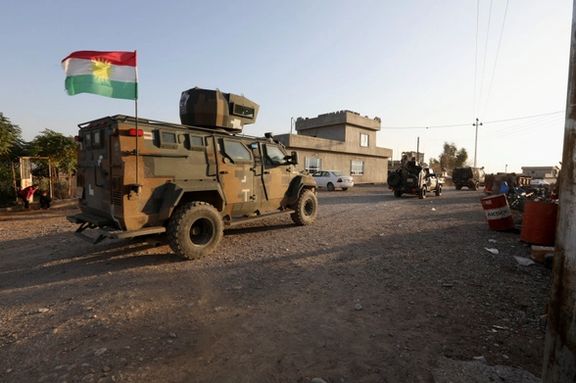
Iraqi forces and Kurdish Peshmerga fighters take part in an intensive security deployment after Islamic State militants took it over the previous day in Luhaiban village in Kirkuk, Iraq December 6, 2021.

Iraqi security forces deployed in the northern city of Kirkuk on Sunday as Iran-backed militias have killed several Kurds and continue to threaten more attacks.

According to police and security sources, four Kurds were shot dead and 15 people were wounded during the clashes in the city, controlled by the Iraqi government and home to diverse groups of people including Kurds, Turkmens, and Arabs.

Amir Shwani, a spokesman for Kirkuk police, said in a statement that a curfew had been lifted and vehicles were moving normally in the city on Sunday, but security forces had deployed additional troops to "prevent violence and protect civilians."

The city has been a point of contention, witnessing disputes between Kurdish forces and the Iraqi government. Iranian-backed militias have recently escalated aggression in the region, firing rockets to target gas fields on the road to Sulaymaniyah, a large city in the Kurdistan autonomous region about 100 kilometers west of Kirkuk.

Flames and smoke rise from oil wells inside the Bai Hassan oilfield, which was attacked by militants, close to the northern Iraqi city of Kirkuk, Iraq, May 5, 2021.
100%
Flames and smoke rise from oil wells inside the Bai Hassan oilfield, which was attacked by militants, close to the northern Iraqi city of Kirkuk, Iraq, May 5, 2021.

The clashes followed days of tensions over a building in Kirkuk that was once the headquarters for the Kurdistan Democratic Party (KDP) but was used by the Iraqi army as a base since 2017. Iraq's federal supreme court issued an urgent ruling on Sunday obliging the government to delay procedures regarding the handover of the building to the KDP.

Kirkuk, an oil-rich province in northern Iraq along the fault lines between the Kurdish autonomous region and areas controlled by Iraq's Shiite-dominated central government, has been the focus of some of the country's worst post-Islamic State violence. Arab residents and minority groups, who say they suffered under Kurdish rule, have protested the KDP's return to the city.

“Dozens of protesters, mainly members of the Iran-backed Asaib Ahl al-Haq militia and their supporters, have set up tents near the JOC headquarters since Sunday evening in protest to the potential return of the KDP. They have blocked access to the highway and vowed to continue their demonstration until [Prime Minister Shia al-Sudani retracts his decision,” Rudaw Kurdish news agency reported reported.

Similar clashes are also happening between Kurdish-led forces and groups of Islamic militias and tribes in eastern Syria. The violence has killed 49 fighters from both sides and eight civilians, according to the Syrian Observatory for Human Rights war monitor.

The involvement of the pro-Iran militias also has another dimension. Late in August, Iran and Iraq formalized an agreement to dismantle Iranian Kurdish dissident factions stationed in the northern reaches of Iraq and relocate them from their bases.

Nasser Kanaani, spokesperson for Iran's Foreign Ministry, said the Iraqi government had undertaken the commitment "to disarm the armed terrorist groups stationed in Iraq's territory by September 19, and subsequently, evacuate and transfer them from their military bases to camps designated by the Iraqi government."

Historically, Iran has intermittently executed targeted operations against the Kurdistan Democratic Party in Iran (KDPI) and other Iranian Kurdish dissident elements operating within Iraq's semi-autonomous Kurdish region, adjacent to Iran's borders.

Various Iranian dissident factions in Iraq have aligned their allegiances with the two principal Iraqi Kurdish parties: the Kurdistan Democratic Party, headquartered in Erbil, and the Patriotic Union of Kurdistan party, with its stronghold in Suleimaniyah.

Most Viewed

US blockade enters murky phase as tankers spoof signals and buyers hesitate
1
ANALYSIS

US blockade enters murky phase as tankers spoof signals and buyers hesitate

2
INSIGHT

Ideology may be fading in Iran, but not in Kashmir's ‘Mini Iran'

3
INSIGHT

Hardliners push Hormuz ‘red line’ as US blockade tests Iran’s leverage

4
VOICES FROM IRAN

Hope and anger in Iran as fragile ceasefire persists

5

US sanctions oil network tied to Iranian tycoon Shamkhani

Banner
Banner

Spotlight

  • Hardliners push Hormuz ‘red line’ as US blockade tests Iran’s leverage
    INSIGHT

    Hardliners push Hormuz ‘red line’ as US blockade tests Iran’s leverage

  • Ideology may be fading in Iran, but not in Kashmir's ‘Mini Iran'
    INSIGHT

    Ideology may be fading in Iran, but not in Kashmir's ‘Mini Iran'

  • War damage amounts to $3,000 per Iranian, with blockade set to add to losses
    INSIGHT

    War damage amounts to $3,000 per Iranian, with blockade set to add to losses

  • Why the $100 billion Hormuz toll revenue is a myth
    ANALYSIS

    Why the $100 billion Hormuz toll revenue is a myth

  • US blockade targets Iran oil boom amid regional disruption
    ANALYSIS

    US blockade targets Iran oil boom amid regional disruption

  • Iran's digital economy battered by prolonged blackout
    INSIGHT

    Iran's digital economy battered by prolonged blackout

•
•
•

More Stories

IRGC Deputy Says Mass Pilgrimage To Iraq Is To Defend Hijab And Khamenei

Sep 3, 2023, 15:33 GMT+1

A senior Revolutionary Guard commander has said that the main message of the Arbaeen pilgrimage to Iraq is defending hijab and the Supreme Leader.

Gen. Mohammad-Reza Naghdi, the coordinating deputy to IRGC commander Hossein Salami, made the remarks during an event about the Arbaeen Shiite ceremony that the Islamic Republic regime views the event as a show of influence in the region.

Naghdi said promoting the pilgrimage on media is in line with the regime’s efforts to emphasize on the principles of Velayat-e Faghih – another term for the rule of the Supreme Leader – and observance of hijab.

The uprising last September has made it increasingly difficult for the clerical regime to enforce the mandatory Islamic dress code, and has damaged the legitimacy of Supreme Leader Ali Khamenei.

The rule of Islamic jurist gives a cleric such as Ali Khamenei extraordinary powers including the power to overrule all elected bodies and officials and hence, people’s choice. As a system of governance, Velayat-e Faqih has underpinned the way the Iranian regime has operated since the country’s 1979 Islamic Revolution. At its most basic, the theory -- advocated by some Shiite thinkers -- justifies the rule of the clergy over the state.

Despite numerous incentives to encourage the pilgrimage, including providing free medical services and rest stops along the way, free internet on the road and inside Iraq, offering interest-free loans and granting 200,000 Iraqi dinars ($153) to pilgrims, the number of Iranians willing to undertake the Arbaeen Shiite pilgrimage is in decline.

Media In Tehran Raise Questions About Oil Exports And Revenues

Sep 3, 2023, 12:55 GMT+1
•
Iran International Newsroom

Some media outlets in Iran are discussing apparent contradictions between estimated volume of oil exports and the income the government has secured.

Foreign sources monitoring Iran’s oil shipments estimated in August that daily exports reached close to two million barrels per day, after climbing to one million in 2022 and 1.5 million earlier this year. A Reuters survey published August 31 showed that OPEC’s oil output rose in August as Iranian supply jumped to its highest since 2018, despite ongoing cuts by Saudi Arabia and other members of the wider OPEC+ alliance to support the market.

However, the head of Iran’s Planning and Budget Organization, Davoud Manzoor, said in late August that only half of the government’s projected income form oil exports has materialized since the beginning of the current Iranian calendar year on March 22. He also claimed that the oil was sold at around $60 per barrel. 

Given the fact that in this period the government was expecting to earn around $13 billion from oil exports, the Fararu website in Tehran argued that Manzoor’s statement means the government earned only $6.5 billion.

the head of Iran’s Planning and Budget Organization, Davoud Manzoor (undated)
100%
the head of Iran’s Planning and Budget Organization, Davoud Manzoor

Apart from uncertainty about the real volume of Iran’s oil exports, another puzzle preoccupies the media. How much discount Iran provides to buyers of its oil. Perhaps that discount should explain why the government has earned only half of the expected oil revenues.

If an average daily 1.5 million barrels of oil was sold since March at $60 a barrel, the government should have earned $13.5 billion, EcoIran and Fararu websites point out. Therefore, either the volume of exports was lower, or the Islamic Republic offered deeper discounts amid US sanctions on its oil exports and banking transactions.

This leads to the belief that Iran is offering its oil at closer to $30 a barrel, while Russia, which is also under sanctions, sells its crude at around $60, and Tehran must compete with its ally to attract Chinese buyers.

The $30 price estimate comes from an average daily export of 1.5 million barrels, that industry sources have been reporting in recent months. At that price, Iran could earn $6.75 billion in five months since March, which is close to what Manzoor, the head of the Budget organization announced as government oil revenues in this period.

There is also the possibility that China pays more for the oil on paper, but actually remits much less in cash and the rest in barter. There are also middlemen who facilitate the illicit oil shipments and launder the payments for Iran amid banking sanctions. These activities could also take a big chunk out of the revenues.

Tankers carrying Iranian oil usually engage in ship-to-ship transfers in Asian waters to hide the origin of the shipments before it reaches China.

A substantial part of these hard currencies is sold at a subsidized rate to importers of essential goods, such as food and animal feed. While one US dollar fetches 500,000 rials on the open market, the government provides the hard currency at 285,000 rials for imports of food and medicine.

Since the United States exited the JCPOA nuclear accord and imposed the sanctions in 2018, Iran has been selling its oil in clandestine methods to China. Export volumes and prices are a state secret, and all figures are estimates by industry observers and occasional bits and pieces of information from government officials.


Reform Activists In Iran Demand Referendum On Protest Anniversary

Sep 3, 2023, 08:25 GMT+1
•
Iran International Newsroom

More than 300 reform activists and figures in Iran have issued a statement demanding a referendum on the future political shape of the country.

Expressing support for the "Woman, Life, Freedom" movement and those killed and imprisoned by the regime, the activists pointed out, "We repeatedly remind that the structure of religious authoritarianism not only undermines our national foundations but also propels us towards future upheavals and movements towards rebellion."

Two weeks before the anniversary of Iranian protests, the pro-reform individuals representing a more radical posture than former President Mohammad Khatami demanded a referendum to make "structural changes" in the Islamic Republic political system.

Iranians expect renewed protests on the anniversary of the "Woman, Life, Freedom" movement later this month, and the signatories of the statement, without explicitly calling for demonstrations, voiced support for young dissidents. "Now, we express our solidarity once again with all the families affected by the protests of the past year and hold the uprising of young people seeking freedom and equality, especially the resistance of justice-seeking and freedom-loving women, in high regard," they emphasized.

"Therefore, structural change and a referendum to establish a government derived from the people's vote will remain a right that we continue to advocate so that Iran no longer suffers beyond what it already has," they said.

Protesters set fire to a motorcycle of the security forces as protests began on September 19, 2022
100%
Protesters set fire to a motorcycle of the security forces as protests began on September 19, 2022

Iran's reformists, who advocate for a more humane version of the Islamic Republic as a form of government, have been driven out of power by hardliners in the past three years. Even moderate conservatives, such as former parliament speaker Ali Larijani, have been pushed into retirement from public office.

When nationwide protests began in September 2022, after the death in custody of Mahsa Amini, reformists were initially ambivalent toward the movement, which appeared to be more radical than simply demanding reforms within the Islamic Republic system. Prominent reformists adopted contradictory postures, with many rejecting regime change as the desirable goal of the protests.

On November 14, two reform figures, former President Mohammad Khatami (1997-2005) and former vice president Massoumeh Ebtekar, broke their silence after more than 8 weeks of protests about the possible demise of the regime and voiced their opposition to dramatic changes in Iran.

Khatami revealed his opposition to regime change by saying that it was "neither possible nor desirable." Nonetheless, he warned that if the current state of affairs continues, the ground is paved for a looming social collapse.

The divergence of opinions among reformists sharpened in February when former prime minister and Green Movement Leader Mir-Hossein Mousavi issued a statement demanding "fundamental change" based on the "Woman, Life, Freedom" movement and constitutional revisions. Mousavi, who has been under house arrest since 2011, said in his statement that the people have given up hope for reforms and they demand widespread change.

Although Mousavi did not openly call for regime change, the demands he put forward could lead to a new and more democratic political system. Ironically, his statement implicitly repeated what exiled Prince Reza Pahlavi has been saying for years, and other opposition figures were demanding during the protests. Mousavi was a pre-imminent Islamic revolutionary in the 1980s.

Khatami, as the symbolic father of the reform movement, nevertheless has maintained his more loyalist position, asking for reforms, while parliamentary elections in March put average reformist figures in a quandary of whether to announce their candidacy or boycott what, in most probability, will turn out to be another engineered vote by the ruling hardliners.

The 300 mostly reformist figures who have signed the latest statement appear to have adopted a position closer to Mousavi, by calling for a referendum.

Controversy Erupts Over Removal Of Makeup Artist Licenses In Iran

Sep 2, 2023, 22:44 GMT+1
•
Iran International Newsroom

A decision by Iran’s ministry of labor to revoke licenses for many female makeup and beauty salons and workers has ignited a contentious debate in Iran.

Critics view it as an attempt to limit employment opportunities for women. According to a report by the Shargh newspaper, the Technical and Vocational Organization of the Ministry of Labor has taken the step, which has drawn widespread criticism.

The move is part of regime efforts to crack down on “un-Islamic” social behavior as more Iranian women unveil and appear in public in ordinary attire.

Makeup artists argue that the revocation of their licenses not only hinders new women from entering the field of nail and eyelash extensions and other cosmetic services, but also compels established professionals to operate their businesses in an underground, unregulated manner.

Previously, educational standards for the nail and eyelash extension industry had been accessible through the national portal of the Technical and Vocational Organization, allowing private educational institutions to offer courses, define curricula, charge tuition fees, and conduct training programs accordingly.

However, Shargh newspaper reports that these standards were abruptly removed from the national portal without prior notice. This development leaves graduates who completed their training courses in limbo, as they are no longer able to take the professional competency exams.

Shargh links this situation to a draft law known as the "chastity and hijab" bill, currently being discussed in parliament. It appears that the government is preemptively acting ahead of the bill's passage, with the Ministry of Labor quietly revoking the licenses of some female makeup artists.

On Friday, United Nations rights experts issued a statement calling Iran’s so-called hijab law an outright tool for gender discrimination.

“The draft law could be described as a form of gender apartheid, as authorities appear to be governing through systemic discrimination with the intention of suppressing women and girls into total submission,” the UN experts said. They emphasized that the proposed “Bill to Support the Family by Promoting the Culture of Chastity and Hijab” and existing restrictions are “inherently discriminatory” and may amount to gender persecution.

In a related report, Etemad newspaper suggests that parliament is considering a "ban on nail and eyelash extensions for women" based on provisions in the chastity and hijab bill. The report also notes that parliament members have proposed various suggestions connected to this bill, including prohibiting nail and eyelash extensions for all female students, teachers, and women working in education, both in administrative and instructional roles.

Simin Mohammad Baqeri, the head of the Women's Care and Beauty Schools Association in Tehran, confirmed these restrictions to Shargh. She emphasized that the ban on eyelash and nail extensions alone affects approximately 15 subbranches of the industry.

This sudden government action is expected to lead to a significant number of women either becoming unemployed or resorting to underground employment, thereby relinquishing their legal rights in the job market.

Although there is no precise data on the number of female makeup artists in Iran, a report from 2015 indicated that around 20,000 beauty salons out of 21,000 were operating illegally in Tehran. However, in recent years, more than one-third of these establishments have closed due to stricter regulations, resulting in approximately 747 legal beauty salons remaining in Tehran.

This trend is not confined to Tehran; it is also observed in Mashhad. According to the Women's Care and Beauty Schools Association in Mashhad, prior to 2019, approximately 2,000 beauty salons were operating legally in the city. However, due to the COVID-19 pandemic and associated restrictions, nearly 35% of these businesses have shuttered, leaving approximately 1,300 legal beauty salons in operation.

Iranian Activist Sentenced To 15 Months After Unmasking Interrogator

Sep 2, 2023, 22:00 GMT+1

Iranian activist and labor journalist Sepideh Qolian, who was jailed before, has received a 15-month prison sentence due to a complaint by pro-regime reporter.

Qolian (Gholian) gained prominence for her journalistic coverage of prolonged labor strikes at the Haft-Tappeh sugar factory during 2017-2018. Her advocacy on behalf of workers' demands resulted in her arrest and subsequent imprisonment.

In 2019, while detained at Qarchak Prison, Qolian witnessed her own confessions being broadcast on state television. She identified the TV presenter as Ameneh Sadat Zabihpour, known as a mouthpiece for the Iranian regime. She was also a prison interrogator referred to as Ms. Askari during her interrogations. The case was publicized by Qolian which led to Zabihpour filing a lawsuit against her.

Interrogator and state TV "reporter"  Ameneh Sadat Zabihpour. Undated
100%
Interrogator and state TV "reporter" Ameneh Sadat Zabihpour

The latest court session pertaining to this case took place on August 22. Notably, this session was conducted in secret due to Qolian's refusal to wear the mandatory hijab.

Mehdi Qolian, Sepideh's brother and a civil activist himself, documented the court proceedings on his Instagram account. He reported that Zabihpour repeatedly objected to Sepideh's presence in court without wearing a headscarf. In response, the court judge issued a "criminal offense" against Sepideh for this reason.

Throughout the court session, Zabihpour, who combines the roles of an interrogator and a reporter, persistently threatened Qolian with charges such as "spying" and "sedition" from the moment she entered the courtroom.

Qolian's commitment to activism remained unwavering even after she completed a four-year prison term and was released in March. Shortly after her release, she was re-arrested for publicly chanting against Supreme Leader Ali Khamenei while not wearing a hijab. This led to an additional two-year prison sentence.