• العربية
  • فارسی
Brand
  • Iran Insight
  • Politics
  • Economy
  • Analysis
  • Special Report
  • Opinion
  • Podcast
  • Iran Insight
  • Politics
  • Economy
  • Analysis
  • Special Report
  • Opinion
  • Podcast
  • Theme
  • Language
    • العربية
    • فارسی
  • Iran Insight
  • Politics
  • Economy
  • Analysis
  • Special Report
  • Opinion
  • Podcast
All rights reserved for Volant Media UK Limited
volant media logo

Iran Increases Stockpile Of Nuke Material With Slower Pace
Sep 4, 2023, 14:58 GMT+1
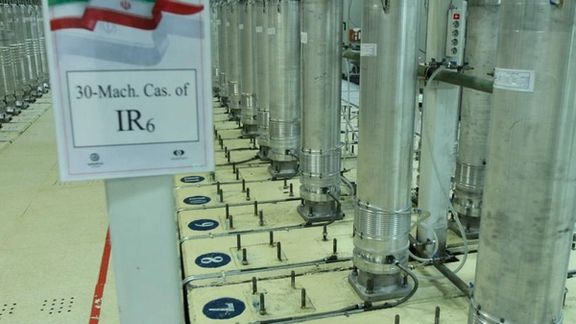
A cascade of centrifuges enriching uranium in an Iranian underground facility

Iran's stock of uranium enriched to up to 60 percent purity, close to weapons grade, continues to grow, the UN nuclear watchdog said on Monday in a report.

In reports to diplomats of countries forming the board of directors of the International Atomic Energy Agency (IAEA), the watchdog’s experts also said there has been no progress in talks with Tehran on sensitive issues such as explaining uranium traces at undeclared sites. The head of Iran’s nuclear agency has claimed repeatedly in recent months that the IAEA’s questions have been “satisfactorily” addressed regarding to the undeclared sites use more than two decades ago.

According to one of the confidential quarterly reports to member states seen by Reuters and other media, the IAEA said Iran's stockpile of uranium enriched to up to 60-percent purity, close to the roughly 90% of weapons grade, continued to increase albeit at a slower pace, despite some of it having been diluted.

"The (IAEA) Director General (Rafael Grossi) regrets that there has been no progress in resolving the outstanding safeguards issues in this reporting period," one report said, referring to Iran's failure to credibly explain the origin of uranium particles found at two undeclared sites.

The reports, sent to IAEA member states ahead of a quarterly meeting of the IAEA's 35-nation Board of Governors next week, also said that after limited progress on re-installing IAEA surveillance cameras in the previous quarter, there had since been none, further raising tensions with Western powers.

IAEA Director Rafael Grossi speaking on June 5, 2023
100%
IAEA Director Rafael Grossi speaking on June 5, 2023

Iran and the IAEA announced an agreement in March on re-installing surveillance cameras introduced under a deal with major powers in 2015 but removed at Iran's behest last year. Only a fraction of the cameras and other monitoring devices the IAEA wanted to set up have been installed. But US officials have already acknowledged, according to Bloomberg that they have reduced enforcement of sanctions that has led to a doubling of Iran's oil exports since mid 2022.

Adding to the issues likely to cause tension with the West, Iran's stock of uranium enriched to up to 60 percent grew by an estimated 7.5 kg to 121.6 kg, the report said, even though 6.4 kg of it was diluted with uranium enriched to a lower level.

Iran's production of uranium enriched to up 60 percent has slowed to around 3 kg a month from about 9 kg a month previously, a senior diplomat said.

Other diplomats have said the slowdown could be part of so-called "de-escalation" efforts between Iran and the United States also involving Iranian funds frozen abroad and US prisoners held in Iran, though US Secretary of State Anthony Blinken has denied the issues are linked.

"Of course, Iran claims (the slowdown in enrichment to up to 60%) as a positive, but more HEU (highly enriched uranium) is still more HEU," one Western diplomat said.

CAMERAS WITHOUT FOOTAGE

Iran's stock of uranium enriched to 60 percent is now almost three times the roughly 42 kg that by the IAEA's definition is theoretically enough, if enriched further, to produce a nuclear bomb. Experts add, however, that some uranium would be lost in the process. Iran denies wanting to produce nuclear weapons.

The IAEA continues to have regular access to Iran's declared nuclear facilities and its core nuclear activities under long-standing agreements that predate the 2015 nuclear deal, but the 2015 deal added monitoring to areas such as the production of parts for centrifuges, machines that enrich uranium.

Even where IAEA monitoring equipment has been re-installed, such as at a site in Isfahan, it does not have access to the footage that its cameras record since that was not included in the March agreement it negotiated with Iran.

One of Monday's reports spelled out that problem.

"The Director General reiterates that for Agency cameras to be effective, including those installed at Esfahan, the Agency needs access to the data they record."

With reporting by Reuters, Bloomberg
Most Viewed

US blockade enters murky phase as tankers spoof signals and buyers hesitate
1
ANALYSIS

US blockade enters murky phase as tankers spoof signals and buyers hesitate

2
INSIGHT

Ideology may be fading in Iran, but not in Kashmir's ‘Mini Iran'

3
INSIGHT

Hardliners push Hormuz ‘red line’ as US blockade tests Iran’s leverage

4
VOICES FROM IRAN

Hope and anger in Iran as fragile ceasefire persists

5

US sanctions oil network tied to Iranian tycoon Shamkhani

Banner
Banner

Spotlight

  • Hardliners push Hormuz ‘red line’ as US blockade tests Iran’s leverage
    INSIGHT

    Hardliners push Hormuz ‘red line’ as US blockade tests Iran’s leverage

  • Ideology may be fading in Iran, but not in Kashmir's ‘Mini Iran'
    INSIGHT

    Ideology may be fading in Iran, but not in Kashmir's ‘Mini Iran'

  • War damage amounts to $3,000 per Iranian, with blockade set to add to losses
    INSIGHT

    War damage amounts to $3,000 per Iranian, with blockade set to add to losses

  • Why the $100 billion Hormuz toll revenue is a myth
    ANALYSIS

    Why the $100 billion Hormuz toll revenue is a myth

  • US blockade targets Iran oil boom amid regional disruption
    ANALYSIS

    US blockade targets Iran oil boom amid regional disruption

  • Iran's digital economy battered by prolonged blackout
    INSIGHT

    Iran's digital economy battered by prolonged blackout

•
•
•

More Stories

Iranian Government’s Annual Borrowing Reaches 30% Of GDP

Sep 4, 2023, 12:08 GMT+1
•
Mardo Soghom

The Iranian government’s debt surged by 61% during the last budgetary cycle, amid a severe economic crisis, as reported by Parliament’s Research Center on Sunday.

The huge jump occurred during the first full year of Ebrahim Raisi’s presidency, dominated by hardliners, who insisted on continuing their anti-Western foreign policy and claiming that economic sanctions imposed on Iran can be defeated. The period spans from March 22, 2022, to March 21, 2023, or the Iranian calendar year 1401.

The annual borrowing total reached nearly $50 billion, representing 30 percent of the yearly GDP. This level of borrowing is unprecedented and indicates an increase in money printing by the government, which is likely to result in further inflation, since the borrowing was entirely from domestic state or quasi-governmental banks. In turn, these banks face huge debts and an unstable financial situation. Therefore, when the government borrows from these institutions, they have to turn to the Central Bank of Iran for liquidity and the central bank has to print more money.

To provide context, Turkey's total government debt is equivalent to 31 percent of its annual GDP, whereas in Iran's case, one year's borrowing alone has reached the same level.

An employee of Iran’s Central Bank checking the quality of newly printed banknotes (File photo)
100%
An employee of Iran’s Central Bank checking the quality of newly printed banknotes

This development poses the question about Iran’s increased oil exports in 2022 and 2023, which should have provided financial resources to the government and forestalled more borrowing. During the period in question Iran sold around 1.2 million barrels of oil daily, mostly to China, and with high prices in 2022 it should have brought in at least $26 billion even if sold the oil at the discounted price of $60 per barrel. 

Around $11 billion is provided at deeply discounted exchange rates to importers of food, medicine and animal feed. This means that around $5 billion is “wasted” on indirect subsidies. That still leaves around $20 billion for other government expenses, including 15 percent as share of the National Oil Company.

This is basically half of what the government needs from oil exports in order to balance its budget, and it explains why it was forced to borrow more, or to be precise, to print more money. But $20 billion in 2022 was probably more than the government had earned from oil exports in previous years since 2018, when the United States imposed sanctions on Iran’s oil exports.

One explanation about why the government fell into more borrowing in 2022-2023 could be that national reserves dwindled after repeated withdrawals since 2018. A report in August indicated that in the past decade Iran withdrew $140 billion from its National Development Fund, mostly since 2018, leaving an estimated small amount of $10 billion.

Oil exports are said to have increased in recent months reaching 1.5 million and in August surging to around 1.9 million barrels a day, as the United States relaxed its enforcement of sanctions to try to reach a nuclear deal with Tehran.

However, it is not clear how much discount Iran is offering Chinese importers to compete with discounted oil from Russia. In recent days, media in Tehran estimated that the government could be selling its oil for as little as $30 per barrel, given a statement by a top official that it was able to earn just half of what it expected from March to August of this year.

Annual inflation is already hovering at around 50 percent and the national currency has fallen by 50 percent in one year to 500,000 rials per one US dollar. The coming months will show if the higher borrowing will lead to even higher inflation.

Iran Says Ready For Military Exercises With 'Friends And Allies'

Sep 4, 2023, 12:07 GMT+1

Iran’s Commander of the Army Air Defense Force has declared the readiness to engage in cooperative military activities with "friendly and allied" countries.

During a meeting of foreign military attaches stationed in Tehran, Brigadier General Alireza Sabahifard said that Iran is prepared to expand various forms of military cooperation, which include planning joint exercises and exchanging technical and operational expertise, as well as holding regular bilateral meetings.

As reported by the Fars News Agency, Sabahifard also emphasized the army’s need to exchange knowledge and experience with allies, as well as share new scientific developments and the strategic aims.

Prioritizing equipment reliability and operational performance enhancement, he disclosed ongoing efforts to carry out necessary maintenance and repairs, aligning with standard practices adopted by military forces around the world.

The announcement comes against the backdrop of heightened tensions in the region. In recent weeks, the United States has increased its military presence in response to Iran's actions aimed at disrupting maritime traffic in the Strait of Hormuz and the surrounding waters.

The Pentagon's response included the deployment of additional F-35 and F-16 fighter jets, along with a warship to the Middle East. These measures were taken to monitor crucial waterways in the region following Iran's seizure and harassment of commercial shipping vessels.

Incidents involving shipping in Persian Gulf waters have occurred since 2019 during times of escalated tensions between the United States and Iran. The Strait of Hormuz, through which approximately one-fifth of the world's crude oil and oil products pass, remains a strategically vital maritime choke point.

Iranian FM Sets Ambitious Goal For Trade Relations With Turkey

Sep 4, 2023, 11:09 GMT+1

Iranian Foreign Minister Hossein Amir-Abdollahian met with his Turkish counterpart, Hakan Fidan, in Tehran to discuss the expansion of bilateral trade relations.

During the meeting, Amir-Abdollahian announced an ambitious goal of increasing trade between the two nations up to 30 billion euros.

The two foreign ministers reiterated their commitment to strengthening economic ties and agreed to sign a comprehensive agreement on trade cooperation.

Notably, during the presidency of Mahmoud Ahmadinejad, Iran and Turkey had previously agreed to increase bilateral trade to 30 billion dollars by 2016. However, recent official figures from Turkey reveal that the trade volume remains significantly lower, with total exports to Iran amounting to only 1.66 billion dollars in the first seven months of this year, and imports from Iran standing at 1.36 billion dollars.

Last year, the total bilateral trade between Iran and Turkey amounted to less than 6.4 billion dollars, underscoring the need for renewed efforts to achieve the ambitious trade target.

Meanwhile, Hakan Fidan, the Turkish Foreign Minister, emphasized the need for cooperation between Turkey and Syria in combating the Kurdish PKK group, recognized as a terrorist organization by Turkey, the European Union, and the United States. He called for increased collaboration between the Syrian government and Ankara on this issue.

Amir-Abdollahian echoed the importance of addressing Turkey and Syria's concerns related to terrorism, border security, and refugees through diplomatic dialogue, emphasizing respect for the sovereignty and territorial integrity of both countries.

Iranian Politicians Discuss Upcoming Elections With Resentment

Sep 4, 2023, 08:11 GMT+1
•
Iran International Newsroom

Some of Iran's high-profile politicians have spoken about the upcoming parliamentary elections in March 2024, albeit with a tone marked by bitterness. 

Former parliamentary Speaker Ali Larijani made it clear in an interview with centrist website Entekhab that he is not going to run for parliament (Majles) in March. However, he said that he will explain his reasons for not taking part in the election at a later date.

Larijani's aides had said earlier that although he is not going to run himself, he will present a list of likeminded candidates including his brother-in-law, outspoken moderate conservative former lawmaker Ali Motahari who at times has even criticized Supreme Leader Ali Khamenei's policies. 

Larijani who still harbors hard feelings about his disqualification in the 2021 Presidential election, criticized the current ultraconservative-dominated parliament and teasingly called its hardliner members "wheeling-dealing revolutionaries."

"They claim to be revolutionaries and they want to win all the positions in the government," Larijani said. He added that this group's presence in the Iranian politics dates back to the early days after the 1979 Islamic revolution. "They have always tried to create a bipolar situation and attempted to kick their political rivals out of the scene," he said. 

Former parliamentary Speaker Ali Larijani and Supreme Leader Ali Khamenei   (undated)
100%
Former parliamentary Speaker Ali Larijani and Supreme Leader Ali Khamenei

Larijani once again talked about his idea of political purification adding that this is a policy hardliners are advancing in order to ensure that others are excluded political competition and participation. 

This purging, he said, will belittle the revolution and will inevitably lead to the disintegration and fragmentation of the nation. 

However, Larijani charged that hardliners are furthering the idea of political purification to secure their personal and factional interests. They do not believe that positions of power should be held by individuals who have the right talent and capability for those posts. 

Meanwhile, Khabar Online reported last week that Former President Mahmoud Ahmadinejad is also going to present a list of candidates for the Majles elections. However, according to the website, although Ahmadinejad and his aides will actively take part in presenting the list, their main objective is to secure a foothold for the 2025 Presidential election, when Ahmadinejad is hoping to have a political comeback. 

For the Majles, Khabar Online wrote that Ahmadinejad's team may independently present a list of candidates for all the constituencies although they might decide at one point to come up with a shared list of candidates with one of the major conservative camps. 

Like Larijani, Ahmadinejad has also tasted the bitter disqualification by Khamenei's Guardian Council in previous presidential elections. If they are ever allowed to run again, that would mean that Khamenei is desperate to have a high-turnout election. 

In another development, conservative heavyweight Mohammad Reza Bahonar, who has repeatedly spoken with the media, warning about a low turnout, has once again lashed out at current lawmakers for their inefficiency, which he said has disappointed Iranian voters.

Bahonar, who like Larijani and Ahmadinejad, is a member of the expediency Council, said in an interview with Khabar Online that Khamenei usually issued an occasional warning about previous parliaments' performance, but he has warned the current parliament several times about various legislative matters. 

Bahonar said that he has told Speaker Mohammad Bagher Ghalibaf that one of the main weaknesses of the current Majles is that it does not have a powerful minority faction. The lawmakers think they have no rivals and challenges ahead of them, and that they can do whatever they like. 

Nonetheless, the Majles and the government are in a state of denial about almost everything. Vice President Mohammad Hosseini told the press on Friday that the previous government should be blamed for the low turnouts in recent elections, without presenting any evidence.

Homeownership Impossible In Tehran As Quality Of Life Drops

Sep 3, 2023, 23:28 GMT+1
•
Iran International Newsroom

Owning a home in the Iranian capital Tehran has become virtually impossible while the key indicators of the quality of life are also in decline. 

Iran's leading economic daily Donyaye Eqtesad (World of Economy) published an article Saturday listing a plethora of problems facing the residents of the capital. 

The average time people needed to save money to be able to buy a residence in Tehran has increased to a staggering 112 years, from about 22 years in 2005. According to Donyaye Eqtesad, the period of time for those born since late 1990s -- the so-called generation Z -- is now estimated to be 200 years.

Economist Hassan Mansour told Iran International that the Housing Affordability Index is about four to 10 years in England, where housing prices are among the most expensive in the world. “This means there is no hope for Iranians to own a home,” he noted.

Last week, Mohsen Pirhadi, the vice-chairman of the parliamentary committee for Iran’s Seventh National Development Plan, said the government plans to reduce the timespan to 12 years in the next development plan. Despite launching seven development plans since the 1980s, to continue building infrastructure, establishing key industries, and expanding public services and education, which were fast expanding during the monarchy, Iran still remains classified as a developing country, with an average economic growth rate of only 2.5 percent during the Islamic Republic.

A view from the capital Tehran   (file photo)
100%
A view from the capital Tehran

Donyaye Eqtesad released the new data after Tehran's city council members held a meeting with officials of the municipality and experts to mull over a comprehensive plan for the capital, comparing the current indicators about the city with those of 2005. Three major indicators of "quality of life" in Tehran have significantly deteriorated since then, with affordable housing, air pollution and urban decay being the main issues.  

Amir Mansouri, a professor at the Faculty of Architecture at the University of Tehran, said during the meeting that "We live in a city where half of the population is in danger of devastating earthquakes, the price per square meter of housing exceeds 600 million rials (approximately $1,300), and ordinary people can no longer afford to buy a home in this city, even renting a place in some neighborhoods has become impossible.” The monthly minimum take-home pay (without benefits) is around $120.

Earlier reports in mid-2022 indicated that there was a more than 300 percent rise in rents in Tehran in a matter of three years. And figures released in December 2021, some six months after Ebrahim Raisi took office as President indicated that food and housing expenses had risen between 300 to 740 percent during the preceding six years while wages went up by around only 270 percent during the same period. A prominent economist, Hossein Raghfar, said earlier this year that high rents in Tehran have pushed many tenants to the less expensive margins of the capital where a new social sub-class is taking shape, with some people having chosen to live in makeshift houses built on some of Tehran's rooftops.

According to a report by reformist daily Shargh earlier this week, the Iranian government has exerted pressure on real estate advertising platforms to keep property prices hidden. The newspaper also noted that for the past eight months, the government has refrained from disclosing housing market data on the official portals of the Iranian Statistical Center and the Central Bank. 

Mansouri added that the residents of the capital are exposed to polluted air for more than 200 days a year. Tehran has been logged as the most polluted city in the world for at least several days per year. The capital’s pollution is mainly blamed on poor government policies, desertification and low water levels, as well as climate change that has intensified sandstorms. 

Moreover, the usage of highly polluting diesel and mazut fuels in power plants -- instead of natural gas -- jumped in Iran in 2021 on top of increases in previous years. Mazut -- commonly called waste oil -- is a heavy, low quality fuel oil, only used when the facilities to blend or break it down into more conventional petrochemicals such as diesel are not available.

Iran has the world’s second largest natural gas deposits but is unable to boost production because it lacks capital and Western technology. It needs to invest $40 billion in modernizing and expanding its gas fields, but most are in the Persian Gulf and need Western technology. Due to its anti-West foreign policy and an expanding nuclear program, Iran is under US sanctions and cannot borrow money or technology from the West.