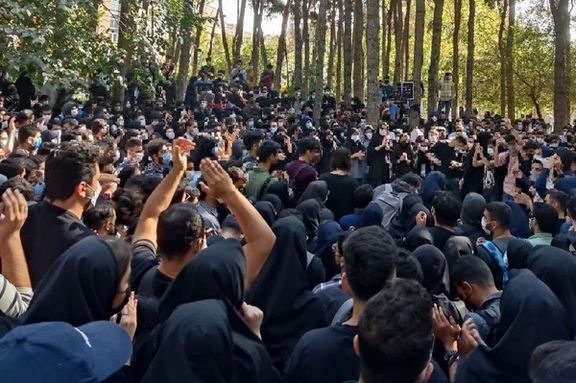
Protests by university students in Tehran in October 2022
The Chancellor of Tehran University claims that dissident professors are being sacked because of “ethical issues,” while hardliners say it is a “Revolutionary act.”
“I have full knowledge that some of these individuals were terminated because they had moral issues and have been sued [by alleged victims] but they claim in the media that their termination was politically motivated,”Mohammad Moghimi, Chancellor of Tehran University, told the Iranian Labour News Agency (ILNA) Sunday.
The Ministry of Higher Education has not commented on the recent dismissals of dozens of professors. However, on August 28, the Interior Ministry released a statement denouncing criticism of the expulsions as "media propaganda" and defended the Higher Education Ministry’s "revolutionary action" against “a few professors who were academically sluggish”.
The Interior Ministry's statement also accused the sacked professors who had opposed the crackdown on students during anti-government protests, of "political immorality and media show-off," and of "defiling" the academic arena with their "factional and even anti-national views."
Mohammad Moghimi, Chancellor of Tehran University
According to the reformist Etemad daily, 52 professors have been removed from their posts at several universities across Iran since President Ebrahim Raisi’s administration took office two years ago. Additionally, the Human Rights Activists News Agency (Hrana) stated last week that at least twenty-four professors have been sacked since mid-July this year.
Etemadclaimed, that these professors included those who were “banned from entering their university, banned from teaching, fired, or forced into retirement” under various pretexts including “lacking academic proficiency”.
Some of the professors who have recently been terminated have stated their political beliefs and actions, including signing statements in support of last year’s protests and protesting students, as the reason for their removal from their posts.
Moghimi accused these professors of lying and called their social media statements “extremely unethical”.
Supreme Leader Ali Khamenei has on many occasions stressed that universities must be Islamic and those who are not aligned with the regime should not be allowed to teach. “Do not employ unreliable individuals in universities at any cost,” he said in a speech in July 2015. “There are good professors, employ them,” he added.
Mirdamadi said those behind the purge in universities aim to “silence universities”. “But previous experience shows that this will not happen,” he said.
Reformist politician Mohsen Mirdamadi
In 1980, soon after the victory of the Islamic Revolution, the new government’s Cultural Revolutionary Headquarters shut down universities for three years to purge the academia of its challengers and to enforce its own Islamic revolutionary ideology (Islamification) in higher education establishments. During this period, thousands of professors and students were purged for various reasons, including political inclinations and western influences.
In a statement on August 27, the National Union of Iranian University Professors criticized the "profuse meddling" of security bodies in academic affairs and warned about the "gradual decline" of universities.
On August 27, the National Union of Iranian University Professors criticized the "profuse meddling" of security bodies in academic affairs and warned of the "gradual decline" of universities. Dr Mohsen Borhani, a professor of Islamic and criminal law at Tehran University who was dismissed a few months ago for criticizing the regime after the execution of four young protesters, suggested in an August 28 tweet that some professors' dismissals might be due to "illegal orders" by the National Security Council (NSC), headed by Ahmad Vahidi, the interior minister. "Universities and the country will be managed like military barracks when someone from the military becomes interior minister," Borhani remarked.
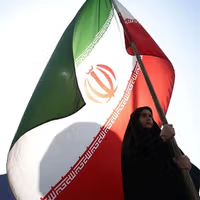
An Iranian woman without mandatory hijab in Tehran
The Iranian regime has developed a mobile application designed to streamline the process of reporting unveiled women in urban areas.
The application, known as Nazer (surveillant), is being made available to individuals who collaborate with a government committee, effectively serving as informants for the regime.
According to a report published in Shargh newspaper and quoted by Mohsen Borhani, a legal expert and lawyer, some individuals have equipped their mobile devices with the Nazer app, which enables them to "patrol the streets and report unveiled women."
The app empowers informants to directly input information, such as license plate numbers, into the system. The consequences of these systematic reports include the issuance of "unveiling notifications" sent via text messages to vehicle owners, often resulting in the impoundment of their vehicles.
Individuals who express their willingness to cooperate with the committee are required to attend brief training sessions. Upon successful completion of these courses, they are granted access to the application, allowing them to actively participate in the surveillance.
It is important to note that the information concerning vehicles and their locations is manually entered into the application without any form of verification. This has raised concerns about the potential misuse of the app and has given rise to a systematic approach to harassing citizens.
The practice of sending hijab notifications to vehicle owners began approximately four years ago, with authorities urging citizens to report instances of non-compliance with mandatory hijab in vehicles through text message reports.
A panel during Iran: Transitional Justice conference in Oslo
A conference focused on protecting the rights of Iranians has discussed economic and environmental justice, and misinformation during transitional periods.
The second and final day of the conference, titled Iran: Transitional Justice, in Oslo brought together experts with specific experience in transitions from authoritarian regimes to democracies.
Kambiz Ghaffari, a journalist and a member of the Iran Human Rights Organization, which are hosts of the conference, shared insights with Iran International from the event, saying that the 22 speakers invited were not only Iranians but international specialists.
Srdjan Darmanovic, former Minister of Foreign Affairs of Montenegro, examined various facets of transitioning from authoritarian governance. He stressed that while discussions of transitions to democracy often evoke an "epic image" of Eastern Europe, the process can be considerably more challenging in some cases.
Nikahang Kowsar, a journalist and environmental analyst, discussed the exploitation of environmental resources during the Islamic Republic's rule. Speaking on a panel dedicated to environmental justice, Kowsar underscored the vital importance of responsible resource management especially water during transitional phases as mismanagement can lead to food insecurity and instability.
This is the third annual conference hosted with the aim to create debate and dialogue between citizens and experts on the challenges of establishing justice during the transitional period, and in parallel, to propose solutions by examining different transition models.
The conference's first day featured Javaid Rehman, a Pakistani-British legal scholar based in London and United Nations Special Rapporteur on Human Rights in Iran who is not allowed to enter the country. Speaking about his pursuit against human rights violations and state brutality, he said he would continue despite all resistance and push for Iran to transition to a democratic state.
A Swedish citizen, part of the EU diplomatic corps, has been covertly detained in Iran for over 500 days as part of Iran's hostage diplomacy, reports The New York Times.
Johan Floderus, 33, who worked for the European Union's diplomatic corps, was arrested at Tehran airport in April 2022 as he prepared to depart the country after what was described as a private tourist trip with friends.
In July 2022, the Iranian government released a statement announcing that it had apprehended a Swedish national for espionage who was being held in Evin prison, however they did not disclose any further details.
The New York Times spoke to six individuals with first-hand knowledge of the case, who all confirmed that Floderus’ had nothing to do with any espionage claims.
The Swedish Ministry for Foreign Affairs said it would not comment on the details of the case, citing a need for secrecy. “A Swedish citizen — a man in his 30s — was detained in Iran in April 2022,” its press department said in a recent email. “The Ministry for Foreign Affairs and the Embassy of Sweden in Tehran are working on the case intensively.”
“We understand that there is interest in this matter, but in our assessment, it would complicate the handling of the case if the ministry were to publicly discuss its actions,” it added.
Floderus was detained when EU diplomats were hard at workto broker a nuclear deal between Iran and the United States. Two top EU foreign policy officials visited Tehran in mid-2022, while they kept his detention hidden from the public and European institutions. It is not clear to what extent the fact that one of their employees was held hostage impacted their mediating role.
Hannah Neuman, a German member of the European Parliament commented on the case on social media saying that parliament should have been informed about Floderus’ arrest, as well as attempts to secure his release and the impact on JCPOA negotiations.
She directly criticized the EU's policy of keeping Floderus’ arrest and detainment a secret as it may impact attempts to revive nuclear diplomacy. Others called for a policy re-think. “A serious recalibration of policy is needed,” said Kasra Aarabi, an academic, who took to social media to comment on the case. He further demanded the proscription of the IRGC and consolidated international action against the Iranian regime.
The European External Action Service, the diplomatic service for which Floderus works confirmed that they have been following the case very closely and that his arrest “underlines the very concerning tendency of Iranians to use EU nationals or Iranian dual nationals as pawns for political reasons." However, neither Swedish nor EU authorities have publicly discussed the situation, citing the need for confidentiality.
“This case has also to be seen in the context of the growing number of arbitrary detentions involving EU citizens,” added Nabila Massrali, a spokeswoman for the EU bloc’s diplomatic body. “We have used and will continue to use every opportunity to raise the issue with the Iranian authorities to obtain the release of all arbitrarily detained EU citizens.”
The arrest of Floderus follows a pattern of Iran detaining dual nationals and foreigners on dubious charges to use them as bargaining chips for prisoner exchanges or to extract concessions and funds.
A recent deal saw five American prisoners being released in return for freeing up $6bn of frozen Iranian funds in South Korea, which puts an approximate price of $1.2bn per head.
Relations between Iran and Sweden have soured recently, notably with the sentencing of a former senior Iranian judicial official, Hamid Nouri, to life in prison in Sweden for war crimes committed in Iran. Iran has escalated pressure on Sweden in response.
People take part in a flash mob in solidarity with the Iranian protests during the 80th Venice Film Festival on September 2, 2023.
A movie about the Islamic Republic’s pressures on Iranian athletes not to face Israeli competitors is the first production co-directed by Iranian and Israeli filmmakers.
The film, which premiered at the Venice Film Festival, had to be shot in secret to prevent possible interference by Tehran, directors Zar Amir Ebrahimi and Guy Nattiv told Reuters on Sunday.
"Tatami", a tense thriller centered on a world judo championship, received a standing ovation during its premier at the weekend. The film takes place over the course of the single day of competition as an Iranian judoka champion, played by Farsi-speaking US actress Arienne Mandi, is ordered to fake an injury to avoid a possible match-up with an Israeli competitor, a scenario that has happened to several Iranian athletes in real life.
Amir Ebrahimi and Nattiv shot the movie in Georgia, a country Iranians can easily visit. They stayed in separate hotels, spoke English and did not let on that they were making such a politically charged film.
"I knew there are many Iranians there, so we were trying to keep it calm and secret," said Amir Ebrahimi, who is an award-winning actress who fled Iran in 2008.
Iran does not recognize Israel's right to exist and has forced athletes into intentionally losing matches, forfeiting games, or claiming injuries to evade encounters with Israeli competitors.
banned its athletes from competing against Israelis in an incident that inspired "Tatami", the International Judo Federation in 2021 gave Iran a four-year ban for pressuring one of its fighters not to face an Israeli.
Last week, a weightlifter was banned from the sport for life after posing for a photograph with an Israeli at the World Master Championships in Poland.
Over the past few years, approximately 30 Iranian athletes have defected from national teams and sought asylum in foreign nations.
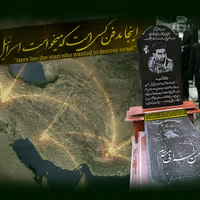
The grave of Mehrshad Shahidinejad, a 20-year-old protester who was beaten to death by Revolutionary Guard agents
The Iranian regime has imposed severe sentences on protesters detained during nationwide rallies and several others who gathered at the grave of a deceased protester.
In Arak, the judiciary sentenced eight people to approximately seven years in prison and over 70 lashes each on charges of "insulting sanctities, disrupting public order, and promoting propaganda against the system" for their presence at the gravesite of Mehrshad Shahidinejad during a religious holiday.
These individuals were arrested while gathering at Shahidinejad's grave on Tasu'a, a Shiite holiday that precedes the death anniversary of Hussein ibn Ali, the third Shiite imam and the grandson of the Islamic prophet Muhammad. Regime agents released a video clip of the gathering and portrayed it as disrespectful to the Shiite ritual.
In line with the regime's strategy to intimidate and humiliate protesters, the judge emphasized that "the flogging sentences for these individuals must be carried out publicly, following Friday prayers at Arak's main prayer site."
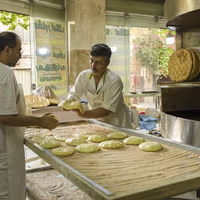
Mehrshad Shahidinejad, a 20-year-old chef, was arrested in October during anti-government rallies and died after being beaten with a baton at the Revolutionary Guard Intelligence's detention center in the city. He soon became an icon of the Women, Life, Freedom protests.
In another case, six protesters arrested in Tabriz were collectively sentenced to 18 years in prison and various fines. Pejman Eslami and Bagher Taji Ahmadifard each received five-year sentences, while the remaining four were sentenced to two years in prison and fines totaling around $11,000. The average Iranian's monthly salary is approximately $150 to $200.