• العربية
  • فارسی
Brand
  • Iran Insight
  • Politics
  • Economy
  • Analysis
  • Special Report
  • Opinion
  • Podcast
  • Iran Insight
  • Politics
  • Economy
  • Analysis
  • Special Report
  • Opinion
  • Podcast
  • Theme
  • Language
    • العربية
    • فارسی
  • Iran Insight
  • Politics
  • Economy
  • Analysis
  • Special Report
  • Opinion
  • Podcast
All rights reserved for Volant Media UK Limited
volant media logo

Qatar Pursues More US-Iran Talks After Hostage Release Deal
Iran International Newsroom
Sep 20, 2023, 14:32 GMT+1Updated: 11:53 GMT+0
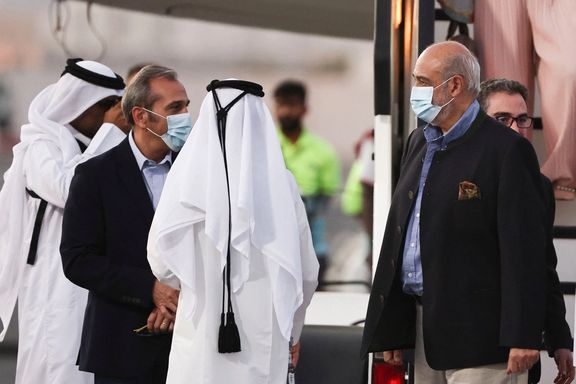
American hostages arriving in Qatar on September 18, 2023

After US hostages were released this week, Qatar is pressing Iran and the United States to engage in more talks over nuclear and other issues, Reuters reported.

Quoting three regional sources familiar with discussions that Doha has held with Tehran and Washington, the effort is aimed at reaching “understandings” to iron out some differences. The aim is to address slowing Tehran's uranium enrichment alongside more international monitoring, curbing activities of Iran's proxy militias in the region and halting Iran's drone exports, all in return for some waivers on US sanctions on Iranian oil exports, the three sources said.

Officials in Doha said Qatari officials would hold separate meetings with Iranian and US officials on the sidelines of the UN General Assembly in New York this week. One source briefed on the talks told Reuters those meetings would include discussing enrichment and Iranian drones.

If there is progress, Qatar aims to host indirect talks between Tehran and Washington, the source said. Qatar helped forge the hostage release deal with shuttle diplomacy between Iranian and US negotiators staying in separate hotels in Doha. The Biden administration agreed to authorize the release of $6 billion in Iranian funds blocked in South Korea since 2018.

Iran's President welcoming Qatar's foreign minister in Tehran in May 2022
100%
Iran's President welcoming Qatar's foreign minister in Tehran in May 2022

Various media have been long reporting about a potential limited and unwritten agreement after formal talks to revive the 2015 JCPOA failed last year. Speculations in this regard became more frequent since June when the US authorized the release of $2.7 billion blocked in Iraqi banks. The Biden administration has played down any prospect of a wider deal, because according to the law, it must report to the US Congress about any nuclear agreement with Iran.

Republicans and some Democrats are becoming more critical of the Iranian regime and the administration’s apparent secret dealings with Tehran. The House of Representatives overwhelmingly passed the Mahsa Act September 13, which hardened US sanctions against Iran’s ruler Ali Khamenei and President Ebrahim Raisi.

When the US hostages were released earlier this week, Secretary of State Antony Blinken left the door open to diplomacy on the nuclear file, which he described as "perhaps the number one issue of concern", but said nothing was imminent.

"In this moment, we're not engaged on that, but we'll see in the future if there are opportunities," he said in New York, in his response to a question about whether there could be more indirect talks with Iran soon.

Two Iranian insiders said there would be indirect meetings between Tehran and Washington in New York that could pave the way for talks on a nuclear "understanding". They said Iran had never shut the door to nuclear diplomacy.

Another Iranian insider briefed on discussions so far with Qatar told Reuters: "Considering the upcoming US elections, it is possible to reach an understanding that will involve issuing waivers on banking and oil sectors that would allow Iran to export its oil freely and get its money back via the banking system" - currently barred by existing US sanctions.

This would mean an almost total unravelling of economic sanctions imposed since 2018, while leaving Iran on the nuclear threshold, with more than 100 kilograms of uranium enriched to 60 percent.

The three regional sources said Tehran had already committed to lowering enrichment of uranium to 60% - below the roughly 90% needed for a nuclear weapon - and was ready to resume cooperation with the UN International Atomic Energy Agency (IAEA) which monitors Iran's nuclear work.

However, last week Iran withdrew accreditation to several UN nuclear inspectors, angering the IAEA and Western powers that later issued a statement calling on Tehran to rescind its decision. Iran could be upping the ante precisely because there are behind the scenes talks, to extract maximum concessions.
Most Viewed

US blockade enters murky phase as tankers spoof signals and buyers hesitate
1
ANALYSIS

US blockade enters murky phase as tankers spoof signals and buyers hesitate

2
INSIGHT

Ideology may be fading in Iran, but not in Kashmir's ‘Mini Iran'

3
INSIGHT

Hardliners push Hormuz ‘red line’ as US blockade tests Iran’s leverage

4
VOICES FROM IRAN

Hope and anger in Iran as fragile ceasefire persists

5

US sanctions oil network tied to Iranian tycoon Shamkhani

Banner
Banner

Spotlight

  • Hardliners push Hormuz ‘red line’ as US blockade tests Iran’s leverage
    INSIGHT

    Hardliners push Hormuz ‘red line’ as US blockade tests Iran’s leverage

  • Ideology may be fading in Iran, but not in Kashmir's ‘Mini Iran'
    INSIGHT

    Ideology may be fading in Iran, but not in Kashmir's ‘Mini Iran'

  • War damage amounts to $3,000 per Iranian, with blockade set to add to losses
    INSIGHT

    War damage amounts to $3,000 per Iranian, with blockade set to add to losses

  • Why the $100 billion Hormuz toll revenue is a myth
    ANALYSIS

    Why the $100 billion Hormuz toll revenue is a myth

  • US blockade targets Iran oil boom amid regional disruption
    ANALYSIS

    US blockade targets Iran oil boom amid regional disruption

  • Iran's digital economy battered by prolonged blackout
    INSIGHT

    Iran's digital economy battered by prolonged blackout

•
•
•

More Stories

Raisi Says Iran Keen On More Cooperation With US Shiite Community

Sep 20, 2023, 12:59 GMT+1

Iranian President Ebrahim Raisi expressed the Iranian government's preparedness to expand collaboration with the US Shiite community.

During his visit to New York for the 78th United Nations General Assembly, he said the Islamic Republic is ready to boost such cooperation in areas like social services, healthcare, and culture.

Raisi made the remarks while meeting with a delegation of Shiite community members, stressing the importance of nurturing Shiite culture in the United States.

The move comes as some critics have alleged that the Iranian regime uses mosques and Islamic centers to promote its propaganda and hostility towards those who oppose the Iranian government.

Recently, a group of Republican members of Congress sent a letter to Attorney General Merrick Garland and Director of National Intelligence Avril Haines, alerting them to the influence of Iran's extremist ideology in several US-based mosques and centers.

The letter also raised concerns about the promotion of hatred by Iran's leadership within these mosques and cultural centers. It called on the US government to recognize and address the threat posed by state-sponsored terrorism, whether abroad or domestically.

Earlier this month, Omid Nouripour, leader of Germany's Green Party, called for the closure of the Islamic Center in Hamburg, which he referred to as a "spy nest." He accused regime officials of using this network for espionage activities targeting both the German population and Iranians seeking refuge in Germany.

Additionally, in August, the UK Charity Commission initiated an investigation into an Iran-linked British foundation called Al-Tawheed Charitable Trust. This foundation has hosted hardline Islamic clerics and paramilitary figures while promoting the propaganda of the Islamic Republic's regime among Shia Muslim youth in the UK.


Israel Stages Lone Walkout In Raisi Speech While West Watches

Sep 20, 2023, 12:20 GMT+1
•
Iran International Newsroom

Israel’s ambassador to the United Nations was the only diplomat to protest at President Ebrahim Raisi’s speech Tuesday but was escorted away by security. 

While Ebrahim Raisi, the man known as the ‘Butcher Of Tehran’ for his history of gross human rights violations, was addressing the UN with an onslaught of regime propaganda including claiming the country is an “unparalleled” beacon of women’s rights, Israel’s ambassador to the UN was physically escorted off site for protesting Raisi’s presence. 

Ambassador Gilad Erdan held a poster calling for women’s rights in Iran, showing the face of Mahsa Amini, the face of the Woman, Life, Freedom movement after her death in morality police custody last year, and was forcefully removed from the United Nations by security. 

Erdan was the only member of the UN General Assembly to protest. In contrast, in March, more than 100 diplomats from 40 Western countries and allies including Japan walked out of a speech by Russian Foreign Minister Sergei Lavrov to the top UN human rights forum in protest over Russia's invasion of Ukraine. The boycott by envoys from the European Union, the United States, Britain and others left only a few diplomats in the room including envoys from Syria, China and Venezuela.

Soon after, in April, the United States, Britain, Albania and Malta walked out on Russia's envoy for children's rights, Maria Lvova-Belova, who the International Criminal Court wants to arrest on war crimes charges, as she spoke by video to UN Security Council members. 

Israel's Ambassador to the United Nations Gilad Erdan is led out of the United Nations General Assembly hall by security officials on September 19, 2023.
100%
Israel's Ambassador to the United Nations Gilad Erdan is led out of the United Nations General Assembly hall by security officials on September 19, 2023.

Emboldened, Raisi - who as a prosecutor, took part in the 1988 mass executions that killed some 5,000 political prisoners in Iran - told the UN on Tuesday that the United States should prove its "goodwill and determination" to revive Tehran's 2015 nuclear pact as months of indirect talks between the long-time foes have led nowhere. This was after he publicly stated that the US should "stop interfering in the countries of the Persian Gulf and other regions in the world and mind their own business".

Raisi was speaking on the back of a prisoner swap which saw five US convicted Iranians exchanged for five wrongly held US-Iranian citizens, in addition to $6bn in frozen Iranian funds freed up from South Korea. 

In a show of appeasement to the barrage of criticism levied to the Biden administration for the deal, which critics say opens the door to yet more hostage diplomacy by Iran, putting further Americans at risk, the administration levied more sanctions on seven individuals and four entities in Iran, China, Russia, and Turkey for their roles in Iran's UAV and military aircraft development.

However, while Raisi was addressing the world’s leaders, Russia’s Defence Minister, Sergei Shoigu, who is in Tehran, announced that “relations between Russia and Iran in the field of defense are developing dynamically. The number of meetings at different levels has increased. The relationship is developing well,” suggesting the $6bn in released funds will be used to fund the regime’s military and nuclear development. 

Raisi is reveling in the PR potential of the visit as the world watches. Only Monday, on the sidelines of the UN General Assembly, he denied sending weapons to Russia, in spite of extensive evidence otherwise which has led to multiple nations including the US and UK, issuing sanctions against Iran. 

While the Russian defense minister speaks of burgeoning ties from Tehran, Raisi said from New York, “We are against the war in Ukraine”, while evidence has also shown the two nations building munitions factories together in Russia. 

Despite the global backlash for Raisi’s welcome in the UN, the Council of Foreign Relations (CFR) has gone ahead with its invitation to meet with him in New York. Iranian actress and rights activist Nazanin Boniadi, a member of CFR, refused to attend the private meeting. 

“Some say that these meetings allow us to hold the feet of dictators to the fire, but the past 44 years have shown us that not only are these meetings futile, the Islamic Republic also uses them to legitimize themselves on the global stage,” she wrote on X. 

“Continuing the same practices and expecting tyrants to change their behavior seems completely irrational,” she added. “Democratic institutions hold the key to tipping the balance of power in favor of those risking everything for freedom. If you afford your members the opportunity to meet dictators behind closed doors, then at least offer them the chance to also hear from their opponents in the open.”

Biden, Netanyahu To Discuss Saudi Normalization, Iran

Sep 20, 2023, 10:36 GMT+1

President Joe Biden and Israeli Prime Minister Benjamin Netanyahu on Wednesday will hold their first face-to-face talks since Netanyahu took power in December.

The topics expected to be discussed include a potential Israel-Saudi normalization deal and Iran.

Biden had held off extending an invitation to Netanyahu out of concern about a judicial overhaul that curbs the power of judges as well as Israel's expansion of settlements.

Instead of meeting at the White House - Netanyahu's preferred venue - the two leaders ended up arranging their talks on the sidelines of the UN General Assembly in New York.

US officials expect the judicial overhaul to come up in their conversations, as well as efforts to counter Iran's nuclear program and the possibility of what would be a major development - a normalization of Israel-Saudi relations.

The United States, Israel and Saudi Arabia have been discussing a potential deal in which the Israelis and the Saudis would normalize diplomatic relations and Washington and Riyadh would agree on a defense pact but talks still have far to go.

Observers believe the Saudi deal's enormous potential has left Biden & Netanyahu little choice but to meet despite differences.

The Biden administration is calculating that the US could reap big rewards from such a mega-deal if it can overcome steep obstacles.

"Many of the elements of a pathway to normalization are now on the table. We don't have a framework; we don't have the terms ready to be signed. There is still work to do," White House national security adviser Jake Sullivan told reporters on Sept. 7.

US officials have not ruled out an eventual White House meeting between Biden and Netanyahu.

Reporting by Reuters

Gulf Cooperation Council, US Urge Iran To Fully Cooperate With IAEA

Sep 20, 2023, 08:58 GMT+1

Gulf Cooperation Council (GCC) countries and the US renewed calls for Iran to fully cooperate with the International Atomic Energy Agency (IAEA), in a joint statement.

The statement came after a meeting of the GCC Arab foreign ministers, the US Secretary of State and GCC Secretary-General in New York.

Iran barred multiple International IAEA's inspectors assigned to oversee Tehran's atomic activities in a move described by the UN nuclear watchdog chief, Rafael Grossi, as "disproportionate and unprecedented."

Iran's move was a response to a call led by the United States, Britain, France and Germany at the IAEA's Board of Governors meeting last week for Tehran to cooperate immediately with the IAEA on issues including explaining uranium traces found at undeclared sites.

Despite talks since President Joe Biden assumed office, the United States has not been able to bring Tehran to agree to a new nuclear agreement, after former President Donald Trump left the JCPOA accord and imposed sanctions on Iran.

Iran’s controversial nuclear program that has been expanding at a faster pace since early 2021, is a source of great concern for its regional Arab neighbors. Tehran has long been projecting power throughout the Middle East and the Persian Gulf, arming and supporting militants and intimidating shipping in the strategic waters of the region.

Iran's President In UN Claims Protests Were A Propaganda War

Sep 19, 2023, 23:09 GMT+1
•
Iran International Newsroom

President Ebrahim Raisi blamed foreign countries for waging a propaganda campaign against the Islamic Republic in his UN General Assembly speech Tuesday.

He avoided the topic of the 2022 anti-regime protests almost entirely and referred to it only indirectly as the West’s worst media assault in history.

Raisi was speaking only a few days after the first anniversary of the killing of Mahsa Amini, which sparked widespread protests across Iran beginning in September 2022.

More than 500 were killed, 22 thousand arrested and at least 7 executed in the brutal crackdown that followed.

“The previous year was a year of victory for the Iranian people,” Raisi claimed brazenly, spinning last year’s events in Iran in the most spectacular fashion.

Images coming out of Iran last week, told a very different story: thousands of armed security forces and plain-clothes thugs had been stationed all over the capital Tehran, in anticipation of protests on the anniversary, intimidating passersby and preventing any gatherings in the streets.

Iran's President Ebrahim Raisi holds up the Quran as he addresses the 78th Session of the UN General Assembly in New York City, September 19, 2023.
100%
Iran's President Ebrahim Raisi holds up the Quran as he addresses the 78th Session of the UN General Assembly in New York City, September 19, 2023.

Raisi also lambasted the United States for ‘breaking a promise’ and leaving the JCPOA. He repeated the claim that Iran’s nuclear program is purely peaceful, despite accumulating well over 100 kilograms of uranium enriched to 60 percent.

"The Iranian nation prides itself on playing, thanks to the Islamic Revolution, the biggest role in unmasking the imperialists in the East and West," Raisi said, while the regime has supplied hundreds of kamikaze drones to Russia and exports more than million barrels of oil to China daily at discounted prices.

"The world is transitioning into a novel international order, and the project to Americanize the world has failed," he claimed.

Despite Iran's 12-year involvement in Syria's civil war and supply of weapons to Houthi forces in Yemen, Raisi said, “Our unambiguous position as the Islamic Republic: We do not stand nor support any war anywhere, not in Europe nor anywhere,”

On Monday, the UN nuclear chief said he had asked to meet Raisi on the sidelines of the General Assembly to try to reverse Iran’s decision to remove monitoring devices set up by IAEA and expel “a very sizable chunk” of the agency’s inspectors.

Rafael Grossi, Director of UN's International Atomic Energy Agency, warned that such measures make it impossible for IAEA to verify the nature of Iran's nuclear program.

Earlier on Tuesday, Iranian Americans opposed to the Islamic Republic held a rally ahead of Raisi’s appearance outside the UN headquarters in New York City.

The protesters had banners and posters portraying the Islamic regime's crimes in its 45-year history – including messages targeting Raisi and his role in those crimes.

Raisi was a member of the infamous Death Committee which oversaw summary execution of at least two thousand Iranian political prisoners in 1988.