• العربية
  • فارسی
Brand
  • Iran Insight
  • Politics
  • Economy
  • Analysis
  • Special Report
  • Opinion
  • Podcast
  • Iran Insight
  • Politics
  • Economy
  • Analysis
  • Special Report
  • Opinion
  • Podcast
  • Theme
  • Language
    • العربية
    • فارسی
  • Iran Insight
  • Politics
  • Economy
  • Analysis
  • Special Report
  • Opinion
  • Podcast
All rights reserved for Volant Media UK Limited
volant media logo

World Must Pressure Iran To Revoke 'Despicable' Hijab Bill – Rights Group
Iran International Newsroom
Sep 22, 2023, 10:34 GMT+1Updated: 11:52 GMT+0
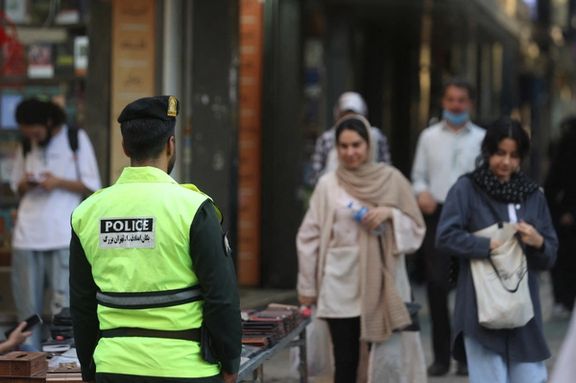
Iranian women walk on a street during the revival of morality police in Tehran, Iran, July 16, 2023.

Amnesty International has decried Iran’s new hijab law that will impose “draconian penalties” and increase prison terms and fines for defying compulsory veiling.

In a statement issued Thursday, Diana Eltahawy, the human rights group’s deputy regional director for the Middle East and North Africa said, “This bill is a despicable assault on the human rights of women and girls that will further entrench violence and discrimination against them in Iran.”

Earlier in the week, Parliament Speaker Mohammad-Bagher Ghalibaf announced that the bill was approved for a "three-year trial run" following coordination and a written confirmation by the judiciary. The contentious bill's content was finalized by a committee of approximately 10 lawmakers making the best use of an obscure regulation known as Article 85. The only aspect voted upon was the duration for the trial implementation.

Article 85 of the constitution enabled the parliament to effectively sideline opposition by restricting discussions on the bill to an internal committee. The committee's decisions are set to be sent to the Guardian Council, whose members are chosen by Supreme Leader Ali Khamenei. If the council deems the decisions to be in line with the Constitution, they will be implemented throughout the country. Legal experts say the hijab bill violates not only civil rights but also the Constitution and requires vast resources beyond the government’s means.

Eltahawy said that the new regulations will further “exacerbate the already suffocating surveillance and policing of women’s bodies, ”mandating the Islamic Republic’s various political, security and administrative bodies to “obsessively observe compliance with compulsory veiling laws and control women’s and girls’ lives.”

Iranian women defying mandatory hijab in Tehran  (undated)
100%
Iranian women defying mandatory hijab in Tehran

Initially comprising only 15 articles, the "Hijab and Chastity" bill was sent to parliament by the administration of Ebrahim Raisi. It has since expanded to include 70 articles. The bill was proposed after months of nationwide protests following the death of Mahsa Amini, a 22-year-old woman who died in police custody last year, allegedly for breaching hijab rules.

The uprising sparked by the death in police custody of Mahsa Amini in September 2022 has made it increasingly difficult for the clerical regime to enforce the mandatory Islamic dress code. Since the beginning of the ‘Women, Life, Freedom’ movement, tens of thousands of girls and women have shed their compulsory hijab. The regime seeks to criminalize hijab defiance, but no branch of government wants to solely shoulder the responsibility for complications of such a provocative and risky action in society.

Amnesty International's Eltahawy further described the bill as an "all-out assault," meant to "crush the spirit of resistance among those who dared to stand up against decades of oppression and inequality as part of the 'Women, Life, Freedom' popular uprising."

She also called on the global community to pressure the Islamic Republic's authorities to revoke the bill and abolish all degrading and discriminatory compulsory veiling laws and regulations, stating that the world must "pursue legal pathways at the international level to hold Iranian officials accountable for ordering, planning, and committing such widespread and systematic violations against women and girls."

Human rights advocates have warned that the bill's implementation could lead to “increased violence, harassment, and arbitrary detentions of women and girls in Iran.” Both the United Nations Human Rights Commission and the UN's Independent International Fact-Finding Mission on the Islamic Republic of Iran have issued statements this month expressing their concerns over the potential consequences of this bill on the rights and freedoms of Iranian women.
Most Viewed

US blockade enters murky phase as tankers spoof signals and buyers hesitate
1
ANALYSIS

US blockade enters murky phase as tankers spoof signals and buyers hesitate

2
INSIGHT

Ideology may be fading in Iran, but not in Kashmir's ‘Mini Iran'

3
INSIGHT

Hardliners push Hormuz ‘red line’ as US blockade tests Iran’s leverage

4
VOICES FROM IRAN

Hope and anger in Iran as fragile ceasefire persists

5

US sanctions oil network tied to Iranian tycoon Shamkhani

Banner
Banner

Spotlight

  • Hardliners push Hormuz ‘red line’ as US blockade tests Iran’s leverage
    INSIGHT

    Hardliners push Hormuz ‘red line’ as US blockade tests Iran’s leverage

  • Ideology may be fading in Iran, but not in Kashmir's ‘Mini Iran'
    INSIGHT

    Ideology may be fading in Iran, but not in Kashmir's ‘Mini Iran'

  • War damage amounts to $3,000 per Iranian, with blockade set to add to losses
    INSIGHT

    War damage amounts to $3,000 per Iranian, with blockade set to add to losses

  • Why the $100 billion Hormuz toll revenue is a myth
    ANALYSIS

    Why the $100 billion Hormuz toll revenue is a myth

  • US blockade targets Iran oil boom amid regional disruption
    ANALYSIS

    US blockade targets Iran oil boom amid regional disruption

  • Iran's digital economy battered by prolonged blackout
    INSIGHT

    Iran's digital economy battered by prolonged blackout

•
•
•

More Stories

Musk’s Plan To Charge For X Will Block Most Users From Iran

Sep 21, 2023, 23:07 GMT+1
•
Iran International Newsroom

Elon Musk has said that X (formerly Twitter) might start charging its users “a small fee” and insisting that the aim is to “combat vast armies of bots."

It’s hard to tell if that’s the real intention – or if it’s just about money. It’s also hard to tell how effective it would be in keeping out the bots.

One thing is almost certain, however: that any ‘monthly payment’, no matter how small, would keep out thousands of users living in Iran.

Thanks to the tireless efforts of the Islamic Republic since its inception, Iran is completely isolated from the global financial system. There’s no Visa or Mastercard in Iran. Those inside can’t even use PayPal, due to the US sanctions regime.

Some may find ways to go around this, of course, especially those with friends or family abroad who are willing to pay on their behalf. But they would be a tiny minority. The rest would have to abandon the platform.

And no one would be happier than the ayatollahs.

Elon Musk during a conference at the Porte de Versailles exhibition center in Paris, France, June 16, 2023
100%
Elon Musk during a conference at the Porte de Versailles exhibition center in Paris, France, June 16, 2023

Elon Musk is, of course, aware of the information isolation people in Iran face. At the same meeting where he floated the idea of charging X users, he revealed that he had received a letter from Tehran, complaining about the activation of the satellite internet service Starlink over the country.

“We got permission from the State Department to turn on Starlink over Iran,” he said in a conversation with Israeli Prime Minister Benjamin Netanyahu, “and a few people are using it… we got an upset letter from the government of Iran”.

For many years now, the anachronistic regime in Iran has been trying to cut off Iranians from thousands of websites and social media –generally, because it doesn’t like spaces it can’t control, even virtual ones, but more specifically, because more elite Iranians use X for political expression and organization perhaps more than any other platform.

Reliable figures on users (or usage) are hard to come by. But the most popular accounts on X –those which post solely in Persian– have around 2 million followers.

Instagram has a lot more active users inside Iran, perhaps ten times that of X, if the biggest accounts are an indication. Instagram wasn’t blocked until the 2022 protests last September. But it’s a different universe entirely. Millions use it to advertise, sell and buy (partly because it was the only non-blocked platform for a long time).

On X, however, politics seems to be a much more prominent topic. It’s the platform of choice for Iranian journalists, activists and those who’re often called ‘opinion-makers, for want of a better word. Even the Islamic Republic insiders have active accounts on X –from the Supreme Leader and the President down to the state-affiliated journalists who support their politics of restriction and suffocation.

They will all be over the moon to see X go behind a paywall.

Of course, Musk and X could always come up with ‘smart’ solutions: excepting those living under dictatorships, for instance, for whom the platform offers a lifeline. But it won’t be easy, since ordinary Iranians inside Iran have to use circumvention tools to access X, making it harder to determine their real location.

It’s not clear when the plan to charge X users takes effect. And it’s not clear how much people should pay to access the platform.

X does have a subscription service already, charging for features like editing posts and ranking higher in conversations and search –and of course the blue tick. That service starts at $8 a month.

The new subscription is likely to be cheaper. Musk says a “lower tier” pricing is “the only defense against vast armies of bots." Time will tell if that’s the case where Elon Musk lives. In Iran, though, the winners and losers of his plan are clear from now.

Iranian Filmmakers Call For Inquiry Into Regime-Backed Oscars Submission

Sep 21, 2023, 19:57 GMT+1

The Independent Filmmakers Association of Iran (IFMA) has requested an independent inquiry into the selection of next year's Oscars nomination.

The IFMA sent an official letter to the Oscars Academy regarding the submission of The Night Guardian by Reza Mirkarimi as Iran's entry for the prestigious awards ceremony, objecting to the involvement of the Farabi Cinema Foundation, a governmental entity,.

"The representative of Iran's state cinema for participation in the 2024 Oscars ceremony has been selected and introduced by the Farabi Cinema Foundation, which is a state entity affiliated with the oppressive regime of Iran," states the letter.

The IFMA's letter drew attention to the oppression faced by independent filmmakers in Iran over the past year, citing arrests, interrogations, and threats. The Farabi Foundation has stated its coordination with security and intelligence agencies.

The IFMA is calling for the establishment of a selected group to review and introduce independent Iranian films for consideration at the Academy Awards next March, the ceremony held annually in Los Angeles. The association has also submitted a list of proposed works for the Oscars Academy's consideration.

Iran has achieved success at the Oscars in recent years, winning awards for "A Separation" in 2011 and "The Salesman" in 2016, both directed by Asghar Farhadi.

Tehran Municipality Installs Barriers In Subway To Separate Women

Sep 21, 2023, 18:21 GMT+1

The Tehran Municipality has constructed locked barriers between the women's and men's subway cars in Tehran as gender apartheid deepens in Iran.

Local media reported on Thursday that the actions are on the orders of conservative mayor Alireza Zakani, pointing out the safety risks of the measures which could prevent women escaping in the case of fire or emergencies.

In May, a video circulated on social media showing the installation of a curtain to segregate the women's and men's subway cars in Tehran, reinforced in June when the head of Tehran City Council, Mehdi Chamran, said gender segregation was necessary and affirmed the enforcement of compulsory hijab on the subway. 

Since the inception of the subway system in the late 1990s, separate carriages for women have existed, but women were also allowed to use other cars.

The potential challenges associated with implementing gender segregation in the subway system include families being separated, individuals becoming disoriented in crowded stations, and family members accidentally disembarking at different stops.

Morality police patrols have also recently increased around subway stations.

Iran’s President Entourage Attacks Iran International Reporters In NY

Sep 21, 2023, 18:08 GMT+1
•
Iran International Newsroom

The entourage of Iran’s president attacked, harassed and insulted Iran International journalists covering Ebrahim Raisi’s stay in New York.

In the latest incident on Wednesday, an official from Raisi's delegation attacked Iran International correspondent Kian Amani outside the Millenium Hilton New York One UN Plaza Hotel. 

The official tried to grab Amini’s cellphone as he was capturing footage of them exiting the hotel. The hotel's security team finally intervened and halted the aggressor.

In another encounter, an official identified as Reza Naghipour – who ironically accompanied Raisi as a protocol coordinator -- was asked by Amani about his name and credentials. Amani also tried to ask questions about the protesters who were killed during the regime crackdown on dissent last year. But instead of replying or even refraining from answering, Naghipour started to threaten the reporter, telling him that he “should be trembling with fear until the end of his life” because he works for dissident media.

Raisi’s team in New York had a repertoire of pre-planned strategies to avoid answering questions from media outlets critical of the regime. As soon as a reporter approached them with challenging questions, Raisi’s men started filming the reporter as they embarked on a barrage of unrelated questions to and accusations of treason to intimidate the reporter. 

The encounters by Raisi’s delegation have drawn countless reactions by other journalists, human rights activists and even media inside Iran. Earlier this year, Iran International's offices in London were forced to relocate to Washington after repeated threats from the IRGC forced the UK's highest security services to admit they were no longer able to safeguard the lives of the reporting team.

Iranian President Ebrahim Raisi speaks during a press conference concluding his appearance at the United Nations General Assembly, in New York City, September 20, 2023.
100%
Iranian President Ebrahim Raisi speaks during a press conference concluding his appearance at the United Nations General Assembly, in New York City, September 20, 2023.

Activists, such as Ladan Boroumand, the co-founder of Abdorrahman Boroumand Center for Human Rights in Iran -- praised Iran International reporters for refusing to allow "the false narrative of the regime to become dominant”.

The composition of the entourage has raised serious questions as to how they were granted visas as part of its ‘diplomatic delegation'. Navid Mohebbi, a policy director with the National Union for Democracy in Iran think-tank, said, “These individuals should not have been granted entry in the first place" calling the entourage "thugs harassing journalists". 

Recently-sanctioned Tasnim news agency, affiliated with the Revolutionary Guards, celebrated the circus created by the entourage behavior, publishing a video of one such case of harassment, boasting that “Iran International’s journalist fled in such a hurry that he didn't even turn back to pick up his headphones!”

Kasra Aarabi, with the United Against Nuclear Iran advocacy group, shared the video of the physical assault on Iran International’s Amini, saying, “This is what happens when you grant a mass murdering president and terrorist entourage entry to the West.”

One of the controversial figures who accompanied Raisi was a leader of a government vigilante mob who carried out the 2011 storming of the British embassy in Tehran. Now he is an advisor to the culture minister. 

Moderate Iranian news website Rouydad 24, also criticized the selection of Raisi’s companions. Instead of ministers and high-ranking officials, Raisi’s team is comprised of “odd and peculiar people” who were tasked with “stopping foreign-based Persian-language media by shouting,” the media outlet said. 

“If we look at President Raisi's agenda in New York, it appears more like a publicity campaign, and it probably won't yield any significant results,” Rouydad 24 said, pointing out that “What stands out most in President Raisi's trip to New York is the absence of an 'economic team' in his delegation, replaced instead by a group of 'slogan-shouting' individuals.”

Saman Arbabi, an Iranian-American journalist mainly known to Iranians as a co-creator and co-host of Voice of America's satirical television shows Parazit, released a video about his encounter with some of Raisi’s so-called ‘diplomatic delegation.’ He said when he saw how Raisi’s men attacked them when they sought to film them in an event at their New York hotel so “angrily and violently,” he tried to imagine the level of brutality during regime crackdown on protesters in Iran. 

Hundreds Of Iranian Women Detained On Anniversary Of Amini's Death

Sep 21, 2023, 16:44 GMT+1

At least 600 women have been arrested in Tehran on the anniversary of Mahsa Amini's death on September 16.

Among this group, 130 individuals are presently being held in the quarantine wing of the notorious Gharchak (Qarchak) Prison south of Tehran, according to the Committee to Follow Up on the Status of Detainees.

Quoting the families of detainees, the committee said the majority of those arrested were released on bail upon their initial arrest by the police. Cases have been referred to the prosecutor's office, with hopes that they may secure their release on bail or bond.

The arrests took place across Iran. Javad Hashemi-Mehr, the political and security deputy of the governor of Kohgiluyeh and Boyer-Ahmad Province, reported that on the evening of September 16, 15 people, including 13 men and 2 women, were detained in Dehdasht alone.

In total, the committee has identified 118 detainees arrested between September 10 and 20. The regime's security forces, aiming to suppress the wave of protests that erupted last September following Mahsa Amini's death in police custody, intensified their pressure on activists and carried out numerous arrests, particularly in the days leading up to the anniversary of the protests.

The figures come as the wife of President Ebrahim Raisi, Jamileh Alamolhoda, gave a rare interview to US-based Newsweek claiming "women in Iran have not fought for their rights because they already enjoy their rights" while President Raisi himself claimed on the sidelines of the United Nations General Assembly this week that women in Iran have "unparalleled" rights. The two have been on a propaganda campaign during the visit to New York while the world watches.

The US-based Human Rights Activists News Agency (HRANA) has described the situation of women in Iran as “dire”.