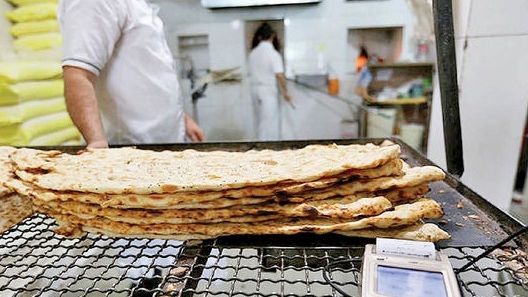
A bakery in Tehran where one type of flat bread is baked
Faced with an apparent financial crunch to subsidize bread, the Iranian government is gradually raising prices, a move that can have both political and inflationary repercussion.
To avoid public blame and anger the government is trying to redirect the responsibility to provincial officials, although the central government would remain the main decision maker.
Iran's economy minister Ehsan Khanzoudi said on Wednesday that provincial authorities are now authorized to decide the prices of various types of bread, always set nationally before, “based on local circumstances”.
Earlier in September Government Spokesman Ali Bahadori-Jahromi had said in a televised interview that “the government has no plans to increase the price of bread” but added that provincial authorities in the future would be deciding the price of bread with the “approval of the interior ministry.”
Khandouzi also confirmed that provincial authorities need the approval of the interior ministry for increasing the price of bread in their respective provinces and added that the government will “specifically supervise bread prices.”.
Since Iran reduced subsidies for food and medicine last year, the government had repeatedly vowed not to increase bread prices. In May 2022 Khandouzi had stated that an increase in the price of bread was “the President’s redline” and other officials had repeated his promise of keeping the price of bread steady.
Iran's economy minister Ehsan Khandouzi speaking in parliament. FILE PHOTO
The government of President Ebrahim Raisi appears to be delegating the pricing of bread to provincial authorities to minimize criticism of its dismal economic performance including skyrocketing food prices analysts say. Prices rose as much as 100 percent in the past year for ordinary food items.
In early August after weeks of contradictory statements and denials, the government finally confirmed that bread prices had increased in 13 provinces by around 40 percent.
Analysts say the capital Tehran and Tehran Province, the most populous in the countrywith a population of over 13 million, were spared so far for political reasons including possibility of protests.
In the past few days, the price of Sangak, a popular flatbread weighing around 450g, rose by 50 percent from 20,000 rials to 30,000 (around 7 cents) in Tehran and surrounding regions due to a drop in the flour subsidy allocated to bakeries.
Bread prices in Iran might seem cheap by world standards, but any increase in the price of bread can hugely affect impoverished households given that bread is the main staple in Iranians’ diet.
Iranians are the second biggest bread consumers in the world with annually 160kg (350 lb) per person after Turkish consumers with 199.6 kg (440 lb) per person.
Bread consumption in Iran has risen by ten kilos in the past ten years due to higher cost of living that has made rice less affordable to many Iranians, particularly the three lowest-income percentiles.
Iran's food inflation rate, according to World Bank figures in June, stood at 78 percent, placing the country in the fifth place in the world after Venezuela (426%), Lebanon (350%), Argentina (115%), and Zimbabwe (102%). In April Iran had ranked fourth among the countries with the highest food inflation with a food inflation rate of 71 percent.
On May 1, 2022, the parliament voted to allow the government to scrape an annual $10-14 billion subsidy for essential food and medicine despite warnings of higher inflation, which already stood at around 40 percent, and hardship for the most vulnerable. This led to a ten-fold increase in the price of flour.
The government of President Raisi then introduced a “smart plan” to continue the bread subsidy and issued digital cards that have to be used at the time of purchase, arguing that the plan would prevent the smuggling of subsidized flour and bread to neighboring countries where they sold at much higher prices.
Earlier in June the Bakers’ Union revealed that subsidized flour allocations to some bakeries had dropped by more than half their quota. Bakers say despite the lower cost of subsidized flour, other production costs (labor, other ingredients including yeast and oil) have increased, and their sales have dropped so much in the past year that they are not able to make a profit even by using subsidized flour.
Iranian-Americans released as part of a US prisoner swap deal inside a plane en route to the US
Iran's regime has revealed the identities of two American prisoners it recently released along with five known hostages as part of a swap arrangement with Washington.
According to Nour News, which is linked to Iran's Supreme National Security Council, the previously unnamed prisoners are Reza Behrouzi and Fakhr al-Sadat Moeini, who had chosen to remain anonymous.
“While US government was hiding pictures and identities of two prisoners released from Iran, National Security Advisor Jake Sullivan published their photos,” wrote Nour News.
The two individuals, along with Emad Sharghi, Siamak Namazi, and Morad Tahbaz, were released on Monday as part of the agreement between Tehran and Washington, which also included $6 billion blocked in South Korea due to US sanctions.
The daughter of Jamshid Sharmahd, a German-Iranian, and a US permanent resident currently facing the death penalty in Iran, called upon reporters and US lawmakers to investigate the issue of these two prisoners.
She posed several questions, seeking information about their connection to the US, their activities in Iran, the reasons for their imprisonment, and the circumstances surrounding their release. She also questioned why these individuals received expedited treatment from the State Department, contrasting it with the extended captivity of others in Iran for years, such as her father Jamshid Sharmahd.
Sharmahd, a 68-year-old software developer and California resident, was abducted during a visit to the United Arab Emirates in 2020 and forcibly taken to Iran. He was subsequently sentenced to death by on charges of "spreading corruption on Earth," a verdict that Amnesty International has already denounced as a sham, and his family vehemently disputes the allegations against him.
Mojtaba Amini, an advisor to Iran's Culture Minister Mohammad Mehdi Esmaeili
A leader of a government vigilante mob who carried out the 2011 storming of the British embassy in Tehran is now accompanying Iran's president during his visit to the United States.
Mojtaba Amini is also the producer of a TV series that has been criticized for glorifying the imprisonment of dual nationals and journalists.
Amini's producing of the Gando TV series was aimed to undermine the administration of former President Hassan Rouhani while receiving praise from supporters of Supreme Leader Ali Khamenei.
Members of President Hassan Rouhani's administration, including Foreign Minister mohammad Javad Zarif, protested the series and even wrote a letter of complaint to Khamenei, requesting its cancellation.
Despite the protests, a second season of the series was produced. The first season had drawn inspiration from Khamenei's repeated warnings about the "enemy infiltration" of the nuclear negotiating team.
Gando can be seen as a reflection of the complex power dynamics within the Islamic Republic. Despite the presence of an Intelligence Ministry, the IRGC's Intelligence Organization was formed in 2009 and now holds significant influence, if not more than the ministry. Gando was evidently intended to undermine the Intelligence Ministry and Rouhani's government.
In June, Mohammad Mehdi Esmaeili, Iran's Minister of Culture, appointed Mojtaba Amini as his advisor. Amini also served as the secretary of the 41st edition of the annual International Fajr Film Festival in 2021, a significant event in the Iranian cinema scene.
A session of the Iranian parliament on September 18, 2023
The Iranian parliament has approved a controversial hijab bill aimed at tightening pressure on women who defy the mandatory dress code in public.
On Wednesday, Parliament Speaker Mohammad-Bagher Ghalibaf announced that the bill was approved for a "three-year trial run" following coordination and a written confirmation by the judiciary.
The contentious bill's content was finalized by a committee of approximately 10 lawmakers making the best use of an obscure regulation known as Article 85. The only aspect voted upon was the duration for the trial implementation. During the Wednesday session, 152 MPs voted in favor, 34 voted against, and seven abstained.
Article 85 of the constitution enabled the parliament to effectively sideline opposition by restricting discussions on the bill to an internal committee. Under normal circumstances, the parliament cannot delegate its legislative authority. However, in necessary cases -- through Article 85 -- it can assign an internal committee to draft specific laws. The committee's decisions are then sent to the Guardian Council, whose members are chosen by Supreme Leader Ali Khamenei. If the council deems the decisions to be in line with the Constitution, they can be implemented in the country for a specified period as determined by the parliament.
Initially comprising only 15 articles, the "Hijab and Chastity" bill was sent to the Islamic Consultative Assembly by the administration of Ebrahim Raisi. It has since expanded to include 70 articles. The bill was proposed after months of nationwide protests following the death of Mahsa Amini, a 22-year-old woman who died in police custody last year, allegedly for breaching hijab rules.
An Iranian woman without mandatory hijab in Tehran
The bill outlines a wide range of punishments and penalties for individuals who defy hijab laws or even criticize compulsory hijab rules, whether online or offline. Even mocking the hijab on social media or elsewhere is subject to specific fines, and offenders may face a ban on leaving the country for up to two years. Additionally, various organizations, including the state broadcaster, are mandated to regularly report on their "duties" related to hijab enforcement to the parliament, interior ministry, or the Supreme Council of the Cultural Revolution.
The approval of the legislation comes amid mounting concerns raised by human rights experts and organizations who argue that the Islamic Republic is employing the bill as a tool for systematic discrimination against women and girls, with the aim of coercing them into unwavering compliance with the government's dictates.
Human rights advocates have warned that the bill's implementation could lead to “increased violence, harassment, and arbitrary detentions of women and girls in Iran.” Both the United Nations Human Rights Commission and the UN's Independent International Fact-Finding Mission on the Islamic Republic of Iran have issued statements this month expressing their concerns over the potential consequences of this bill on the rights and freedoms of Iranian women.
“The legislation proposes increased fines and prison terms for women and girls found in breach of mandatory veiling provisions. It also proposes harsher punishments including travel bans, vehicle confiscations, the denial of education and public services, including medical facilities, and sanctions against businesses,” read the statement by the fact-finding mission.
The uprising sparked by the death in police custody of Mahsa Amini in September 2022 has made it increasingly difficult for the clerical regime to enforce the mandatory Islamic dress code. Since the beginning of the ‘Women, Life, Freedom’ movement, tens of thousands of girls and women have shed their compulsory hijab. The regime seeks to criminalize hijab defiance, but no branch of government wants to solely shoulder the responsibility for complications of such a provocative and risky action in society.
Iranian Foreign Minister Hossein Amir-Abdollahian (right) during a meeting with EU's Foreign Policy Chief Josep Borrell in New York on September 19, 2023
The EU's top diplomat strongly condemns the arbitrary detention of numerous EU citizens, including those with dual nationality, in Iran.
During a meeting held on Tuesday on the sidelines of the UN General Assembly in New York with Iranian Foreign Minister Hossein Amir-Abdollahian, Josep Borrell, the EU's Foreign Policy Chief, raised critical concerns regarding EU-Iran bilateral relations and the latest developments concerning the JCPOA nuclear agreement.
Borrell reiterated his call for the immediate release of all EU citizens in Iranian custody. In a statement released on the EU's official website, the bloc emphasized that its stance remains unchanged regarding the deeply troubling human rights situation within Iran.
"Iran must ensure the preservation of fundamental freedoms, as articulated by all 27 EU Member States on the anniversary of Mahsa Amini's tragic death."
Regarding the JCPOA, Borrell stressed the importance of pursuing a path of de-escalation. He urged Iran to reconsider its decision to revoke the official status of around one third of the International Atomic Energy Agency (IAEA) inspectors in Iran and to enhance its cooperation with the watchdog.
On Saturday, Iran withdrew the designation of several inspectors tasked with verifying activities in Iran under the Non-Proliferation Treaty Safeguards Agreement. Rafael Grossi, the Director General of the IAEA, stated, “This profoundly regrettable decision by Iran is another step in the wrong direction and constitutes an unnecessary blow to an already strained relationship between the IAEA and Iran in the implementation of the NPT Safeguards Agreement."
Borrell also expressed his strong belief in the necessity of seeking a diplomatic resolution to the Iran nuclear issue within the framework of the JCPOA and once again urged the Iranian government to cease its ongoing military cooperation with Russia in the unlawful war of aggression against Ukraine.
Russia's Defence Minister Sergei Shoigu, accompanied by Iran's high-rank military officials, visits an Iranian aerospace industry's exhibition to inspect air defence weapons and unmanned aerial vehicles in Tehran, Iran, September 20, 2023.
Russia's Defense Minister says despite opposition from much of the Western world, Russia and Iran have taken their relations to a higher level.
During his visit to Tehran on Tuesday, Sergei Shoigu said, "We are pursuing a comprehensive range of planned activities, notwithstanding opposition from the United States and its Western allies."
He went on to emphasize that the pressure of sanctions on both Russia and Iran has proven to be “ineffective”, while the interaction between Russia and Iran is progressing to a new stage.
For his part, Mohammad Baqeri, the Chairman of the Chiefs of Staff of the Iranian Armed Forces, declared that Tehran and Moscow have intentions to solidify their military and technical cooperation through a long-term treaty.
Baqeri characterized the relations between Tehran and Moscow as "advancing and evolving" and disclosed that, based on decisions made by the leaders of both nations, a document outlining their long-term cooperation will soon be finalized.
Baqeri also noted that a joint military exercise between Iran and Russia is slated for February, with the objective of bolstering military ties between the two nations.
Shoigu arrived in Tehran on Tuesday, leading a delegation of Russian military officials.
The news of increased military cooperation between the Islamic Republic and Russia comes at a time when Tehran's provision of military support to Moscow during the Russian war on Ukraine has led to yet more sanctions.
Although officials from the Islamic Republic have consistently denied any involvement or cooperation with Russia during the Ukraine war, the United States, the European Union, Australia, and New Zealand have imposed sanctions on Iran based on on-site evidence and intelligence, alleging its supply of drones to Russia.