• العربية
  • فارسی
Brand
  • Iran Insight
  • Politics
  • Economy
  • Analysis
  • Special Report
  • Opinion
  • Podcast
  • Iran Insight
  • Politics
  • Economy
  • Analysis
  • Special Report
  • Opinion
  • Podcast
  • Theme
  • Language
    • العربية
    • فارسی
  • Iran Insight
  • Politics
  • Economy
  • Analysis
  • Special Report
  • Opinion
  • Podcast
All rights reserved for Volant Media UK Limited
volant media logo

Saudi Arabia Vows To Go Nuclear If Iran Develops Weapons
Iran International Newsroom
Sep 21, 2023, 10:56 GMT+1Updated: 11:53 GMT+0
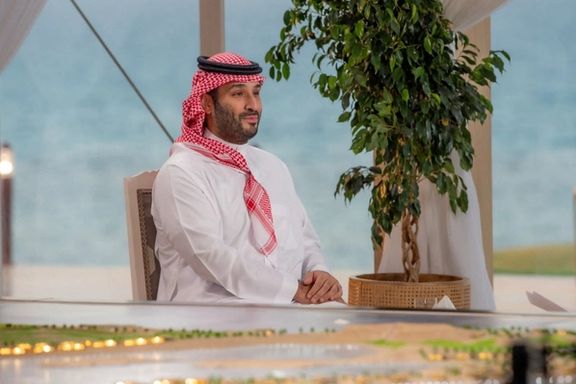
Saudi Arabia's Crown Prince, Mohammed bin Salman speaks with FOX News Channel, in an interview aired September 21, 2023

As Iranian President Ebrahim Raisi concluded his visit to the UN, Saudi Arabia's de facto ruler Mohammed bin Salman vowed to acquire nuclear weapons if Iran does.

Speaking to Fox News, bin Salman, Saudi Arabia’s Crown Prince, known as MBS, spoke candidly about the kingdom’s nuclear ambitions.

While Riyadh and Tehran only reinstated diplomatic ties this year, it is clear the mistrust remains and nuclear is at the heart of their long-strained relations.

While Tehran continues to deny making a nuclear bomb, in recent days it banned one third of the International Atomic Energy Agency’s inspectors from visiting the country and continues enriching uranium up to 60-percent purity, only a short step from producing weapons grade fissile material.

When asked about Iran’s escalating nuclear program, MBS said it is “a bad move". "If you use it, you got to have a big fight with the rest of the world,” he said in his English language interview.

An Iranian ballistic missile on display in Tehran, in April 2022
100%
An Iranian ballistic missile on display in Tehran, in April 2022

Making no secret of his own ambition to match the threat, he told the channel: "If they get one, we have to get one, for security reasons and the balance of power in the Middle East. But we don't want to see that.”

It is no secret that the shared threat of Iran is at the heart of Saudi’s ongoing US-brokered negotiations to normalize diplomatic ties with Israel, which until now, have been conducted behind closed doors but include allowing Israeli flights to use Saudi airspace and granting permission to athletes and businessmen to attend events in the kingdom.

During the interview, MBS said ties with Israel are deepening, claiming “every day we get closer”, remarks quickly slammed by Raisi who was clearly unmoved by the fragile nature of the newly revived alliance.

"The initiation of a relationship between the Zionist regime and any country in the region, if it is with the aim to bring security for the Zionist regime, will certainly not do so," Raisi told a news conference as he attended the UN General Assembly, without specifically naming Saudi Arabia.

Iranian President Ebrahim Raisi looks on during a press conference concluding his appearance at the United Nations General Assembly, in New York City, September 20, 2023.
100%
Iranian President Ebrahim Raisi looks on during a press conference concluding his appearance at the United Nations General Assembly, in New York City, September 20, 2023.

"We believe that a relationship between regional countries and the Zionist regime would be a stab in the back of the Palestinian people and of the resistance of the Palestinians," he said.

It was not the only diplomatic faux pas Raisi made as he spoke amid the world’s leadership summit, the United Nations General Assembly.

When asked if the regime was still seeking revenge for the murder of Qods force commander, Qassem Soleimani, the architect of Iran’s proxy wars in the Middle East murdered in an airstrike by US forces as he traveled from Baghdad’s international airport in January 2020, Raisi was clear.

"That cannot be forgotten or forgiven... How can we overlook this criminal act? ... The perpetrators... they must meet the punishment for the crime committed,” he said when asked by Al Monitor’s reporter.

Just last year, an Iranian operative was charged in a plot to murder former US national security adviser John Bolton, but plots have been unveiled against several other of the Trump administration advisors under whom the orders were given.

US lawmakers and others have criticized the Biden administration for issuing a visa to Raisi to travel to New York, while the Iranian regime continues to threaten former Trump administration top officials, such as Bolton and former Secretary of State Mike Pompeo.

Last week, Senators Lindsey Graham and Bill Hagerty raised the issue in a letter to President Joe Biden, asking if the administration has raised the issue with Iran as it released $6 billion in frozen funds as part of a prisoner release deal.

“It was determined by the Biden Administration that ‘serious and credible threat[s] from a foreign power’…namely the Islamic Republic of Iran, still exists towards” former Trump administration officials…,” the Senators said.

Most Viewed

US blockade enters murky phase as tankers spoof signals and buyers hesitate
1
ANALYSIS

US blockade enters murky phase as tankers spoof signals and buyers hesitate

2
INSIGHT

Ideology may be fading in Iran, but not in Kashmir's ‘Mini Iran'

3
INSIGHT

Hardliners push Hormuz ‘red line’ as US blockade tests Iran’s leverage

4
VOICES FROM IRAN

Hope and anger in Iran as fragile ceasefire persists

5

US sanctions oil network tied to Iranian tycoon Shamkhani

Banner
Banner

Spotlight

  • Hardliners push Hormuz ‘red line’ as US blockade tests Iran’s leverage
    INSIGHT

    Hardliners push Hormuz ‘red line’ as US blockade tests Iran’s leverage

  • Ideology may be fading in Iran, but not in Kashmir's ‘Mini Iran'
    INSIGHT

    Ideology may be fading in Iran, but not in Kashmir's ‘Mini Iran'

  • War damage amounts to $3,000 per Iranian, with blockade set to add to losses
    INSIGHT

    War damage amounts to $3,000 per Iranian, with blockade set to add to losses

  • Why the $100 billion Hormuz toll revenue is a myth
    ANALYSIS

    Why the $100 billion Hormuz toll revenue is a myth

  • US blockade targets Iran oil boom amid regional disruption
    ANALYSIS

    US blockade targets Iran oil boom amid regional disruption

  • Iran's digital economy battered by prolonged blackout
    INSIGHT

    Iran's digital economy battered by prolonged blackout

•
•
•

More Stories

Raisi Claims Iran Has 'No Problem' With IAEA Inspections

Sep 21, 2023, 08:53 GMT+1

Iran has no issue with the UN nuclear watchdog's inspection of its nuclear sites, President Ebrahim Raisi said on Wednesday, days after Tehran barred multiple inspectors.

"We have no problem with the inspections, but the problem is with some inspectors ... those inspectors that are trustworthy can continue their work in Iran," Raisi told a press conference on the sidelines of the U.N. General Assembly.

Iran's move was a response to a call led by the United States, Britain, France and Germany at the International Atomic Energy Agency's (IAEA) Board of Governors earlier this month for Tehran to cooperate immediately with the agency on issues including explaining uranium traces found at undeclared sites.

"Tehran's decision was in reaction to some unfair statements by the Western members of the IAEA," Raisi said.

UN nuclear watchdog chief Rafael Grossi has condemned Iran's "disproportionate and unprecedented" move.

Iran has gradually reduced IAEA monitoring at its nuclear sites since 2021 as the United States and its European allies were engaged in negotiations to revive the 2015 nuclear agreement known as the JCPOA. Tehran has also failed to cooperate with the UN nuclear watchdog in its investigation of why traces of uranium were found in three undeclared sites.

Tehran's move, known as "de-designation" of inspectors, is allowed; member states can generally veto inspectors assigned to visit their nuclear facilities under the nuclear Non-Proliferation Treaty and each country's safeguards agreement with the agency governing inspections.

With reporting by Reuters

Qatar Pursues More US-Iran Talks After Hostage Release Deal

Sep 20, 2023, 14:32 GMT+1
•
Iran International Newsroom

After US hostages were released this week, Qatar is pressing Iran and the United States to engage in more talks over nuclear and other issues, Reuters reported.

Quoting three regional sources familiar with discussions that Doha has held with Tehran and Washington, the effort is aimed at reaching “understandings” to iron out some differences. The aim is to address slowing Tehran's uranium enrichment alongside more international monitoring, curbing activities of Iran's proxy militias in the region and halting Iran's drone exports, all in return for some waivers on US sanctions on Iranian oil exports, the three sources said.

Officials in Doha said Qatari officials would hold separate meetings with Iranian and US officials on the sidelines of the UN General Assembly in New York this week. One source briefed on the talks told Reuters those meetings would include discussing enrichment and Iranian drones.

If there is progress, Qatar aims to host indirect talks between Tehran and Washington, the source said. Qatar helped forge the hostage release deal with shuttle diplomacy between Iranian and US negotiators staying in separate hotels in Doha. The Biden administration agreed to authorize the release of $6 billion in Iranian funds blocked in South Korea since 2018.

Iran's President welcoming Qatar's foreign minister in Tehran in May 2022
100%
Iran's President welcoming Qatar's foreign minister in Tehran in May 2022

Various media have been long reporting about a potential limited and unwritten agreement after formal talks to revive the 2015 JCPOA failed last year. Speculations in this regard became more frequent since June when the US authorized the release of $2.7 billion blocked in Iraqi banks. The Biden administration has played down any prospect of a wider deal, because according to the law, it must report to the US Congress about any nuclear agreement with Iran.

Republicans and some Democrats are becoming more critical of the Iranian regime and the administration’s apparent secret dealings with Tehran. The House of Representatives overwhelmingly passed the Mahsa Act September 13, which hardened US sanctions against Iran’s ruler Ali Khamenei and President Ebrahim Raisi.

When the US hostages were released earlier this week, Secretary of State Antony Blinken left the door open to diplomacy on the nuclear file, which he described as "perhaps the number one issue of concern", but said nothing was imminent.

"In this moment, we're not engaged on that, but we'll see in the future if there are opportunities," he said in New York, in his response to a question about whether there could be more indirect talks with Iran soon.

Two Iranian insiders said there would be indirect meetings between Tehran and Washington in New York that could pave the way for talks on a nuclear "understanding". They said Iran had never shut the door to nuclear diplomacy.

Another Iranian insider briefed on discussions so far with Qatar told Reuters: "Considering the upcoming US elections, it is possible to reach an understanding that will involve issuing waivers on banking and oil sectors that would allow Iran to export its oil freely and get its money back via the banking system" - currently barred by existing US sanctions.

This would mean an almost total unravelling of economic sanctions imposed since 2018, while leaving Iran on the nuclear threshold, with more than 100 kilograms of uranium enriched to 60 percent.

The three regional sources said Tehran had already committed to lowering enrichment of uranium to 60% - below the roughly 90% needed for a nuclear weapon - and was ready to resume cooperation with the UN International Atomic Energy Agency (IAEA) which monitors Iran's nuclear work.

However, last week Iran withdrew accreditation to several UN nuclear inspectors, angering the IAEA and Western powers that later issued a statement calling on Tehran to rescind its decision. Iran could be upping the ante precisely because there are behind the scenes talks, to extract maximum concessions.

Biden, Netanyahu To Discuss Saudi Normalization, Iran

Sep 20, 2023, 10:36 GMT+1

President Joe Biden and Israeli Prime Minister Benjamin Netanyahu on Wednesday will hold their first face-to-face talks since Netanyahu took power in December.

The topics expected to be discussed include a potential Israel-Saudi normalization deal and Iran.

Biden had held off extending an invitation to Netanyahu out of concern about a judicial overhaul that curbs the power of judges as well as Israel's expansion of settlements.

Instead of meeting at the White House - Netanyahu's preferred venue - the two leaders ended up arranging their talks on the sidelines of the UN General Assembly in New York.

US officials expect the judicial overhaul to come up in their conversations, as well as efforts to counter Iran's nuclear program and the possibility of what would be a major development - a normalization of Israel-Saudi relations.

The United States, Israel and Saudi Arabia have been discussing a potential deal in which the Israelis and the Saudis would normalize diplomatic relations and Washington and Riyadh would agree on a defense pact but talks still have far to go.

Observers believe the Saudi deal's enormous potential has left Biden & Netanyahu little choice but to meet despite differences.

The Biden administration is calculating that the US could reap big rewards from such a mega-deal if it can overcome steep obstacles.

"Many of the elements of a pathway to normalization are now on the table. We don't have a framework; we don't have the terms ready to be signed. There is still work to do," White House national security adviser Jake Sullivan told reporters on Sept. 7.

US officials have not ruled out an eventual White House meeting between Biden and Netanyahu.

Reporting by Reuters

Gulf Cooperation Council, US Urge Iran To Fully Cooperate With IAEA

Sep 20, 2023, 08:58 GMT+1

Gulf Cooperation Council (GCC) countries and the US renewed calls for Iran to fully cooperate with the International Atomic Energy Agency (IAEA), in a joint statement.

The statement came after a meeting of the GCC Arab foreign ministers, the US Secretary of State and GCC Secretary-General in New York.

Iran barred multiple International IAEA's inspectors assigned to oversee Tehran's atomic activities in a move described by the UN nuclear watchdog chief, Rafael Grossi, as "disproportionate and unprecedented."

Iran's move was a response to a call led by the United States, Britain, France and Germany at the IAEA's Board of Governors meeting last week for Tehran to cooperate immediately with the IAEA on issues including explaining uranium traces found at undeclared sites.

Despite talks since President Joe Biden assumed office, the United States has not been able to bring Tehran to agree to a new nuclear agreement, after former President Donald Trump left the JCPOA accord and imposed sanctions on Iran.

Iran’s controversial nuclear program that has been expanding at a faster pace since early 2021, is a source of great concern for its regional Arab neighbors. Tehran has long been projecting power throughout the Middle East and the Persian Gulf, arming and supporting militants and intimidating shipping in the strategic waters of the region.

Iran Reacts Angrily To US And E3 Statement On IAEA Inspectors

Sep 19, 2023, 16:37 GMT+1
•
Iran International Newsroom

Following Iran's move to bar IAEA inspectors from monitoring its nuclear activities, a hardliner close to the Supreme Leader has once again called for leaving the NPT.

Earlier on Monday, the US and E3 (The United Kingdom, France and Germany) issued a statement condemning Iran's move a few days after the IAEA announced that Iran has withdrawn the designation of several UN inspectors assigned to conduct verification activities in Iran under the Non-Proliferation Treaty Safeguards Agreement. 

According to conservative website Alef in Tehran, Hossein Shariatmadari, the editor of the Kayhan daily which is funded by Khamenei's office, wrote: "The United States has currently under no obligation about the JCPOA. At the same time, Europe has neither acknowledged nor fulfilled any one of its commitments under the nuclear deal. It is only Iran that has made so many concessions and brought its nuclear facilities on the brink of destruction despite enduring decades of economic and political pressure and is also expected to accept further commitments if it continues its presence in the JCPOA."

Hossein Shariatmadari, the editor of the Kayhan daily  (undated)
100%
Hossein Shariatmadari, the editor of the Kayhan daily

Shariatmadari further claimed that "the Raisi administration has heroically resisted against powerful countries and the United States' arrogance and has even humiliated them at times." He referred to the recent comments by the Iranian foreign minister in which he said, "Iran will not leave any hostile act by the United States without a response."

He added that "Iran's presence in the NPT is detrimental to Iran and provides an opportunity to the enemies to blackmail Tehran and hinder its progress." He asked: "Why should Iran remain in the Non-Proliferation Treaty while the United States refuses to fulfil its commitments and China and Russia have no objections to Iran's withdrawal from the treaty?"

Shariatmadari's comments came hours after the US and three European allies condemned Iran’s move to bar IAEA inspectors, considering it another step in the wrong direction. IAEA Director Rafael Grossi characterized Tehran's move as non-constructive, adding that it was not a step in the right direction.

Grossi emphasized that the only way that Iran could dispel any doubts about its nuclear program is to allow the IAEA to inspect, noting that “If they allow us to work, then there will be confidence; otherwise, it will be very complicated.”

Meanwhile, Iranian analyst Ali Bigdeli warned that barring the IAEA inspectors would pave the way for the issuance of a UN Security Council resolution against Iran. He added that Iran's move will not lead to the revival of the JCPOA, as the next meeting of the agency is likely to issue a warning to Iran and send the case to the UN Security Council. 

Bigdeli noted that in the previous cases, Iran used to show some flexibility and offer concessions to the IAEA to prevent the issuance of a resolution. Last week, 24 countries that are members of the IAEA in a statement assessed Iran's cooperation with the agency as "insufficient." In response, the Iranian Foreign Ministry branded IAEA experts as "illiterate" and denied that Tehran had refused to cooperate with the UN nuclear watchdog.

Media expectations suggest that President Ebrahim Raisi is likely to face tough questions in New York during the UN General Assembly, as politicians and reporters will certainly ask him about this development and its timing, especially after some of Iran's frozen assets abroad have been released.