• العربية
  • فارسی
Brand
  • Iran Insight
  • Politics
  • Economy
  • Analysis
  • Special Report
  • Opinion
  • Podcast
  • Iran Insight
  • Politics
  • Economy
  • Analysis
  • Special Report
  • Opinion
  • Podcast
  • Theme
  • Language
    • العربية
    • فارسی
  • Iran Insight
  • Politics
  • Economy
  • Analysis
  • Special Report
  • Opinion
  • Podcast
All rights reserved for Volant Media UK Limited
volant media logo

Is Iran Producing More Oil? Facts And Figures

Iran International Newsroom
Nov 3, 2023, 04:30 GMT+0

Iran’s oil minister Javad Owji claimed on Wednesday that the country is producing 3.4 million barrels per day (mb/d) of crude oil, about 1.2 mb/d more than in mid-2021.

In recent months, Owji has consistently reported oil production growth figures that contradict estimates from international entities.

Both OPEC and the International Energy Agency, put the country’s crude oil production at 3.1 mb/d in September, when Owji had claimed 3.3 mb/d output level for that month.

A possible reason for Owji’s exaggerated claims is repeated promises by President Ebrahim Raisi’s administration to boost the energy industry, while e its overall economic performance has remained dismal. Annual inflation hovers around 50 percent, while the government is in a race to print more money. The national currency, rial, is near its historic lows at 520,000 per US dollar.

Iran used to produce about 3.8 mb/d of crude oil as well as 650,000 b/d of gas condensate (ultralight oil) before the US imposed sanctions in 2018, when it withdrew from the Obama-era JCPOA nuclear accord and opted to put ‘maximum pressure’ on Tehran.

From the higher pre-sanction volumes, roughly 2.5 mb/d was exported and about 1.95 mb/d was consumed domestically. Currently its domestic consumption stands at 2.2 mb/d due to operational of new phases of Persian Gulf Star refinery, which refines gas condensate.

Iran-oil-figure-october-2023
100%

How much oil Iran produces?

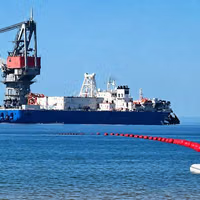
According to Kpler trade intelligence firm’s tanker tracking data, Iran’s crude oil and gas condensate exports reached 1.812 mb/d together in October, the highest since 2019 and about 370,000 b/d more than in September 2023. However, a part of this growth is due to selling its floating oil storage, not production growth.

Iran’s crude oil floating storage has declined 10 million barrels during October, or 322,000 b/d. Iran exported 1.5 mb/d of its surplus oil production as well as 322,000 b/d of flouting stockpile.

Iran had about 60 million barrels of unsold floating crude oil, stored on tankers as well 50 million barrels of gas condensate in mid-2022, but they had declined to 26 million barrels and 1 million barrels respectively as of late October 2023.

According to Oil Ministry’s official data, obtained by Iran International, the country’s 10 refineries currently consume about 1.75 mb/d of crude oil and 450,000 barrels of gas condensate (2.2 mb/d together).

As the country produces 650,000 barrels of gas condensate daily; It has 200,000 b/d of surplus to export.

If Owji’s claims are true and Iran is producing 3.4 mb/d of crude oil, then it should export its surplus 1.65 mb/d of crude oil as well as 0.2 mb/d of gas condensate.

However, as it was mentioned above, the country exported 1.812 mb/d of oil in October, including about 322,000 barrels of floating crude oil sale.

Therefore, Iran had only 1.5 mb/d of surplus crude oil and gas condensate for export in October.

It means crude oil production was about 3.1 mb/d, in line with OPEC and IEA’s estimates, not 3.4 mb/d, claimed by Owji.

Iran has still 26 million barrels of floating crude oil storage to be sold, according to Kpler.
Most Viewed

US blockade enters murky phase as tankers spoof signals and buyers hesitate
1
ANALYSIS

US blockade enters murky phase as tankers spoof signals and buyers hesitate

2
INSIGHT

Ideology may be fading in Iran, but not in Kashmir's ‘Mini Iran'

3
INSIGHT

Hardliners push Hormuz ‘red line’ as US blockade tests Iran’s leverage

4
VOICES FROM IRAN

Hope and anger in Iran as fragile ceasefire persists

5

US sanctions oil network tied to Iranian tycoon Shamkhani

Banner
Banner

Spotlight

  • Hardliners push Hormuz ‘red line’ as US blockade tests Iran’s leverage
    INSIGHT

    Hardliners push Hormuz ‘red line’ as US blockade tests Iran’s leverage

  • Ideology may be fading in Iran, but not in Kashmir's ‘Mini Iran'
    INSIGHT

    Ideology may be fading in Iran, but not in Kashmir's ‘Mini Iran'

  • War damage amounts to $3,000 per Iranian, with blockade set to add to losses
    INSIGHT

    War damage amounts to $3,000 per Iranian, with blockade set to add to losses

  • Why the $100 billion Hormuz toll revenue is a myth
    ANALYSIS

    Why the $100 billion Hormuz toll revenue is a myth

  • US blockade targets Iran oil boom amid regional disruption
    ANALYSIS

    US blockade targets Iran oil boom amid regional disruption

  • Iran's digital economy battered by prolonged blackout
    INSIGHT

    Iran's digital economy battered by prolonged blackout

•
•
•

More Stories

US Boycotts UN Human Rights Council Social Forum Chaired By Iran

Nov 3, 2023, 01:47 GMT+0

The United States has announced that it will not participate in the Social Forum of the UN Human Rights Council as Iran is scheduled to chair the meeting.

“We categorically refuse to sit, converse, or engage in any discussion on human rights chaired by Iran,” read a statement by Michèle Taylor, US permanent representative to the Human Rights Council, at the start of the Social Forum in Geneva.

She rejected as “absurd” and “unacceptable” the Iranian regime’s chairing of the Social Forum as the country itself is implicated in “persistent and flagrant human rights abuses,” including the murder of over 500 civilians during the last year's Women, Life, Freedom protests.

Referring to Armita Geravand and Mahsa Amini, the Iranian women who lost their lives after being assaulted by the regime’s morality police, Taylor stipulated that “state-sponsored violence” is “a daily reality for the Iranian people, especially for women and girls,” amidst the regime's tightening of oppressive hijab laws.

“It is an affront to the collective conscience of the global community that Iran’s officials occupy any leadership role within the corridors of the UN, especially on matters related to human rights,” she added.

Taylor also questioned the very existence of the Social Forum, saying that Washington was against its creation in 2015 for its “limited utility” and “additional costs.”

On October 31, Narges Mohammadi, the imprisoned Iranian Nobel peace laureate, dismissed Tehran’s leadership in the Social Forum as “perplexing and disheartening” in a letter to UN Secretary-General Antonio Guterres.

She urged the UN to remove Tehran from the position, saying the Islamic Republic is “a gender apartheid regime” and “a suppressor of civil society.”

In May 2023, UN Watch, an independent human rights organization, also submitted a resolution to the UN to overturn Iran's appointment as the chair of the Social Forum.

Father Of Slain Iranian Protester Sentenced For Insulting Supreme Leader

Nov 3, 2023, 00:14 GMT+0

The father of one of the Iranian protesters killed during the November 2019 demonstrations has been sentenced to an extra six months in prison on the charge of "insulting the leader."

The verdict was issued against Manouchehr Bakhtiari by the Qazvin Revolutionary Court, according to the US-based Human Rights Activists News Agency (HRANA), who is already serving a three years and six month sentence in Qazvin Central Prison.

His wife, Sara Abbasi, informed HRANA about his deteriorating physical condition, stating that over a year and a half ago, forensic medicine confirmed the urgent need for hernia and prostate surgery.

He has also been suffering from a toothache for over three months and has been denied specialized medical treatment and a medical furlough, despite the family's appeals to relevant authorities.

Bakhtiari was detained in his home in Tehran in 2021 by security forces, accompanied by beatings and insults. Subsequently, he was sentenced by the Revolutionary Court to two years and six months of internal exile and a two-year travel ban in addition to his three years and six months prison sentence.

Bakhtiari's son, 27-year-old Pouya, was shot in the head in Karaj during the November 2019 protests. The family has accused security forces of his death. His father has been an outspoken advocate for holding the authorities accountable for the death of his son and hundreds of others allegedly killed by security forces.


Iran Pressures Jewish Minority To Sever Ties With Relatives In Israel

Nov 2, 2023, 19:20 GMT+0
•
Iran International Newsroom

Amid Iran’s unequivocal support for its proxy Hamas, the regime has pushed Iranian Jews to cut ties with Israel-based friends and relatives.

Sources told Iran International Wednesday that an unknown number of members of the community were forced to block their relatives' phone numbers in Israel and some have left family and group chats on messaging apps, including WhatsApp. The sources did not specify how the authorities pressure them but there are other reports about unknown people – presumably intelligence or Revolutionary Guard agents -- calling the Jewish people in Shiraz and pushing them into cutting relations with their Israeli relatives. 

Clearly organized by the regime, Iranian Jews have held ceremonies in synagogues across various cities over the past few days to express support for Hamas, which killed 1,400 mostly civilians on October 7 and took over 230 hostages to Gaza.

A regime-sponsored event in a synagogue in Tehran  (October 2023)
100%
A regime-sponsored event in a synagogue in Tehran (October 2023)

In April, the regime pressured the Jewish community to participate in Quds Day, which coincided with the Jewish holiday of Passover. The one-year anniversary of Mahsa Amini’s murder, which sparked months of anti regime protests in 2022, coincided with the Jewish New Year on September 16, prompting community leaders to warn Jews to stay off the streets.

In a Telegram posting from Iran’s roughly 9,000 strong Jewish community, the leadership wrote “All worshipers are strongly requested to refrain from stopping and gathering in the streets for any reason during Rosh Hashanah and after performing religious duties in synagogues.”

Although Iran has voted several times on pro-Palestinian UN resolutions that called for a two-state solution for the conflict, Tehran’s official ultimate goal is the destruction of the Jewish state, as prophesied by the octogenarian despot. 

The pressure on the Jewish community comes on the backdrop of Iran extending its criteria to criminalize support for Israel. This week, a body tasked with determining instances of criminal content, under the judiciary, updated its articles to include any activity in support of Israel in cybersphere.

Since Hamas declared war with the operation it codenamed al-Aqsa Flood (Storm in Persian), Iranians have become even more vocal about their distance from the Islamic Republic’s narrative of the conflict, making trendy hashtags like IranStandsWithIsrael or chanting creative slogans about where the regime should put the Palestinian flag. 

An emotional funeral for a young Israeli soldier of Iranian origin killed in the Hamas attack earlier this week went viral, jogging Iranians’ memory of deep common roots with the Jewish community. Shirel Haeimpour’s grandfather sang a traditional Jewish love song and a wedding song with his Esfahani Persian accent for the young woman. 

In October, the Islamic Republic revealed again that it exerts considerable pressure on the country’s tiny Jewish community to denigrate Israel. The Tehran-born Beni Sabti, an expert on Iran from the Israeli National Security and Strategy Institute, told Iran International that the Islamic Republic strong-armed the Tehran Jewish community into condemning Israel on its Telegram channel for its efforts to defeat Iran’s ally, Hamas.

Iranian authorities have recently nudged down their saber-rattling against Israel and claim Tehran does not have any proxy militia under its command. Iran’s ruler Ali Khamenei attempted to counter international reports suggesting Iran's role in organizing pro-Hamas rallies in major European and US cities during a speech on Wednesday. He dismissed the claims, saying it's as if the Basij militia of the Revolutionary Guard had branches in London and Paris. In fact, the UK now claims Iran is one of the country's number one threats, having attempted multiple attacks on UK soil in the last year. Khamenei also called on Muslim states to cease oil, food and goods exports to Israel. 

US and European officials are concerned that actions by the Iranian government could escalate the conflict to other fronts with Iranian proxy forces' potential involvement. Since the war broke out, multiple attacks on US bases in the Middle East have already set tensions to crisis level. 

Prior to the war, Israel and Saudi Arabia were edging ever closer to opening diplomatic ties, in the footsteps of other nations such as the United Arab Emirates which was one of several countries party to the US-brokered Abraham Accords of 2020. However, the warming of ties with Israel and Saudi had been a huge point of contention for the regime which repeatedly warned against the normalization. 

US President Joe Biden listed the disruption of the normalization of relations between Saudi Arabia and Israel as one of the reasons behind the Hamas attack.

Hardliners In Iran Promote Polygamy, Obedience Of Wives

Nov 2, 2023, 18:47 GMT+0

An IRGC-affiliated newspaper in Iran has promoted the practice of polygamy and the obedience of wives in marriage amid growing pushback in the country to increasingly oppressive reforms.

Typical of regime propaganda, the newspaper, Javan, shared the notion that principles of polygamy and obedience of women are rooted in the fundamental framework of Islamic sexual theory. Among Iran's young population, especially in urban areas, polygamy is seen as a thing of the past, much like its rejection of the mandatory hijab as was seen in the Women, Life, Freedom movement uprising since last year.

The article even argued that if Islamic principles are correctly implemented in society, it could alleviate the current challenges faced by Iranian society in matters related to sexual issues, referring to Iran's declining marriage and birth rates, a challenge the regime has long been trying to overcome as young women delay marriage in favour of education and careers.

Women in Iran have long confronted legal, political, economic, and social challenges. Marriage laws are particularly discriminatory, allowing men to have up to four wives simultaneously, while women can only marry one husband. Women also require male guardian consent for marriage, and there are restrictions on interfaith marriages.

Additionally, the legal age of marriage has decreased over the years. Marriage contracts often include clauses mandating a woman's obedience to receive financial support for housing, clothing, food, and furniture.

In addition, women face discrimination in divorce proceedings, as they can only obtain a divorce through a court, whereas men can unilaterally declare divorce without their spouse's presence.

Travel restrictions for women also exist, as they typically require their husband's permission to obtain a passport or travel abroad. Unmarried women aged 18 and above are allowed to apply for a passport without requiring prior permission, yet they still need permission by their male guardians -- father or husband -- to travel abroad.

Tehran City Council Head Announces Aid For Gaza

Nov 2, 2023, 17:42 GMT+0

The head of Tehran City Council has announced plans to support the reconstruction of Gaza during an upcoming meeting involving city council leaders.

Coming amid the ongoing war between Israel and Iran-backed Hamas in Gaza, which Israeli prime minister Benjamin Netanyahu has said will be "long and difficult", Mehdi Chamran said that a meeting is scheduled to discuss “strategies to prevent future Israeli bombings.”

His offer of aid to Hamas-run Gaza comes when ordinary Iranians are struggling to survive as the country grapples with one of its most severe economic crises. The national currency is at a historic low, causing unexpected poverty for tens of millions of Iranians.

Questions about taking the domestic budget abroad will likely raise questions among a population grappling for even the basics such as food and fuel.

The Islamic City Council of Tehran oversees the governance of the capital city. It plays a pivotal role in selecting the mayor and managing the budget of the Municipality of Tehran.

Recent developments have shed light on financial irregularities within the Tehran municipality. In May, Tehran City Council revealed nearly $400 million worth of financial discrepancies, highlighting a history of corruption cases in Tehran's municipal administration.