• العربية
  • فارسی
Brand
  • Iran Insight
  • Politics
  • Economy
  • Analysis
  • Special Report
  • Opinion
  • Podcast
  • Iran Insight
  • Politics
  • Economy
  • Analysis
  • Special Report
  • Opinion
  • Podcast
  • Theme
  • Language
    • العربية
    • فارسی
  • Iran Insight
  • Politics
  • Economy
  • Analysis
  • Special Report
  • Opinion
  • Podcast
All rights reserved for Volant Media UK Limited
volant media logo

Iran’s Government Plans To Increase Taxes Amid Economic Crisis
Iran International Newsroom
Nov 23, 2023, 22:11 GMT+0Updated: 11:28 GMT+0
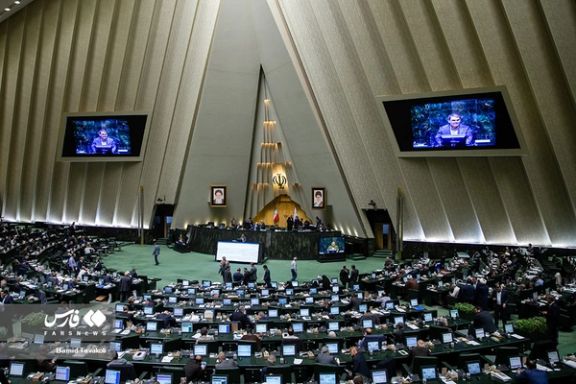
A session of the Iranian parliament on November 21, 2023

A sharp increase in taxes in next year’s budget bill has shocked both the public and analysts in Iran, signaling a deepening of the current economic crisis.

Entekhab news website in Tehran reported that according to the budget bill, even the monthly incomes of 100 to 140 million rials ($200 to $280) will be subject to a 10 percent tax.

Jahan-e-Sanat daily also warned that the Iranian government has counted on “inflation tax” to fill the next year’s budget. The Iranian calendar and fiscal year begins on March 21, 2024, and the government has already submitted its budget draft bill to parliament.

In order to close its huge budget deficit, the government has projected a 50-percent increase in taxes of various kind compared to this year’s budget. Total expected tax revenues will reach over 11,220 billion rials ($22.44 billion), Jahan-e-Sanat said.

The total government budget will reach 24,620 billion rials ($49.2 billion) next year, which shows an increase of 18.2 percent compared to this year’s budget, the report added.

Iranian President Raisi submitting the state budget to the parliament (undated)
100%
Iranian President Raisi submitting the state budget to the parliament

That is to say, the tax revenues will account for more than 45 percent of the Iranian government’s operating budget, although the 18.2 percent overall budget increase of half what it was this year. Some media outlets wondered what the reason is for a smaller than anticipated budget growth- less than half of the current inflation rate. Some speculated that this can be interpreted as an austerity measure.

Khabaronline news website also called the tax hikes “odd.,” as the government claims more oil exports and insists that it is able to repatriate the income despite US banking sanctions. Iranian oil exports have reached 1.5 million barrels per day from a low of 300,000 barrels in 2019, but the impact of higher revenues is not felt in the economy.

The government has tried to increase “luxury” taxes, as average Iranian live on less than $200 a month. According to Khabaronline, passenger cars worth over 30 billion rials ($60,000) will be subject to a 1 percent annual tax.

Large homes, garden, villas and lands whose value are more than 250 billion rials ($500,000) will also be taxed, the report added.

Another point of significance in the next year’s budget bill is that the government’s currency resources and expenditures have been counted in terms of euro instead of the US dollar. It seems that the government has decided to replace dollar with euro as the basis of its transactions, reformist Arman Daily noted. This is more of a symbolic ideological gesture against the United States.

Tehran officials have time and again stressed the necessity of removing the US dollar from the country’s limited economic transactions with the international community.

During a November 2017 meeting with Russian President Vladimir Putin, Iran's Supreme Leader Ali Khamenei called for the elimination of the dollar in both bilateral and multilateral economic exchanges, aiming to counteract US sanctions.

Aftabnews, a reformist news website, also warned that the government’s general budget next year will grow only by 18 percent compared to this year, which is a far cry from the inflation rate, estimated to be at least 40 percent.

Discussing the worrisome aspects of the next year’s budget bill, reformist daily Ham-Mihan noted that the bill carries a clear messages: the US sanctions will continue and will even get tougher; there will be no economic improvement next year.
Most Viewed

US blockade enters murky phase as tankers spoof signals and buyers hesitate
1
ANALYSIS

US blockade enters murky phase as tankers spoof signals and buyers hesitate

2
INSIGHT

Ideology may be fading in Iran, but not in Kashmir's ‘Mini Iran'

3
INSIGHT

Hardliners push Hormuz ‘red line’ as US blockade tests Iran’s leverage

4
VOICES FROM IRAN

Hope and anger in Iran as fragile ceasefire persists

5

US sanctions oil network tied to Iranian tycoon Shamkhani

Banner
Banner

Spotlight

  • Hardliners push Hormuz ‘red line’ as US blockade tests Iran’s leverage
    INSIGHT

    Hardliners push Hormuz ‘red line’ as US blockade tests Iran’s leverage

  • Ideology may be fading in Iran, but not in Kashmir's ‘Mini Iran'
    INSIGHT

    Ideology may be fading in Iran, but not in Kashmir's ‘Mini Iran'

  • War damage amounts to $3,000 per Iranian, with blockade set to add to losses
    INSIGHT

    War damage amounts to $3,000 per Iranian, with blockade set to add to losses

  • Why the $100 billion Hormuz toll revenue is a myth
    ANALYSIS

    Why the $100 billion Hormuz toll revenue is a myth

  • US blockade targets Iran oil boom amid regional disruption
    ANALYSIS

    US blockade targets Iran oil boom amid regional disruption

  • Iran's digital economy battered by prolonged blackout
    INSIGHT

    Iran's digital economy battered by prolonged blackout

•
•
•

More Stories

Iranian Security Forces Clash With Victims Of Fraud In Qazvin

Nov 23, 2023, 21:54 GMT+0

In a tense confrontation, security forces attacked a gathering of individuals who lost their money to the fraud of Rezayat Khodro Taravat Novin, a vehicle leasing company in Qazvin, west of Tehran.

The incident happened on Thursday when victims gathered in front of the governor's office in Qazvin, expressing their grievances over financial losses incurred at the hands of the company.

The victims claim the company embezzled a staggering 300 trillion rials (approximately $600 billion) through schemes for pre-selling cars. For several months, hundreds of people have been staging protests in Tehran, Qazvin, and Takestan, demanding justice and restitution. The nationwide fraud involves at least 38,000 people.

Recent videos show security forces using teargas and water cannons against the protesters. Government forces on several occasions attacked the protests by the victims.

Over the past three months, the Qazvin judiciary has detained managers from Rezayat Khodro Taravat Novin, announcing that all assets belonging to the company's CEOs will be seized.

Mohammadreza Ghaffari, the owner of the company, reportedly moved a portion of the capital abroad. The judiciary says the victims' gatherings are illegal, citing concerns about disturbances in public order.


War Is A Blessing For Iran, Political Prisoners Warn

Nov 23, 2023, 18:36 GMT+0

Nine Iranian political prisoners denounced both Hamas and Israel actions in Gaza, warning that potential Iranian involvement would benefit the Islamic Republic.

In a statement released from the Evin Prison, the political prisoners took to task Tehran’s “proxy and devastating policies” in the region, stressing that the war is a “blessing” for reactionary rulers.

“The eight-year Iran-Iraq war helped stabilize the regime and the killing of thousands of political prisoners” at that time, the statement added.

They warned that in the event of the expansion of the ongoing Middle Eastern conflict, the Iranian regime would intensify its crackdown against civil and political activists, women and student movements, and religious minorities such as the Baha'i community.

Anisha Asadollahi, Golrokh Iraee, Reza Shahabi, Keyvan Mohtadi, and Arash Johari are among the signatories of this statement.

Earlier in the month, the UN special rapporteur on human rights in Iran, Javaid Rehman, warned that the Israel-Gaza War bolsters repression inside Iran by deflecting attention from internal criticism of the regime.

The political prisoners also questioned the sincerity of Tehran’s claims regarding its support of the Palestinian cause.

“The government, responsible for the deaths of thousands of children and teenagers in the past year and beyond, is now attempting to mask its reactionary nature under the guise of defending the Palestinian people,” read the statement.

Iran witnessed massive protests last year after Mahsa Jina Amini, a 22-year-old girl, lost her life in morality police custody for not observing mandatory hijab codes. According to reports, more than 500 people, including children and teenagers, were killed by the regime’s security forces last year.

Australian Shadow FM Advocates For Designating IRGC

Nov 23, 2023, 15:38 GMT+0

The Australian Shadow Assistant Foreign Minister expressed disappointment that Australia has not listed Iran's Islamic Revolutionary Guard Corps (IRGC) as a terrorist organization.

In an interview with Iran International, Senator Claire Chandler voiced her concerns about Iran's influence in using proxies to spread terror and violence globally. Attacks by IRGC operatives have been thwarted across the globe, in countries including the UK, Cyprus and Azerbaijan.

Chandler emphasized the link between the Islamic Republic of Iran and entities like Hamas and Hezbollah, both known for their involvement in acts of terror, referring to the current war in Gaza, triggered by the October 7 of Hamas in Israel, killing 1,200 mostly civilians. Since then, increasing attacks from Hezbollah on Israel's north have meant 150,000 Israelis have been displaced from north and south Israel.

“We know that the Islamic Republic of Iran regime funds Hamas, which is obviously causing so much terror and violence currently in the Middle East. They founded Hezbollah. And of course, are closely linked with the IRGC,” noted Chandler.

She underscored the role of the IRGC in these activities, urging the Australian government to designate it as a terrorist organization. The Australian Senate had recommended such a designation in February, but Canberra has indicated legal uncertainties surrounding the matter.

In 2019, the United States, under the Trump administration, designated the IRGC as a foreign terrorist group amidst escalating tensions with Iran following Washington's withdrawal from the 2015 nuclear deal. In response, Tehran designated the US military as a terrorist group. Other countries such as the UK, Canada and France, have so far hesitated to follow suit but have sanctioned the organization and individuals linked to it heavily.


Iran Not Fulfilling Nuclear Commitments, Says IAEA Chief

Nov 23, 2023, 14:31 GMT+0

The head of the UN nuclear watchdog says Iran is not fulfilling many aspects of its commitments under the 2015 nuclear deal and the March agreement. 

In a press briefing on the sidelines of the International Atomic Energy Agency's Board of Governors session, Director-General Rafael Grossi told Iran International that "Iran has ceased to implement lots of aspects and nuclear related obligations under the JCPOA (the Joint Comprehensive Plan of Action) and it's not implementing mutually agreed additional measures under the joint statement of March 4th.”

On Wednesday, Grossi presented his latest report on verification and monitoring in the Islamic Republic of Iran in light of United Nations Security Council Resolution 2231 (2015), saying that “Iran’s stockpiles of uranium enriched up to 5%, enriched up to 20% and enriched up to 60% – high enriched uranium – have all increased since we met in September with the increase of the 60% continuing at the same rate as I reported at the time of the last Board."

The European Union’s representative told the IAEA Board of Governors that “the EU remains committed to the JCPOA... to ensure that Iran does not acquire a nuclear weapon.” The bloc also implicitly called on the US to return, saying, “The EU calls on all countries to support the implementation of the United Nations Security Council Resolution 2231 (2015)," the UN document that is the foundation of the JCPOA.

Expressing deep concerns by the successive IAEA reports documenting the alarming acceleration of Iran’s nuclear program “that gravely departs from its JCPOA commitments," the EU said that Iran’s actions have “no credible civilian justification” and “carry very significant proliferation-related risks and raise grave concerns about Iran’s intentions.”

Director General of the International Atomic Energy Agency (IAEA) Rafael Grossi holds a press conference on the opening day of a quarterly meeting of the agency's 35-nation Board of Governors in Vienna, Austria, November 22, 2023.
100%
Director General of the International Atomic Energy Agency (IAEA) Rafael Grossi holds a press conference on the opening day of a quarterly meeting of the agency's 35-nation Board of Governors in Vienna, Austria, November 22, 2023.


The recent IAEA report documented a substantial accumulation of the enriched uranium stockpile and an expansion of nuclear enrichment infrastructure “far beyond JCPOA thresholds for quantity and level of enrichment.” 

In June 2022, Iran removed all IAEA JCPOA-related surveillance and monitoring equipment and since March it agreed to put them back on operation, but it has been stonewalling the process ever since. Additionally, Tehran withdrew the designation of several inspectors assigned to conduct verification activities in Iran under the Non-Proliferation Treaty Safeguards Agreement a few days after securing a prisoner swap with the US that included unfreezing of about $6 billion of its oil revenues blocked in South Korea. 

Tehran's move, which the IAEA called "disproportionate and unprecedented", was in response to a call by the United States, France, Britain and Germany at another round of IAEA Board of Governors to give credible explanations on the uranium particles and let the IAEA install more surveillance cameras. So far, the IAEA has had no progress in getting Iran to reverse its so-called "de-designation" in September of the IAEA inspectors. The move effectively barred some inspectors, who diplomats said were from France and Germany and the IAEA said were among its most experienced experts, from working in Iran.

After the US withdrawal from the JCPOA and reimposition of sanctions in 2018, Iran has accelerated its enrichment pace and stockpiling load, using them as bargaining chips to get concessions from the West. Iran did not agree to a compromise plan proposed by the European Union in 2022 to revive the agreement, despite the Biden administration’s stated goal of finding a diplomatic solution.Washington has informally relaxed sanctions on Iran’s oil exports and allowed blocked funds in Iraq and South Korea to be released, but Tehran has shown no willingness to resolve the nuclear issue.

When it comes to nuclear commitments, Iran does not abide by rules but when a sunset clause of the same 2015 accord comes, Iran is there to reap the harvest. In October, the United Nations’ checks and balances on Iran’s missile program expired, enabling a newly emboldened Iran to legally supply Russia with arms for the invasion of Ukraine as its global reign of terror continues even less abated. 

Iranian Foreign Minister Denies Intent To Expand Regional War

Nov 23, 2023, 12:51 GMT+0

Iran's foreign minister continued to deny Tehran's goal to expand war in the region on the back of the Gaza war while simultaneously meeting heads of Iran-backed Hamas and Hezbollah.

In a meeting with Lebanese Prime Minister Najib Mikati, Iranian Foreign Minister Hossein Amir-Abdollahian said “if Iran were pursuing such a goal, it would lead to a significant change in the overall conditions in the region.”

However, the foreign minister traveled to Beirut for discussions on the situation in Gaza with Iran's largest proxy, Lebanese Hezbollah Secretary-General Hassan Nasrallah as well as Palestinian Islamic Jihad Secretary General Ziad al-Nakhalah and Hamas' Khalil al-Hayya on Thursday.

The leadership in Tehran has had multiple meetings during the course of this year with heads of its proxies in the lead up to the Hamas invasion of Israel on October 7, in which 1,200 mostly civilians were murdered and 240 taken hostage to Gaza.

Israel's relentless retaliation has seen the worst bloodshed since Hamas took over the strip in 2007, vowing to take out the proscribed terror group once the hostages have been returned.

Iran has consistently made similar statements in the past four weeks while expressing support for Hamas and celebrating the attacks across Iran. Since October 7, Iran's proxies across the region have targeted Israel, from Iraq, Syria, Yemen and Lebanon, making it ever more difficult for Tehran to deny its involvement in a conflict which has claimed thousands of lives.