• العربية
  • فارسی
Brand
  • Iran Insight
  • Politics
  • Economy
  • Analysis
  • Special Report
  • Opinion
  • Podcast
  • Iran Insight
  • Politics
  • Economy
  • Analysis
  • Special Report
  • Opinion
  • Podcast
  • Theme
  • Language
    • العربية
    • فارسی
  • Iran Insight
  • Politics
  • Economy
  • Analysis
  • Special Report
  • Opinion
  • Podcast
All rights reserved for Volant Media UK Limited
volant media logo

Iran's Education System Afflicted With Crises

Maryam Sinaiee
Maryam Sinaiee

Iran International

Dec 1, 2023, 16:14 GMT+0Updated: 11:26 GMT+0
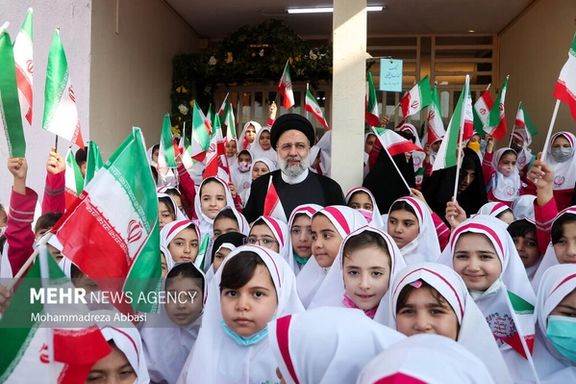
Iranian President Ebrahim Raisi among a group of schoolgirls in Tehran

Policies adopted in recent years have seriously damaged the quality and fairness of Iran’s education system, a report released by a group of experts says.

The report an excerpt of which was published by the reformist Etemad newspaper highlights significant qualitative deficiencies in Iran's education system. Alongside these shortcomings, the system is criticized for a lack of justice in providing educational opportunities and a legitimacy gap, stemming from disparities between students' expectations and authorities' ideological perspectives.

According to the report, this disconnect has severed ties between the educational system and civil society, leading to resistance from students, their families, and even teachers against the system's policies. The study group, comprised of experts, researchers, and educators, convened at the invitation of former reformist president Mohammad Khatami (1997-2005) to address these issues.

“The education system has turned into an arena for those in power to pursue their political goals,” the report says, explaining that schoolbooks and teacher training and selection have become engineering tools to ensure the political and ideological goals.

The report contends that the accelerating privatization of education in Iran has disproportionately disadvantaged poorer regions, with some areas, like Sistan- Baluchestan Province, having villages located up to fifty kilometers from the nearest school. Schoolbooks, first re-written after the 1979 revolution, have been modified over the years to align with Islamic standards, have increasingly become tools to serve the political interests of the hardliners in power, imposing their ideological values.

A classroom in southeastern province of Sistan-Baluchestan  (file photo)
100%
A classroom in southeastern province of Sistan-Baluchestan

Religious censorship has invaded many textbooks, including literature and history, where the hardliner Shiite faction has imposed its own version of values on the educational system. Some writers and poets have been purged from textbooks while others have been given a more prominent place. Even Islamic history has been manipulated to fit the narrow religious agenda of the ruling hardliners.

In recent weeks, reports indicate that hardliners controlling parliament and enjoying influence in the presidential administration, have begun hiring thousands of their followers as teachers and school principals, without any consideration for qualification.

Resistance against the ideological values of the hardliner clerical rulers clearly manifested itself last year during the several-month-long Woman, Life, Freedom protests when female students displayed their anger by refusing to wear the mandatory hijab and protested both inside and outside schools in many areas of the country. Some of the students who were arrested for protesting were banned from attending school. 

Many Iranians suspect the mysterious poisoning incidents that affected thousands of students across the country following the protests were orchestrated as revenge by the regime or the religious hardliners it protects. This was perceived as a measure to intimidate and subdue those involved in the protest movement. The poisonings began in Qom on November 30, spreading nationwide until April, leading to hospitalizations and at least one reported death.

Authorities first denied any suspicious activity, then admitted “mild poison attacks”. Later they blamed dissidents and foreign powers and arrested some individuals who they blamed for isolated cases and forced to make televised “confessions”.

Eventually in a statement on April 28, the intelligence ministry denied any indication that poisonous substances had caused the illness of students and said samples taken from the scene of the incidents examined by “the most reliable laboratories” in the country had not yielded any suspicious materials. The ministry blamed pranksters who it claimed had used stink pots, pepper sprays, tear gas and similar substances to disrupt classes.
Most Viewed

US blockade enters murky phase as tankers spoof signals and buyers hesitate
1
ANALYSIS

US blockade enters murky phase as tankers spoof signals and buyers hesitate

2
INSIGHT

Ideology may be fading in Iran, but not in Kashmir's ‘Mini Iran'

3
INSIGHT

Hardliners push Hormuz ‘red line’ as US blockade tests Iran’s leverage

4
VOICES FROM IRAN

Hope and anger in Iran as fragile ceasefire persists

5

US sanctions oil network tied to Iranian tycoon Shamkhani

Banner
Banner

Spotlight

  • Hardliners push Hormuz ‘red line’ as US blockade tests Iran’s leverage
    INSIGHT

    Hardliners push Hormuz ‘red line’ as US blockade tests Iran’s leverage

  • Ideology may be fading in Iran, but not in Kashmir's ‘Mini Iran'
    INSIGHT

    Ideology may be fading in Iran, but not in Kashmir's ‘Mini Iran'

  • War damage amounts to $3,000 per Iranian, with blockade set to add to losses
    INSIGHT

    War damage amounts to $3,000 per Iranian, with blockade set to add to losses

  • Why the $100 billion Hormuz toll revenue is a myth
    ANALYSIS

    Why the $100 billion Hormuz toll revenue is a myth

  • US blockade targets Iran oil boom amid regional disruption
    ANALYSIS

    US blockade targets Iran oil boom amid regional disruption

  • Iran's digital economy battered by prolonged blackout
    INSIGHT

    Iran's digital economy battered by prolonged blackout

•
•
•

More Stories

IRGC Navy Commander Issues Warning To Extra-Regional Ships

Dec 1, 2023, 16:08 GMT+0

The commander of Revolutionary Guard’s navy says ships belonging to foreign forces are only in the region to foment tensions, referring to US warships.

Alireza Tangsiri made the remarks during a meeting with Ahmed bin Harith al-Nabhani, the visiting Chief of Staff of Oman's Armed Forces, stating, “Regional countries are responsible for ensuring security in the strategic Strait of Hormuz, and the presence of foreigners is only aimed at creating discord among Muslim nations." In past years, Iranian officials have repeatedly threatened to close the world's most important chokepoints for maritime oil traffic by force in response to flaring tensions with the US.

The spillover of the Gaza war, initiated by the Hamas invasion on October 7,has led to increased attacks against the US bases in the region. Washington has also moved naval bases to the region both in the Mediterranean Sea and the Persian Gulf.

Iranian authorities have leveled up their regional tours to consolidate ties with the Arab states of the region while Tehran’s proxy militias are destabilizing the region by firing missiles and attacking vessels.

On Thursday, the United States said it has intercepted and shot down an Iranian-produced drone near the Bab el-Mandeb Strait in the southern Red Sea. A day later, Iran's Foreign Minister Hossein Amir-Abdollahianmet the Houthis' envoy at the Yemeni embassy in Tehran in order to express his gratitude for the Iran-backed fighters' "support for the people of Palestine". The incident came a week after the USS Thomas Hudner, another American warship deployed in the region, shot down several one-way attack drones launched by the Houthis.

Tangsiri claimed earlier in the week that his forces had sent drones to harass the operations of the USS Dwight D. Eisenhower aircraft carrier and its strike group. The incident was confirmed and described as "unsafe, unprofessional and irresponsible" in a statement issued Wednesday by US Naval Forces Central Command chief Vice Admiral Brad Cooper.

In addition to firing ballistic missiles American targets, Houthis have fired multiple missiles and drones at Israel and attacked two ships that they thought were Israel’s.

Iran Renews Call For Ceasefire Hours After Truce Ends

Dec 1, 2023, 14:58 GMT+0

Within hours after the resumption of fighting between Iran-backed Hamas and Israel, Tehran’s top diplomat called for an extension of the ceasefire.

Foreign Minister Hossein Amir-Abdollahian said Friday, "No solution exists other than an open-ended ceasefire, extensive delivery of humanitarian aid and an agreement on fresh exchange of prisoners." The truce saw the release of 105 Israeli captives held in Gaza and 240 Palestinian prisoners.

"Progress of the Washington and Tel Aviv war means new genocide in Gaza and West Bank,” he said, calling on the US and Israel to “Stop the war on Gaza before it’s too late.” He warned that Israeli hostages " will rather be killed in the bombings."

Nasser Kanaani, the spokesman of the Foreign Ministry, also released a statement similar to that of his boss, pointing the finger at Israel for the failed truce while Israel blames Hamas for firing rockets into Israel and not releasing all the abducted women and children it has in its custody.

Iran supports Hamas but says it did not play any role in the Islamist militants' October 7 terror attack that triggered the current crisis. Iran also backs the Hezbollah, a Lebanese militant group that has deep ties with Hamas and Islamic Jihad, another Palestinian faction in Gaza that is also backed by Iran.

The war in Gaza has also escalated tensions in the West Bank, where Palestinian sources claim about 240 Palestinians have been killed since the Hamas operation.

The war, initiated by the Hamas invasion on October 7, resulted in at least 1,200, mostly civilians losing their lives, and an additional 240 taken hostage. Retaliatory attacks have left over 15,000 dead in Gaza, with hundreds of thousands displaced. Israel pounded the enclave to uproot the Islamist group, which has made the war exceedingly bloody hiding deep among the civilian population and underneath the coastal sliver’s non-military facilities. 

Iran’s Delegation Walks Out Of UN Summit Over Israel's Presence

Dec 1, 2023, 12:59 GMT+0

Iranian delegates walked out of UN climate talks in the United Arab Emirates Friday in protest over the presence of Israeli representatives.

Energy Minister Ali Akbar Mehrabian, who heads the Iranian delegation, said Iran considers Israel’s presence at COP28 “as contrary to the goals and guidelines of the conference and, in protest, it left the conference venue.”

On Thursday, Iran's President Ebrahim Raisi also announced that he would not attend the UN Climate Change Conference (COP28) in Dubai, citing the presence of his Israeli counterpart.

It is not clear that why Tehran had sent the delegation in the first place as it knew about Israel’s participation in advance enough to cancel Raisi’s trip.

The UAE and Israel normalized relations during the presidency of Donald Trump in the United States when in 2020 the Abraham Accords opened diplomatic ties along with other Arab nations such as Bahrain.

During Herzog's inaugural visit to the UAE last year, the Iran-backed Houthis in Yemen sent a ballistic missile to the Persian Gulf state amidst a period of attacks which killed three. The missile was intercepted by the UAE. The Houthis' military spokesman said they fired Zulfiqar missiles at Abu Dhabi and launched drones at Dubai.

Dramatic Increase In Liquid Gas Price Hits Iran's Poor

Dec 1, 2023, 11:36 GMT+0
•
Iran International Newsroom

The government decision to increase the price of liquid gas (LPG) cylinders from $1.2 a cylinder to $8 this week has hit Iran's poor as winter takes hold.

The decision has hit hardest the poor southern provinces which do not have access to LPG at home. Ordinary workers barely make $150 a month and can't afford to pay the higher price for fuel they need for cooking and in some cases for heating their homes.

A local official with the Iranian oil ministry said that the inhabitants of Hormozgan are required to register in an electronic system in order to be given subsidized LPG but with many of the poor living in shanty towns, they remain locked out of the system.

If registered, each household will receive a quota of four subsidized LPG cylinders per month but a restaurant owner in the province told Aftab News that the allocated amount is still not enough and he has to find the extra fuel for his job in the black market at exorbitant prices.

liquid petroleum gas cylinders (file photo)
100%

Despite the criticisms, Iranian officials defended their decision, saying the distribution of LPG has been “adjusted” in an attempt to fight smuggling. The Iranian government has sold fuel and electricity at extremely low prices for decades, partly because of inertia and partly due to fears of popular protests. In 2019, a gasoline price hike led to days of nationwide protests. Security forces killed at least 1,500 people, which badly eroded the government's legitimacy. But as people's incomes have dwindled by high inflation since 2018, now the government faces even a tougher choice to raise prices.

The sharp increase in prices has also raised serious concerns among environmental activists.

Sirous Zareh, an environmental activist in Fars province warned that the drastic increase of the LPG price will practically leave no choice for the local communities living on the edges of habitats to use wood and tree trunks instead of the expensive gas.

Logging and deforestation will multiply as a result of the government’s new policy, Zareh predicted.

He stressed that while Iran’s large gas resources could serve as “a protective shield against indiscriminate deforestation,” the economically vulnerable sections of the society will have no other way but to stop gas consumption and start using forest fuel at their houses.

It comes while some of Iran's southern provinces such as Hormozgan and Khuzestan abound with gas resources, Iran the second richest gas nation in the world.

Iran has a serious shortage of natural gas which is in decline because of decades of inadequate investments and lack of Western technology to increase extraction in Iran's main underwater gas fields in the Persian Gulf. Years of various sanctions and mismanagement have prevented the necessary upgrades of gas platforms. 

The government is juggling between ever-increasing domestic consumer and commercial demand and its need for power generation, exports and using needed gas for oil production.

Despite the celebratory and optimistic rhetoric of the Iranian regime officials about Tehran’s increasing ties with non-Western partners, even the Chinese and the Russians have not been willing to render any significant assistance to boost Iran’s gas and oil productions.

UK, France, Germany Condemn Iran’s Missile Advances

Dec 1, 2023, 11:26 GMT+0

The UK, France and Germany have condemned Iran’s missile advances about a week after the unveiling of the Fattah-2, a ballistic missile that Tehran claims is “hypersonic.”

In a joint statement, the so-called E3 Iran continues to develop its missile program despite repeated international calls to halt it, and after years of disregarding UN restrictions.

Iran unveiled the new ballistic missile variant on November 19. Fattah II is reportedly equipped with an advanced warhead and hypersonic glide vehicle capable of maneuvering at high speeds to evade air defense systems. The missile was put on display at Ashura Aerospace Science and Technology University, a division of the Islamic Revolutionary Guard Corps (IRGC) in Tehran. Iran’s Supreme Leader Ali Khamenei visited the site to review an exhibition of new weapons systems, among them the Fattah II.

Highlighting the “grave threat Iran poses to global and regional security,” the countries decried Iran’s continued development of its ballistic missile program that “follows continued nuclear escalation, beyond all credible civilian justification, and previously conducted research on nuclear weapons delivery.”

The expiration of UN sanctions on Iran's missile program in October has raised concerns about the accelerated proliferation of potentially dangerous weapons. Iran is now free to sell its drones, ballistic missiles, and related long-range strike technologies to its anti-Western partners and clients and can also procure technology for further development.

The lifting of sanctions provides Iran with the opportunity to generate revenue from missile sales, potentially using the profits to finance militant and terror proxies in the Middle East.