• العربية
  • فارسی
Brand
  • Iran Insight
  • Politics
  • Economy
  • Analysis
  • Special Report
  • Opinion
  • Podcast
  • Iran Insight
  • Politics
  • Economy
  • Analysis
  • Special Report
  • Opinion
  • Podcast
  • Theme
  • Language
    • العربية
    • فارسی
  • Iran Insight
  • Politics
  • Economy
  • Analysis
  • Special Report
  • Opinion
  • Podcast
All rights reserved for Volant Media UK Limited
volant media logo

Tehran’s Response To Attacks On Houthis Sticks To Usual Rhetoric
Iran International Newsroom
Jan 13, 2024, 20:57 GMT+0Updated: 11:13 GMT+0
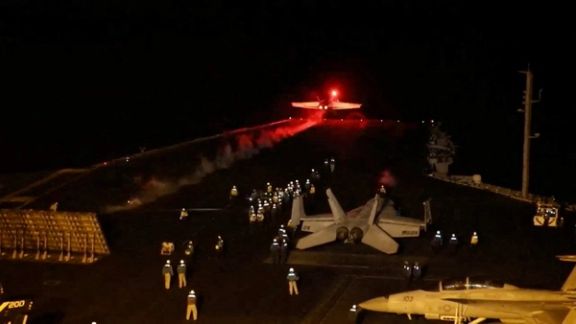
An aircraft takes off to join the US-led coalition to conduct air strikes against military targets in Yemen, aimed at the Iran-backed Houthi militia that has been targeting international shipping in the Red Sea, January 12, 2024.

The limited responses from Iranian officials to the US and UK's attacks on Houthi targets in Yemen have largely consisted of typical rhetoric from the regime.

So far, Iran's Foreign Ministry Spokesman Nasser Kanaani has provided the most "critical" response to the Western air strikes. He strongly condemned the military action and claimed that they only divert attention from the "crimes" in Gaza and "have no result other than fueling insecurity and instability in the region."

In a reaction that can be evaluated as relatively mild, Iran’s Foreign Minister Hossein Amir-Abdollahian wrote on X that Houthis are committed to maritime and shipping security in the region.

Since mid-November Iran’s Yemeni proxies have launched dozens of missile and drone attacks against international commercial vessels in the Red Sea, after the Supreme Leader in Tehran called for a blockade of goods to Israel.

“Instead of a military strike on Yemen, the White House should immediately end all military and security cooperations with Tel Aviv against the people of Gaza and the West Bank,” stated Amir-Abdollahian, adding that only then, security will be restored across the region.

Iran’s Supreme Leader Ali Khamenei and top IRGC commanders have not yet made any comments on the strikes.

Newly recruited fighters who joined a Houthi military force intended to be sent to fight in support of the Palestinians in the Gaza Strip, march during a parade in Sanaa, Yemen December 2, 2023.
100%
Newly recruited fighters who joined a Houthi military force intended to be sent to fight in support of the Palestinians in the Gaza Strip, march during a parade in Sanaa, Yemen December 2, 2023.

Likewise, state-sponsored media in Iran have also provided limited reporting on the events in Yemen, mostly repeating stereotypical statements made by the Islamic Republic, Houthi officials, and Tehran’s allies in the region.

IRNA, the Iranian state news agency, covered the condemnation of the attacks by Syria, Oman and Iraq’s Hezbollah, a Tehran-backed militant group.

In an article released on Friday, IRNA called the US and UK airstrikes against Houthi targets “the escalation of tensions by cowboys,” warning that the offensives “can further complicate the spiral of instability in the region and increase the risk of expanding the war.”

Other state-sponsored and military-affiliated news agencies in Iran such as Fars, Mehr, and Tasnim, have adopted a similar stance by reiterating the familiar “the enemy will be conquered” rhetoric while avoiding any straightforward pledge regarding the Islamic Republic’s direct interference in support of Houthis.

Tabnak news website, reportedly owned by Mohsen Rezaei, a former IRGC commander, conducted an interview with Heshmatollah Falahatpisheh, a former lawmaker. Falahatpisheh, who once served as the head of the National Security and Foreign Policy Committee of the Iranian parliament, claimed that Saudi Arabia greenlit the recent attacks on Yemeni Houthis.

Citing Saudi Crown Prince Mohammed Bin Salman, Falahatpisheh stressed that Riyadh is still willing to normalize relations with Israel despite the war in Gaza. 

Relatively independent media in Iran, nonetheless, can be said to adopt a more analytical approach toward the escalation of the tensions in the region. KhabarOnline news website predicted on Saturday that the Islamic Republic will not enter the war as it is “mired in complex internal issues” that it has yet to resolve.

The tension and conflict in the Red Sea will continue “on a normal, and not very heavy, scale,” added the report by Khabaronline, further noting that the US, Britain, and NATO will avoid a full-scale, long-term, ground war against Houthis as they believe it will benefit Russia and China.

Meanwhile, Fereydoun Majlesi, a former Iranian diplomat, said that the recent strikes in Yemen were predictable because targeting commercial vessels in the Red Sea affected a large variety of players across the region and the whole world.

“The Red Sea is not just a cargo route for Israel’s port of Eilat, but a transit route for oil and other commodities to go through the Suez Canal,” Majlesi told Rouydad24 news website, adding that US President Joe Biden has been under the pressure of the Republicans to respond to the Houthis.

The most controversial stance among Iran’s relatively independent media belonged to Donya-e-Eqtesad daily which covered the attacks against the Houthis under the headline, “The US Sealed Yemen’s Fate.” Kayhan daily, the regime's most uncompromising media outlet, severely criticized Donya-e-Eqtesad's title, saying it shows that some newspapers that serve the US and NATO's interests are still active in Iran.

The US and UK strikes came two days after the UN Security Council passed a resolution, calling on Yemeni Houthis to stop attacks on shipping in the Red Sea immediately.

Biden issued a veiled threat to the Islamic Republic following the strikes. Asked by a reporter if he had a message for Tehran in the light of the attack, Biden said “I’ve already delivered the message to Iran. They know not to do anything.”

On Thursday, the leader of Iran-backed Houthis warned that the group is ready to respond to any “US aggression.”

We will continue “to fulfil our duties with regard to Palestine” despite the efforts by Washington and London to protect Israeli and Israel-related ships in the region, Abdul-Malik al-Houthi stressed, adding that Houthis will do “what is necessary” in the case of a “direct confrontation” with the US.


Most Viewed

US blockade enters murky phase as tankers spoof signals and buyers hesitate
1
ANALYSIS

US blockade enters murky phase as tankers spoof signals and buyers hesitate

2
INSIGHT

Ideology may be fading in Iran, but not in Kashmir's ‘Mini Iran'

3
INSIGHT

Hardliners push Hormuz ‘red line’ as US blockade tests Iran’s leverage

4
VOICES FROM IRAN

Hope and anger in Iran as fragile ceasefire persists

5

US sanctions oil network tied to Iranian tycoon Shamkhani

Banner
Banner

Spotlight

  • Hardliners push Hormuz ‘red line’ as US blockade tests Iran’s leverage
    INSIGHT

    Hardliners push Hormuz ‘red line’ as US blockade tests Iran’s leverage

  • Ideology may be fading in Iran, but not in Kashmir's ‘Mini Iran'
    INSIGHT

    Ideology may be fading in Iran, but not in Kashmir's ‘Mini Iran'

  • War damage amounts to $3,000 per Iranian, with blockade set to add to losses
    INSIGHT

    War damage amounts to $3,000 per Iranian, with blockade set to add to losses

  • Why the $100 billion Hormuz toll revenue is a myth
    ANALYSIS

    Why the $100 billion Hormuz toll revenue is a myth

  • US blockade targets Iran oil boom amid regional disruption
    ANALYSIS

    US blockade targets Iran oil boom amid regional disruption

  • Iran's digital economy battered by prolonged blackout
    INSIGHT

    Iran's digital economy battered by prolonged blackout

•
•
•

More Stories

Heavy Snow, Rainfall In Iran Bring A Measure Of Hope Amid Drought

Jan 13, 2024, 20:49 GMT+0

Heavy snowfall and rainfall are causing significant disruptions in 11 provinces across Iran, intensifying concerns about potential road closures and transportation challenges.

The weather development is critical as it comes amid heightened anxieties over a prolonged drought in the country.

Ahmad Shirani, Chief of Information and Traffic Control Center of the Police, confirmed on Saturday that snowfall and rainfall have affected highways in East Azarbaijan, West Azarbaijan, Kordestan, Ardabil, Mazandaran, Alborz, Zanjan, Tehran, Lorestan, Kermanshah, and Hamedan provinces. He urged citizens to avoid unnecessary travel to ensure safety during adverse weather conditions.

The Meteorological Organization issued a red-level warning for heavy snowfall, signaling the potential for blocked transportation routes in four provinces. Hamedan province, in particular, reported significant snowfall in some areas, compounding challenges for residents and authorities.

Prior to the recent weather events, the spokesperson for the water industry, Isa Bozorgzadeh, stated in a press conference on Monday that Iran is experiencing its fourth consecutive dry year, with the country's precipitation in the current water year measured at 48.2 millimeters showing a 40% shortfall from the required 80 millimeters for normal conditions.

The usually wetter northern provinces are also experiencing inadequate rainfall.

Between mid-March and April 2018, extensive flash flooding wreaked havoc in numerous regions of Iran. Over a span of two weeks, Iran faced three significant waves of rain and flooding, causing inundation in at least 26 out of the country's 31 provinces killing at least 70.

It is crucial to note that the floods experienced in 2018 provided only temporary respite, emphasizing the need for a sustained period of precipitation extending over several months to bring substantial relief this year.

Iran Official Says Only Khamenei Knows Everything Soleimani Did

Jan 13, 2024, 19:14 GMT+0

Mohammad Shirazi, the head of the military office of Iran’s Supreme Leader, has praised the “achievements” of Qasem Soleimani, the slain head of IRGC Quds Force.

Only a fraction of Soleimani’s activities have been revealed, said Shirazi on Saturday, further stressing that “nobody” knows what the slain IRGC commander did except for Supreme Leader Ali Khamenei.

It is not unprecedented for those in the inner circle of power in the Islamic Republic to employ a magniloquent and sycophantic rhetoric to praise Khamenei and Soleimani to guarantee their upward mobility on political and economic ladders within the theocratic establishment.

Soleimani, the Iranian regime’s top military and intelligence operative in the Middle East, was killed in a US drone strike in January 2020 in Iraq.

Via a costly and extensive propaganda campaign, the Islamic Republic has tried to promote the image of Soleimani as a national hero.

However, many Iranians view the slain IRGC commander as a destructive figure, labeling him a master terrorist, echoing the terminology used by the United States. Some critics argue that his primary focus was on developing Iran’s regional militant proxy networks rather than addressing domestic concerns.

Earlier in the month, Markus Rosch, the Istanbul-based correspondent for the German public TV station ARD, sparked anger over his report that claimed all Iranians worship Soleimani.

“Every Iranian, whether opposition or not, worships him as a hero,” he had told millions of viewers watching the popular ARD Tagesschau news program. Rosch’s comment about a man accused of fomenting bloodshed in the Middle East triggered widespread outrage on social media, prompting Rosch to apologize.

Amid Red Sea Turmoil, Iranian FM Praises Actions By Yemen's Houthis

Jan 13, 2024, 17:36 GMT+0

Iranian Foreign Minister Hossein Amir-Abdollahian has praised the actions of the Houthi rebels in Yemen, describing their attacks as "commendable."

In a statement on X, he asserted that the Houthi group is "fully committed to maritime security and shipping," despite their repeated attacks on commercial vessels.

Amir-Abdollahian went further to call on the White House to halt its "comprehensive military and security support" for Israel in its conflict with Hamas, suggesting that redirecting the support would contribute to "restoring security across the entire region."

Earlier, Naser Kanaani, spokesperson for the Ministry of Foreign Affairs of the Islamic Republic, condemned the US and British attacks on the Houthis, denouncing them as "a self-serving act, a clear violation of Yemen's sovereignty and territorial integrity, and a breach of international laws and rights."

On Friday evening, supporters of the Islamic Republic gathered outside the British Embassy in Tehran, vocalizing their discontent with the United States and Britain.

Citing financial and arms support from the Islamic Republic to the Houthi rebels, the United States and its allies hold Tehran responsible for the recent attacks on vessels in the Red Sea.

UK Defense Secretary Grant Shapps, in a message to Iran, demanded an immediate cessation of support for the Yemeni Houthi militants, amid the ongoing conflict involving Israel and Gaza. The call coincides with coordinated airstrikes targeting over 60 Houthi sites in Yemen, indicating an intensified international response to the escalating tensions in the region.

In a related context, Linda Thomas-Greenfield, the United States Ambassador to the United Nations, asserted on Friday that without Iran's support, the Houthi militants lack the capability to carry out attacks on commercial ships.

Expert Calls Iran’s Dried Lake Urmia An ‘Ecological Disaster’

Jan 13, 2024, 16:31 GMT+0
•
Iran International Newsroom

Water management researcher Aida Tavakoli calls the current condition of Lake Urmia “an ecological disaster” as the Middle East’s once second largest lake disappears.

Tavakoli blamed the shrinking on several factors including mismanagement, drought, and increased water diversion for irrigated agriculture within the lake’s watershed.

“Like all totalitarian regimes, food self-sufficiency has been a core priority of the Islamic Republic’s ideology. Regardless of the precarious hydrography of the country, the regime multiplied projects that diverted water from the rivers feeding Lake Urmia, taking more than half of its inflow to irrigate agricultural lands,” she went on to say.

In late March and early April 2019, 26 of Iran’s 31 provinces were affected by flooding from the rain and the seasonal melting of snow cover in the mountains. The rains were reported to be the heaviest Iran had seen in 50 years. The unprecedented phenomenon raised hopes for the restoration of Lake Urmia as its depth increased by 62 centimeters (24 inches) compared to the spring of 2018. However, the positive impact of the heavy rains did not last long.

Aerial photos of Lake Urmia in 2006 and 2023 (file)
100%
Aerial photos of Lake Urmia in 2006 and 2023

Referring to the incident, Tavakoli stressed that seasonal rainfall alone cannot save Lake Urmia and a profound change in water management policies is necessary.

“The increased salinity caused an alteration of local climate which induced an acceleration of water evaporation. In addition, the water diversion projects have proliferated, which did not allow for this temporary return of water to last more than a few months,” she stated.

In a report released in October, 2023, NASA Earth Observatory confirmed that most of the basin of Lake Urmia was filled with water in September 2020 subsequent to a period of above-average precipitation. Despite this phenomenon, “the longer-term trend for Urmia has been one toward drying” as a result of “consecutive droughts, agricultural water use, and dam construction on rivers feeding the lake,” NASA Earth Observatory added. 

Meanwhile, an Iranian official said on Thursday that Lake Urmia has completely dried up and the calls for its revival are “unrealistic.”

“The lake has no water anymore and there is nothing in its bed but salt and dust,” Ahad Vazifeh, head of the National Center of Climate and Drought Crisis Management, told Rouydad24 news website. He warned that what has befallen the lake will have “dangerous repercussions” for the region. If the lake bed remains dry, it can turn into a source of dust which can affect the whole region.

The main cause of the disappearance of Lake Urmia was the indiscriminate drainage of its water supplies, stressed Vazifeh, noting that no practical step has been taken to revive the lake.

In April 2023, NASA MODIS warned of the “tragic” consequences of the complete loss of the lake: “The mineral crust and bottom sediments contain not only salt, but heavy toxic metals used in industry and toxic agricultural substances. As the lakebed is exposed and desiccated, these may become airborne and pose a risk to the environment and people.”

Located between the provinces of East and West Azarbaijan provinces in northwestern Iran, Lake Urmia was the second largest lake in the Middle East and the sixth-largest saltwater lake on Earth with an original surface area of 5,200 square kilometers in the 1970s, or 2,000 square miles.

Back in November, Iranian daily Etemad reported that the lake retains only four percent of its water, which means that it is dead.

Iran Briefing, a group of investigative journalists, speculated in December that authorities have been mining titanium, present in Lake Urmia, which could explain why the once thriving salt-lake has dried up.

Several videos were also released of trucks allegedly carrying titanium around the lake. The Urmia region possesses a titanium mine and magnesium recovered from lake brine can be used to refine it.

Some experts have also ruled out the possibility of reviving the lake which has been illegally salt mined for years, with rumors last year of lithium mining. “It is not in the government’s interest, will, or power to revive Lake Urmia,” Roozbeh Eskandari, a hydraulic structures and dam construction expert, told Iran International. 

Iran’s Environment Department has dismissed reports of lithium extraction from Lake Urmia and the alleged involvement of China in it. The Director of Environmental Protection in West Azarbaijan, Saeed Shahand, claimed that the activities in question solely pertain to “salt extraction, not lithium.”


UK Warns Iran Against Backing Houthis Of Yemen

Jan 13, 2024, 15:09 GMT+0

UK Defense Secretary Grant Shapps has urged Iran to immediately halt its support for Yemeni Houthi rebels as the ongoing Middle East conflict is spiraling out.

Shapps, in an exclusive interview with The Telegraph, emphasized that global patience is wearing thin and expressed deep concern over the continuous missile attacks on trade vessels in the Bab el-Mandab Strait and the Red Sea.

“You must get the Houthi rebels, others who are acting as proxies for you, Lebanese Hezbollah are obvious examples, [and] some in Iraq and Syria, you must get these different organizations to cease and desist,” he addressed Tehran.

Iran is the main supporter of Houthi rebels. Iran's involvement in the current conflict, which started after Hamas Islamist militia attacked Israel on October 7, extends to providing aid and training to Hamas as well as dozens of militia groups in Iraq and Syria along with substantial financial and logistic backing to Hezbollah in Lebanon.

The remarks by the British defense secretary came in the wake of coordinated US and UK airstrikes on Houthi targets in Yemen, signaling a heightened international response to the escalating tensions in the region.

The military strikes were a retaliatory measure in response to recent attacks on trade vessels, which have led several companies to suspend operations in the region.

Following the joint strikes on Friday, the Iranian Ministry of Foreign Affairs accused the US and UK of supporting "war crimes" committed by Israel against the Palestinian people and Gaza.