• العربية
  • فارسی
Brand
  • Iran Insight
  • Politics
  • Economy
  • Analysis
  • Special Report
  • Opinion
  • Podcast
  • Iran Insight
  • Politics
  • Economy
  • Analysis
  • Special Report
  • Opinion
  • Podcast
  • Theme
  • Language
    • العربية
    • فارسی
  • Iran Insight
  • Politics
  • Economy
  • Analysis
  • Special Report
  • Opinion
  • Podcast
All rights reserved for Volant Media UK Limited
volant media logo

Khamenei Jettisons Rouhani, The Man Once Regarded As Future Leader
Iran International Newsroom
Jan 24, 2024, 16:30 GMT+0Updated: 11:10 GMT+0
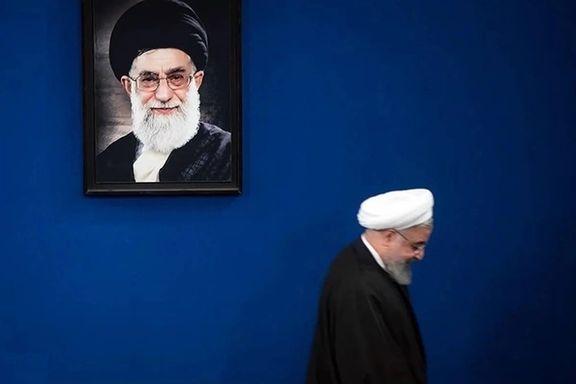
Iran's former president Hassan Rouhani passing by a photo of Ali Khamenei

Reports from Tehran indicate that former President Hassan Rouhani has been barred from re-election at the Assembly of Experts election to be held on 1 March.

The news still awaited confirmation by the Interior Ministry when Rouhani's official account on X announced that he has been barred from running for the Assembly that is tasked with choosing the Islamic Republic's next Supreme Leader.

The interior ministry and the Guardian Council, both in charge of vetting candidates, have rejected hundreds of non-hardliners for the March vote, repeating the same tactic as was employed in the 2020 parliamentary and the 2021 presidential elections. As a result, the outgoing parliament is controlled by ultraconservatives, who also dominate President Ebrahim Raisi’s administration.

Meanwhile, moderate conservative websites such as Khabar Online, which speculated about options ahead of Rouhnai, and Nameh News, which splashed a headline saying, "The End of Rouhani," rather quickly published the first analyses about the implications of this development and Rouhani's choices and political future.

Now, Supreme Leader Ali Khamenei has effectively alienated all of Iran's former Presidents. Rouhani, the man who was believed to be one of the candidates for succession as Supreme Leader is the last one to be jettisoned out of what many see as Khamenei's sinking ship.

President Rouhani with his well-known foreign minister Javad Zarif in 2020
100%
President Rouhani with his well-known foreign minister Javad Zarif in 2020

Having served as Iran's security chief for many years, as a member and deputy speaker of parliament and a member of the Assembly of Experts for several rounds, and as Iran's President for eight years, Rouhani’s disqualification sounds odd to anyone not familiar with the political and leadership dynamics in Iran.

Khamenei has not respected the loyalty of any of his obedient servants such as former Majles Speaker Ali Larijani, his close friends such as former President Akbar Hashemi Rafsanjani, and those he strongly endorsed such as former President Mahmoud Ahmadinejad. Although current President Ebrahim Raisi has never challenged Khamenei, no one can be certain what awaits him at the end.

Guardian Council Spokesman Tahan Nazifhas implied that Rouhani might have to stand trial at the Special Court for Clerics for his involvement in irregularities at the Iranian stock market. However, he said that Rouhani's final disqualification is awaiting the Interior Ministry's confirmation. Meanwhile, the Iranian Students News Agency ISNA, which was one of the first agencies to break the news of Rouhani's disqualification, called the news "a rumor" in a report published Wednesday afternoon.

Hardline politician Javad Karimi Ghoddousi, a staunch critic of Rouhani, resorted to a religious story and alluded to Rouhani's ambitions for rising to become the Islamic Republic's next Supreme Leader.

Iranian journalist Siamak Rahmani wrote that Mostafa Pourmohammadi, Rouhani's Justice Minister and the proprietor of Nameh News has been also disqualified by the Guardian Council. Meanwhile several social media users pointed out that the disqualification of Rouhani shows that the regime does not care about people's participation in the elections.

Another user wrote that it appears that everyone else other than Rouhani himself knew beforehand that he could be disqualified. One said that this was even evident from the start of the second round of Rouhani's presidency in 2017.

Talking about the next level in the Islamic Republic's power hierarchy, Maziar Khosravi, the editor of Faraz Daily website wrote in a tweet: "As the scene is set now, one must recognize Ebrahim Raisi as Iran's next Supreme Leader."

On Rouhani’s future plans, Khabar Online opined that if the disqualification is finalized, Rouhani might follow a course like Rafsanjani and become a kingmaker for the moderate camp: A position less than glamorous considering what happened to Rafsanjani, who was pushed out of the center of power and eventually died in suspicious circumstances in a swimming pool. Nameh News wrote in an analysis entitled "The End of Rouhani": "This is the final shot fired at Rouhani and the moderate camp."
Most Viewed

US blockade enters murky phase as tankers spoof signals and buyers hesitate
1
ANALYSIS

US blockade enters murky phase as tankers spoof signals and buyers hesitate

2
INSIGHT

Ideology may be fading in Iran, but not in Kashmir's ‘Mini Iran'

3
INSIGHT

Hardliners push Hormuz ‘red line’ as US blockade tests Iran’s leverage

4
VOICES FROM IRAN

Hope and anger in Iran as fragile ceasefire persists

5

US sanctions oil network tied to Iranian tycoon Shamkhani

Banner
Banner

Spotlight

  • Hardliners push Hormuz ‘red line’ as US blockade tests Iran’s leverage
    INSIGHT

    Hardliners push Hormuz ‘red line’ as US blockade tests Iran’s leverage

  • Ideology may be fading in Iran, but not in Kashmir's ‘Mini Iran'
    INSIGHT

    Ideology may be fading in Iran, but not in Kashmir's ‘Mini Iran'

  • War damage amounts to $3,000 per Iranian, with blockade set to add to losses
    INSIGHT

    War damage amounts to $3,000 per Iranian, with blockade set to add to losses

  • Why the $100 billion Hormuz toll revenue is a myth
    ANALYSIS

    Why the $100 billion Hormuz toll revenue is a myth

  • US blockade targets Iran oil boom amid regional disruption
    ANALYSIS

    US blockade targets Iran oil boom amid regional disruption

  • Iran's digital economy battered by prolonged blackout
    INSIGHT

    Iran's digital economy battered by prolonged blackout

•
•
•

More Stories

Iranian Official Visiting Moscow Says 'US Grandeur Shattered'

Jan 24, 2024, 14:28 GMT+0

US grandeur has been shattered in the Middle East, secretary of Iran’s national security council, Ali-Akbar Ahmadian, stated during a visit to Moscow on Wednesday.

Ahmadian, who is the representative of Supreme Leader Ali Khamenei at the security council, held a meeting with the secretary of Russia’s security council Nikolai Patrushev. He told his Russian counterpart, "America's grandeur has shattered, and today, it cannot even rally its traditional allies. A country that considers itself a superpower is engaged in war against resistance groups and the people of the region."

Iran that armed and trained Hamas before the October 7 invasion of Israel, has avoided direct military conflict with Israel and the United States in the ensuing Gaza war. However, its armed proxy groups in the region have targeted US and international interests.

Yemen’s Houthis, one of Iran’s proxies, began targeting international commercial shipping in the Red Sea from mid-November, causing disruptions and forcing the US and the UK to launch airstrikes against their military bases.

Other Iranian allies in Iraq and Syria have launched more than 150 rocket and drone attacks at US forces in the two countries, to which the US military has responded with strikes.

IRNA reported that Ahmadian held talks over promised Russian investments in Iran’s oil and gas sector. Russia has signed many preliminary agreements with Iran about economic cooperation, but it has delivered very little.

Iran Lawmaker Says Mossad Infiltrators Helped In Killing Of Guards

Jan 24, 2024, 12:16 GMT+0

A member of Iran's National Security Commission claims that Israeli spy agency Mossad infiltrators played a role in the killing of five Quds Force members in Syria.

Morteza Mahmoudvand stated, "According to our information, the incident undoubtedly involved infiltration and intelligence operations," pointing to Mossad, the Israeli security service, as specialists in such activities, suggesting their likely involvement in the assassinations of the chiefs from the IRGC's foreign wing, the Quds Force.

“The Israeli security service known as Mossad specializes in that exactly – undoubtedly, it has been at the forefront of infiltration and intelligence work.”

Some Iranian critics of the regime have also mocked the IRGC for having been infiltrated by Israel.

Syria's state-run SANA news agency attributed the Saturday attack in Damascus to Israel. The Islamic Revolutionary Guard Corps (IRGC) confirmed the loss of four members in the airstrikes, with a fifth succumbing to injuries later. Subsequently, Iran-backed militant groups in Iraq launched rockets at Assad Air Base in Anbar province, where US forces are stationed.

In response to the killings, Iranian Parliamentary Speaker Mohamad Bagher Ghalibaf warned of "severe punishment" for Israel. Iran has consistently threatened Israel with severe consequences for its alleged role in the deaths of IRGC commanders and forces in the region though Tehran has refrained from direct attacks.

In December, Razi Mousavi, also known as Seyyed Razi, was killed in an Israeli airstrike near Damascus. He was responsible for overseeing logistics and military coordination for the Islamic Revolutionary Guard Corps (IRGC) in Syria. His role included acquiring weapons and coordinating activities for Iran-backed forces in both Syria and Lebanon.

Sen. Cardin Unaware Of Bi-Partisan Iran Sanctions Bill

Jan 24, 2024, 12:06 GMT+0
•
Iran International Newsroom

Chairman of the US Senate Foreign Relations Committee, Ben Cardin, says he’s not familiar with the MAHSA Act, an Iran sanction bill that activists say he’s blocking.

The bipartisan Mahsa Amini Human rights and Security Accountability Act (MAHSA Act) passed the House of Representatives with overwhelming majority in September 2023, but has not yet been moved forward for a vote in the Senate.

It is named after the 22-year-old Kurdish-Iranian girl whose death in hijab police custody in September 2022 sparked country-wide protests, challenging the clerical regime like never before.

Iranian-American activists blame Senator Cardin for the grounding of the MAHSA Act –a bill that aims to codify sanctions on the offices of the President and the Supreme Leader of the Islamic Republic of Iran.

But Senator Cardin seemed to be unaware of any such legislation, when approached by Iran International’s Arash Alaei at the Capitol on Tuesday.

“First, we’re not blocking any legislation,” Cardin said. “There is an order to how we bring up legislation... So, I’m not familiar with this bill, when it’s going to be coming up.”

His response baffled and angered many Iranian-American activists.

“It’s almost laughable,” wrote one activist on X, “after months of back-and-forth emails between activists and his legislative team, several meetings, protest’s outside of his DC office? Senator Cardin is unfamiliar.”

As the chairman of the influential Foreign Relations Committee, the Democratic Senator is ultimately responsible for marking up the bill for a vote.

Last December, Cardin’s staff confirmed in a brief email that there were no plans to “move forward with the bill.” This spurred a group of Iranian-American activists to gather in front of his office two weeks ago, protesting what they see as a deliberate attempt to halt the bipartisan initiative.

Senator Cardin rejected this in his interview with Iran International, suggesting that he had not heard of the MAHSA Act, and that any delay was a matter of “procedure”.

“I’m afraid Senator Cardin is very familiar with the MAHSA Act,” wrote another activist on X. “We sent several petition letters with 117 signatories from MD and 405 signatories from 33 other states. We have email correspondence that goes back to July 2023 with his staff. A few of us met with his staff on zoom on 8/10/23. Then on 12/21/23 we finally received this response after 4 months of being completely ignored.”

Since Mahsa Amini’s killing by Iran’s hijab police, and the ensuing protests in which the regime killed around 550 civilians and blinded and maimed many more, Iranian-American activists have been trying to fight human rights abuses in Iran; hence the MAHSA Act.

At dawn Tuesday morning Iran time, the regime executed another young protester, Mohammad Ghobadlou, despite the fact that his sentence had been overturned by the Islamic Republic’s Supreme Court.

The execution highlighted the importance of pressuring the regime in Iran through such punitive measures as the MAHSA Act.

“Mohammad Ghobadlu’s execution is an extrajudicial killing according to international law and the Islamic Republic’s own laws,” Mahmoud Amiry-Moghaddam, director of the Norway-based Iran Human Rights (IHR NGO) said, demanding that Iran's Supreme Leader Ali Khamenei and its judiciary to be held accountable for the execution.

In Washington, Senator Cardin tried to reassure the public that everything possible would be done to effect positive change in Iran.

“Iran’s actions are horrible,” he said. “We’ve taken extreme steps. We’ve imposed the maximum amount of sanctions that we’ve imposed against a country. We continue to look for additional ways to put additional pressure on Iran to stop its nefarious activities.”

Many Iranian activists have become increasingly critical of the Biden administration –and by extension, the Democratic party– for what they believe is “appeasement” of the regime ruling in Iran. Some say that Senator Cardin, a senior Democratic party member, would prefer to go along with Biden's diplomatic soft approach with Iran.

Cardin, however, claimed that he was prepared “to take additional steps” against Iran. “We’ve already taken a lot of steps,” the Senator said. “But make no mistake about it: we’ll do everything we possibly can to isolate Iran and what it's doing.”

Hardliners In Iran Bar Ex-President Rouhani From Elections

Jan 24, 2024, 10:48 GMT+0

Iranian hardliners controlling the candidate vetting process for the March 1 elections, have rejected the candidacy of former President Hassan Rouhani, local media report.

Rouhani had registered and was eager to run for a seat on the Experts Assembly that will take place along with parliamentary elections in five weeks. The Assembly has the constitutional duty to select Iran’s next Supreme Leader after Ali Khamenei’s death.

Rouhani in November had stressed the importance of the election, considering political uncertainties in the event of Khamenei’s absence.

The interior ministry and the Guardian Council, both in charge of vetting candidates, have rejected hundreds of non-hardliners for the March vote, repeating the same tactic as was employed in the 2020 parliamentary and the 2021 presidential elections. As a result, the outgoing parliament is controlled by ultraconservatives, who also dominate President Ebrahim Raisi’s administration.

Rouhani's rejection by Khamenei loyalists has now pushed all former Iranian presidents into political isolation.

Those rejected are all regime insiders and not opponents, who could never be allowed to run in an election. Many are former high-ranking officials or lawmakers.

Relatively independent media outlets, commentators and many politicians agree that turnout in the elections will be extremely low, as voters have lost trust that any election in the Islamic Republic can improve their deteriorating economic condition or offer more freedoms. The widespread candidate rejections also diminish any chance that government efforts to entice the population to vote can bear any results.

The manipulation of elections take place even though hardliners know a low turnout can further erode the regime’s legitimacy, damaged by economic crisis and repeated nationwide protests.

Iran Arrests Victims Of Eye Injuries During Protests

Jan 24, 2024, 09:53 GMT+0

Two Iranian protesters who suffered eye injuries during the 2022-2023 protests have been arrested as the regime cracks down further on dissidents.

Amir Shahvelayati and Matin Hassani were apprehended on Tuesday in Tehran and Bukan, West Azarbaijan province, respectively.

Human rights organizations Hengaw and HRANA reported that Amir Shahvelayati was summoned to the Evin courthouse on Tuesday, detained, and subsequently transferred to Evin Prison. The charges against him include "propaganda against the system," "membership in a subversive group," and "actions against security."

Shahvelayati sustained eye damage from a pellet shot during the Woman Life Freedom protests. First arrested last May, he was released on bail after two months until the latest arrest.

Matin Hassani, another victim of eye injuries, was reportedly arrested in Bukan on the same day. Hassani lost vision in one eye due to a pellet gunshot during protests following the death in custody of Mahsa Amini.

Recent weeks saw him sharing images of his visits to the graves of protest victims. His arrest coincided with the publication of images showing him at the gravesite of Yalda Aghafazli, a victim of the Woman Life Freedom movement.

Despite the arrests, the judicial authorities of the Islamic Republic have not issued any official comments on the situation.

In September, the Iran Human Rights Organization (IHR) disclosed the identities of numerous individuals who suffered eye injuries when Iranian security forces fired at protesters. The IHR emphasized in its report that security forces targeted protesters' eyes, particularly women, in a "systematic and deliberate" manner with alarming precision.

The report documented 138 cases of eye injuries, with 43 individuals choosing anonymity while providing evidence. The remaining 95 cases, including 8 children under 18, were extensively detailed in the report.