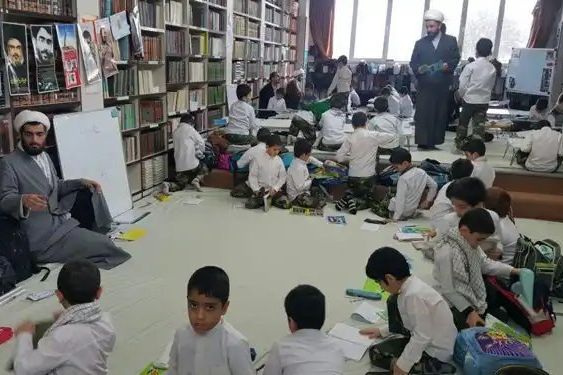
Recruitment of clerics as teachers and new legislation allowing mosques to run private schools has fueled concerns about the future of Iran's educational system.
In a statement published on its Telegram channel on January 18, the Coordination Council of Iranian Teachers’ Unions strongly criticized the employment of clerics as teachers by the education ministry.
The statement alleged that this meant “purging schools” from expert teaching staff and replacing them with clerics and seminary students who have no expertise in child education, or a standard education. The teachers’ union called the decision a “reactionary move” that resurrects the concept of schools run by the clergy (maktab), which were abolished nearly a hundred years ago. The ministry has denied a nationwide purge is underway.
However, hardliners controlling the parliament and the executive branch have been also purging university faculties and openly speak about “purification.”
The powerful Shiite clergy in Iran lost its monopoly on education and the justice system with the establishment of modern courts and schools by the founder of the Pahlavi Dynasty, Reza Shah, in the 1920s who fundamentally curbed their powers.
The council also warned Iranian families about the consequences of “the systematic presence of clergy in schools and its dangers to children.”
Iranian President Ebrahim Raisi among a group of schoolgirls in Tehran (September 2022)
The ministry has expelled scores of teachers and forced many others to retire early for supporting last year’s protests, instead hiring 3,500 clerics and seminarians as teachers to fill some of the tens of thousands of new positions it has created to overcome the shortage of teaching staff.
Ali Farhadi, the ministry’s spokesman, has claimed that the ministry only became aware of the recruitment after the fact. “We, too, found out that these individuals had been accepted [for the positions] after the examinations [of candidates for teaching positions] were held,” he claimed. However, regime-controlled media have been talking about the subject for months, saying that clerics should become schoolteachers.
The clergy have been running unofficial schools for over a decade but last week the establishment of “mosque-centered schools” was given official status when lawmakers hastily approved a proposal to oblige the ministry of education to issue licenses to persons and legal entities to establish private schools attached to mosques if building requirements were met.
In a report entitled “Autonomous Schools” Monday, the reformist Ham-Mihan newspaper said there are around 150 so-called “mosque-centered” schools with around 7,000 students now that operate unofficially.
An administrator of a “mosque-centered” school for girls told Ham-Mihan that their curriculum included homemaking, sewing, cooking and traditional medicine as well as computers and mobile photography to their students. They also selected and screened their own teachers, he said, but could not issue any kind of certificates under the current circumstances.
Former Minister of Education Mohsen Haji Mirzaei told Ham-Mihan that mosque-centered schools are "a rebellion against the official educational system" and warned that they could “delegitimize” the formal education system and foster extremist beliefs.
Speaking to the conservative Farhikhtegan newspaper, Rezvan Hakimzadeh, former Deputy Minister of Education, also expressed concern about the curriculum of these schools. “Who will supervise how the curriculum is replaced if the official one is to be disregarded? Who will approve of its suitability?” he asked.
Other critics such as another former education minister, Ali-Asghar Fani, have warned that the education ministry may fail to supervise these schools due to the political influence of the imams of the mosques to which they are attached.
Lawmakers supporting the legislation such as Ahmad-Hossein Fallahi, spokesman of the Education, Research and Technology committee, argue that schools attached to mosques can answer the dire need for more educational facilities, but claim the education ministry will have control over the curriculum of these schools.
An organization calling itself ‘Mosque-Centered Schools Headquarters’, says on its website that those behind the drive aim to “fulfil the heavy task of training and preparing an efficient revolutionary workforce” to meet the need for “human resources worthy of the Islamic Revolution.”
The organization’s secretary, Hossein-Ali Deylam, told Ham-Mihan that establishment of schools attached to mosques started in the religious city of Mashhad twelve years ago. He claimed that the number of these schools has grown since then due to the great demand from families who want their children to study in these schools, most of which are at the primary level.
“From the start, these schools have not been under the supervision of education ministry … Each school determines its tuition fees based on its activities and specifications,” he said without elaboration on their curriculum.
US President Joe Biden in the East Room of the White House in Washington, August 16, 2023
A recent online poll in the United States reveals that 61 percent of Americans believe the Biden administration's Iran policy has failed.
Moreover, a significant majority, 76 percent, believe that the Gazan militant group, Hamas, is receiving support from Iran in its war waged on October 7 against Israel.
Two thirds (67 percent) of voters expressed support for the US actively striking against terrorist groups with 74 percent of voters endorsing retaliatory attacks on the Houthis in Yemen for the blockade of global shipping in the Red Sea and the group's targeting of US ships. A further 84 percent advocate for increased military responses if the Houthis persist in the blockade on the route which accounts for 12 percent of global trade.
The survey also highlights public sentiment towards Iran and its proxies in the Middle East, with 74 percent of respondents affirming the belief that the Houthis receive guidance and assistance from Iran. Additionally, 63 percent agree that sanctions against Iran should be intensified in light of the more than 100 attacks on US targets in the region since October 7 and the US backing of Israel's retaliatory bombardment of Gaza following the Hamas atrocities of what was the single most deadly day for Jews since the Holocaust.
The monthly poll, a collaboration between the Center for American Political Studies at Harvard (CAPS) and the Harris Poll and HarrisX, surveyed 2,346 registered voters.
The Iranian government has refrained from direct military engagement in the Gaza conflict, opting to avoid escalation with Israel and the US. Nonetheless, its proxy militias in the Middle East have increasingly targeted US and Israeli interests, along with international shipping routes in the Red Sea.
The United States maintains a presence of 900 troops in Syria and 2,500 in Iraq, supporting and advising local forces to counter the resurgence of the Islamic State which had previously seized significant territories in both countries in 2014 before facing defeat.
Former Jerusalem Mayor and Knesset member Nir Barkat at his home in Jerusalem, October 6, 2021
Israeli's minister of economy and industry has claimed that after Iran's proxy activities across the region, Tehran has become a 'legitimate target' for military action.
In an exclusive interview with The Telegraph, Nir Barkat said, "Iran is a legitimate target for Israel. They will not get away with it. The head of the snake is Tehran."
Since the Hamas invasion of Israel on October 7, Iran's proxies in Iraq, Syria, Yemen and Lebanon have joined a regional coalition against both Israel and the US, including a blockade on global shipping in the Red Sea.
"We should very very clearly make sure the Iranians understand that they will not get away with using proxies against Israel," Barakat, who has no input to the war cabinet, told the newspaper.
Barkat, tipped as the favorite to succeed PM Benjamin Netanyahu to take over the ruling Likud party, said, "we should very very clearly make sure the Iranians understand that they will not get away with using proxies against Israel".
The terror attack by Hamas on October 7, resulting in the deaths of at least 1,200 mostly civilians, has triggered a wide scale regional conflict. Described as the most deadly single day for Jews since the Holocaust, Iran has distanced itself from the day known as the Black Sabbath, but has commended Hamas for the atrocities, lauding it a victory against Israel.
A worker walks past a container ship at Mundra Port in the western Indian state of Gujarat April 1, 2014.
The director general of the Ports and Maritime Organization in Iran’s Sistan and Baluchestan province said there are still challenges faced by Iranian ships in Indian ports.
Qasem Askari Nasab, addressing reporters during a press conference on Thursday, underscored the hurdles Iran faces in the global arena, with Mundra port emerging as a focal point of concern.
Hossein Shahdadi, Deputy of the Ports and Maritime Organization in Sistan and Baluchestan, elaborated further to ILNA, stating that “while commercial activities between ports remain unhindered, specific shipping lines encounter obstacles in docking ships due to contractual complexities.”
The remarks follow earlier revelations by an Iranian transportation official, highlighting the necessity for global ports to obtain approval from the US Office of Foreign Assets Control before accommodating Iranian vessels. Masoud Daneshmand, a member of the board of directors at the Center of Transport Institutions, echoed the sentiment, emphasizing that numerous Iranian shipping assets are subject to sanctions, resulting in their inactivity.
The United States imposed fresh sanctions in March on entities associated with Iran's shipping and petrochemical sectors. The sanctions align with a 2018 executive order that reinstated measures targeting Iran's oil, banking, and transportation industries. Additionally, in 2019, the Office of Foreign Assets Control issued a cautionary advisory to global entities engaged in shipping petroleum or related products from Iran, alerting them to potential repercussions.
The United States has announced a bounty of up to $15 million for any information leading to the apprehension of Iranian businessman Hossein Hatefi Ardakani.
Ardakani is accused of aiding in the acquisition of technology for attack drones sold to Russia. He faces sanctions and charges for his alleged involvement in procuring dual-use technology utilized in drone production by Iran's Islamic Revolutionary Guard Corps (IRGC).
The decision to issue the bounty comes amidst growing concerns over Iran's provision of drones utilized in various conflicts, including Russia's war on Ukraine. The Commerce Department, responsible for administering US export controls, disclosed the bounty as part of a broader effort to combat national security threats.
“US-origin flight guidance components procured by the Ardakani network have been identified in recovered wreckage of Shahed drones in Ukraine and other conflict zones. Additionally, the Ardakani network has illegally procured US export-controlled high electron mobility transistors (a.k.a. HEMTs) and other components with ballistic missile applications, as well as other electronics with weapons application,” said Rewards for Justice, the fusion intelligence center created by the State Department that oversees domestic and foreign intelligence committees.
Despite an outstanding warrant for his arrest, Ardakani remains at large, with Tehran listed among his possible locations. People with information on Ardakani's whereabouts are encouraged to come forward through channels including Signal and WhatsApp.
The huge bounty underscores the gravity of sensitive technology proliferation amidst ongoing conflicts. US agencies are stepping up collaboration to enforce export controls, signaling heightened penalties for violators. The move aligns with the Biden administration's call for increased vigilance among businesses to prevent Iran's acquisition of materials supporting its ballistic missile program.
Ardakani joins a long list of wanted figures with bounties on their heads such as Irish gang leaders in Dubai and Somali militants. In January, a $10m reward was offered for information regarding financiers of Iran-backed Palestinian militia, Hamas.
Turkish President Recep Tayyip Erdoğan (left) and Iranian President Ebrahim Raisi in Ankara, January 24, 2024
Iranian President Ebrahim Raisi’s visit to Turkey this week came against the backdrop of the Gaza war, ongoing regional crisis and conflicts in bilateral relations.
The visit on Wednesday and the issues discussed reflected the intricate dynamics between Iran and Turkey. The visit resulted in ten agreements, emphasizing collaboration in energy, free trade, and transportation. This highlights the significance of political collaboration and dispute resolution in the Iran-Turkey relationship, striking a delicate balance between cooperation and addressing regional complexities amidst geopolitical challenges.
Raisi's visit highlighted ongoing efforts to strengthen economic relations, while forging an image of agreement on regional issues. While mutual distrust may persist, the visit and their evolving relationship indicate a continued effort to navigate complex ties, focusing on economic cooperation and potential areas of convergence in regional policies.
Challenges
Geopolitical competition, conflicting regional goals, and security concerns drive friction between Iran and Turkey. Despite joint efforts to combat terrorism, drug trafficking, and enhance regional security, political and ideological disagreements persist, heightened by the evolving political landscape in the Middle East. Historically, both nations have sought to exploit the shifting regional balance, intensifying rivalry, particularly in Syria and Iraq. Collaborative efforts against the PKK and PJAK and shared economic and security interests are overshadowed by significant differences.
While the Islamic Republic emphasizes the economic aspects of the relationship to improve morale at home, the significance of Raisi's visit to Ankara lies in discussions on regional security, stability, and shared concerns regarding terrorist groups and Kurdish factions. Raisi and Erdogan likely addressed Ankara's concerns about Kurdish groups viewed as "terrorists" in Turkey, Iran,Iraq, and Syria during their meeting. The bilateral talks also touched upon the impasse in Gaza, where Israel continues its operations against Hamas, a client of Iran and a friend of Turkey.
Israeli soldiers operate in the Gaza Strip amid the ongoing conflict between Israel and the Palestinian Islamist group Hamas, January 25, 2024
Gaza War
The Israel factor introduces complexity to the Turkey-Iran relationship, marked by historical ties encompassing trade, tourism, and some intelligence and military collaboration. Geopolitical shifts, particularly Turkey's stance on Syria to the detriment of Iran’s ally Bashar al-Assad, strain the ties.
The recent Gaza conflict has influenced the dynamics between Iran and Turkey, resulting in a mix of collaboration and tensions. The relationship's intricacies involve a blend of collaboration and rivalry, influenced by geopolitical, economic, and security factors. Khamenei's call to "cut vital lifelines" to Israel contrasts with Turkey's ongoing economic ties, highlighting nuanced dynamics. Turkey's pursuit of economic relations with Israel may diverge from Iran's objectives, as Tehran leverages the Gaza war to enhance its regional influence through proxy groups amid tensions.
Economic Cooperation
A wide range of circumstances have shaped Iran and Turkey's economic relations. Both countries have continued their business relations, particularly in the oil industry, despite Iran's economic difficulties and sanctions. The two sides have tried to find solution, such as "gas for commodities" and Iran’s natural gas exports. President Ebrahim Raisi's declared goal of increasing bilateral commerce to $30 billion annually is indicative of ambitious economic aspirations.
However, trade between Iran and Turkey reached a modest $4.4 billion in the first 10 months of 2023, a 16 percent decline from the same period the year before.Mehdi Safari, the Deputy for Economic Diplomacy at the Ministry of Foreign Affairs, mentioned that President's visit to Turkey would focus on strengthening energy cooperation, including the extension of the gas contract. Collaborative efforts in investing in Iran's gas resources and establishing an electricity connection from Khoy to Van were indeed discussed, but to what extent Raisi’s wish list would materialize is somewhat questionable. The present natural gas agreement between Iran and Turkey is scheduled to expire in 2026. This emphasizes the difficulties and unknowns involved in maintaining the two countries' economic partnership.
The anticipation is that Iran-Turkey relations will encompass both collaboration and rivalry, characterized by mutual mistrust alongside a maintained level of cooperation. Although a significant shift in their relationship might not be on the horizon, cooperation is expected to persist in counterterrorism, fighting drug trafficking, and promoting regional stability. Both nations have a track record of finding common ground amid occasional conflicts, navigating the complexities of their intricate relationship. The delicate balance between cooperation and rivalry is influenced by geopolitical realities and their respective objectives in Iran-Turkey relations.
President Raisi's visit to Turkey may not immediately resolve ongoing issues between the two countries. Beyond official statements, a comprehensive approach is necessary to examine conflicts and cooperation, particularly in areas like theSyrian crisis, and Kurdish issues. It's noteworthy that Iran's potential inability to supply more natural gas to Turkey due to anatural gas shortage adds another layer of complexity to the situation.