• العربية
  • فارسی
Brand
  • Iran Insight
  • Politics
  • Economy
  • Analysis
  • Special Report
  • Opinion
  • Podcast
  • Iran Insight
  • Politics
  • Economy
  • Analysis
  • Special Report
  • Opinion
  • Podcast
  • Theme
  • Language
    • العربية
    • فارسی
  • Iran Insight
  • Politics
  • Economy
  • Analysis
  • Special Report
  • Opinion
  • Podcast
All rights reserved for Volant Media UK Limited
volant media logo

Biden Says US Will Respond To Deadly Attack On US Forces
Iran International Newsroom
Jan 28, 2024, 17:46 GMT+0Updated: 11:08 GMT+0
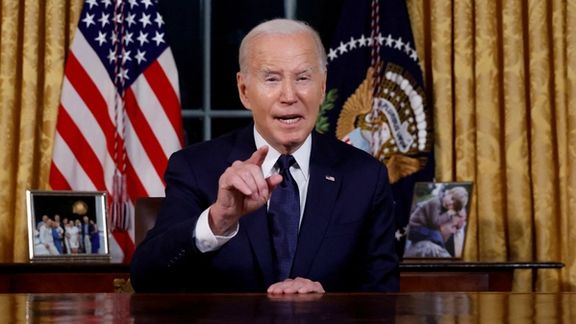
US President Joe Biden delivering an address to the nation about his approaches to the conflict between Israel and Hamas from the Oval Office of the White House in Washington, October 19, 2023

President Joe Biden said the US will respond to an Iran-backed attack on its forces in Jordan, after he announced the news that three US troops were killed.

"We shall respond," he said at a campaign event in South Carolina, asking for a moment of silence. Biden earlier blamed Iran-backed groups for the attack that occurred Saturday night.

“While we are still gathering the facts of this attack, we know it was carried out by radical Iran-backed militant groups operating in Syria and Iraq,” the President said in a statement released by the White House.

At least 34 personnel were being evaluated for possible traumatic brain injury, a US official told Reuters.

"While we’re still gathering facts, this is most assuredly the work of an Iranian-backed militia group," a second official said.

US lawmakers began to react to the news by demanding a tough US reaction to what they see as a major escalation by Iran.

US Senate Republican Leader Mitch McConnell (R-KY) issued a statement, urging the President to be decisive. “Last night, the cost of failure to deter America’s adversaries was again measured in American lives. We cannot afford to keep responding to this violent aggression with hesitation and half-measures," the statement reads.

Senator Tim Scott (R- S. Carolina) issued a tweet saying, "The Biden administration’s appeasement of Iran must end. It’s time for clear and decisive action, and Iran must be held accountable for the malign activities of its proxies."

Senator Dan Sullivan of Alaska fired off a tweet saying, "The President needs to order a clear, lethal and overwhelming response that demonstrates to Iran and to the world that whoever targets our men and women in uniform—or supports these attacks—will face the full might of the U.S. military."

The deaths marked the first fatalities of US troops in the region since war began in Gaza. Biden said the attack occurred on Saturday night. Iranian backed proxy militia forces have launched more than 150 attacks in Syria and Iraq targeting US forces since mid-October.

The attack is a major escalation of the already tense situation in the Middle East, where war broke out in Gaza after Palestinian Islamist group Hamas' attack on Israel on Oct. 7 which killed 1,200, mostly civilians.

Thousands have also been killed in the subsequent Israeli military operation in Gaza, although there is no independent and reliable figure.

While Iran has avoided direct military involvement in the Gaza war, its strategy seems to be using proxy forces to harass the US and Israel.

Iran International reported on Saturday that according to a diplomatic source, the Biden administration is discussing with European allies a scenario to increase sanctions on the Islamic Republic. Iran’s aggressive regional policies since October seems to be the reason the White House has decided to adopt a tougher stance against Tehran.

The US has launched a few retaliatory attacks against militia forces in Iraq and Syria, but the attacks have continued. Critics of President Biden’s Iran policy argue that the United States should directly target Iranian interests to deter Tehran’s proxies.

Iranian backed Houthi forces in Yemen have also launched dozens of missile and drone attacks against commercial vessels and Western warships in the Red Sea area. Commercial maritime traffic has suffered as a result.

While the United States has thus far maintained an official line that Washington is not at war in the region, and does not seek escalation, it has made strikes against targets of Yemen's Houthi forces.

"We will carry on their commitment to fight terrorism. And have no doubt - we will hold all those responsible to account at a time and in a manner of our choosing," Biden said in his statement released by the White House.
Most Viewed

US blockade enters murky phase as tankers spoof signals and buyers hesitate
1
ANALYSIS

US blockade enters murky phase as tankers spoof signals and buyers hesitate

2
INSIGHT

Ideology may be fading in Iran, but not in Kashmir's ‘Mini Iran'

3
INSIGHT

Hardliners push Hormuz ‘red line’ as US blockade tests Iran’s leverage

4
VOICES FROM IRAN

Hope and anger in Iran as fragile ceasefire persists

5

US sanctions oil network tied to Iranian tycoon Shamkhani

Banner
Banner

Spotlight

  • Hardliners push Hormuz ‘red line’ as US blockade tests Iran’s leverage
    INSIGHT

    Hardliners push Hormuz ‘red line’ as US blockade tests Iran’s leverage

  • Ideology may be fading in Iran, but not in Kashmir's ‘Mini Iran'
    INSIGHT

    Ideology may be fading in Iran, but not in Kashmir's ‘Mini Iran'

  • War damage amounts to $3,000 per Iranian, with blockade set to add to losses
    INSIGHT

    War damage amounts to $3,000 per Iranian, with blockade set to add to losses

  • Why the $100 billion Hormuz toll revenue is a myth
    ANALYSIS

    Why the $100 billion Hormuz toll revenue is a myth

  • US blockade targets Iran oil boom amid regional disruption
    ANALYSIS

    US blockade targets Iran oil boom amid regional disruption

  • Iran's digital economy battered by prolonged blackout
    INSIGHT

    Iran's digital economy battered by prolonged blackout

•
•
•

More Stories

Iran Seizes Foreign Vessel 'Smuggling' Fuel

Jan 28, 2024, 17:39 GMT+0

Iran has seized a foreign vessel carrying two million liters of smuggled Diesel fuel near the southern port city of Bushehr.

Commander Heidar Honarian-Mojarrad of the Second Naval Region of the Islamic Revolutionary Guard Corps said on Sunday that “The vessel, flying the flag of a country from Oceania, was apprehended 60 miles off the coast of Bushehr port under a judicial order. Fourteen foreign crew members from two Asian countries were detained following the identification of the smuggling activity.”

Honarian announced the completion of legal procedures and the transfer of the vessel's crew to the judicial authorities of Bushehr province. He claimed that the confiscated contraband fuel is being handed over to the National Oil Refining and Distribution Company of Bushehr province in compliance with the law.

He also added that the vessel had been under surveillance since loading fuel and was intercepted upon entering the operational area of the Second Naval Region of the Revolutionary Guards. He did not provide any information as to where the vessel loaded the fuel and where it was traveling to.

Iran's role as a major oil producer and its provision of globally low petrol prices contribute to fuel trafficking activities in the region. Iranian forces regularly target tankers involved in fuel transportation in the Gulf.

The incident follows a similar occurrence in September when Iran seized two oil tankers flying the flags of Panama and Tanzania for allegedly smuggling fuel in the Gulf.

The heightened presence of the US military in the Gulf has also been noted, with accusations against Iran for seizing or attempting to seize vessels in the strategic shipping lane.


UK Warship Repels Houthi Drone Attack In Red Sea

Jan 28, 2024, 14:18 GMT+0

British warship the HMS Diamond has repelled a drone attack from Yemen's Houthi group in the Red Sea, British officials said.

"Deploying her Sea Viper missile system, Diamond destroyed a drone targeting her with no injuries or damage sustained to Diamond or her crew," the Ministry of Defence said in a statement on Sunday.

"These intolerable and illegal attacks are completely unacceptable and it is our duty to protect the freedom of navigation in the Red Sea."

The Iran-backed Houthi movement began launching waves of exploding drones and missiles at vessels on November 19 in response to Israel's military operations in Gaza. Israel launched its offensive after Hamas, another Iran-backed group, invaded Israel, killing 1,400 mostly civilians and taking hundreds of hostages.

On Friday, Houthis claimed responsibility for a missile attack that set a British oil tanker on fire in the Gulf of Aden. Shipping data suggests the Marlin Luanda was heading towards Singapore under the flag of the Marshall Islands. It was hit by a missile 60 nautical miles southeast of Aden in Yemen, according to UK Maritime Trade Operations.

Reports suggest the tanker is carrying Russian naphtha. This fully contradicts Houthi claims that they target vessels bound for Israel of linked to Israeli interests.

Oil tanker Marlin Luanda has caught fire 60 nautical miles southeast of Aden in Yemen after a missile attack by Houthi fighters based in Yemen on Jan 26, 2024.
100%
Oil tanker Marlin Luanda has caught fire 60 nautical miles southeast of Aden in Yemen after a missile attack by Houthi fighters based in Yemen on Jan 26, 2024.

Earlier Friday, the Houthis had fired an anti-ship missile toward USS Carney. That missile was successfully shot down, according to the US Central Command.

The attacks come amid reports that China has called on Iran to rein in the Houthis.

US and British warplanes, ships and submarines have responded to the Houthi attacks on shipping with dozens of retaliatory strikes across Yemen against Houthi forces.

Iranian Parliament Sets $180 Base Salary For Government Employees

Jan 28, 2024, 14:06 GMT+0

In a recent parliamentary session, lawmakers in Iran reportedly set the pay scale for government employees and retirees for the new financial year starting March 21.

The base salary for government workers was fixed at 100 million rials, while a minimum pension of 90 million rials was endorsed for retirees. The bill, presented during Saturday's session, garnered approval with 123 votes in favor, 53 against, and 11 abstentions out of 193 lawmakers out of 290 present.

The decision arrives as Iranian workers are about to receive a government-approved average minimum wage increase of 20 percent, scheduled to come into effect in March. The development unfolds against the backdrop of an alarming annual inflation rate nearing 50 percent. The timing underscores the delicate balance between consumers' purchasing power and the rising US dollar rate, currently standing at 560,000 rials. Notably, the Iranian rial depreciated by over ten percent within the past two weeks alone.

Last week, the new base monthly salary was equivalent to approximately 200 US dollars. However, a sudden decline in the value of the rial now pegs it to around 180 US dollars. The looming threat of further depreciation in the upcoming year, starting in March, presents a significant challenge, potentially diminishing the minimum wage's value relative to the dollar.

Persistent inflation and a sluggish economy have severely diminished the purchasing power of ordinary Iranians, with tens of millions falling into the category of "working poor." Experts highlight that the poverty line for residents of Tehran stands at approximately 300,000,000 rials (approximately $600) per month, three times the current minimum wage.

The Role Of 'Players In The Middle' In Iran's Political Landscape

Jan 28, 2024, 14:03 GMT+0
•
Majid Mohammadi

A new term was coined during the 2022-2023 Iranian protests to describe crtain individuals as “players in the middle,” who tried not to oppose the Islamic regime.

Player in the middle" (PITM) was coined to describe individuals who positioned themselves between the protesters and the regime, offering mild criticism of both sides. As useful elements for the regime, PITMs were occasionally invited to state TV programs, but they are generally disliked, not only among the protesters but also within the ruling class.

The protesters were so angry at the PITMs that they rejected figures like Mahnaz Afshar (actress) who wanted to join a protest abroad but was expelled from the rally. Other celebrities were insulted by anti-regime activists, and some disappeared from the scene. This was not just an intolerance issue, but anger at minimal cooperation with a brutal regime that was busy killing children and young people in the streets, arresting tens of thousands of people, and shooting at people’s eyes and genitals with shotgun ‘birdshots.’

A downward curve

The people who do not benefit from the status quo (more than 80 percent of the population) and are living in poverty and misery have made up their minds regarding the regime, and if they do not come to the streets, it is because of fear and not because they are satisfied. They have made their position very clear: by throwing garbage into the government’s charity boxes, attacking emergency vehicles transporting police special forces, burning the banners of Soleimani, Khomeini, Khamenei, and Hamas, turning classic car shows into a disco, chanting anti-regime slogans in sports stadiums, such as insulting the Palestinian flag, and attacking clergymen, Basijis, and hijab enforcers.

Some insiders - such as Mahmoud Karimi, a religious eulogist, and Parviz Parstouei, an actor - have recently began playing in the middle to fill the slots of absent PITMs to reduce anger towards the regime. The regime’s die-hard fans also express their wishes clearly, such as no PITMs should be seen on state TV and that the country belongs to Hezbollahis, or those who are not loyalists should leave the country.

Mahnaz Afshar and Parviz Parstouei in a scene of ‘Los Angeles Tehran’ (undated)
100%
Mahnaz Afshar and Parviz Parstouei in a scene of ‘Los Angeles Tehran’

The dominant tactic of the PITMs

PITMs aim to offer mild and "non-destructive" criticism of the government while avoiding any negative consequences for themselves. As a result, in their speeches, they often target opponents abroad and emphasize their loyalty to the security forces, exemplified by figures such as Sadeq Zibakalam and Abbas Abdi, two commentators allowed to express opinions in the government-controlled media. They acknowledge some regime shortcomings, as in the case of Ahmad Zeidabadi, another pundit who is often allowed to express critical views. Like loyalists, they tend to steer clear of engaging in conversations with opponents and staunch critics of the system.

The government’s benefits from the PITMs

Debates between PITMs and staunch defenders of the regime are sometimes held on state TV to show that the regime allows a conversation with the opposition. Nevertheless, PITMs often do not engage with those who believe the regime should be toppled. They sanctify Qasem Soleimani (Parastou’i and Zibakalam) and also warn the government to reduce discontent (Abdi and Zibakalam). They consider a revolution against the regime useless or harmful (Abdulkarimi) and sympathize with the regime (Zaidabadi and Shari`ati).

The Islamist regime has consistently embraced PITMs because, on one hand, they align with its strategy of incentivizing compliance, potentially persuading staunch opponents to acquiesce or reconcile with the status quo. On the other hand, it serves as a means to demotivate and dishearten the opposition while fostering division and conflict, especially in universities where the majority of students oppose the tyrannical regime. PITMs can also manipulate public opinion and attempt to pacify dissatisfied segments of society. They promote the system's norms using various forms of discourse while subtly communicating with opponents and critics. Mehran Modiri excelled in this role.

Pundits Sadeq Zibakalam (left) and Ahmad Zeidabadi (undated)
100%
Pundits Sadeq Zibakalam (left) and Ahmad Zeidabadi

A sense of danger from the PITMs

However, the weakening of the regime after the Mahsa Revolution reached the point where the rulers felt that the PITMs could be a danger to them by voicing mild criticism. The PITMs are no longer perceived as the layer to shelter or cover government officials seen as corrupt and repressive, as they have lost credibility among the majority in society - even those who do not come to the streets to protest.

Sending the PITMs to the sidelines

In the current situation, purification of public platforms such as universities or the state TV from any kind of opposition and disloyalties is at the top of the government agenda.

Right after the Mahsa Revolution, Ali Shamkhani (the secretary of the National Security Council at the time) tried to hold meetings with the reformists to prevent them from joining the movement. These meetings quickly reached a dead end because the regime did not need mediators and wanted to end the protests only with guns, torture, and aggression.

According to a Gamaan opinion survey, 81 percent of the population say no to the Islamist regime with only 15 percent endorsing it. The reports provided by the Basij and other agents engaged in repression of street protests show that they have realized how much they are hated by the people. In one of these reports, it is stated that when agents were pursuing the protesters in the streets, people were throwing heavy objects from apartment buildings at them. Knowing how much they are hated, rulers feel that PITMs cannot be useful any longer.

Now, the regime needs "hardliners" who will be with it in difficult times and if they are given orders, they will carry them out, specially during popular protests.

The opinions expressed by the author do not necessarily reflect the views of Iran International

Fate Of Iran's Hijab Bill Hangs On Government Financing

Jan 28, 2024, 12:20 GMT+0

The completion of Iran's controversial Hijab bill depends on its financial endorsement by the government, a step that has yet to materialize, speaker of the Iranian parliament said Sunday.

Parliament Speaker Mohammad Bagher Ghalibaf announced that the parliament insists on the prompt approval of the bill's financing.

“We have sent a letter to the government regarding Article 75 (acceptance of financial liability) more than 25 days ago, and they have not yet responded,” he added.

In September, the Iranian parliament passed a bill titled "Protection of Family Through Promotion of Hijab and Chastity Culture." The legislation included penalties, notably hefty fines, for violations by women.

But the bill's enforcement needs hijab agents in streets and public venues, as well as other expenses, which might prove a challenge for the cash-strapped government.

The bill faced an unexpected setback when the constitutionally mandated Guardian Council, comprising 12 members with ultimate legislative authority, rejected twice. The Council cited ambiguities within the text, prompting a call for revisions by the parliament.

While some speculate the rejection stems from procedural issues, others suggest that the Guardian Council may be exercising caution amidst concerns of potential public unrest leading up to the parliamentary elections in March.

The enforcement of hijab regulations has intensified following widespread protests in Iran since the death of Iranian-Kurdish Mahsa Amini in 2022. Amini's arrest in Tehran, reportedly for defying the mandatory hijab law, ignited one of the most significant uprisings in recent Iranian history.

Women across the nation have been actively challenging the compulsory hijab, resulting in a heightened presence of hijab enforcement personnel in public areas such as subway stations.