• العربية
  • فارسی
Brand
  • Iran Insight
  • Politics
  • Economy
  • Analysis
  • Special Report
  • Opinion
  • Podcast
  • Iran Insight
  • Politics
  • Economy
  • Analysis
  • Special Report
  • Opinion
  • Podcast
  • Theme
  • Language
    • العربية
    • فارسی
  • Iran Insight
  • Politics
  • Economy
  • Analysis
  • Special Report
  • Opinion
  • Podcast
All rights reserved for Volant Media UK Limited
volant media logo

Lawmaker Urges Inquiry Into Iran Meddling In Canada's Politics
Iran International Newsroom
Feb 4, 2024, 13:42 GMT+0Updated: 11:07 GMT+0
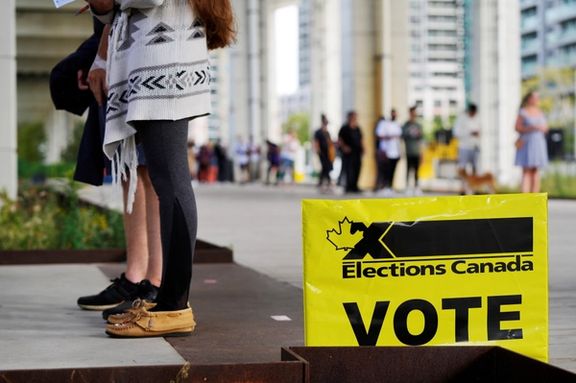
People line up outside a polling station to vote in Canada's federal election, in Toronto, Ontario, Canada September 20, 2021.

A Canadian-Iranian lawmaker has called for an inquiry about Tehran’s potential interference in the country’s elections as was seen in the 2020 US presidential vote.

“Given the catalogue of malign and illegal activities committed by the Islamic Republic of Iran on Canadian soil, it would be naïve to believe that the Iranian regime has any compunction to shape public opinion in Canada,” Ali Ehsassi said in his letter, calling for soliciting testimony and relevant documentation from Iranian-Canadians and others with a substantial interest in the proceedings.

In a formal letter addressed to Commissioner Marie-Josee Hogue, who oversees Canada’s Foreign Interference Commission, Ehsassi demanded that Iran be included within the ambit of her inquiry. 

Officially called the "Public Inquiry into Foreign Interference in Federal Electoral Processes and Democratic Institutions," the inquiry was established by the government of Canada in September 2023 focusing on the interference by China, Russia and other foreign actors on the 2019 and 2021 federal elections. Its first public hearing has been underway since late January and its interim report should be submitted by February 29. 

Expressing concern about “the rather inconclusive public commentary that has surrounded the specific scope of the inquiry,” Ehsasi strongly urged Hogue “to consider examining and assessing any nefarious activities attributable to the Islamic Republic of Iran in Canada that may have impacted our political processes or democratic foundations.” 

Canadian lawmaker of Iranian heritage Ali Ehsassi (October 2023)
100%
Canadian lawmaker of Iranian heritage Ali Ehsassi

He mentioned the inclusion of India in the inquiry as a precedent for expanding its scope, saying that the inquiry requested that the Federal Government collect and produce all classified information that may be within its possession that relate to the alleged interference by India. He suggested that she do the same about Iran. 

Representing Willowdale in Toronto, Ehsassi highlighted the presence of a sizable Iranian-Canadian community in his federal riding. He emphasized the need to examine the Iranian regime's potential involvement in Canada's political landscape, citing concerns about cyberattacks, money laundering operations, and various attempts to influence elections.

In 2021, two Iranians were charged for cyber disinformation and a threat campaign designed to influence the 2020 US presidential election. Mohammad Hossein Muousakazemi (27) and Sajjad Kashian (24) illicitly acquired confidential US voter information through a breach of at least one state election website. Subsequently, they sent threatening email messages to instill fear and disrupt voters. Additionally, the perpetrators produced and circulated a deceptive video, spreading disinformation about alleged vulnerabilities in election infrastructure. They also made attempts to access several states' voting-related websites.

“Any familiarity with the intentions and capabilities of the Islamic Republic confirms that it retains a keen interest in furthering its perceived objectives in Canada, albeit by clandestine and surreptitious means," he said. “Apart from being able to draw on various individuals linked to it that reside in Canada, the Iranian Government is believed to rely on a number of organizations and foundations to assist it in sowing division, slandering individuals, silencing its critics, or holding sway over our elections.”

Ehsasi also pointed to Tehran’s efforts to harass and target people throughout North America, saying that “in recent years numerous plots by the Iranian regime to assassinate individuals in North America have been foiled.”

Just last month, US prosecutors accused an Iranian drug lord of recruiting two Canadian Hells Angels to assassinate Iranian defectors in Maryland as attacks on dissidents abroad continue. A federal indictment accused Naji Sharifi Zindashti of leading a network that has perpetrated the killings, tortures and kidnappings of Iranian dissidents around the world on the orders of Iran’s Ministry of Intelligence and Security.

In his letter, he referenced warnings from Jody Thomas, former National Security Adviser to Prime Minister Trudeau, and Richard Fadden, former Canadian Security Intelligence Service director, who cautioned against ignoring potential interference by Iran. “The Public Inquiry will prove unable to detect, deter or encounter the full breadth of threats posed to Canada by foreign regimes without an examination of the Islamic Republic of Iran.”

Ehsasi concluded by urging the commission not to turn a blind eye to the Iranian regime's malign intent and activities on Canadian soil, emphasizing that failure to do so might cast doubt on the overall efficacy of the inquiry's findings and “embolden the Iranian regime to attempt to influence Canada’s elections in the future.”

A report by Canada’s Global News in November cited Canadian-Iranians, legal experts, and security and intelligence sources as concurring that Canada has an especially big problem with hundreds, maybe thousands, of potentially dangerous regime-connected officials on Canadian soil. 

Earlier this week, Canada’s refugee board ruled that former Iranian government official Majid Iranmanesh cannot stay in the country because of his high-level connections to the regime. Iranmanesh is one of nine alleged senior members of the Iranian regime who face possible deportation. The Canada Border Services Agency has said it was investigating 141 such cases. Thirty-eight have been closed without action.

According to Canada-based activist Hamed Esmaeilion who lost his daughter and wife in the shooting down of Flight PS752 by Iran’s Revolutionary Guard in 2020, said, “Islamic Republic agents are everywhere in this country. Everywhere.”

He is one of many Iranians in the diaspora calling on Western governments to designate the IRGC. 
Most Viewed

US blockade enters murky phase as tankers spoof signals and buyers hesitate
1
ANALYSIS

US blockade enters murky phase as tankers spoof signals and buyers hesitate

2
INSIGHT

Ideology may be fading in Iran, but not in Kashmir's ‘Mini Iran'

3
INSIGHT

Hardliners push Hormuz ‘red line’ as US blockade tests Iran’s leverage

4
VOICES FROM IRAN

Hope and anger in Iran as fragile ceasefire persists

5

US sanctions oil network tied to Iranian tycoon Shamkhani

Banner
Banner

Spotlight

  • Hardliners push Hormuz ‘red line’ as US blockade tests Iran’s leverage
    INSIGHT

    Hardliners push Hormuz ‘red line’ as US blockade tests Iran’s leverage

  • Ideology may be fading in Iran, but not in Kashmir's ‘Mini Iran'
    INSIGHT

    Ideology may be fading in Iran, but not in Kashmir's ‘Mini Iran'

  • War damage amounts to $3,000 per Iranian, with blockade set to add to losses
    INSIGHT

    War damage amounts to $3,000 per Iranian, with blockade set to add to losses

  • Why the $100 billion Hormuz toll revenue is a myth
    ANALYSIS

    Why the $100 billion Hormuz toll revenue is a myth

  • US blockade targets Iran oil boom amid regional disruption
    ANALYSIS

    US blockade targets Iran oil boom amid regional disruption

  • Iran's digital economy battered by prolonged blackout
    INSIGHT

    Iran's digital economy battered by prolonged blackout

•
•
•

More Stories

Flight PS752 Victims Families Protest UN Official's Visit To Iran

Feb 4, 2024, 13:01 GMT+0

Families of the victims of Flight PS752 protested the visit of the deputy United Nations human rights commissioner to Iran outside the UN's Tehran offices on Saturday.

Nada Al-Nashif is scheduled to arrive in Iran Sunday. During the three-day visit, she is due to address rights abuses in the Islamic Republic including spiking executions and deepening crackdowns on women's freedoms.

Protesters were confronted by law enforcement and security forces who quickly dispersed the crowd who lost families in the downed Ukrainian airliner incident on January 8, 2020. Iran's Revolutionary Guards (IRGC) shot down the plane shortly after it took off near Tehran's Imam Khomeini International Airport, resulting in the deaths of all 176 passengers and crew on board.

On Tuesday, families of Flight PS752 victims issued a statement addressing Nashif's visit. They emphasized the ongoing struggle against compulsory hijab laws and urged the UN official to meet with families of executed individuals and those impacted by recent protests in Iran.

In April, the Tehran military court sentenced the operator of the system, responsible for firing the missiles at the plane, to 13 years in prison and ordered him to pay compensation. Among the military personnel accused, none of the high-ranking military or government officials of the Islamic Republic are named.

Global Protests Erupt Against Iranian Executions

Feb 4, 2024, 10:06 GMT+0

The Iranian diaspora led demonstrations in the world's capital cities this weekend in a bid to protest the killing spree in Iran which is executing dissidents at record rates.

Protests were held in cities including Berlin, Stockholm, Vienna, and Copenhagen with others slated to take place in Amsterdam, Bern, Paris, Dublin, Cologne, London and others.

It follows growing calls globally to halt the executions. According to reports from HRANA, a human rights organization, the year 2023 witnessed the execution of at least 791 individuals in Iran, including 25 women and two juveniles—a staggering increase of over 33% compared to the preceding year. 

The intensification of executions in Iran has spurred widespread global outrage, precipitating numerous protests in various corners of the world.

In its latest monthly assessment of the human rights landscape in Iran, HRANA documented that at least 90 people faced execution in December alone, underscoring the urgency of the international community's response to the escalating human rights violations within the country.

A panel of United Nations experts claim the number is even higher, announcing that at least 834 people were executed in Iran in 2023, including eight associated with the nationwide protests. 

This year alone, dozens more have been executed as the crackdown on dissent deepens. At least 28 people are known to have been executed in just 10 days during January. 

Statistics from the Iran Human Rights Organization reveal that since the beginning of 2024, at least 71 people have been executed in prisons across Iran. Of those, 28 were killed between January 21 and 31 alone.


Iran Insists US Strikes Have Nothing To Do With IRGC

Feb 4, 2024, 09:53 GMT+0
•
Iran International Newsroom

Iran’s Revolutionary Guard had no presence in the military bases bombed by the United States, an IRGC general and a member of the Iranian parliament reiterated on Sunday.

Esmail Kowsari, who is of many IRGC senior officers in the hardliner faction in the parliament, reiterated that if there were any Iranian bases among the targets hit by the US in Iraq and Syria, Tehran would have retaliated. He also dismissed any role in the drone attack in Jordan on January 28 that killed three US soldiers and precipitated current tensions.

In the meantime, the United States and Britain launched strikes against 36 Houthi targets in Yemen on Saturday, in the second day of major US operations against Iran-linked groups. The strikes hit buried weapons storage facilities, missile systems, launchers and other capabilities the Houthis have used to attack Red Sea shipping, the Pentagon said, adding it targeted 13 locations across the country.

US officials had warned during the week that they were planning a string of attacks on Iran-affiliated targets in the region, and that the retaliatory operation would not be limited to one massive attack.

A Tomahawk land attack missile (TLAM) is launched from the US Navy Arleigh Burke-class guided missile destroyer USS Gravely against Houthi military targets in Yemen, February 3, 2024.
100%
A Tomahawk land attack missile (TLAM) is launched from the US Navy Arleigh Burke-class guided missile destroyer USS Gravely against Houthi military targets in Yemen, February 3, 2024.

The action against the Houthis seems to have proven that threat. "This collective action sends a clear message to the Houthis that they will continue to bear further consequences if they do not end their illegal attacks on international shipping and naval vessels," US Defense Secretary Lloyd Austin said.

Iran seeing the writing on the wall tries to disassociate itself from the US strikes on its proxies. Kowsari, when asked if Iran would retaliate, said, "These attacks have no connection to Iran at all. But if the slightest action threatens our resources or interests by the United States, we will undoubtedly and certainly respond with a crushing blow that they will regret."

It is noteworthy that the first wave of retaliatory strikes in Iraq and Syria took place five days after the attack on the US base in Jordan, leading to criticism that IRGC personnel and senior proxy leaders had ample time to vacate military bases and potential target areas.

Attacks by Iran-backed armed groups started in mid-October after the Gaza war began and so far more than 160 such strikes on US forces in Iraq and Syria have taken place using drones and rockets. The US has retaliated several times against militia targets, but critics say without inflicting pain on the Iranian regime, which is the main sponsor of these groups, nothing will change. Tehran is ready to sacrifice Arab and Afghan fighters it employs, so any retaliation should be aimed at deterring Iran’s rulers.

Official Iranian statements and media coverage of US airstrikes on Saturday indicated that the concerns about a serious retaliation have dissipated and Tehran can move on with pursuing its regional policies.

By Sunday, Iran’s battered currency continued to rise and regained half of the losses it had sustained since early January, once the US strikes appeared to be limited to militia targets, and not directly aimed at any Iranian assets.

However, any increase in tensions with the United States could lead to further currency losses less than four weeks from parliamentary elections, already marred by voter apathy.


Iran Plans More Nuclear Reactors Despite Serious Hurdles

Feb 4, 2024, 06:27 GMT+0
•
Umud Shokri

Iran’s recently stated plan to build four more nuclear power reactors has raised questions about its feasibility as the country wrestles with economic crisis and isolation.

According to early estimates, work has started in the southern region with a five-thousand-megawatt total capacity in mind. With 4,000 employment prospects and an estimated $20 billion cost, the planned nine-year schedule raises questions under current economic circumstances.

The difficulties Iran has faced in building new power plants in the last ten years raise doubts about whether the 25,000 megawatts of new electricity that the previous national development plan sought to bring about can be achieved.

The Iranian government pledged to raise the percentage of renewable and clean energy power plants to a minimum of five percent in line with the sixth development plan (2017–2021). However, the share of nuclear power is currently one percent, which means that the program's goals have been significantly missed.

The Research Center of the Iranian Parliament emphasizes that over 80 percent of the nation's energy is thermally produced, heavily reliant on natural gas, necessitating a diversification of the energy generation portfolio.

The only nuclear power plant in the country is a 1,000 megawatt facility that started up in 2011 with help from Russia. A 300 megawatt plant is reportedly under construction in Khuzestan.

A Russian worker walks past the Bushehr nuclear power plant, 1,200 km (746 miles) south of Tehran October 26, 2010.
100%
A Russian worker walks past the Bushehr nuclear power plant.

Building times for nuclear power plants vary greatly due to factors like supply chain maturity, design revisions, and project management efficiency, but Iran faces a severe electricity shortage now. Consumption peaked at over 72,000 megawatts in 2023, surpassing the actual production capacity of power plants, capped at 60,000 megawatts during the warm season.

Iran is facing several obstacles in its efforts to build further nuclear power reactors, including financial and technological constraints, geopolitical and political instability, and international sanctions. The interplay of political and economic dynamics, together with worries about public opinion, safety, and international compliance, complicate Iran's nuclear energy development scenario. Moreover, Mohammad Eslami, the head of Iran’s nuclear energy said last week that Tehran is planning to build the new reactors relying on domestic financing and knowhow.

One interesting finding is that Iran seems to value nuclear energy security more than its overall needs for energy production. The strategic emphasis on deterrent and national security capabilities highlights a departure from the traditional objective of increasing nuclear power generation for energy purposes. Iran's attitude to international engagement, technical collaborations, and safety considerations in the nuclear realm may be greatly impacted by this strategic direction.

With its protracted delays and non-operational issues, Iran's first nuclear power plant—built with Russian assistance—remains insufficient to the country's energy security.

Iran's nuclear efforts are made more difficult by the geopolitical environment, namely by its confrontational foreign policy and various sanctions.

The question of whether these initiatives are feasible arises from the effect of sanctions on international collaboration and technical development. Iran must perform a sophisticated diplomatic dance to strike a balance between its desire for energy security and international relations as well as sanctions.

Examining Iran's foreign policy, one can see that the country is committed to scientific progress even in the face of external challenges, as seen by its tenacity in pursuing its nuclear program despite sanctions. Careful navigation is necessary to resolve the delicate dance between energy demands, geopolitical concerns, and the difficulties presented by international sanctions. Iran's prospects for the energy sector both at home and abroad will depend on how well it can surmount these challenges.

American Adult Film Actress Sparks Controversy With Iran Trip

Feb 3, 2024, 22:49 GMT+0

Amidst restrictions barring many Iranians and artists abroad from entering Iran, an American adult film actress has ignited controversy by sharing photos of her journey to Iran.

Whitney Wright published her photos including visits to sites like the former American embassy in Tehran.

Wright, known for her support of Palestine, posted images with captions expressing her curiosity about Iran. The controversy began when she shared a story of herself at Tehran's Golestan Palace, fully covered with Iran's mandatory hijab. Wright had previously solicited recommendations from her followers for Tehran's best foods and attractions.

Her Instagram page also features photos from her recent trips to Lebanon and Egypt. However, Wright's presence in Iran has sparked backlash from social media users, questioning the ease of her entry considering Iran's strict principles for women's morality and chastity.

Famous actress Setraeh Pesyani voiced her opposition, criticizing authorities for permitting Wright's visit while penalizing citizens for defying compulsory hijab. Pesyani took to Instagram, stating, "You punish the people of this land for hijab defiance, yet you allow a porn star to visit Iran for sightseeing? What's happening here?"

Earlier in January, Roya Heshmati, an Iranian woman, was subjected to 74 lashes for violating the Islamic Republic's mandatory hijab law, while another woman who refused to wear the hijab received a two-year prison sentence.

The Iranian regime, surprised by women's unwavering resistance of the compulsory hijab law, has been employing various tactics to dissuade them from removing their hijabs in public, albeit with very little success.