• العربية
  • فارسی
Brand
  • Iran Insight
  • Politics
  • Economy
  • Analysis
  • Special Report
  • Opinion
  • Podcast
  • Iran Insight
  • Politics
  • Economy
  • Analysis
  • Special Report
  • Opinion
  • Podcast
  • Theme
  • Language
    • العربية
    • فارسی
  • Iran Insight
  • Politics
  • Economy
  • Analysis
  • Special Report
  • Opinion
  • Podcast
All rights reserved for Volant Media UK Limited
volant media logo

US Blasts Iran’s Decision To Ban VPNs
Iran International Newsroom
Feb 22, 2024, 12:51 GMT+0Updated: 11:02 GMT+0
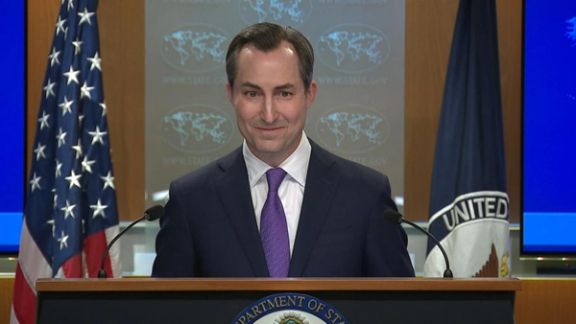
 US State Department Spokesperson Matthew Miller
US State Department Spokesperson Matthew Miller

The United States has called Iran's decision to ban the use of virtual private network (VPN) services a "reminder of how much the Iranian regime fears its people".

Spokesman Matthew Miller made the comments amid Iran's lowest ebb, when on the eve of next month's elections, turnout is expected to be the lowest in the history of the Islamic Republic.

Miller said the government fears "what they [Iranians] are capable of when they are given unfettered access to the internet and information", the 2022 uprising and its subsequent rejection of the government reflecting the power of the people in the face of the country's tyrannical regime.

Blaming Tehran for “choking off information that people need to make decisions about their lives and decisions about their futures,” Miller stressed that the regime’s policies to restrict the virtual space have harmed businesses and cost Iran’s economy billions of dollars.

Iran’s National Virtual Space Center announced a resolution banning the use of VPNs in the country on Tuesday, approved by Supreme Leader Ali Khamenei.

Iranian President Ebrahim Raisi during a meeting with Supreme Leader Ali Khamenei  (undated)
100%
Iranian President Ebrahim Raisi during a meeting with Supreme Leader Ali Khamenei

“Employing VPN devices is prohibited, except for those with a legal permit,” the resolution stated, without specifying who will be eligible for the permits and what actions and purposes will be allowed under the new law.

During the press conference, Miller also vowed that Washington will continue its support for internet freedom in Iran, an integral part of the US campaign to further the cause of human rights in the country.

“In the height of the protests in 2022 and 2023, as many as one in three Iranians used US-supported anti-censorship and digital security tools such as VPNs. There are millions of Iranians that have continued to use those tools to this day,” Miller went on to say.

Since the Women, Life, Freedom uprising, sparked by the death in morality-police custody of Mahsa Amini, the likes of Instagram and Whatsapp have been banned. For millions of small businesses, it has been crippling. Many small businesses depend on such platforms, not least, women in remote regions.

Miller’s remarks come against the backdrop of mounting criticisms against US President Joe Biden over his policies regarding Tehran. Many Iranian activists and opposition figures, as well as American politicians, accuse the Biden administration of being too lenient towards Iran.

Iran's disruption of VPN networks has been coupled with an ongoing surge in internet crackdowns to silence opposition voices. The disruptions have led to decreased internet access speed, exacerbating concerns over online censorship and surveillance in Iran.

The latest bans come amid a broader crackdown on internet freedom activists. Among those detained is Youssef Ghobadi whose unofficial detention has sparked widespread outcry, along with the arrest of another activist known as "Segaro," who was active on the X platform. The two had been working to develop and distribute circumvention tools such as VPNs to help Iranians bypass internet censorship.

In last year's Freedom House report, the NGO stated "Iran experienced the worst score decline among the countries assessed, driven by the authorities’ disproportionate and violent crackdown on nationwide anti-government protests". It noted that "the government also shut down internet services, blocked WhatsApp and Instagram, and expanded its repressive surveillance apparatus".
Most Viewed

US blockade enters murky phase as tankers spoof signals and buyers hesitate
1
ANALYSIS

US blockade enters murky phase as tankers spoof signals and buyers hesitate

2
INSIGHT

Ideology may be fading in Iran, but not in Kashmir's ‘Mini Iran'

3
INSIGHT

Hardliners push Hormuz ‘red line’ as US blockade tests Iran’s leverage

4
VOICES FROM IRAN

Hope and anger in Iran as fragile ceasefire persists

5

US sanctions oil network tied to Iranian tycoon Shamkhani

Banner
Banner

Spotlight

  • Hardliners push Hormuz ‘red line’ as US blockade tests Iran’s leverage
    INSIGHT

    Hardliners push Hormuz ‘red line’ as US blockade tests Iran’s leverage

  • Ideology may be fading in Iran, but not in Kashmir's ‘Mini Iran'
    INSIGHT

    Ideology may be fading in Iran, but not in Kashmir's ‘Mini Iran'

  • War damage amounts to $3,000 per Iranian, with blockade set to add to losses
    INSIGHT

    War damage amounts to $3,000 per Iranian, with blockade set to add to losses

  • Why the $100 billion Hormuz toll revenue is a myth
    ANALYSIS

    Why the $100 billion Hormuz toll revenue is a myth

  • US blockade targets Iran oil boom amid regional disruption
    ANALYSIS

    US blockade targets Iran oil boom amid regional disruption

  • Iran's digital economy battered by prolonged blackout
    INSIGHT

    Iran's digital economy battered by prolonged blackout

•
•
•

More Stories

Ex-Iranian FM Hails Islamic Revolution Amid Mass Discontent

Feb 22, 2024, 12:20 GMT+0

Iran’s former foreign minister has claimed that many in the country believe Iran's 1979 revolution is “unique in world history” as the regime claws for legitimacy on the eve of elections.

Mohammad Javad Zarif who was speaking at a conference held at Tehran University stated, “various observers have pointed out that Iran's revolution stands apart from others because it was not led by a political party or armed group”, hailing the religious nature of the revolution which ousted the ruling monarchy.

His remarks come at a critical juncture as Iran commemorates the 45th anniversary of the Islamic Revolution, coined by its founder, Ruhollah Khomeini, as the revolution of the "bare-footed."

However, the occasion is overshadowed by growing disillusionment among the populace with the regime's shortcomings and fears the upcoming elections will be boycotted en masse as a sign of the country’s discontent amid ever more social and economic repression.

Traditionally, the Islamic Republic celebrates the Ten Days of Dawn (dahe-ye fajr), marking the period from Ayatollah Khomeini's return to Iran on February 1, 1979, to the victory of the Islamic Revolution.

However, this year's observance was fraught with challenges, including the ongoing inflation and increasing reluctance to address the unfulfilled promises of freedom and prosperity made during the revolution.

Poverty has never been as bad as the current depression, an all time low since 1979.

Official figures from the interior ministry suggest that approximately 60% of Iran's 84 million citizens live below the relative poverty line, with between 20 to 30 million enduring "absolute poverty."

This contrasts starkly with government statistics from 2010, which indicated around 10 million people living below the absolute poverty line.

Iran’s IRGC Chief Urges Voter Participation Amid Anticipated Boycott

Feb 22, 2024, 10:31 GMT+0

With the Iranian parliamentary elections approaching, officials are urging citizens to actively participate amidst concerns of the lowest voter turnout since the founding of the Islamic Republic in 1979.

Hossein Salami, the Commander of the Revolutionary Guards, said, "People should perceive the sensitivity of the situation and come to the ballot boxes to once again demonstrate their impressive presence." He claimed that “elections hold significance beyond casting ballots, due to their global impact", aware of the international reputational damage a major boycott will impose on the regime amid Iran's being a pariah state.

His call for participation coincides with growing frustration among Iranians over what they perceive as the regime's neglect of their demands for greater freedom and economic improvement. Official statistics reveal an inflation rate just below 50 percent, with essential goods, especially food, experiencing even sharper price hikes. 

The aftermath of the severe crackdown on the 2022 nationwide protests has fueled internal dissent, resulting in numerous deaths, injuries, and arrests as social and economic oppression continues at full speed.

Discontent has escalated due to the enforcement of medieval hijab laws, lashings for women, and internet controls by hardline authorities, leading to heightened surveillance of the population.

Supreme Leader Ali Khamenei, recognizing the disqualification of most moderate and reformist candidates by the Guardian Council for the upcoming March election, acknowledges his inability to directly mandate voter participation. Instead, he is relying on officials and institutions to utilize various methods to encourage citizens to engage in the electoral process.


US Indicts Japanese Yakuza Leader Over Selling Nuclear Materials To Iran

Feb 22, 2024, 09:05 GMT+0
•
Iran International Newsroom

The United States has indicted a Japanese leader of the Yakuza transnational organized crime syndicate over his attempts to traffic nuclear materials to Iran.

Takeshi Ebisawa is accused of conspiring to transfer uranium and weapons-grade plutonium from Myanmar to Iran for use in Iran's nuclear program, the US Justice Department reported on Wednesday.

According to the report, Ebisawa approached an undercover agent working for the US Drug Enforcement Administration (DEA) in early 2020 in Thailand, informing him that he had a large quantity of uranium and plutonium and asked him to find a customer for the materials.

The Yakuza leader then sent the DEA undercover agent “a series of photographs depicting rocky substances with Geiger counters measuring radiation, as well as pages of what Ebisawa represented to be lab analyses indicating the presence of thorium and uranium in the depicted substances,” the report added.

Following the DEA’s investigation, the undercover agent told Ebisawa that he could connect him to an associate, who was posing as an Iranian general. The Japanese side then suggested that plutonium would be more “powerful” than uranium for the production of nuclear weapons, offering to supply the material to the “Iranian general.”

The samples provided by Ebisawa were confiscated by Thai authorities and transferred to the US. According to the analysis by a US nuclear forensic laboratory, the samples were proved to include uranium and weapons-grade plutonium.

Iran's Supreme Leader Ali Khamenei visits the Iranian centrifuges in Tehran, Iran June 11, 2023.
100%
Iran's Supreme Leader Ali Khamenei visits the Iranian centrifuges in Tehran, Iran June 11, 2023.

“It is impossible to overstate the seriousness of the conduct alleged in today’s indictment” against the Japanese Yakuza leader, said Damian Williams, the US Attorney for the Southern District of New York, adding that he conspired to traffic nuclear uranium and platinum fully aware "the material was going to be used in the development of a nuclear weapons program.”

Meanwhile, Matthew G. Olsen, the Assistant Attorney General of the Justice Department’s National Security Division, stressed that such a trade could have had dire consequences if Ebisawa’s plans had succeeded.

“The Justice Department will hold accountable those who traffic in these materials and threaten US national security and international stability,” he warned.

Ebisawa also negotiated with the DEA’s undercover agent in May 2021 for purchasing military-grade weapons, including surface-to-air missiles. The weapons were demanded by the leader of an insurgent group in Myanmar, added the report by the US Justice Department.

“This is an extraordinary example of the depravity of drug traffickers who operate with total disregard for human life,” said DEA Administrator Anne Milgram in reference to the Yakuza leader’s engagement in weapons, narcotics, and nuclear materials transactions.

In recent years, Iran has become more brazen and vocal around its nuclear program, sanctions so far unable to stem the tide of its progress. Earlier this month, Ali-Akbar Salehi, the former head of Iran's nuclear agency, said Iran has everything it needs for a nuclear weapon, claiming, "we have [crossed] all the thresholds of nuclear science and technology". 

This is not the first time that Iranian officials have claimed to have the ability to build a nuclear bomb. In July 2022, Kamal Kharrazi, the head of the Strategic Council for Foreign Relations of the Islamic Republic and a close advisor to Supreme Leader Ali Khamenei, said in an interview with Al Jazeera that Tehran had the technical capabilities to build a nuclear bomb but does not intend to do so.

"We have increased the level of uranium enrichment from 20 percent to 60 percent in just a few days, and it can easily be enriched to 90 percent," Kharrazi said, implying that Iran is very close to making nuclear weapons.

The head of the UN's nuclear watchdog, Rafael Grossi, announced on Monday that Iran continues to enrich uranium well beyond the needs for commercial nuclear use, further adding that the regime is still enriching at an elevated rate of around 7 kg of uranium per month to 60% purity.

Enrichment to 60% brings uranium close to weapons grade, and is not necessary for commercial use in nuclear power production. Iran denies seeking nuclear weapons but no other state has enriched to that level without producing them.

Iran Allocates 13.6 Billion Euros For Import Of Essential Goods

Feb 22, 2024, 08:59 GMT+0

Iran's Expediency Discernment Council has approved the allocation of 13.6 billion euros for the import of essential, agricultural, pharmaceutical, and raw materials.

As announced by the Council’s Supreme Supervisory Board on Wednesday, the authorization allows the government and the Central Bank to utilize the allocated funds "solely for the import of essential agricultural goods, pharmaceuticals, and their raw materials, as well as medical consumables."

Amidst the drastic devaluation of the Iranian currency in recent years, the government has resorted to providing foreign currency at cheaper exchange rates to importers of a pre-approved list of essential goods, including medicine, food, and crucial raw materials. Importers are mandated to procure and transport the approved goods into the country.

The official exchange rate of the Iranian rial, subsidized by the state, stands at 285,000 rials per US dollar, significantly lower than the open market rate of about 570,000 rials per dollar. The official rate is exclusively utilized for importing essential goods, aiming to shield Iranian consumers from sudden and dramatic price increases due to sanctions.

However, concerns have been raised regarding the misuse of allocated foreign currency, with reports indicating that some individuals and companies fail to import the agreed-upon goods or sell them at inflated prices after importation.

In a recent example, Debsh company, responsible for a significant portion of the country's tea imports, reportedly received an astounding $3.37 billion in foreign currency from the government at a preferential exchange rate for tea and machinery imports between 2019 and 2022. However, reports suggest that the company has sold $1.4 billion of the currency on the free market at higher rates.


Critic Of Iran's Supreme Leaders Brands Elections 'Staged'

Feb 22, 2024, 08:28 GMT+0

Abolfazl Ghadiani, once an ally and now a vocal opponent of Iran’s Supreme Leader, has unleashed criticism against the electoral process, denouncing it as "staged, scripted, and engineered."

In a statement issued on Wednesday, Ghadiani, a prominent political activist, urged "freedom-seekers, justice-seekers, and government opponents to boycott the upcoming elections," citing concerns over the legitimacy of the electoral system.

Directing his ire at Supreme Leader Ali Khamenei, Ghadiani labeled him as "power-hungry, delusional, and deceptive," lambasting the Islamic Republic for deceiving Iranians with false promises of government reform and manipulating them into participating in flawed electoral processes.

Highlighting the intelligence of the Iranian people, Ghadiani praised their past decisions to boycott previous elections, emphasizing their rejection of participation calls with resolute negativity.

Ghadiani also accused certain political activists of employing "strange justifications" aimed at perpetuating the regime's survival by artificially bolstering voter turnout.

His remarks took aim at 110 reformist political and media activists who recently called for participation in the upcoming parliamentary elections and advocated for supporting "moderate candidates." However, their appeal was met with widespread backlash, with many accusing them of "power-seeking and profiting at the expense of people's blood."

Recent years have witnessed a significant decline in voter participation due to severe economic challenges, extensive suppression of dissenting voices, and oversight by the Guardian Council. The decline has precipitated a crisis of legitimacy for the Islamic Republic.

With parliamentary and Assembly of Experts elections scheduled for March 1, expectations loom for historically low voter turnout, marking the first elections since the 2022 uprising sparked by the death in morality-police custody of Mahsa Amini.