• العربية
  • فارسی
Brand
  • Iran Insight
  • Politics
  • Economy
  • Analysis
  • Special Report
  • Opinion
  • Podcast
  • Iran Insight
  • Politics
  • Economy
  • Analysis
  • Special Report
  • Opinion
  • Podcast
  • Theme
  • Language
    • العربية
    • فارسی
  • Iran Insight
  • Politics
  • Economy
  • Analysis
  • Special Report
  • Opinion
  • Podcast
All rights reserved for Volant Media UK Limited
volant media logo

Hardliner Disobedience Signals Weakness In Iran's Khamenei
Iran International Newsroom
Mar 9, 2024, 12:11 GMT+0Updated: 10:57 GMT+0
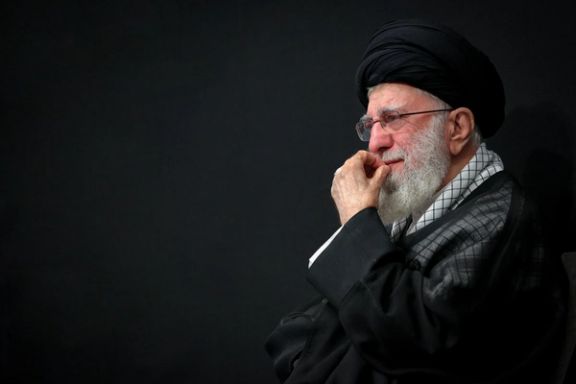
Iran’s ruler Ali Khamenei during a religious ceremony in Tehran

Signs of disobedience among Iranian hardliners towards Supreme Leader Ali Khamenei have emerged shortly after an election that brought numerous new figures to the political forefront.

This can also signal Khamenei's weakness in controlling the ultraconservatives he helped bring to power in an election on March 1 with the lowest turnout in the Islamic Republic's history.

The latest indications of disobedience emerged within hours of Khamenei's advice and orders to hardliners to avoid disgraceful confrontations with each other.

Hamid Rasaei, a former hardliner lawmaker with a questionable reputation, who was disqualified to run in the 2020 parliamentary election, got the go ahead to run this year and won a seat at the parliament (Majles). Within a few days of his election, Rasaei attacked the incumbent Majles Speaker Mohammad Bagher Ghalibaf and his predecessor Gholam-Ali Haddad Adel and called for Ghalibaf's removal from his post.

Former lawmaker Hamid Rasaei  (undated)
100%
Former lawmaker Hamid Rasaei

Both the incumbent and former speakers happen to be relatives of Khamenei. Iranian pundits predicted that granting too much leverage to the ultraconservatives would one day lead them to turn against the leader. It took only a few days for this prediction to come true.

Rasaei wrote in a tweet Friday evening that IRGC-linked Fars News Agency has called for rejecting his credentials as a member of parliament. Rasaei added defiantly that the IRGC agency's threat does not scare him.

As if that was not enough to signal the disobedience that was swiftly responded to by an IRGC media outlet, hours after Khamenei's speech on Thursday, Rasaei repeated his accusations against Ghalibaf once on X (previously known as Twitter) and again on live state television.

Rasaei tweeted that Ghalibaf should be removed from his post as Majles Speaker because he has won only around 400,000 votes in the election while he had won more than 1,200,000 votes in 2020. The decline in Ghalibaf's popularity meant that a major change should occur in the leadership of the parliament.

On prime-time Thursday evening, Rasaei repeated that in a live program on the state television and charged that Tasnim News Agency and Javan Newspaper, two of the media outlets of Iran's revolutionary Guards (IRGC), which he said support Ghalibaf, have attacked him subsequently.

Rasaei also claimed that Khamenei's advice to newly elected lawmakers to avoid conflicts and controversies did not address him. This comes while Tasnim News Agency made it clear on its official X account that Rasaei's statements on state TV were clearly in contravention of Khamenei's remarks.

However, the state TV's deputy chief for political affairs, Alireza Khodabakhshi, was fired the day after, possibly for allowing Rasaei to utter his provocative remarks on air. Khodabakhshi is a an ultraconservative Paydari figure.

In another sign of disobedience to Khamenei, Hassan Bayadi, one of the founders of Abadgaran, a political organization that gave rise to Paydari Party and supported former President Mahmoud Ahmadinejad and is currently a staunch supporter of the Raisi administration, accused the older generation of lawmakers of not knowing what to say and what not to say.

Iran’s ruler Ali Khamenei planting a sapling on March 5, 2024
100%
Iran’s ruler Ali Khamenei planting a sapling on March 5, 2024

The Iranian Labor News Agency (ILNA) quoted Bayadi as using an expression Haddad Adel had used to describe the new ultraconservatives and older politicians. Haddad Adel had likened older conservatives such as Ghalibaf to big trees and the new ultraconservatives as tiny plants. Bayadi said in the interview with ILNA: "May God help us! The totalitarian big trees at the Parliament do not know what to say and what not to say."

Bayadi, who has been so far close to Khamenei's office, also made unforgivable mistakes in that statement: First he attacked Khamenei's relatives, and second, he did not abide by Khamenei's advice to avoid controversies and conflicts among insiders.

The occurrence of two such cases in one day, make it difficult for Khamenei to re-establish his authority in the eyes of his devoted followers who used to see him as an infallible God-like father figure. Almost everyone has seen the signs of aging and illness in Khamenei's face and posture, despite his attempt to walk without a walking stick to prove his fitness.

As conservative activist and analyst Abdolrahim Ansari pointed out, Khamenei did not ask ordinary social media activists to avoid infighting and controversy. He was addressed candidates who have been elected with his blessing without the right qualifications in an engineered election.
Most Viewed

US blockade enters murky phase as tankers spoof signals and buyers hesitate
1
ANALYSIS

US blockade enters murky phase as tankers spoof signals and buyers hesitate

2
INSIGHT

Ideology may be fading in Iran, but not in Kashmir's ‘Mini Iran'

3
INSIGHT

Hardliners push Hormuz ‘red line’ as US blockade tests Iran’s leverage

4
VOICES FROM IRAN

Hope and anger in Iran as fragile ceasefire persists

5

US sanctions oil network tied to Iranian tycoon Shamkhani

Banner
Banner

Spotlight

  • Hardliners push Hormuz ‘red line’ as US blockade tests Iran’s leverage
    INSIGHT

    Hardliners push Hormuz ‘red line’ as US blockade tests Iran’s leverage

  • Ideology may be fading in Iran, but not in Kashmir's ‘Mini Iran'
    INSIGHT

    Ideology may be fading in Iran, but not in Kashmir's ‘Mini Iran'

  • War damage amounts to $3,000 per Iranian, with blockade set to add to losses
    INSIGHT

    War damage amounts to $3,000 per Iranian, with blockade set to add to losses

  • Why the $100 billion Hormuz toll revenue is a myth
    ANALYSIS

    Why the $100 billion Hormuz toll revenue is a myth

  • US blockade targets Iran oil boom amid regional disruption
    ANALYSIS

    US blockade targets Iran oil boom amid regional disruption

  • Iran's digital economy battered by prolonged blackout
    INSIGHT

    Iran's digital economy battered by prolonged blackout

•
•
•

More Stories

Canada Sanctions Iranian Officials Over Women’s Repression

Mar 9, 2024, 09:59 GMT+0

The Canadian government announced on Friday that it would be imposing new sanctions on two Iranian individuals accused of participating in the repression of women.

Foreign Affairs Minister Melanie Joly made the announcement on the International Women's Day, targeting Masoud Dorosti, the chief executive of Tehran's metro system, and Zohreh Elahian, a conservative parliamentarian.

Dorosti is responsible for enforcing Iran's mandatory hijab law on public transit, and Elahian, a vocal supporter of measures including the death penalty for protesters, have been accused of leveraging their positions to enforce increasingly repressive measures against women and girls in Iran.

“These two individuals have used their positions of influence to call for or carry out increasingly repressive measures against women and girls in Iran,” Joly’s office said.

The move marks Canada's latest effort to respond to the death of 22-year-old Mahsa Amini in 2022, who died in police custody after allegedly being arrested for incorrectly wearing her hijab and the subsequent bloody repression of protests in Iran.

So far, Canada has sanctioned 155 individuals and 87 entities connected to human rights abuses in Iran. Those on the sanctions list are barred from entering Canada and conducting business with Canadians.

The Iranian regime continues its policies of punishing women for removal of hijab. Aziz Jafari, former commander of the Islamic Revolutionary Guard Corps, announced this week that the government will undertake new measures against hijabless women.

Addressing hijab enforcer agents on Friday, he said, "I regret not being able to accompany you on the field due to physical limitations. The removal of hijab is a major cultural problem for us that can strike at the root of the revolution."

Iran's Terror Plot In Peru Signals 'Lack Of Deterrence'

Mar 9, 2024, 09:03 GMT+0
•
Iran International Newsroom

Peruvian officials say an Iranian man arrested for planning to kill an Israeli citizen is a member of IRGC's Quds Force, signaling Tehran's terror activities in the Western hemisphere.

Ever since Hamas’ rampage of Israel on 7 October and the ensuing Israeli onslaught on Gaza, Iran has intensified its indirect campaign against American and Israeli interests, utilizing armed groups that it funds, equips, and trains across the Middle East.

But to attempt an assassination in Peru, in South America, suggests a different level of brazenness on Iran’s part and an almost complete absence of US deterrence.

Majid Azizi was arrested earlier this week for allegedly plotting with a Peruvian national to attack an Israeli citizen at the Asia-Pacific Economic Cooperation (APEC), scheduled to be held later this year in Peru. A third individual is reportedly on the run, according to a police statement.

"We had to act quickly because today [Majid Azizi] was set to return to Iran after forming a terrorist cell to wipe out an Israeli national" who was going to participate in the APEC event, Peru's police chief Oscar Arriola said.

Azizi, 56, holds Peruvian citizenship by marriage and has had regular trips to the country for many years, the last of which was in ‘early March’, allegedly to set up the assassination plan and leave. He is now under investigation for “terrorism against the state,” according to Peru’s ministry of interior.

Peruvian authorities have identified the Israeli citizen who was to be targeted but have not revealed their identity for security reasons.

This is the second time in the last decade that Iran has attempted an attack on Israelis in Peru. In 2014, a Hezbollah operative called Mohammed Amadar was arrested in Lima on suspicion of plotting against Israeli and Jewish targets. Later, the police found explosives and detonators in the Lebanese residence.

This time, however, the alleged plotter is not Lebanese but Iranian. And the authorities in Peru say he is a member of IRGC’s Quds Force. If true, the arrest could mark a significant moment as there’s no proxy ‘cover’ to help deny culpability for the regime in Tehran.

The revelation may not be significant enough to sway those who oppose the designation of IRGC as a terrorist organization in many European and other democratic countries. It may weaken their opposition, however, especially if more information emerges and the Quds Force connection is proven beyond doubt.

The Quds Force, the overseas arm of Iran’s Revolutionary Guards, is widely believed to be behind most attacks against the United States and its allies across the Middle East, from Hezbollah in Lebanon to the Houthis in Yemen and an array of armed groups in Iraq and Syria –all visibly emboldened in the past few years, and since October 7th, in particular.

Critics of President Joe Biden lay this issue squarely at his door. Biden and his team, they say, have eroded deterrence by their unwillingness to confront Iran and impose “costs” on the regime for all the ‘malign activities’ in the region that they admit comes out of Tehran.

“It is indisputable that Tehran controls its proxies, and those proxies have killed Americans,” Senator Roger Wicker (R-MISS) said in a Senate Armed Service Committee hearing Friday. “Iran's objective is and has always been to evict the United States from the Middle East so it can achieve regional hegemony.”

The hearing, titled Posture of US Central Command and US Africa Command in Review of the Defense Authorization Request for Fiscal Year 2025 and the Future Years, saw many senators denouncing the Biden administration for its Iran policy.

“President Biden ordered minor counter strikes on Iran's proxies in Syria, Iraq, and Yemen,” Wicker continued. “This approach has failed and will fail because it assumes that we can deter terrorist groups without causing pain to their chief sponsor, Iran.”

A key witness at the hearing was General Michael Kurilla, Commander of the US Central Command, who refrained from any criticism of the administration while offering a clear picture of the situation with Iran.

“Iran is undeterred in support to the Houthi,” he said, “they are undeterred in their support to Hezbollah, their support to Hamas, the support into the West Bank. They are deterred right now in Iraq and Syria and their support to the Iranian aligned militia groups, but not in terms of attacks, but not necessarily in terms of their funding and equipping.”

Iran Denounces Critical UN Report On 2022 Protests As Baseless

Mar 9, 2024, 08:40 GMT+0

Iran has strongly condemned a recent report by a UN fact-finding mission which had said that the regime’s crackdown on 2022 protests amounted to crimes against humanity.

“The unfounded allegations in this report are based on false and biased information and thus lack legal standing,” claimed Iran’s Foreign Ministry Spokesman Nasser Kanaani on Saturday.

He accused the United States, Israel and some Western countries of “preparing” the mission’s report, adding that they try “to continue the project of Iranophobia and Iran’s defamation.”

The UN’s human rights mechanisms have turned into a plaything to fulfill the nefarious and illegal goals of these countries, Kanaani claimed.

The Fact-Finding Mission (FFM) was established by the United Nations’ Human Rights Council in November 2022, two months after the Woman, Life, Freedom protests swept Iran in response to the death in morality-police custody of 22-year-old Mahsa Amini.

The mission published its first report on Friday after 18 months of investigations with help from experts, witnesses and victims. The FFM concluded that the Iranian regime is responsible for the “physical violence” that led to the death of Amini.

“Credible figures suggest that as many as 551 protesters were killed by the security forces, among them at least 49 women and 68 children. Most deaths were caused by firearms, including assault rifles,” the report said, adding, “The Mission found cases of women and girls subjected to rape and other forms of sexual and gender-based violence, including gang rape, rape with an object, electrocution of genitalia, forced nudity and groping.”

People Hold Global Rallies In Support Of Iranian Women

Mar 9, 2024, 07:09 GMT+0

On the occasion of the International Women's Day, protests were held in several cities including in Germany, the UK, and Sweden in solidarity with Iranian women.

The demonstrations in London and Stockholm were held outside parliaments, with the protesters demanding that these counties hold Iran accountable for its human rights violations.

Designating Iran’s Revolutionary Guards as a terrorist organization was the key demand in the gatherings. The IRGC is the main force for the crackdown on dissent by the Islamic Republic.

The demonstrators said that the IRGC has not only suppressed women during the 2022 uprising – ignited by the death in custody of Mahsa Amini, but also put them under pressure, imprisoned them, and killed them over the past four decades for pursuing their basic rights.

In Gothenburg, another Swedish city, Iranians gathered to support women in Iran and to call for the overthrow of the Islamic Republic.

The protesters carried pictures of political prisoners such as Nasrin Sotoudeh and Narges Mohammadi, as well as pictures of some of those killed in the uprising.

In London, a group of Iranian women staged a silent protest in front of the parliament, wearing red dresses similar to the characters of the TV series "The Handmaid's Tale". The Handmaid's Tale is a series set in a dystopian New England, in which an authoritarian, totalitarian, religious and anti-women government as overthrown the United States government and victimizes its citizens, especially women.

The protesters outside the British Parliament told Iran International that Iranian women are the real victims of a religious and oppressive government as they grapple with the consequences of a gender apartheid, highlighting the similarities between the series and the real lives of women in Iran.

New Report Says Iran Treated Protesters As ‘Combatants’

Mar 9, 2024, 04:31 GMT+0
•
Maryam Sinaiee

A recent report by an Iranian rights group contends that authorities treated the Woman, Life, Freedom protests of 2022-2023 as an "armed conflict," categorizing the demonstrators as combatants.

Consequently, they deployed military units specialized in combating armed groups, alongside security forces armed with military-grade weapons, authorized to use lethal force, torture, and terrorize civilians to suppress the uprising, stated Omid Shams, a lawyer and director at Justice for Iran, in an interview with Iran International.

Shams also noted that authorities deployed tanks and armored vehicles in several provinces. His organization identified at least twenty military units from the Revolutionary Guards (IRGC), the IRGC’s Basij militia force, and the police, along with 526 individuals directly involved in severe crimes against protesters.

The report highlights recurring suppression tactics, including the deliberate and indiscriminate firing on protesters, bystanders, and those documenting the attacks, reminiscent of previous protests such as those in 2019.

A scene of the Women, Life, Freedom protests in Tehran (September 2022)
100%
A scene of the Women, Life, Freedom protests in Tehran (September 2022)

The protests erupted when Iran’s ‘hijab police’ arrested Mahsa Amini, a 22-year-old woman in the street for improper attire and hours later she was transferred to hospital with severe head injuries and died three days later. Months of protests that followed represented the most serious challenge to the Islamic Republic since its inception in 1979. Iranian authorities had used brutal force against protesters in the past also, the worst being in November 2019, when they killed at least 1,500 people in the streets.

Justice for Iran, a London-based non-governmental organization (NGO), focuses on human rights abuses in Iran. It maintains a database of political prisoners in Iran (The Atlas of Iranian Prisons) and organized the Iran Atrocities tribunal in London to mark the first anniversary of the November 2019 protests.

The organization's new 250-page report, titled "Waging War on Civilians: Exposing Iran's Repressive Units and Crimes Against Humanity," offers a comprehensive overview of the command structure responsible for the protester massacre, the forces involved, and the weaponry used.

During the Woman, Life, Freedom protests, which began in mid-September following Amini’s death, security forces reportedly targeted passing cars, public transport, residential and commercial buildings, medical centers, and hospitals, instilling fear among citizens.

Many protesters were systematically targeted in the face, resulting in numerous cases of blindness. Iran Human Rights (IHR) reported in September 2023 that women comprised 9 percent of slain protesters and 28% of those who suffered eye injuries.

Justice for Iran employed various methodologies, including open-source intelligence, expert interviews, and an in-depth analysis of visual evidence from its archive database of 35,000 videos, to assess the government's actions during the 2022-23 protests and identify serious human rights violations.

Based on its findings, the report argues that authorities treated the protests as an armed conflict, labeling protesters as combatants and deploying military units and security forces authorized to use lethal force, torture, and terrorize civilians.

In April 2022, Iran's Supreme Leader, Ali Khamenei, called for a robust response to criticism and attacks against the Islamic Republic, advocating for the use of "hybrid warfare" to counter various forms of aggression.

Justice for Iran has shared its findings with relevant international rights organizations, including the United Nations Fact Finding Mission on Iran, established in December 2022 after the brutal crackdown on protesters. The mission is set to release a preliminary report on March 8 and a comprehensive report on March 18.