• العربية
  • فارسی
Brand
  • Iran Insight
  • Politics
  • Economy
  • Analysis
  • Special Report
  • Opinion
  • Podcast
  • Iran Insight
  • Politics
  • Economy
  • Analysis
  • Special Report
  • Opinion
  • Podcast
  • Theme
  • Language
    • العربية
    • فارسی
  • Iran Insight
  • Politics
  • Economy
  • Analysis
  • Special Report
  • Opinion
  • Podcast
All rights reserved for Volant Media UK Limited
volant media logo

Thousands Of Iranians Visit Persepolis, Ancient Seat Of Monarchy
Mar 23, 2024, 23:07 GMT+0Updated: 06:56 GMT+0
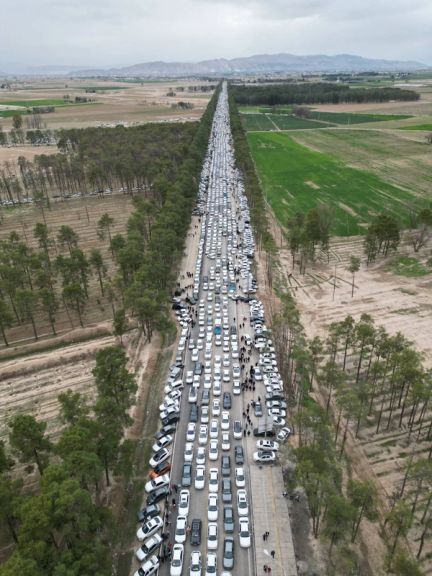
The traffic jam in the road to Persepolis, the ceremonial capital of the Achaemenid Empire, near Shiraz (March 2024)

Images and videos posted online show large crowds of people visiting Persepolis, the ancient seat of Achaemenid kings, and the royal Sa'dabad Palace in Tehran during Norouz holidays.

Thousands celebrated the moment of the beginning of the Iranian New Year at Persepolis on Wednesday morning. Despite the strict measures by the Iranian regime and the coincidence of Norouz and the Islamic fasting month of Ramadan, many Iranians danced and rejoiced in this historical venue in southern Iran to celebrate the New Year.

Ettela’at Online news website described as “unprecedented” the presence of people at Persepolis. Mohammad Sabet Eghlidi, Director General of Tourism Department at Fars province, announced that more than 10,000 people, including tourists, attended the New Year’s celebration at Persepolis.

Over the past decades, the Iranian government has systematically tried to distance people from the pre-Islamic traditions, rituals and cultural heritage. It has frequently banned people from visiting the Pasargadae and Persepolis, ancient sites dating back to the Achaemenid Empire, on Cyrus the Great Day.

The coincidence of Nowruz and Ramadan this year has prompted the Islamic Republic to step up its harsh measures against those opting for a different lifestyle and worldview than those endorsed by the regime. On Thursday, Iran’s deputy interior minister for security affairs said Nowruz travelers eating in public will be punished. “The sacredness of Ramadan must be respected,” stressed Majid Mirahmadi.

Meanwhile, photos from Iran in the past four days show thousands of people waiting in long lines to enter the Sa'dabad Palace, one of the main residences of Iran's last king, Mohammad Reza Pahlavi. During the Norouz holidays last year, the Sa'dabad Palace was declared the most visited historical site in the Iranian capital city Tehran.

The Islamic Republic has tried in vain to spread a negative picture of the Pahlavi dynasty and reduce their popularity.
Most Viewed

US blockade enters murky phase as tankers spoof signals and buyers hesitate
1
ANALYSIS

US blockade enters murky phase as tankers spoof signals and buyers hesitate

2
INSIGHT

Ideology may be fading in Iran, but not in Kashmir's ‘Mini Iran'

3
INSIGHT

Hardliners push Hormuz ‘red line’ as US blockade tests Iran’s leverage

4
VOICES FROM IRAN

Hope and anger in Iran as fragile ceasefire persists

5

US sanctions oil network tied to Iranian tycoon Shamkhani

Banner
Banner

Spotlight

  • Hardliners push Hormuz ‘red line’ as US blockade tests Iran’s leverage
    INSIGHT

    Hardliners push Hormuz ‘red line’ as US blockade tests Iran’s leverage

  • Ideology may be fading in Iran, but not in Kashmir's ‘Mini Iran'
    INSIGHT

    Ideology may be fading in Iran, but not in Kashmir's ‘Mini Iran'

  • War damage amounts to $3,000 per Iranian, with blockade set to add to losses
    INSIGHT

    War damage amounts to $3,000 per Iranian, with blockade set to add to losses

  • Why the $100 billion Hormuz toll revenue is a myth
    ANALYSIS

    Why the $100 billion Hormuz toll revenue is a myth

  • US blockade targets Iran oil boom amid regional disruption
    ANALYSIS

    US blockade targets Iran oil boom amid regional disruption

  • Iran's digital economy battered by prolonged blackout
    INSIGHT

    Iran's digital economy battered by prolonged blackout

•
•
•

More Stories

US Lawmakers Urge Blocking Entry To Iranian Officials

Mar 23, 2024, 21:01 GMT+0

In a letter to the State Department, 27 members of the House of Representatives have urged the Biden administration to ban the entry of Iranian officials to the United States.

“We must not offer the Iranian regime the privilege of setting foot on US soil or the validation of speaking at the United Nations,” read the bipartisan letter addressed to Secretary of State Antony Blinken.

The lawmakers referred to the involvement of Iranian President Ebrahim Raisi in the massacre of thousands of political prisoners in 1988 and his current role in suppressing dissidents in the country, calling for “the denial of visas to President Raisi and any government officials or organizations connected to the regime.”

In 1988, Raisi was a member of an ad hoc judicial committee known as the “Death Commission,” responsible for deciding the fates of prisoners during summary trials that were held in secret.

According to the bipartisan group, the Iranian government continues to destabilize the region by funding, training and supplying its proxies, such as Hamas, Yemeni Houthis and Hezbollah, which target American forces in the region and seek to destroy Washington’s ally, Israel.

“The barbaric October 7, 2023, attack on Israel was a stark wake-up call about the threats Iranian-backed terrorist groups pose to both Israelis and Americans,” the letter added.

Over the past years and particularly, following the 2022 nationwide uprising, Iranian political activists and opposition figures have called on Western countries not to issue visas for regime officials and block their presence in international organizations.

Back in January, the World Economic Forum was urged to revoke its invitation to Iran’s Foreign Minister Hossein Amir-Abdollahian over his close links to the IRGC.

As New Year Begins, Iran Grapples With Inflation And Poverty

Mar 23, 2024, 20:21 GMT+0
•
Iran International Newsroom

As the new Iranian year commenced on March 20, the Iranian press overflowed with complaints, criticism of the government, and dire economic forecasts.

A video released by Etemad online, showed prominent cleric Alavi Boroujerdi speaking out against the government regarding the people's challenging circumstances. He protested that "The people are no longer able to endure the economic hardships," and pointed out that "the clerics are being held responsible for all their troubles."

Boroujerdi also criticized the government for the way it is running the affairs of the state. He said: "The people's economic situation is very bad. Bring in a few honest experts to address the problems as people's patience has come to an end."

Meanwhile, in an interview with Rouiydad24 website, labor activist Hassan Sadeghi warned the government about a fast approaching 67-percent inflation rate in the new year. Sadeghi also warned that the price of gasoline is also going to rise in the new year. The latest gasoline price increase by the government in 2019 led to nationwide protests in Iran during which security forces reportedly killed around 1,500 Iranians.

Sadeghi lamented the state of the country's economy, criticizing the decision to entrust economic matters to individuals lacking adequate expertise in the field of economics. He cautioned that with inexperienced non-experts overseeing the nation's economy, the Iranian currency is poised to face further devaluation in the upcoming New Year, beginning on March 20.

Former central bank chief Abdolnaser Hemmati
100%
Former central bank chief Abdolnaser Hemmati

Expressing concern, Sadeghi cautioned that these developments could precipitate crises, including widespread protests in Iran in the coming year. He highlighted the anticipated impact of inflation and rising prices, particularly on the most vulnerable segments of the population. Additionally, he noted that the heavy reliance on taxation in the government's budget for the New Year is likely to exacerbate the inflationary pressures.

Furthermore, Sadeghi suggested that the Iranian government should take cues from Turkey's approach and adjust wages to keep pace with the rise in inflation. However, talks between the government and representatives of workers yielded no progress on the eve of the New Year.

In another development, former Central Bank Governor Abdolnaser Hemmati, who was President Ebrahim Raisi's rival in the 2021 presidential election, wrote in a tweet: "Government officials are lauding each other for achieving a 4 percent economic growth rate, even as the official inflation rate stands at a staggering 42 percent. Hemmati pointed out that "in 2020, despite facing intense pressure from the US and grappling with the pandemic, Iran managed to achieve a 4.2 percent economic growth, with meager oil revenue of only $7.4 billion." This achievement is particularly noteworthy considering that Iran faced fewer obstacles in exporting oil last year, resulting in oil revenues exceeding $30 billion."

In an earlier letter to the Iranian President, Hemmati had told Raisi that "With the plan you called 'economic surgery' you created a triple-digit inflation rate for commodities such as meat, poultry, and dairy products people need on a daily basis.”

He addressed Raisi directly, stating, "You recently expressed your desire for a headline in the press that reflects the government's empowerment of Iran! But can we truly consider the sharp decline in people's purchasing power, in a country endowed with the world's largest oil and gas resources, and the fact that over 30 percent of the population has fallen below the poverty line as indicators of a powerful nation?"

As evidence of the Iranian government's inefficiency, Hemmati highlighted that one year after the conclusion of Iran's 6th development plan, the country's 7th development plan remains unfinished. Additionally, just five days before the end of the current Iranian year, the government has yet to finalize the annual budget bill for the upcoming year.

Iranian Workers Struggle As Minimum Wage Fails To Meet Living Expenses

Mar 23, 2024, 19:58 GMT+0
•
Iran International Newsroom

The head of the Supreme Council of Workers' Guilds in Iran has raised strong concerns about the inadequacy of the new minimum wage to cover living expenses for Iranian households.

Somayeh Golpour stated that “despite a 35 percent increase in the minimum wage, it still falls short of meeting 60% of household living costs when considering taxes, retirement deductions, and insurance.”

The minimum wage, set at approximately 110 million rials (about 175 USD) on March 19, has been deemed insufficient by labor representatives, leading them to abstain from endorsing the wage resolution proposed by the Supreme Labor Council. The government pushed through the below-inflation wage increase despite strong opposition by labor representatives.

The further fall of the national currency since January exacerbates the situation, with the minimum wage effectively stagnating in the new Iranian year (started on March 20). The predicament leaves millions of workers with minimal purchasing power, further compromising their living standards.

The reality is that the increase in the minimum wage lags significantly behind Iran's soaring inflation rate. Government-controlled sources estimate inflation at 43 percent, with food items experiencing even higher rates ranging from 80 to 100 percent. The imposition of economic sanctions by the United States in 2019 triggered a surge in inflation, compounding the financial hardships faced by Iranian wage earners.

Over the past six years, the Iranian rial has depreciated by a staggering 15-fold, reflecting the economic challenges gripping the nation and underscoring the urgency of addressing the widening gap between wages and living expenses for Iranian workers.

Passenger Boat Seized In Iran For Violating Ramadan Rules

Mar 23, 2024, 15:48 GMT+0
•
Iran International Newsroom

A passenger boat was seized in the waters of Bushehr Province, south of Iran in the Persian Gulf on grounds of non-compliance with religious rules during Ramadan.

Abdollah Khosravi, the commander of Bushehr Border Patrol, confirmed the seizure, stating, "This recreational vessel has been seized in order to enforce Islamic principles and the sanctity of the month of Ramadan." However, specific details regarding the violation that prompted the seizure were not disclosed by Khosravi.

Ramadan, a month marked by fasting, sees heightened vigilance from authorities, particularly in cases where it coincides with other significant events such as Norouz, the Persian New Year during which people are in a celebratory mood.

Norouz trips, particularly to the southern regions of Iran renowned for their favorable climate, are always under police scrutiny during the period.

Iranians are required to refrain from eating, drinking, and smoking in public during Ramadan, even if inside their vehicles. Article 638 of Iran's Islamic Penal Code mandates penalties ranging from 10 to 60 days imprisonment or up to 74 lashes for violating fasting regulations, applicable to all regardless of religion.

The Deputy Minister of Interior Majid Mirahmadi earlier issued a warning regarding public fasting during Norouz which deems public fasting a punishable offense.

"Anyone who openly commits a forbidden act in public places and thoroughfares will be sentenced to imprisonment and flogging," the Deputy Minister emphasized.

Furthermore, Mirahmadi added that businesses, including restaurants, cafes, and food vendors within cities, are prohibited from operating until before the sunset.

Meanwhile, in Rey County, located in the south of Tehran, Mohammad Qasem Tarhani, the police commander, announced the sealing of 24 shops for disregarding warnings related to Ramadan observance. Additionally, warning seals have been issued to 73 other shops in the county.

UN Lists Iran Among 25 Countries Facing Extreme Water Crisis

Mar 23, 2024, 13:40 GMT+0
•
Iran International Newsroom

In its annual world water development report, the United Nations Water (UN-Water) announced that Iran is experiencing “extremely high-water stress.”

Entitled “Water for Prosperity and Peace,” the report was published this week on the occasion of World Water Day, held annually on March 22.

According to the report, Iran, along with Pakistan, Turkmenistan and India, are among the countries in the Asia-Pacific region that are grappling with extremely high-water stress. Furthermore, some other regional countries such as Turkey, Afghanistan, Nepal, Uzbekistan, Armenia and Kyrgyzstan are impacted by high-water stress.

The report defines baseline water stress as “the ratio of total water withdrawals to available renewable surface and groundwater supplies.”

The population in the Asia-Pacific region living under high or extremely high water scarcity drastically increased from 1.1 billion in 1975 to 2.6 billion in 2010, the report stated.

UN-Water also pointed out that Asia-Pacific is “the world’s most vulnerable region to disasters caused by natural hazards,” and therefore, water scarcity in the region and responses to it are further exacerbated by climate change.

“Asia accounts for nearly one third (31%) of weather-, climate- and water-related disasters reported globally, for nearly half (47%) of deaths, and nearly one third (31%) of associated economic losses,” read the UN report.

Globally, 25 countries with around 25% of the world’s population are experiencing extremely high water stress as they extract more than 80% of their annual renewable freshwater supply.

In November 2023, World Weather Attribution said human-induced climate change has played a major role in exacerbating a three-year drought in Iran.

According to the latest figures, the volume of water in Iran’s dams over the past six months has decreased by 10 percent compared to the same period last year.