• العربية
  • فارسی
Brand
  • Iran Insight
  • Politics
  • Economy
  • Analysis
  • Special Report
  • Opinion
  • Podcast
  • Iran Insight
  • Politics
  • Economy
  • Analysis
  • Special Report
  • Opinion
  • Podcast
  • Theme
  • Language
    • العربية
    • فارسی
  • Iran Insight
  • Politics
  • Economy
  • Analysis
  • Special Report
  • Opinion
  • Podcast
All rights reserved for Volant Media UK Limited
volant media logo

Hamas Leader Thanks Iran For Support During Tehran Visit
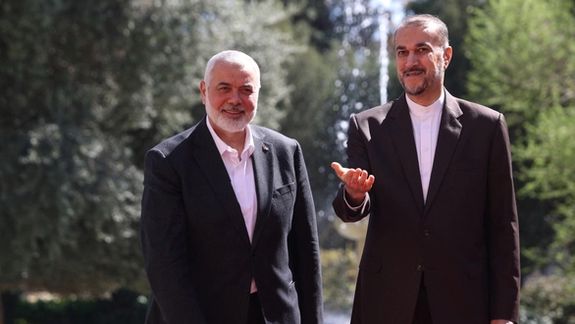
Iran International Newsroom
Mar 26, 2024, 13:04 GMT+0Updated: 10:52 GMT+0
Iran's Foreign Minister Hossein Amir Abdollahian meets with Palestinian group Hamas' top leader, Ismail Haniyeh in Tehran, Iran, March 26, 2024

Hamas leader Ismail Haniyeh during his visit to Tehran met with Iran's Supreme Leader Ali Khamenei, who is a staunch supporter of Islamist groups among Palestinians and in regional countries.

"The Islamic Republic of Iran will not hesitate in supporting the cause of Palestine and the oppressed and resilient people of Gaza," Khamenei said during his meeting with Haniyeh.

The real reason for such trips rarely leaks to media, but Iran has backed Hamas in the nearly six-month war with Israel, which is still reeling from the US decision not to veto the UN Security Council resolution demanding an immediate ceasefire. This is Haniyeh's second visit to Iran since Hamas invaded Israel, killing 1,200 mostly civilians and taking 250 hostages in October.

Hamas leader Ismail Haniyeh (3rd left) and Iran’s ruler Ali Khamenei (right) during a meeting in Tehran on March 26, 2024
100%
Hamas leader Ismail Haniyeh (3rd left) and Iran’s ruler Ali Khamenei (right) during a meeting in Tehran on March 26, 2024

Hamas welcomed the resolution but said the ceasefire needs to be permanent. Iranian officials lauded it as “a positive step” with foreign ministry spokesman Nasser Kanaani saying, “A more important step is effective action for its implementation." 

Haniyeh said in Tehran on Tuesday that Hamas is transitioning into a new phase of war with Israel. “We are in the process of passing through a historic phase in the struggle against the Zionist regime, with the Al-Aqsa Storm being the turning point,” he said during his joint press conference with Foreign Minister Hossein Amir-Abdollahian. Hamas dubs its attack on Israel as the Al-Aqsa Storm.

“Iran stands at the forefront of supporting the cause and people of Palestine,” Haniyeh added. “I extend special thanks to the Supreme Leader of the Islamic Revolution of Iran, the President of Iran, and the people of Iran.” 

In March 2022, Haniyeh revealed that the Islamic Republic paid a total of $70 million to Hamas to help it develop missiles and defense systems. During an interview with Al-Jazeera, Haniyeh said different countries help in financing the group, but Iran is the biggest donor.

Last May, Iran International reported that Hamas pressured the Islamic Republic into inviting its leader, Ismail Haniyeh, to Tehran hoping to get financial support. Our sources said that although the Islamic Republic continues to provide financial aid to Hamas despite its own economic situation, Tehran was not satisfied with the performance of the group against Israel. This was only a few months before Hamas launched the October 7 attack.

While Hezbollah is by far Iran's richest and most powerful proxy, the combined funds of the Palestinian Islamic Jihad Movement, Hamas and the Popular Front for the Liberation of Palestine are enormous, Hamas and Islamic Jihad receiving a large share of Tehran’s aid. In 2018, US President Donald Trump’s special Middle East envoy Jason Greenblatt, who recently visited Israel's communities on the Gaza perimeter and toured the terror tunnel the IDF exploded, claimed Iran provided $100 million annually to Hamas compared to $700m annually to Hezbollah.

Iran's Foreign Minister Hossein Amir Abdollahian looks on during a press conference in Tehran, Iran, March 26, 2024.
100%
Iran's Foreign Minister Hossein Amir Abdollahian looks on during a press conference in Tehran, Iran, March 26, 2024.

During his press conference in Tehran, Haniyeh stated that UN resolution was an indication that Israel is globally isolated. He said that Israel is "losing political cover and protection even in the Security Council" and "the US is unable to impose its will on the international community".

Also on Tuesday, Israel said it is recalling its negotiating team from Qatar after Hamas rejected its latest offer in talks for a hostage deal and truce.

According to Prime Minister Benjamin Netanyahu’s office, Hamas’s decision to reject a US-brokered compromise is “clear proof it is not interested in continuing talks, and a sad testament to the damage caused by the UN Security Council resolution.”

The Israeli government accuses Hamas of retreating to its “extreme demands” including a complete end to the war and full IDF withdrawal from Gaza. “Israel will not cave to Hamas’s delusional demands.”

A diplomatic official quoted by Hebrew-language media said Hamas demanded that Gazans be given carte blanche to return to the north of the Strip and did not even address a hostage release. “There is no one to talk to on the other side and the Israeli negotiating team has nothing to do in Qatar,” the source is quoted saying according to the Times of Israel.
Most Viewed

US blockade enters murky phase as tankers spoof signals and buyers hesitate
1
ANALYSIS

US blockade enters murky phase as tankers spoof signals and buyers hesitate

2
INSIGHT

Ideology may be fading in Iran, but not in Kashmir's ‘Mini Iran'

3
INSIGHT

Hardliners push Hormuz ‘red line’ as US blockade tests Iran’s leverage

4
VOICES FROM IRAN

Hope and anger in Iran as fragile ceasefire persists

5

US sanctions oil network tied to Iranian tycoon Shamkhani

Banner
Banner

Spotlight

  • Hardliners push Hormuz ‘red line’ as US blockade tests Iran’s leverage
    INSIGHT

    Hardliners push Hormuz ‘red line’ as US blockade tests Iran’s leverage

  • Ideology may be fading in Iran, but not in Kashmir's ‘Mini Iran'
    INSIGHT

    Ideology may be fading in Iran, but not in Kashmir's ‘Mini Iran'

  • War damage amounts to $3,000 per Iranian, with blockade set to add to losses
    INSIGHT

    War damage amounts to $3,000 per Iranian, with blockade set to add to losses

  • Why the $100 billion Hormuz toll revenue is a myth
    ANALYSIS

    Why the $100 billion Hormuz toll revenue is a myth

  • US blockade targets Iran oil boom amid regional disruption
    ANALYSIS

    US blockade targets Iran oil boom amid regional disruption

  • Iran's digital economy battered by prolonged blackout
    INSIGHT

    Iran's digital economy battered by prolonged blackout

•
•
•

More Stories

Iran Renews Ultimatum To Kuwait Over Oil Field Rights

Mar 26, 2024, 12:13 GMT+0

Iran has reiterated its ultimatum to Kuwait concerning the disputed Arash gas field.

Iran's vice president for legal affairs, Mohammad Dehghan, emphasized Iran's position, stating, "We will not grant unilateral extraction rights without considering our country's interests to any country."

He stated, "Under no circumstances will the Islamic Republic of Iran retreat from its 'acquired right' in the Arash gas field."

The Arash field, also known as Durra or Dorra by Saudi Arabia and Kuwait, has become a focal point of contention. In 2022, a Kuwaiti-Saudi Arabian development agreement concerning the field drew criticism from Iran, which claims a stake in it. Durra is estimated to hold around 20 trillion cubic feet in proven reserves.

Discovered in 1967, the offshore field boasts substantial reserves, including approximately 310 million barrels of oil and significant gas reserves.

Saudi Arabia and Kuwait's recent statements regarding the energy reserve field have intensified tensions, with demands for Iran to demarcate its maritime borders in the region.

In 2001, Iran deployed drilling equipment into the field, leading Kuwait to file complaints with international organizations. Subsequently, Iran halted its preparations for exploitation, and Kuwait also put on hold its plans in the region with Saudi Arabia.

Iran's access to international companies for the development of its oil and gas fields has been hampered by sanctions over its nuclear program. As a result, Iran has turned to allies like Russia to advance its oil field projects. China remains its biggest customer.


Plainclothes Agents Assault Travelers In Iran’s Zahedan

Mar 26, 2024, 10:46 GMT+0

Plainclothes agents attacked several Norouz travelers in the southeastern city of Zahedan, seizing their mobile phones near the Makki mosque on Monday.

The mosque has been the center of anti-regime protests and gatherings within the past months with Mowlavi Abdolhamid, the outspoken Sunni leader delivering weekly sermons.

Additionally, the windows of several travelers' vehicles were shattered in what appears to be a coordinated effort.

Furthermore, three members of Zahedan's Makki Mosque, who were assisting Norouz travelers, reportedly faced summons and threats from security forces.

The incidents, as outlined by the Halvash rights group and echoed by Baluch activists, are perceived as tactics aimed at instilling fear and discouraging attendance at the Makki Mosque, particularly to prevent interactions with Mowlavi Abdolhamid.

Amid the atmosphere of tension and intimidation, Hossein Ronaghi, a human rights activist and former political prisoner, engaged in a conversation with Mowlavi Abdolhamid at Zahedan's Makki Mosque on Monday. Ronaghi was invited as a guest to Abdolhamid’s reception at the mosque.

Abdolhamid, known for his outspoken criticism of the Iranian regime, continues to advocate for justice and freedom despite facing opposition.

The developments unfold against the backdrop of ongoing struggles faced by Baluch Iranians, especially in Sistan-Baluchestan Province, where minority communities endure repercussions for their participation in the 2022 protests.

The province blighted by poverty and predominantly Sunni Baluch, has witnessed a heavy-handed response from the regime, with dissenters facing punishments, including execution.

Hamas Leader To Meet Iranian Officials Amid UN Ceasefire Resolution

Mar 26, 2024, 08:14 GMT+0

Ismail Haniyeh, the political head of Hamas, is scheduled to visit Tehran on Tuesday to meet senior Iranian officials on the back of the United Nations Security Council's adoption of a resolution demanding a ceasefire between Israel and the Palestinian terror group.

Iran has long been a supporter of Hamas and has vocally praised its war efforts since it invaded Israel on October 7, killing 1,200 mostly civilians and taking more than 250 captive.The forthcoming visit marks Haniyeh's second trip to Iran since the outbreak of the conflict.

On the streets of Tehran just hours after the attack, sweets were distributed and celebrations were taking place to hail the attack.

Reacting to Monday's resolution, Iranian Foreign Ministry spokesman Nasser Kanaani hailed it as a "positive step" as Israel's relentless retaliation has led to the razing of much of Gaza in a bid to eradicate the terror group and free the hostages.

The UN resolution made no mention of the hostages.

Large Attack On Iran-Affiliated Forces In Syria Causes Casualties

Mar 26, 2024, 07:55 GMT+0
•
Iran International Newsroom

Multiple military sites related to Iran’s Revolutionary Guards in Syria were hit early Tuesday local time, causing destruction and casualties, according to several local media.

Sabereen News and Al-Mayadeen, affiliated with the IRGC and Hezbollah respectively, say 20 have been injured in airstrikes targeting both “security and residential” buildings.

The UK-based Syrian Observatory for Human Rights says “nine pro-Iranian fighters, including a leader and a Syrian” have been killed in a villa that served as a “communication center.”

Some sources reported that the commander of IRGC-affiliated forces in eastern Syria, an individual named Haj Askar, a clear nom de guerre, was killed in the strikes. The sources say that he had left Syria in in recent weeks, when the US had threatened retaliatory attacks, but that he had recently returned and was meeting with affiliated militia groups.

The airstrikes seem to have been more powerful than many similar strikes in Syria in recent weeks. Shortly after the explosions, multiple Syrian outlets attributed it to ‘Americans.’ But Al-Jazeera quoted an unnamed US official who denied the country’s involvement in the attacks.

Recent history would suggest that the operation has been carried out either by Israel or the United States, but the reason, the timing, and the actual targets are all unclear at the time of writing.

Unconfirmed reports from Syrian sources claim that “a meeting” was being held at one of the targeted sites, involving IRGC personnel and members of IRGC-affiliated armed groups in Syria and Iraq. This is yet to be confirmed by any official or affiliated outlet.

The airstrikes seem to have hit a-Bukamal and al-Mayadin in Deir Ezzor in eastern Syria, bordering Iraq. The IRGC and its allied forces in the region are known to have a strong presence in these areas.

Israel has repeatedly –almost regularly– struck these areas, often claiming to be destroying weapons storages or shipments. Last month, the US also launched several airstrikes in this region, killing several high-ranking members of the IRGC and its allied groups in retaliation for an attack on a remote US base in Jordan that had killed three American soldiers.

Those US operations reportedly forced Iran to recall its commanders. Regular attacks on American bases and troops –that had started after October 7th and the ensuing Israeli onslaught against Gaza– all but stopped following the US retaliatory strikes. Some reports suggest, however, that after a few weeks of relative calm, IRGC commanders have reappeared.

And on Sunday, reports emerged of a drone and rocket attack on the Kharab al-Jir base used by the US-led coalition in northeast Syria. It’s unclear if the airstrikes Tuesday morning have had anything to do with those reports.

Notably, the airstrikes came only hours after the UN Security Council demanded an immediate ceasefire in Gaza, finally passing a resolution with 14 members of the Council voting in favor and the US abstaining.

The US government’s decision to withhold its veto led to a bitter clash between President Joe Biden and Israeli prime minister Benjamin Netanyahu –whose office called off a visit to Washington by two members of the Israeli cabinet.

It is still too early to say if the airstrikes Tuesday was an isolated incident or would mark a new phase of escalation –where IRGC and its allies in Iraq and Syria resume their attacks against American interests in the region.


Iran's Economic Woes Run Deeper Than Sanctions, Economist Says

Mar 26, 2024, 02:30 GMT+0
•
Iran International Newsroom

Iran's chronic mismanagement and rampant inefficiencies have led to severe economic challenges, to the extent that even lifting sanctions may not ensure a quick recovery, an economist says.

Warning of a worsening economy in the coming months, Tehran economist Morteza Afghah told local media that the roots of the problem lie in the regime’s non-developmental strategy that prioritizes ideological and political agendas over economic progress.

“The reality is that over the past three decades since the end of the [Iran-Iraq] war, the country's economy has been mismanaged. Economic problems have multiplied, and economic and social indicators have deteriorated,” he said. “The reason for this is deeper than even economic policies,” Afghah stressed.

He noted that the problems facing the country are primarily manifested through economic challenges, but their roots are non-economic, criticizing the government for wasting resources of the country with inefficient decision-making.

Despite having a large number of qualified, young, patriotic, educated, and skilled human resources, as well as valuable natural resources, Iran is suffering from poverty, unemployment, and inequality, leading to various social challenges such as addiction, child labor, unsupported women, and theft, he said.

“The main root of the current situation is philosophical and influenced by the non-developmental value system of the decision-makers,” Afghah noted, explaining that such an approach “prioritizes ideological, jurisprudential, and political issues, and does not give due importance to economic well-being and people's livelihood.”

Economist Morteza Afghah  (undated)
100%
Economist Morteza Afghah

He decried the current practices and government's attempts to address the symptoms rather than the root cause of multiple crisis.

"The Iranian government has used a variety of measures to cover its budget deficit, including selling bonds, state assets, and state-owned companies; eliminating subsidized dollars; spending the National Development Fund; raising taxes; increasing the prices of goods and services," and printing money.

Describing the US withdrawal from the 2015 nuclear deal as a heavy blow that exacerbated Iran’s economic problems, Afghah said that former US president Donald Trump’s decision was the result of Iran’s wrong policies. He also rebuked Iran’s hardliners for welcoming US and international sanctions and disregarding their impacts on the country. He quoted former president Mahmoud Ahmadinejad, who famously called UN resolutions “useless pieces of paper” and dared the Security Council to keep issuing them over Iran over its nuclear program.

The economist argued that the government has no choice but to negotiate with the US in order to lift the sanctions. Additionally, Tehran has to resolve its issues with the International Financial Task Force (FATF), which has kept Iran on its financial ‘blacklist’ in recent years for not adhering to transparency and international conventions against money laundering and financing of terrorism.

If the Iranian government is unable to reach an agreement to lift the sanctions and resolve the FATF issue, and regional tensions continue, the economic and social conditions in Iran will deteriorate significantly, he said.

“The hardline Principlists, who dominate the new parliament and the government, prioritize ideological and political issues over solving the economic and social problems of the country. The possibility of Donald Trump's re-election further increases the uncertainty and the economic risk. As a result, we can expect the Iranian currency to lose more value, rising prices and worse economic indicators, more emigration and brain drain, and the flight of capital,” the economist said.

However, he argued that even if the sanctions are lifted, the Iranian economy will not improve significantly. “In the best-case scenario, the situation will not get worse, but it will not get much better either."

Iranian lawmaker Masoud Pezeshkian echoed similar concerns on Monday, highlighting that the main reason for the government’s failure in fulfilling its economic promises is not employing experts for the jobs. “The administration had promised to reduce inflation to less than 10 percent, now it is hovering around 50 percent. It had promised to build one million housing units, but they cannot do it even if eight years at office."

Pezeshkian went on to say, “We always try to say everything is fine and not address the issues we have. As a result, when people protest about the problems, we claim that they are wrong, and we have achieved success."