• العربية
  • فارسی
Brand
  • Iran Insight
  • Politics
  • Economy
  • Analysis
  • Special Report
  • Opinion
  • Podcast
  • Iran Insight
  • Politics
  • Economy
  • Analysis
  • Special Report
  • Opinion
  • Podcast
  • Theme
  • Language
    • العربية
    • فارسی
  • Iran Insight
  • Politics
  • Economy
  • Analysis
  • Special Report
  • Opinion
  • Podcast
All rights reserved for Volant Media UK Limited
volant media logo

Mixed Reactions Among Iranian Regime Insiders Over Israeli Attack
Iran International Newsroom
Apr 2, 2024, 19:57 GMT+1Updated: 10:49 GMT+0
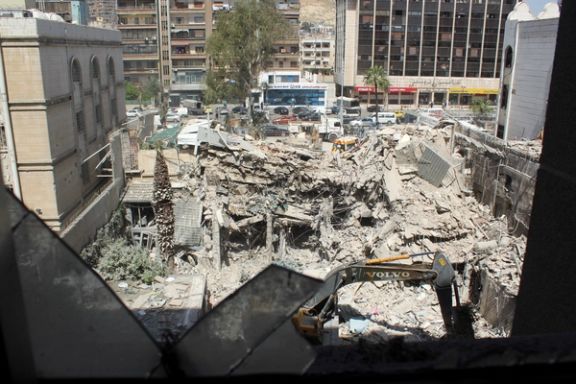
The aftermath of the attack on Iran's consulate in Damascus on April 1, 2024

While certain Iranian regime figures advocate for a military retaliation to the Israeli strike on Iran’s consulate in Damascus, others propose a measured response to avoid escalation.

Former Iranian security chief Ali Shamkhani tweeted that Israel has acted as the United States' proxy army in the region, labeling the strike as foolishness for which Israel should face severe consequences. He vowed that Iran would retaliate regardless of whether the United States was aware of the strike beforehand.

IRGC General Esmail Kowsari, a member of the Iranian parliament, has stated that Israel's attack on Iran's consulate in Damascus constitutes an invasion of Iranian territory, warranting a serious response from Iran. He dismissed the notion of "strategic patience" in the face of such aggression, emphasizing that Iran will not hesitate to retaliate against Israel.

Kowsari also underscored that the United States should anticipate Iran's response, cautioning Israel against further attacks on Iran's interests. He reiterated Iran's stance regarding its military presence in Syria, emphasizing that Iranian personnel are there at the request of the Syrian government. When asked about the nature of Iran's retaliatory measures, Kowsari stated that such decisions lie with Iran's policymakers and military commanders. However, he declined to confirm whether Iran plans to target Israel's diplomatic missions in other countries.

IRGC general and current MP, Esmail Kowsari
100%
IRGC general and current MP, Esmail Kowsari

However, international lawyer Reza Nasri clarified in an interview in Tehran that while the attack on the consulate was illegitimate and violated international law and regulations, it is inaccurate to consider embassies and consulates abroad as extensions of the country's sovereign territory.

Two IRGC generals and five other IRGC officers were killed in the attack on Monday. Subsequently, reports from Iran say that regime supporters in at least in the two cities of Tehran and Sari, have called for serious military strikes on Israel in retaliation for the attack.

In another development, former lawmaker Ali Motahari asked why in a volatile situation in Syria so many high-ranking military officers were taking part in a high-profile meeting. Alireza Pakfetrat, a lawmaker from Shiraz, also reiterated that it is not clear why such a meeting was held while Israel clearly has access to intelligence about the gatherings of Iranian officers in Syria. He suggested that such meetings should be held in a country other than Syria.

Another Iranian lawmaker, Mansour Haqiqatpoor, echoed the sentiment, stating, "Iran is prepared to deliver a robust response to the Zionists." However, he emphasized that such a response would be measured. He emphasized, "Our retaliation will be decisive and inflict significant losses on Israel."

Nonetheless, like many Iranian analysts and social media activists, he warned that the strike on the Iranian consulate could be part of a plot to drag Iran into a wider war in the region, involving Israel.

Meanwhile, in an interview with Entekhab news website, former diplomat and current political analyst Ghasem Mohebali stated that Israel has opted to escalate the conflict. However, Mohebali urged Iran to carefully consider whether broadening the conflict would serve Iran's interests or play into Israel's hands. He cautioned that overlooking details could entangle Iran in a game orchestrated by Israel.

Former diplomat turned commentator, Ghasem Mohebali. Undated
100%
Former diplomat turned commentator, Ghasem Mohebali

While many observers, including commentators on the Iranian state TV, have questioned the Islamic Republic's inaction in the face of repeated Israeli strikes on Iran's positions inside and outside the country. Mohammad Taghi Aghayan, an Iranian analyst said on live Iranian TV: "Everyone talks about hard responses to Israel, but no one says where and when." And in response to those who call for calculated measures and strategic patience, he said: "What exactly should Israel do to prompt us to take hard revenge?"

"Hard revenge" is a term coined by Khamenei and the IRGC after US forces killed IRGC Qods Force Commander Qasem Soleimani in 2020. Talking excessively about "hard revenge," "levelling Tel Aviv and Haifa," and "punishing Israel" without taking action is deeply embarrassing for Khamenei. Even many of his staunch supporters are questioning on social media what he and the IRGC are doing and how they are utilizing their power beyond suppressing women and students in the streets.

Khamenei is faced with two options: retaliating and falling into Netanyahu's trap, or refraining from action and facing further embarrassment.
Most Viewed

US blockade enters murky phase as tankers spoof signals and buyers hesitate
1
ANALYSIS

US blockade enters murky phase as tankers spoof signals and buyers hesitate

2
INSIGHT

Ideology may be fading in Iran, but not in Kashmir's ‘Mini Iran'

3
INSIGHT

Hardliners push Hormuz ‘red line’ as US blockade tests Iran’s leverage

4
VOICES FROM IRAN

Hope and anger in Iran as fragile ceasefire persists

5

US sanctions oil network tied to Iranian tycoon Shamkhani

Banner
Banner

Spotlight

  • Hardliners push Hormuz ‘red line’ as US blockade tests Iran’s leverage
    INSIGHT

    Hardliners push Hormuz ‘red line’ as US blockade tests Iran’s leverage

  • Ideology may be fading in Iran, but not in Kashmir's ‘Mini Iran'
    INSIGHT

    Ideology may be fading in Iran, but not in Kashmir's ‘Mini Iran'

  • War damage amounts to $3,000 per Iranian, with blockade set to add to losses
    INSIGHT

    War damage amounts to $3,000 per Iranian, with blockade set to add to losses

  • Why the $100 billion Hormuz toll revenue is a myth
    ANALYSIS

    Why the $100 billion Hormuz toll revenue is a myth

  • US blockade targets Iran oil boom amid regional disruption
    ANALYSIS

    US blockade targets Iran oil boom amid regional disruption

  • Iran's digital economy battered by prolonged blackout
    INSIGHT

    Iran's digital economy battered by prolonged blackout

•
•
•

More Stories

UN Chief, Taliban Condemn Attack On Iran’s ‘Diplomatic Premise’

Apr 2, 2024, 18:40 GMT+1

UN Secretary-General Antonio Guterres has condemned the recent attack on Iran’s diplomatic premises in Syria’s capital, following similar condemnation from the Taliban’s Ministry of Foreign Affairs in Afghanistan.

Several Arab nations, including Egypt, Kuwait and Lebanon also condemned the widely-believed Israeli air strike, which hit a building next to the Islamic Republic’s alleged diplomatic premise in Damascus.

In an interview with CNN however, the IDF chief spokesman Daniel Hagari said according to Israeli intelligence, the building was not a consulate nor an embassy.

According to Iran’s state media and its foreign ministry, the Israeli airstrike killed seven officials, including IRGC top commander Mohammad Reza Zahedi and IRGC senior commander Mohammad Hadi Haji Rahimi.

In response to the attack, Guterres also said the “inviolability of diplomatic, consular premises, personnel must be respected in all cases”.

The Taliban meanwhile denounced the attack via a spokesperson saying that it “considers Israel's attack on the consular branch of the embassy of the Islamic Republic in Damascus a clear violation of diplomatic norms and a provocative act."

IRGC commanders do not enjoy the immunity diplomats are offered.

While it was alleged that "several long-serving" diplomats were also killed, no names were provided and it has yet to be confirmed by independent media.

Monday’s airstrike coincided with a public holiday for Iranian officials, who commemorate the death anniversary of the first Shiite Islamic Imam, and the embassy should have been closed.

Although Israel has not taken responsibility for the strike, Iran International sources say it was an Israeli operation.

UN Chief Guterres further called on all “concerned to exercise utmost restraint” and “avoid further escalation”.

Iran's Supreme Leader Ali Khamenei and all top officials have condemned the attack vowing revenge at a time of their own choosing.

Journalist Union Urges Iran To Cease Targeting Journalists Following London Stabbing

Apr 2, 2024, 17:47 GMT+1

The International Federation of Journalists (IFJ) has issued a call to the Iranian regime urging an immediate halt to the targeting of journalists in the wake of the stabbing of an Iran International journalist last week.

Pouria Zeraati was seriously injured in an attack as he left his home on March 29 in south London by what is suspected to have been covert Iranian security agents, coming on the back of long standing threats faced by Iran International from the Iranian government, with other journalists at the network also enduring imminent threats of violence since 2022. 

Although the police have yet to identify the assailants, Iran's government has a history of conducting numerous attacks against dissidents and journalists outside the country over the past 45 years.

Expressing solidarity with Zeraati and his family, the IFJ stressed, "Targeting journalists for simply doing their job must stop now!"

Previously, the National Union of Journalists in the UK (NUJ) condemned the attack on Zeraati, with General Secretary Michelle Stanistreet calling the incident a "cowardly attack" and "deeply shocking."

Stanistreet emphasized the need for the international community to pressure Iran and hold it accountable for its actions, stating, "The systematic targeting of journalists – simply for doing their jobs – has to stop."

The NUJ also extended its collective well-wishes to Zeraati for a swift recovery and pledges to collaborate with law enforcement and relevant bodies to combat the harassment and targeting of journalists.

Iranians Defy Regime’s Clampdown On Annual Spring Picnic Tradition

Apr 2, 2024, 15:51 GMT+1
•
Maryam Sinaiee

The regime’s multiple efforts to stop the public from celebrating the ancient Spring Picnic Day (Sizdah Be-dar) on Monday, were met with defiance by many Iranians.

The Iranian authorities’ actions come as the Islamic month of Ramadan and the death anniversary of the first Imam coincided with the Persian New Year celebration of Sizdah Be-dar.

After contradictory statements from the government ahead of the holiday, authorities blocked access to parks and roads to recreational spots around rivers and lakes and forests, using concrete blocks and heaps of earth – common picnic locations where Iranians usually gather on this day.

In some places police also actively interfered with those who had ventured out to picnic despite the warnings and even clashed with them. A video posted on social media shows the police using tear gas to disperse the picnickers in Masouleh. Infuriated Iranians in the touristic town in northern Iran eventually drove them out by booing and shouting “scoundrels” at them.

Police are booed after firing tear gas at picnickers in Masouleh.

Although the Sizdah Be-dar picnic is traditionally celebrated during daytime, Iranians in some areas waited until the evening to get out, as authorities had announced that parks and public gardens would be open after iftar – the evening time of breaking the fast.

Iranian youths are eating ice cream while they are standing together outside a park during the Sizdah Bedar, also known as Nature's Day, in the fasting month of Ramadan in northern Tehran, Iran April 1, 2024.
100%
Iranian youths are eating ice cream while they are standing together outside a park during the Sizdah Bedar, also known as Nature's Day, in the fasting month of Ramadan in northern Tehran, Iran April 1, 2024.

At Tehran’s Gheytarieh Park the police assaulted street musicians who were playing music and took them away while angry people booed them.

Police forcefully remove street musicians from Gheytarieh Park in Tehran.

In many areas the Basij paramilitary and vigilantes patrolled the picnic spots in vehicles, playing loud mourning songs on megaphones to intimidate and threaten the picnickers to leave the area. A video posted on social media shows them threatening picnickers at a beach in Langaroud in northern Iran with one of them shouting “This is the city of Imam Hussain, pick up your stuff and leave” into a megaphone.

Paramilitary Basijis threatening picnickers in Langaroud in northern Iran

The 13th and final day of the Persian New Years holidays is called Sizdah Be-dar and is always celebrated with a picnic. Sizdah Be-dar is often thought to mean “casting off [the inauspiciousness] of thirteen]” but can also mean “spending the thirteenth in the valleys”.

Video sent to Iran International shows a police car blocking the road to a picnic spot.

Since the Islamic Revolution of 1979, the regime has reluctantly tolerated the country’s ancient New Year (Norouz) festival which is celebrated on the day of the Spring Equinox. But the religious establishment has been against the celebration of others such as Charshanbeh Souri bonfire night on the last Tuesday of the old year and Sizdah Be-dar. Authorities, accordingly, have often tried to prevent these festivities, both of which are celebrated outdoors joyfully by Iranians.

Islamists play loud mourning songs on a road in the northern province of Gilan.

To the regime, Chaharshanbeh Suri is viewed as a pagan relic because of its association with fire and Sizdah Be-dar, which was renamed as Nature Day after the Islamic Revolution of 1979, promotes superstition.

Be that as it may, the celebration of Sizdah Be-dar is so popular that it has remained a public holiday in the official calendar as most Iranians, even many religious families, have not forsaken their beloved ancient and pre-Islamic festivals and continue to celebrate them, sometimes even alongside religious occasions.


Israeli Strike In Syria Said To Be Retaliation For Iran's Recurrent Attacks

Apr 2, 2024, 15:31 GMT+1

Iran International sources in Israel say Israel's alleged strike on Revolutionary Guard commanders in Syria was a retaliatory measure against Iran's recurrent proxy attacks since October 7, including a Monday attack on Israeli port town Eilat.

Iran-backed Hamas from Gaza invaded Israel on October 7, sparking the bloodiest Gaza war since Hamas took over the strip in 2007. Most recently, according to the Israel Defense Forces, a drone believed to be launched from Iraq hit a hangar in a naval base in Eilat early Monday morning.

The Islamic Resistance in Iraq, representing various IRGC-backed factions, claimed responsibility for the attack, describing it as targeting a "vital target" in Israel.

The city of Eilat has been subjected to attacks by other Iran-backed groups amidst the conflict in the Gaza Strip, including Yemen’s Houthis and a Syria-based group linked to Lebanon’s Hezbollah. Last month, a missile from Yemen breached Israel's Iron Dome air defense system, landing near Eilat.

In response, sources suggest that Israel was behind the attack on the Islamic Republic's consulate building in Damascus on Monday, resulting in the deaths of senior commander Mohammad Reza Zahedi and other IRGC officials.

While Israel never comments on such allegations, Iran's state media reported that the operation in Damascus also claimed the lives of six Syrian citizens in addition to seven IRGC members.

According to the report, at least 13 people lost their lives in Israel's strike on the Islamic Republic's consulate building in Damascus.

Meanwhile, Israeli Defense Minister Yoav Gallant said Israel’s goal is to “act everywhere, every day to prevent the force build-up of our enemies.”

“We are in a multi-front war, in offense and defense. We see evidence of this every day, including in recent days,” he said at a meeting of the Knesset’s Foreign Affairs and Defense Committee.

Gallant said Israel is also working “to make it clear to everyone who acts against us, all over the Middle East, that the price for acting against Israel will be a heavy price.”


US Deputy Iran Envoy Tours South Caucasus

Apr 2, 2024, 14:41 GMT+1

The US Deputy Iran Envoy discussed issues concerning Iran, including US sanctions and what he termed as Iran's "destabilizing behavior" on a tour of the south Caucasus.

Abram Paley commenced his journey in Armenia where talks focused on border security, sanctions enforcement, human rights, and US concerns about Iran's military support to Russia.

“Productive meetings in Tbilisi with the Deputy Minister of Foreign Affairs, the National Bank of Georgia, and the private sector on Iran, human rights, and the importance of continued sanctions enforcement,” Paley wrote in a post of X of his trip to Georgia.

The tour concluded with a final stop in Baku, Azerbaijan, where the focus remained on Iran's aggression. Just last year, an Iran-backed plot was foiled to attack Israel's embassy in Baku.

Hours before Paley's visit, Azerbaijani law enforcement and border guard agencies announced significant seizures of smuggled drugs from Iran, with operations ongoing since the beginning of the Iranian New Year. Several individuals, including an Iranian citizen, have been detained in connection with the operations.

Relations between Iran and Armenia, Georgia, and Azerbaijan are complex and influenced by various factors including historical, cultural, and geopolitical dynamics. Iran enjoys relatively stable relations with Armenia, with economic cooperation and cultural ties being prominent features. Similarly, with Georgia, Iran maintains cordial relations, focusing on economic cooperation, energy transit, and cultural exchanges.

However, Iran's relations with Azerbaijan have been strained due to issues such as border disputes, security concerns, and differing geopolitical alignments. Since Azerbaijan opened its embassy in Tel Aviv last year, tensions have risen. Border closures and occasional tensions have occurred between Iran and Azerbaijan, particularly concerning the Nagorno-Karabakh conflict and Azerbaijan's relations with Iran's regional rivals.