• العربية
  • فارسی
Brand
  • Iran Insight
  • Politics
  • Economy
  • Analysis
  • Special Report
  • Opinion
  • Podcast
  • Iran Insight
  • Politics
  • Economy
  • Analysis
  • Special Report
  • Opinion
  • Podcast
  • Theme
  • Language
    • العربية
    • فارسی
  • Iran Insight
  • Politics
  • Economy
  • Analysis
  • Special Report
  • Opinion
  • Podcast
All rights reserved for Volant Media UK Limited
volant media logo

Iranian Hardliners Call For Attacks On Israeli Embassies
Iran International Newsroom
Apr 2, 2024, 08:37 GMT+1Updated: 10:50 GMT+0
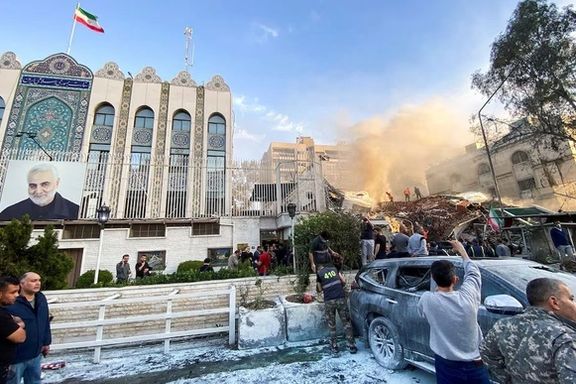
The aftermath of the attack on the Iranian consulate building adjacent to its embassy in Damascus on April 1.

The Iranian regime is shaken but has vowed revenge after suspected Israeli warplanes struck its consulate in Damascus on Monday, killing two high ranking IRGC commanders and five officers.

The response would come “with the same magnitude and harshness,” Iran’s ambassador to Syria Hossein Akbari said a few hours after the strike. He had not been on the premises and survived. In Tehran, President Ebrahim Raisi accusing Israel of the attack, said it will not go unanswered. Foreign minister, Hossein Amir Abdollahian, accused Israel of violating “all diplomatic norms and international treaties.”

Two Iranian hardliner figures called for attacks against Israeli embassies "in the region," one openly saying that Iran should target the embassy in Baku, Azerbaijan.

The airstrike Monday was by all accounts an unprecedented escalation of hostilities that broke out on October 7th, but has been going on with varying intensity for much longer. Israel has on many occasions hit IRGC-related targets in Syria, but never before a diplomatic site.

The gravity of the attack was highlighted by immediate condemnations from governments across the Middle East –with Pakistan, Iraq, Qatar, United Arab Emirates, Oman, and Saudi Arabia all expressing concern and displeasure.

“The Ministry [of Foreign Affairs] expresses the Kingdom’s categorical rejection of targeting diplomatic facilities for any justification, and under any pretext, which is a violation of international diplomatic laws and the rules of diplomatic immunity,” read the statement from the foreign ministry of Saudi Arabia.

Russia also issued a statement, calling the attack on Iran’s consulate in Damascus "categorically unacceptable." But the harshest response came from Hezbollah in Lebanon, Iran’s most powerful ally sharing a border with Israel.

"Certainly, this crime will not pass without the enemy receiving punishment and revenge," the group vowed in a brief but pointed statement. It called Israel "foolish" for believing that assassinating leaders can stop "the roaring tide of people's resistance."

Images emerged on Iranian state-affiliated social media accounts shortly after the attack purporting to show a rally in Tehran to protest against the suspected Israeli targeted assassination of senior IRGC commanders.

The two generals were confirmed by IRGC to be Mohammad-Reza Zahedi, the Quds Force’s top man in Syria and Lebanon, and his deputy, Mohammad-Hadi Haji-Rahimi. Zahedi seems to be the most senior IRGC commander to be assassinated after Qasem Suleimani was killed in a US drone strike in Baghdad in January 2020.

The airstrike on Iran’s consulate in Damascus followed a much bigger Israeli attack inside Syria last week, in which more than 40 people were killed –mainly Syrian soldiers and Hezbollah fighters.

Some sources have suggested that the attack on Iran’s consulate Monday was a response to a drone attack on Israel Sunday night, which hit a naval base in Eilat. A spokesman for Israel army said the drone was “made in Iran” and the attack was “directed by Iran.”

Whether Israel acknowledges the attack or not, the incident is bound to escalate the already tense situation in the region.

The Secretary-General of Kata'ib Sayyid al-Shuhada, an Iraqi armed group backed by the regime in Tehran, posted “You will see Hell” on X, hours after the attack, likely addressing Israel and the United States.

The Pentagon confirmed late Monday a new attempt by Iran proxies in Syria to target a US base after almost two months of quiet on that front. A suicide drone heading towards the Al-Tanf garrison near the Syrian border with Jordan was shot down, the Pentagon said.

Perhaps more worrying for Washington, the Islamic Resistance in Iraq also issued a statement claiming to be ready to equip “the brothers, the Mujahideen of the Islamic Resistance in Jordan,” a US ally and the only country with no visible hostile force on Israeli borders. The statement claimed there were 12,000 fighters in Jordan.
Most Viewed

US blockade enters murky phase as tankers spoof signals and buyers hesitate
1
ANALYSIS

US blockade enters murky phase as tankers spoof signals and buyers hesitate

2
INSIGHT

Ideology may be fading in Iran, but not in Kashmir's ‘Mini Iran'

3
INSIGHT

Hardliners push Hormuz ‘red line’ as US blockade tests Iran’s leverage

4
VOICES FROM IRAN

Hope and anger in Iran as fragile ceasefire persists

5

US sanctions oil network tied to Iranian tycoon Shamkhani

Banner
Banner

Spotlight

  • Hardliners push Hormuz ‘red line’ as US blockade tests Iran’s leverage
    INSIGHT

    Hardliners push Hormuz ‘red line’ as US blockade tests Iran’s leverage

  • Ideology may be fading in Iran, but not in Kashmir's ‘Mini Iran'
    INSIGHT

    Ideology may be fading in Iran, but not in Kashmir's ‘Mini Iran'

  • War damage amounts to $3,000 per Iranian, with blockade set to add to losses
    INSIGHT

    War damage amounts to $3,000 per Iranian, with blockade set to add to losses

  • Why the $100 billion Hormuz toll revenue is a myth
    ANALYSIS

    Why the $100 billion Hormuz toll revenue is a myth

  • US blockade targets Iran oil boom amid regional disruption
    ANALYSIS

    US blockade targets Iran oil boom amid regional disruption

  • Iran's digital economy battered by prolonged blackout
    INSIGHT

    Iran's digital economy battered by prolonged blackout

Tweet unavailable

•
•
•

More Stories

Khamenei Designates All Ministers, Ex-President Admits

Apr 2, 2024, 04:11 GMT+1
•
Iran International Newsroom

Iran's Former President Hassan Rouhani recently admitted a well-known fact in Iranian politics that presidents choose cabinet ministers in "coordination" with Supreme Leader Ali Khamenei.

It was previously known that Khamenei chose or endorsed the Ministers of Intelligence, Interior, Defense and Foreign Affairs of all of Iran's presidents. However, Rouhani has said in an interview with Etemad daily that he also nominated his ministers of Education, Higher Education, and Culture as well as the chairmen of the Iranian Atomic Energy Organization and the Planning and Budget Organization "in coordination" with Khamenei.

This means that Khamenei effectively chose all of the key ministers and top officials in Rouhani's two cabinets between 2013 and 2021. Rouhani said this was done for "certain reasons" but he did not elaborate on what those reasons were.

Mostafa Faghihi, the editor of Entekhab website, a media outlet close to Rouhani, wrote in a long tweet on March 29 that hardliners in Iran: "never thought that Rouhani would win the 2017 election. They were pretty sure that Raisi was going to be the winner, but this was not the case. They were so angry about the failure of their plan."

Faghihi wrote: "By the end of Rouhani's first term of office as President, the nuclear deal with the West was made despite hardliners' obstruction, the value of the rial had remained stable for four years and even worse from the hardliners' point of view, the people were happy with Rouhani's performance. So, the state TV, the Friday Imams and the rest of hardliners' propaganda machine were mobilized to turn the people against Rouhani."

Faghihi added that hardliners then planned and carried out several quasi-Coup d'états against Rouhani. Rouhani himself said in the interview that he may talk about those events at another opportunity, but did not say why was not able to talk about those plots now. However, Faghihi's reference to Mashhad Friday Prayers Imam Ahmad Alamolhoda is reminiscent of the rumors in 2017 that pointed fingers at the firebrand cleric in Mashhad for instigating a riot in the city.

In the interview Rouhani gave a different version of some the events of his presidency. Although there is public knowledge that IRGC commanders held a meeting with him to protest his comments about a parallel "government with guns," a clear reference to the IRGC's intervention in the affairs of the state, Rouhani said in the interview that IRGC commanders including Qasem Soleimani came to him with a request: To choose his Defense Minister from among the ranks of the IRGC. This came while according to Rouhani, Khamenei, when asked, said that it makes no difference as long as he endorses the minister.

Meanwhile, Rouhani complained that after nationwide protests broke out following a sudden rise in the price of gasoline in November 2019, Ebrahim Raisi was the first person to twitt against the price rise while he was one of the three officials who made the final decision about the controversial price rise and had signed the resolution.

At the time, Raisi was the Judiciary Chief, Ghalibaf was the Speaker of the Majles and with Rouhani, they were the heads of the three powers of the government who made the decision as the parliament was too hesitant to make a decision whose consequences were not clear. The price rise was delayed several times since 2013 but it was a measure that was essential for the country in hard times.

According to Rouhani, the Majles was fearing a backlash at a time when Donald Trump's withdrawal from the JCPOA nuclear deal and his additional sanctions against Iran had badly hit the Iranian economy. The inflation rate was fast rising, and the national currency was falling. Acknowledging the impact of price rises, however, Rouhani claimed that he himself did not know about the timing of the gasoline price increase.

Rouhani claimed that there were plots to take advantage of the situation to start a riot, but he did not name any individual or group who were behind the plot. Nonetheless, he said that "The Ministry of Intelligence and the local governors told me they have arrested several individuals and knew who were behind the plot."

Only Two Hotels Constructed In Tehran Since Revolution

Apr 2, 2024, 01:16 GMT+1

Iran's Deputy Tourism Minister Ali-Asghar Shalbafian has announced that since the revolution, only two hotels have been built in the capital, pointing to the country's dire tourism situation under clerical rule.

“After the revolution, only two hotels have been built in Tehran, and one of the reasons for the lack of hotel construction in cities is the high municipal fees, which dissuades people from venturing into hotel development,” he added, blaming bureaucracy.

The revelation comes amidst a broader context of the crisis facing Iran's tourism industry in a country with a once vibrant tourism industry. Concerns about safety and the risk of arbitrary detention by authorities have deterred foreign travelers, despite Iran's rich cultural and historical attractions.

The Iranian government's history of seizing foreign nationals for political leverage or espionage charges has fostered an atmosphere of uncertainty for tourists. This, coupled with mandatory hijab rules and restrictions on alcohol and nightlife, has contributed to a decline in international visitors, particularly after the 1979 Islamic Revolution.

Hopes for a tourism resurgence following the 2015 nuclear deal were dashed when then-US President Donald Trump withdrew from the agreement in 2018, triggering a downturn in Iran's tourism prospects. Mass protests and the detention of several Europeans last year further exacerbated the situation, prompting Western countries to issue travel advisories cautioning against visiting Iran.

Earlier, Hormatollah Rafi'ee, a representative of the tourism sector, expressed concerns about the government's failure to capitalize on tourism opportunities, highlighting a decline in incoming tourists despite claims of growth.


Gasoline Consumption Hits Record In Iran Amid Shortages

Apr 1, 2024, 23:37 GMT+1

Iran is facing record gasoline consumption, sparking fears of rationing as the country battles continued shortages.

Jafar Salari-Nasab, the CEO of the National Iranian Oil Refining and Distribution Company (NIORDC), stated, "On Saturday, 130 million liters of gasoline were distributed in the country, which shows an 18 percent increase compared to the same period last year, which was 110.1 million liters."

New year festivities exacerbated the situation as Iranians traveled during the festive season. He added, "On average, from the beginning of Norouz [March 20] until now, 121.7 million liters of gasoline have been consumed in the country daily, showing an increase of 6.2 percent, equivalent to 7.2 million liters, compared to the same period last year, which was 114.5 million liters."

Concerns regarding the rising consumption have prompted the National Iranian Oil Refining and Distribution Company to issue a warning, urging citizens to manage fuel consumption and observe optimization measures.

Jalel Salari, CEO of the National Iranian Oil Refining and Distribution Company, emphasized the inefficiency of domestically produced vehicles, citing their high fuel consumption compared to international standards. He attributed Iran's gasoline deficit to the annual increase of two million vehicles, contributing an additional five to six million liters to daily consumption.

Furthermore, the imbalance in Iran's refining process, where one-third of products are transformed into mazut and bitumen, exacerbates the shortage of petrol. Official statistics reveal that gasoline constitutes only 28 percent of Iran's refinery products, highlighting the need for modernization akin to refineries in other neighboring countries like the UAE.

Amidst the escalating gasoline deficit, the government has resorted to limited imports of mazut substitutes. However, criticisms have been leveled against the current administration led by President Ebrahim Raisi for a lack of transparency in reporting the volume of gasoline imports.

IRGC News Media Denounces Retaliation Ruling In Protester’s Killing

Apr 1, 2024, 21:33 GMT+1

An Islamic Revolutionary Guards' news agency is criticizing a court ruling in Iran that invoked the Sharia principle of retaliation in the case of a police officer who killed a protester.

The court case involves the police commander of Bandar Anzali, Jafar Javanmardi, who was unprecedentedly prosecuted for the killing of 27-year-old protester Mehran Samak.

Samak was fatally shot on November 29, 2022, during nationwide protests that coincided with celebrations over Iran's national football team's defeat by the US team. Reports suggest that Samak was participating in the protests by honking his car horn when he was shot in the head by agents of the regime in Bandar Anzali, located in northern Iran.

According to Samak’s family lawyer, the military court in the city of Qazvin reaffirmed what is known as a “Qissas” verdict against Javanmardi.

In the Islamic courts in Iran, "Qissas" is the principle of retributive justice under Sharia law, matching punishment to the severity of the crime, particularly in cases of homicide or bodily harm.

In this case, Javanmardi would have to be put to death after the latest military court ruling.

However, the IRGC-run Fars News Agency, expressed concerns about the ruling, claiming that given the circumstances of the incident, “occurring amidst a police operation and amid riots,” such a verdict could “undermine police effectiveness.”

Moreover, the news agency did affirm that Javanmardi was responsible for Samak's death due to what they described as "reckless bullet firing".

Fars further asserted, without citing specific sources, that judicial authorities have deemed the verdict against the defendant as "not final" and due to "numerous flaws," the case is slated for review.

The case of Samak's killing stands out as one of the very rare instances where a protester's death has led to the arrest and trial of a security-police official of the Islamic Republic.

While the protests claimed the lives of over five hundred demonstrators at the hands of Islamic Republic security forces, the regime has yet to be held accountable for such deaths.

Conversely, the government has executed several detained protesters on charges of killing security forces, highlighting a stark contrast in treatment.


Iran Enhances Security On Afghan Borders

Apr 1, 2024, 20:15 GMT+1

Iran’s Defense Minister claims that Iran is boosting the security on eastern borders with the deployment of advanced cameras, helicopters, and drones amid security threats from terror group ISIS.

Speaking to state news agency ISNA, Mohammad-Reza Ashtiani said, “In this plan, it's not just about building walls; rather, in border regions, we have various programs that include creating obstacles, using modern equipment and advanced cameras, helicopters, drones, UAVs, and telecommunications and armaments facilities. Equipment and training for border forces are also important, and all of these together ensure the security of the borders.”

Iran faces significant security concerns, particularly along its border with Afghanistan, stemming from the presence and activities of terrorist groups like ISIS. The porous nature of the Afghan border, combined with the ongoing instability and conflict in Afghanistan, poses a direct threat to Iran.

ISIS, in particular, has been a major concern. The extremist ideology and violent tactics employed by ISIS militants have raised fears of potential infiltration into Iranian territory and the spread of radicalization among vulnerable populations, including Afghan refugees residing in Iran.

Iran has experienced sporadic incidents of violence and terrorist attacks attributed to ISIS such as a double bombing in January in Kerman which killed around 100 people.

Iran's fear of ISIS along its Afghan border reflects the broader security concerns it faces in a volatile region. However, Iran itself has been accused of providing support to groups such as Hezbollah in Lebanon, Hamas in Gaza, and certain factions within Iraq and Yemen.