• العربية
  • فارسی
Brand
  • Iran Insight
  • Politics
  • Economy
  • Analysis
  • Special Report
  • Opinion
  • Podcast
  • Iran Insight
  • Politics
  • Economy
  • Analysis
  • Special Report
  • Opinion
  • Podcast
  • Theme
  • Language
    • العربية
    • فارسی
  • Iran Insight
  • Politics
  • Economy
  • Analysis
  • Special Report
  • Opinion
  • Podcast
All rights reserved for Volant Media UK Limited
volant media logo

US Senators Slam Biden's Iran Policy In Sanctions Hearing
Iran International Newsroom
Apr 10, 2024, 08:22 GMT+1Updated: 10:47 GMT+0
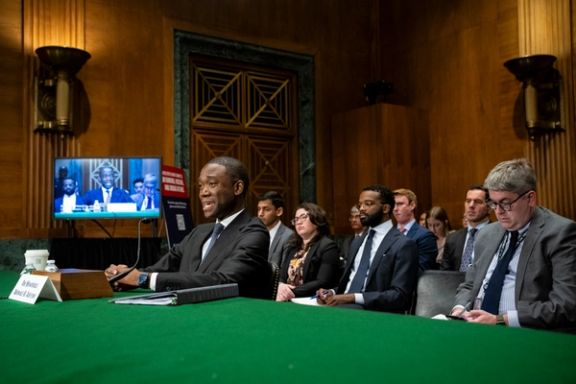
Deputy Secretary of the Treasury Adewale O. Adeyemo testifies during a Senate hearing on US sanctions, on Tuesday, April 9, 2024.

US Senators heaped harsh criticism on President Joe Biden in a hearing Tuesday, accusing the administration of putting Americans “in harm's way” with releasing sanctioned funds to Iran.

"Every dollar this administration gives to Iran is another dollar that will be used against our sons and daughters,” said Senator Tim Scott (R-SC) at a Banking Committee hearing. “The treasury has the ability to stop the dollars… that bolsters the Iranian regime. However, this White House has reduced those barriers through so-called electricity waivers…, licenses, and further billion-dollar payouts.”

Biden’s Iran policy has been a constant source of controversy, especially after October 7th when Hamas, funded and equipped by the Iranian regime, rampaged Israeli areas bordering Gaza, killing hundreds of civilians.

The Senate hearing Tuesday, titled Countering Illicit Finance, Terrorism and Sanctions Evasion, aimed to explore the ways in which the administration’s decisions may have benefited Iran financially and the ways in which such benefits could be stopped.

Testifying in the hearing, Deputy Secretary of the US Treasury Adewale O. Adeyemo admitted that “any dollar” made available to Iran “will go towards their violent activity before they deal with their people.”

“What we’ve seen time and again from the Iranian regime, is that… they put the IRGC first,” he added. “That’s partially why almost none of the humanitarian money has been used for humanitarian purposes, because they don’t care about getting food and drugs for their people.”

The Biden administration has always maintained that funds made available to Iran through ‘third party’ banks (in Qatar, for instance) can only be used for humanitarian purposes. But Biden critics say money is fungible and even if funds are used only for permissible goods, it would free an equal amount somewhere else that can be used for malign activities.

“The Biden administration has acted as Iran’s best friend,” Senator John Kennedy (R-LA) told the hearing. “Iran is not our friend. Biden keeps giving Iran money to buy weapons and try to kill us…Every dollar the US President gives Iran access to will support terrorism aimed at Americans and our allies.”

Other major themes in the hearing were waiving sanctions and Iran’s oil revenue, which has risen dramatically since Biden took office and ended the 'maximum pressure' campaign of former President Donald Trump.

“In spite of US sanctions, Iran's crude oil exports grew by roughly 50% in 2023 to a 5-year high of 1.3 million barrels per day, a vast majority of which goes to China,” Democratic Senator Bob Menendez told the hearing. "The US is reticent to sanction China and its actors."

The Biden administration has turned a blind eye on Iran’s oil exports, partly because it’s challenging to enforce strict and effective sanctions on China, and partly because it seeks to keep the Islamic government in Tehran content enough not to veer towards a more aggressive path with regards to its nuclear program.

Moreover, President Biden may be worried about a supply shortage and a sudden rise in oil prices in an election year. Iran has on many occasions warned that it would ‘close’ the Strait of Hormuz, a narrow but critical waterway through which around 20 percent of all global oil and petrochemicals ships.

This would be a high-risk proposition for Tehran as it would likely draw a harsh response from the United States –something the rulers of Iran want to avoid, their rhetoric notwithstanding. But if they were to act on their threat, however misjudged and short-lived their action might be, the global economy –and Joe Biden– would no doubt suffer.

"Iran can guarantee an election loss for President Biden,” energy expert and former White House special assistant said in an interview with CNBC Tuesday. “Iran can send pump prices to $6 or higher. They can do that. And Biden knows that they can do that."

Most Viewed

US blockade enters murky phase as tankers spoof signals and buyers hesitate
1
ANALYSIS

US blockade enters murky phase as tankers spoof signals and buyers hesitate

2

US tightens financial squeeze on Iran, warns banks over oil money flows

3
INSIGHT

Ideology may be fading in Iran, but not in Kashmir's ‘Mini Iran'

4
INSIGHT

Hardliners push Hormuz ‘red line’ as US blockade tests Iran’s leverage

5
VOICES FROM IRAN

Hope and anger in Iran as fragile ceasefire persists

Banner
Banner

Spotlight

  • Hardliners push Hormuz ‘red line’ as US blockade tests Iran’s leverage
    INSIGHT

    Hardliners push Hormuz ‘red line’ as US blockade tests Iran’s leverage

  • Ideology may be fading in Iran, but not in Kashmir's ‘Mini Iran'
    INSIGHT

    Ideology may be fading in Iran, but not in Kashmir's ‘Mini Iran'

  • War damage amounts to $3,000 per Iranian, with blockade set to add to losses
    INSIGHT

    War damage amounts to $3,000 per Iranian, with blockade set to add to losses

  • Why the $100 billion Hormuz toll revenue is a myth
    ANALYSIS

    Why the $100 billion Hormuz toll revenue is a myth

  • US blockade targets Iran oil boom amid regional disruption
    ANALYSIS

    US blockade targets Iran oil boom amid regional disruption

  • Iran's digital economy battered by prolonged blackout
    INSIGHT

    Iran's digital economy battered by prolonged blackout

•
•
•

More Stories

US Reportedly Issues Visa To Iran's Foreign Minister

Apr 9, 2024, 21:23 GMT+1

Following Israel's bombing of Iran's embassy complex in Syria, Iranian Foreign Minister Hossein Amir-Abdollahian's upcoming visit to New York has stirred controversy.

Sources have told Amwaj.media that entry visas have been issued for Amir-Abdollahian and his delegation, while Tehran continues to support militant groups in the Middle East, who are engaged in attacks on international shipping and against Israel. Observers have raised alarms, particularly as his visit aligns with the anniversary of the 1983 bombing of the US embassy in Lebanon, believed to have been organized by Iranian agents working with proxies.

Against the backdrop of the Gaza conflict, Iran and the United States have reportedly engaged in indirect communication, seeking to prevent further escalation. Talks between the two nations, held in Oman in January, have continued through parallel channels, with Iran pressing for US intervention to compel a ceasefire in Gaza while the US seeks to limit Iranian activities in Iraq, Syria, and Yemen.

Events, including the deadly drone attack on a US military facility in Jordan and Israel's bombing of the Iranian consulate in Syria, have further strained relations. While Washington has emphasized holding Iran accountable for its actions, Iran has alleged US complicity in the Israeli attacks and demanded accountability from Washington.

However, the United States has moved to clarify that it had no prior knowledge of the April 1 bombing and firmly asserts that any retaliation against its interests is deemed unacceptable.

Speculation Mounts On Iran Leader's Health

Apr 9, 2024, 11:36 GMT+1

Statements from the head of Iran's Supreme Leader's medical team celebrating his good health have sparked speculation as to the true state of the aging dictator’s health.

Alireza Marandi highlighted Ali Khamenei's active schedule in spite of his being 84, attributing it to “divine grace”.

Marandi said, "God has been very gracious to the Islamic Republic and all of us, keeping him healthy and well."

The decision to air such statements on a TV talk show has raised questions about the motive behind the sudden public discourse.

Speculation about Khamenei's health has been ongoing, sparking questions about potential successors. While discussions about succession remain taboo in Iranian political discourse, several names have been floated, with Khamenei's son, Mojtaba, emerging as a prominent figure believed to be groomed for the role.

However, experts caution that such an appointment could trigger instability within the regime, given competing power dynamics.

Reports of Khamenei's health issues have surfaced in the past. In 2022, the New York Times reported on his emergency surgery for bowel obstruction amid rumors of his deteriorating health.

Khamenei's subsequent public appearances were seen as attempts to dispel rumors of his death and reaffirm his leadership.

Khamenei has been Iran's supreme leader since 1989 and has been battling ill health for almost a decade. In 2014, he underwent a successful prostate cancer operation which also triggered fears for what would come next.

Iran’s Science Ministry To Close 10 Institutions Involved In Plagiarism

Apr 9, 2024, 10:12 GMT+1

The legal deputy of the ministry of science in Iran announced that 10 institutions involved in the sale of theses and counterfeit documents will be closed down in the coming days.

Reza Saberi said, "Currently, we have identified 10 entities engaged in buying and selling theses … most of them operate through illegal online platforms."

The proliferation of online platforms offering fraudulent academic services has posed a challenge to academic integrity in Iran. These platforms target people seeking shortcuts to academic credentials, exploiting loopholes in the system.

In recent years, degree seeking among students in Iran has escalated, reflecting a concerning trend that highlights broader systemic issues within the country's educational landscape.

While education is highly valued in Iranian society, the pursuit of degrees has increasingly become intertwined with socioeconomic pressures and political realities, leading to a culture of degree seeking that often prioritizes credentials over genuine learning.

One of the primary drivers behind the surge in degree seeking is the competition for limited opportunities in higher education and the job market.

With a large youth population and limited employment prospects, obtaining a degree is often viewed as essential for securing stable employment and socioeconomic advancement.

Moreover, the politicization of education has further complicated the landscape. Government policies, ideological biases, and censorship have shaped educational curricula and restricted academic freedoms, undermining the quality and relevance of education. This has fueled disillusionment among students and exacerbated the pressure to seek degrees as a means of navigating an uncertain future.

Iran's Government Biggest Debtor To Troubled Banks

Apr 9, 2024, 05:17 GMT+1
•
Maryam Sinaiee

Iran's President Ebrahim Raisi asserts that his government maintains transparency regarding the previously undisclosed identities of the banking system’s major debtors.

An examination of the data from the Central Bank of Iran unveils that his government is actually the largest debtor among them.

“You remember that in an election meeting, they handed the candidates the names of three [major debtors] in sealed envelopes, but now [Economy Minister] Mr. Khandouzi is releasing the financial information of 2,000 companies on [the Central Bank] website for everyone to see,” President Raisi said at a meeting with hardliner student activists on Saturday.

Raisi was referring to a highly sensational presidential election debate in 2021. During this debate, his rival, the former Governor of the Central Bank of Iran, Naser Hemmati, handed him a sealed envelope purportedly containing a list of top debtors to the banking system. Hemmati later said that he had previously provided the names to the judiciary, which was headed at the time by Raisi, on multiple occasions – saying that action was taken. Hemmati added that he himself couldn't announce the names during the debate due to legal constraints.

The former Governor of the Central Bank of Iran, Nasser Hemmati (left), and Iranian President Ebrahim Raisi during a presential debate (June 2021)
100%
The former Governor of the Central Bank of Iran, Nasser Hemmati (left), and Iranian President Ebrahim Raisi during a presential debate (June 2021)

It has long been an open secret that Iran's predominantly government-controlled banks face a shortage of capital and that their lending policies are influenced by insiders, such as Iran’s clerics.

The ministry of economy defines a 'major debtor' as persons or entities that hold loans worth at least 10% of a bank's total resources and defaulting on the payments. 

In November 2021, such loans were estimated to total around $10 billion but the value of these loans would have been 5-6-fold higher in dollar equivalents, at the time they were granted. The Iranian currency dropped significantly from mid-2018, but most of these loans were issued before that period.

Six months after an order by the economy minister mandated them to comply, four state-owned banks, including Bank-e Melli, Iran's largest bank, released their lists of major debtors in April 2022. Subsequently, the Central Bank published its list, encompassing 14 other banks along with their major debtors.

The data published at that time and subsequently has, however, been incomplete and vague.

“What interest rates were charged on the loans granted to major debtors? What guarantees were taken for the loans? How were the borrowers’ credit and guarantee assessed? How much of these debts can be recovered and [the collection of] how much is doubtful or impossible?” an editorial in the reformist news outlet Shargh asked after publication of the first set of lists.

Allegations have persisted that major debtors with poor credit utilize loans to speculate in housing, foreign currency, and gold markets rather than investing in production – contributing to higher inflation rates.

“What were these loans for? Were the loans spent for the purposes indicated on loan application forms? What assets were created by the money taken from the bank and how much added value was produced?” the editorial asked, referring to such allegations.

The public is often led to believe that major debtors to the banking system are individuals and private companies.

But, Iran International’s examination of the data provided by the Central Bank and other banks indicates that the private sector’s share of such loans is minimal.

Instead, entities such as the State Welfare Organization, the National Iranian Oil Company (NIOC), and companies owned by banks, automakers, and several other government agencies emerge as the top debtors.

During his campaign Raisi promised that borrowing from the Central Bank was a “redline” his government would not cross. Government officials, accordingly, claim they are fulfilling this promise.

Experts assert that rather than borrowing directly from the Central Bank to address its budget deficit, the government has significantly increased its borrowing from other banks to obscure its financial activities.

This practice, in turn, puts pressure on the Central Bank to print more money in order to provide loans to these banks – leading to an increase in liquidity and higher inflation, according to these experts. According to Iran International's calculations based on periodic official statements, The Raisi government has been printing the equivalent of $460 million per month, adding to the monetary base.

“The government and government-owned companies’ debts to the banking system have doubled since August 2021 when Raisi assumed office,” Dalga Khatinoglu, an Iran economic analyst and oil expert, told Iran International.

“Debts to the banking system include bonds that the government has issued and forced banks to buy as payment of previous government debts. This is the reason the government’s debts to banks are continuously increasing despite payments claimed to be made,” he said.

“But the government’s debt to the banking system is only a fraction of its overall debts. It has also borrowed very heavily from the Central Banks and owes $100 billion to the National Development Fund. The total amounts to $118 billion, that is, equal to two and half years of the government [operating] budget,” Khatinoglu added.

Iranian Football Fans Defy Minute Silence For Slain Commanders

Apr 8, 2024, 23:47 GMT+1

Iranian football fans disregarded a regime directive calling for a minute of silence for top Revolutionary Guard Quds Force commanders killed by Israel in Damascus.

During a match in Tehran, fans turned the moment into a minute of boos and jeers by blowing horns and shouting, a gesture captured on video that swiftly spread across social media platforms.

Last week’s airstrike saw a top commander and six IRGC forces killed in the brazen strike to Iran’s personnel abroad.

The incident echoes a similar occurrence in October, when hundreds of Iranian fans at another football match in Tehran protested against the presence of Palestinian flags on the pitch.

While the Islamic Republic's propaganda machinery orchestrated street celebrations in support of what they termed the "Palestinian victory” after the October 7 invasion of Israel by Hamas, the atmosphere at the football match revealed a different sentiment among Iranian fans.

Chants of "Take that Palestinian flag and shove it up your A**!" were heard, highlighting a divergence from the regime's narrative.

The Hamas attack claimed the lives of 1,200 predominantly civilians, and saw 250 others taken hostage and remains a contentious issue in Iran.

Despite attempts to galvanize public support through organized rallies, ordinary Iranians largely refrained from participating, underscoring the nuanced and diverse nature of public sentiment within the country.