• العربية
  • فارسی
Brand
  • Iran Insight
  • Politics
  • Economy
  • Analysis
  • Special Report
  • Opinion
  • Podcast
  • Iran Insight
  • Politics
  • Economy
  • Analysis
  • Special Report
  • Opinion
  • Podcast
  • Theme
  • Language
    • العربية
    • فارسی
  • Iran Insight
  • Politics
  • Economy
  • Analysis
  • Special Report
  • Opinion
  • Podcast
All rights reserved for Volant Media UK Limited
volant media logo

Iranian Diaspora Continues To Protest Death Sentence For Dissident Rapper

Apr 26, 2024, 23:31 GMT+1Updated: 17:04 GMT+0
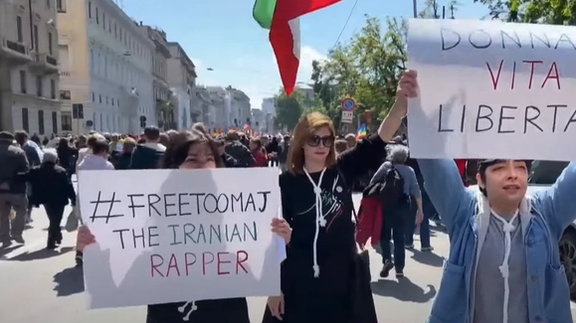
Protesters in support of Toomaj Salehi in Milan

Iranian diaspora has taken to the streets since Wednesday to protest against the dissident rapper Toomaj Salehi's death sentence as calls for continuation of protests over the weekend are mounting.

Rallies are being held in several European, US, and Canadian cities, including London, Bonn, The Hague, Frankfurt, Berlin, Hamburg, Milan, Copenhagen, Montreal, and Washington, to urge their governments to halt the execution.

Protests are also planned for the weekend in Melbourne, Sydney, Vancouver, Vienna, Prague, and Port Douglas.

"We are here to get the international community to put pressure on Iran to stop Toomaj's execution," a protester in Berlin told Iran International on Friday.

A group of Iranians in Washington DC are staging a sit-down strike. "Within 24 hours of Toomaj's death sentence being announced, we started a strike in Washington, and many people joined us despite it being during work hours. We plan to continue protesting over the weekend," Siamak Aram, a protester and political analyst, told Iran International on Friday.

Toomaj Salehi's death sentence by the Revolutionary Court of Isfahan has been criticized widely domestically and internationally since his lawyer announced the verdict on Wednesday.

A 2021 single by Toomaj Salehi, Rat Hole, broke the underground Iranian rap scene. In the song, he attacked Iranians outside and inside Iran who chose to support the regime or did not use their platforms to enhance or relay the voices of struggling and dissenting Iranians.

He became a household name and a symbol of heroic resistance when he joined protesters in 2022 that erupted over the death of Mahsa Amini, fatally injured in police custody for wearing an "improper" hijab.

Toomaj Salehi was initially arrested in 2022, when the intelligence ministry in Isfahan province violently arrested him again for his artistic activities in support of the anti-government movement. He was tortured severely and forced to make televised "confessions" while in custody.

After avoiding a death sentence due to a Supreme Court ruling, he was sentenced to six years and three months in prison in July 2023.

Salehi's lawyer said that the Revolutionary Court of Isfahan later issued new charges in addition to those he had previously been cleared of.

The defense team for Toomaj Salehi has 20 days to file an appeal against the ruling - and they will, according to his lawyer, Amir Raesian.

Mahsa Amini, a 22-year-old woman, who died in the custody of Iran's hijab police in 2022 (undated)
100%
Mahsa Amini, a 22-year-old woman, who died in the custody of Iran's hijab police in 2022

Mahsa Amini's mother, the icon of the nationwide protests during which more than 550 people were killed, also condemned the outspoken rapper’s harsh sentence on Thursday.

“Let Toomaj breathe so that his mother and the mothers of my land don't die,” she said.

On Thursday, Amnesty International also issued the following statement: “Iranian authorities must quash Toomaj Salehi’s conviction and death sentence and release him immediately.”

In videos circulating on the Internet, posters of him are seen on the walls and highways of Iran. There were also reports from Tehran of night-time chants against the regime, as well as youngsters writing slogans on city walls in support of the increasingly popular artist.

Most Viewed

US blockade enters murky phase as tankers spoof signals and buyers hesitate
1
ANALYSIS

US blockade enters murky phase as tankers spoof signals and buyers hesitate

2
INSIGHT

Ideology may be fading in Iran, but not in Kashmir's ‘Mini Iran'

3
INSIGHT

Hardliners push Hormuz ‘red line’ as US blockade tests Iran’s leverage

4
VOICES FROM IRAN

Hope and anger in Iran as fragile ceasefire persists

5

US sanctions oil network tied to Iranian tycoon Shamkhani

Banner
Banner

Spotlight

  • Hardliners push Hormuz ‘red line’ as US blockade tests Iran’s leverage
    INSIGHT

    Hardliners push Hormuz ‘red line’ as US blockade tests Iran’s leverage

  • Ideology may be fading in Iran, but not in Kashmir's ‘Mini Iran'
    INSIGHT

    Ideology may be fading in Iran, but not in Kashmir's ‘Mini Iran'

  • War damage amounts to $3,000 per Iranian, with blockade set to add to losses
    INSIGHT

    War damage amounts to $3,000 per Iranian, with blockade set to add to losses

  • Why the $100 billion Hormuz toll revenue is a myth
    ANALYSIS

    Why the $100 billion Hormuz toll revenue is a myth

  • US blockade targets Iran oil boom amid regional disruption
    ANALYSIS

    US blockade targets Iran oil boom amid regional disruption

  • Iran's digital economy battered by prolonged blackout
    INSIGHT

    Iran's digital economy battered by prolonged blackout

•
•
•

More Stories

Who Sentenced Dissident Iranian Rapper To Death?

Apr 26, 2024, 21:15 GMT+1
•
Iran International Newsroom

Iran International's investigation has identified the judge who handed down the death sentence to Toomaj Salehi, the prominent dissident rapper imprisoned in Iran.

Who sentenced Toomaj to death?

Mohammad Reza Tavakoli, in his capacity as the head of the first branch of the Isfahan Revolutionary Court, together with two officials only identified by their last names, Ravanmehr and Ebrahimi, sentenced Toomaj to death. Iran's Judiciary is one of the most hardliner institutions in the Islamic system of government, where judges, prosecutors and security agents work in tandem to suppress dissent. The Judiciary is under the control of Supreme Leader Ali Khamenei.

A friend of Toomaj described Mohammed Reza Tavakoli as an "illiterate with a great desire to be promoted in the judiciary.”

“Aiming for power and gaining the approval of his superiors who were seeking a harsher sentence, he increased the number of charges against Toomaj from three to ten,” the unidentified friend told Iran International.

Reza Akvanian, a human Rights Journalist, at Iran International said on Friday that “Tavakolian has a history of violating human rights, women’s rights, and persecution of the Bahaei minorities."

Tavakoli was honored as an "exemplary judge of the Islamic Republic" in 2014.

Why does it matter to identify the judge?

Perhaps there is a reason why Iranian state media did not directly name the judge who handed down the death sentence in their coverage of the event.

Toomaj's first prison sentence in July 2023 was handed down by Morteza Barati, who is listed on the UK and Canada sanctions lists.

His sanction is outlined on the website of the British government as follows: “He is and has been involved in the commission of serious human rights violations in Iran, namely being responsible for engaging in serious violations of the right to freedom of expression, the right not to be subject to cruel, degrading, or inhuman punishment and the right to a fair trial through his role as presiding judge of Branch 1 of the Revolutionary Courts of Isfahan.”

Akvanian explained that naming these individuals makes it easier to hold them responsible for "atrocities they commit."

“Iranians in the West can request international sanctions against these individuals once they're identified so they don't escape the consequences of their actions,” Akvanian added.

Why was Toomaj sentenced to death?

Originally sentenced to six years in prison for his role in the 2022 Mahsa Amini protests, Salehi was released after the Islamic Republic Supreme Court reviewed the original sentence and reduced the charges.

The artist was again arrested in November 2023 for releasing a video and expressing his views concerning the Iranian government and revealing that he had been tortured and held in solitary confinement for 252 days following his arrest in October 2022.

After another trial, instead of reducing the alleged offenses in accordance with the Supreme Court's request, the new judge increased the charges, including “Spreading corruption on earth,” an Islamic legal term in Iranian laws, pertaining to actions that undermine the regime. “Corruption on earth" and "Moharebeh" are considered the most serious crimes by the Islamic Republic.

Why was Toomaj's death sentence deemed ‘unusual’?

Amir Raeisian, Salehi’s lawyer, told Roydad24 website in Tehran on Thursday that his client had already been acquitted of "corruption on earth" in the previous court.

Toomaj Salehi's other lawyer, Mostafa Nili, said the verdict had "obvious legal conflicts" in a message on X on Wednesday.

Since the new court was held based on the Supreme Court’s decision to review and lower the charges, the death sentence is deemed unusual.

Photo of Mohammad Ghobadlou (undated)
100%
Photo of Mohammad Ghobadlou

Only one other case is similar to this case. Executed protester Mohammad Ghobadlou, like Salehi, was arrested during the height of the Mahsa Amini protests. His lawyer received less than 12 hours' notice that his client would be executed, despite the Supreme Court's decision to quash Ghobadlou's death sentence and order a retrial in July 2023. A retrial that never took place.

Large Fire In Tehran Warehouse Sparks Safety Concerns

Apr 26, 2024, 19:07 GMT+1

A large fire in a warehouse complex in southern Tehran has reignited longstanding concerns over building safety and sparked protests from the city’s fire department.

Jalal Maleki, the spokesperson for the Tehran Fire and Safety Services Organization, reported on Thursday that the blaze affected several large warehouses, each approximately 500 square meters in size, with an adjoining open space of about a thousand square meters also engulfed in flames.

Despite the intensity of the fire, which nearly caused the warehouse roof to collapse and damaged several containers, there were no casualties or fatalities reported.

Following the incident, Gholamreza Mohammadi, CEO of the Tehran Fire and Safety Services Organization, emphasized the ongoing challenges faced by firefighters due to restrictive laws that prevent them from entering buildings without owner permission to conduct safety inspections.

In response, the organization is calling for legislative changes to empower firefighters as authorized officers to enforce safety measures without needing owner consent. If enacted, the laws would allow the fire department to seal buildings that fail to comply with safety requests.

The incident highlights a broader issue of safety negligence, particularly in Tehran, where unsafe buildings continue to pose significant risks.

Earlier, Mehdi Pirhadi, a member of the Tehran City Council, highlighted a report identifying 35,000 unsafe buildings in the city, underscoring the urgency of addressing such hazards.

The fire department has frequently protested the high percentage of government buildings that are deemed unsafe, with previous statements indicating that up to 50% of such structures pose safety risks.

The recent fire serves as a critical reminder of the need for comprehensive safety reforms to protect lives and property in Iran’s capital.

12 Points You Need To Know About New Iran Sanctions

Apr 26, 2024, 18:06 GMT+1
•
Navid Mohebbi

On April 24, 2024, the US government took a significant step against corruption in Iran by implementing the Holding Iranian Leaders Accountable Act to enhance oversight of the finances of Iranian officials.

This legislation is part of the National Security Act of 2024, an appropriations bill passed by the 118th Congress and signed into law by President Biden.

The bill includes four key Iran-related measures: the Mahsa Act, the Ship Act, the Iran-China Energy Sanctions Act, and the Holding Iranian Leaders Accountable Act.

Although it has received comparatively less media attention, this article will explore the specifics of the Holding Iranian Leaders Accountable Act, examining its implications and the detailed measures it proposes to address critical issues related to Iran.

Here are the "12 Points You Need to Know" about the "Holding Iranian Leaders Accountable Act of 2023" with detailed insights into the bill's provisions:

1. What does the "Holding Iranian Leaders Accountable Act of 2023" do?
The law mandates reporting requirements for the Secretary of the Treasury to compile detailed reports on financial institutions' dealings with designated Iranian officials, including descriptions of asset holding, acquisitions, and ties to financial institutions, asset descriptions, acquisitions, usage, and involved financial institutions.
It imposes restrictions requiring US and foreign financial institutions identified in the reports to terminate accounts and halt significant financial services to the designated Iranian officials.

2. What is the primary objective of the "Holding Iranian Leaders Accountable Act of 2023"?
The bill seeks greater oversight and reports on the financial activities of key Iranian officials and institutions, aiming to monitor and prevent corruption through funding flows that might support activities like terrorism.

3. Who are the specific individuals and groups named in the bill?
The bill targets key figures within the Iranian government and military, including the Supreme Leader, the President, members of the Guardian Council and the Expediency Council, and high-ranking officials within the Islamic Revolutionary Guard Corps (IRGC) and leaders of major terrorist/proxy groups tied to Iran like Hezbollah and Hamas.

4. Why are these particular individuals and groups targeted?
These figures are central in Iran's political, military, and economic system and are involved in corruption and supporting terrorism, thereby undermining regional stability.

5. Who needs to report under this bill, and what must be reported?
The Secretary of the Treasury must submit comprehensive reports detailing assets, financial transactions, acquisition methods, and uses of funds associated with specified Iranian officials and institutions.

6. How frequently must these reports be prepared and submitted?
An initial report is due within 180 days after the bill's enactment, with subsequent updates every two years.

7. What actions must US financial institutions take under this bill?
US financial institutions are required to close accounts and cease significant financial services for listed individuals and entities.

8. Are foreign financial institutions also affected by this bill?
Yes, the bill compels the Treasury to use all necessary means, under existing laws, to close foreign accounts and stop financial services for identified individuals and entities.

9. What are the provisions for public availability of the report?
The unclassified part of the report should be made public in English, Persian, Arabic and Azari if deemed in the US national interest, enhancing transparency and deterring illicit activities.

10. What are the exceptions and waivers included in the bill?
The President may waive specific requirements if the individuals or institutions prove their funds were legally obtained or if they are cooperating with US security or law enforcement. Transactions involving humanitarian aid to Iran are also exempted.

11. When does the bill expire?
The act includes a sunset clause, ceasing its provisions five years post-enactment unless extended by further legislative action. This allows for reassessment of its effectiveness and relevance.

12. Why does this bill matter?
This law provides an opportunity to increase transparency on the financial resources of the senior leaders in the Islamic Republic and offer additional targets for sanctions. Exposing the corruption of regime officials not only aids in accountability and can embarrass these leaders publicly, but it can further encourage Iranian dissidents and protestors who are facing severe economic difficulties due to regime mismanagement, graft, and corruption.
Criticism Surrounds Awarding Of Honorary Doctorate To Raisi In Pakistan

Apr 26, 2024, 15:37 GMT+1

The awarding of an honorary doctorate from Karachi University in Pakistan to Iranian President Ebrahim Raisi has sparked criticism within Iran, contrasting with the positive portrayal of the event by government media.

The Iranian state news agency, IRNA, claimed that Karachi University, recognized as the largest and one of the most prestigious universities in Pakistan, has granted the honorary title to President Raisi.

The ceremony and its protocols, however, were not without detractors. Mostafa Mirsalim, a hardliner lawmaker, expressed his disapproval on the social media platform X. Mirsalim questioned the dignity of the proceedings, criticizing the decision to have a university deputy, rather than a more senior official, present the degree. His comments underscored a broader concern regarding the respect and honor accorded to the Iranian president during foreign engagements.

The award has also reignited discussions about President Raisi's educational background. During the first presidential debate in 2021, rival candidate Mohsen Mehr-Alizadeh highlighted Raisi's limited formal education, noting that he only completed up to the sixth grade in a standard school setting and then was trained in a Shiite seminary.

Raisi claims he pursued religious studies, although not at the main seminary centers of Qom or Mashhad, and his academic credentials in religious education have been subjects of political scrutiny.

Supporters of President Raisi continue to refer to him as "Dr. Ayatollah."

Meanwhile, debates persist over the validity and appropriateness of such honors and the implications they hold for diplomatic traditions on international stages.

International Support Grows For Iranian Rapper On Death Row

Apr 26, 2024, 14:47 GMT+1

The global outcry against the death sentence of Iranian rapper Toomaj Salehi is gaining momentum, with Australia now adding its voice to the condemnation, joining the US, France, Canada, and Italy.

Earlier this week, an Iranian revolutionary court sentenced the 33-year-old dissident artist to death for charges connected to the 2022 nationwide protests that his lawyer says he had been acquitted of previously. Toomaj's action that solicited the wrath of the authorities was a song in support of the protesters.

Salehi, dubbed "the world's bravest rapper" by Western media, has a 20-day appeal period. According to his lawyer, Amir Raeisian, he intends to appeal the decision.

Australia is raising concerns directly with Iranian officials over the death sentence, a Department of Foreign Affairs and Trade spokesperson told Iran International on Friday.

“Australia condemns Iran’s increasing use of the death penalty, including against political opponents, juvenile offenders, and members of religious and ethnic minorities,” reads the letter addressed to Iran International. “Australia will continue to raise these concerns directly with Iran's representative in Canberra, through our Embassy in Tehran, and in multilateral forums.”

Australian senator David Shoebridge, who sponsors Salehi, also told Iran International that “governments around the world should respond” because the verdict is political in nature.

Since the 2022 protests and mass arrests in Iran, politicians in Europe, Canada and Australia have sponsored many Iranian prisoners are sponsored by politicians.

Security forces killed 550 people and arrested around 22,000 others from September 2022 to March 2023, among them many celebrities, writers and human rights activists, who had criticized the violence.

These lawmakers' sponsorship indicates their intent to leverage their political influence to raise awareness about the plight of Iranian prisoners among politicians and human rights organizations. Their aim is to prevent Iranian judges from delivering harsh sentences in secret trials.

On Thursday, Canada's Foreign Affairs minister Mélanie Joly wrote on X: “Like Toomaj, many others have been victim to IRGC’s human rights abuses & blatant disregard for human life in pursuit of democratic change.”

“Use of the death penalty to suppress human rights & freedoms is unjustifiable,” she added.

In a statement published on Thursday, the French Foreign Ministry also decried the harsh sentence as “unacceptable.”

“France strongly condemns this verdict, which joins the numerous other death sentences and unjustified executions linked to the fall 2022 protests in Iran”, the statement said.

Since Wednesday, protesters in several cities in Europe and the US, including Bonn, The Hague, Frankfurt, Berlin, Hamburg, Milan, and Washington, have taken to the streets to call on their governments to halt the execution.

According to opposition activist Hamed Esmaeeilion in Canada, there are also plans to demonstrate in support of Salehi this weekend.