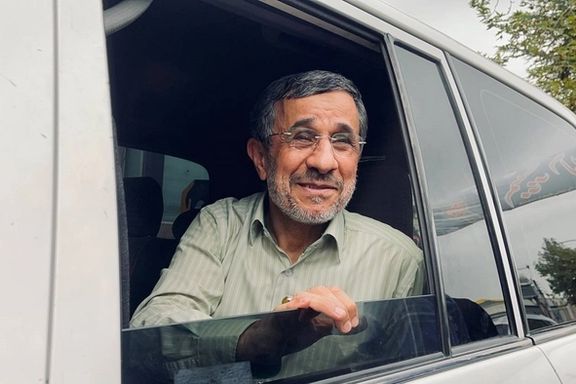
Former President Mahmoud Ahmadinejad announced that he is considering entering the upcoming presidential elections following the recent death of Iranian President Ebrahim Raisi.
Dolat Bahar Telegram channel, run by Ahmadinejad supporters, posted a video of him on Saturday addressing his fans and saying that he’s confident “the situation is changing for the better.”
“There are rapid changes taking place, not just in Iran but in the world, and I am hopeful that we will soon see the sweet changes,” Ahmadinejad said.
A new president will be elected on June 28th following the death of Ebrahim Raisi and his delegation in a helicopter crash last weekend.
Ahmadinejad supporters in the parliament have already welcomed his possible candidacy, claiming he’s “one of the most popular political figures in the country.”
Speaking to ILNA, Ahmad Alireza Beigi, a representative of Tabriz in the parliament, said, "If Mahmoud Ahmadinejad runs for president, he will win."
He also warned about the consequences of Ahmadinejad's disqualification without going into further detail. He was barred from running in the 2017 and 2021 presidential elections by the Guardian Council largely controlled by Supreme Leader Ali Khamenei.
Supreme Leader Ali Khamenei (L) Mahmoud Ahmadinejad (R), 2011
"Ahmadinejad must be assured that the Guardian Council will approve him for candidacy because if he signs up and is disqualified, it will have dire consequences," Alireza Beigi added.
After the former president was denied the chance to run in the 2017 elections, he became an outspoken critic of the system, even openly criticizing Mr. Khamenei. He has been walking a tightrope in the past two years and remaining mostly silent to avoid a backlash by loyalists close to the Supreme Leader.
Candidates seeking to run for the presidency, parliament, and the Assembly of Experts, which appoints Ali Khamenei's successor, must be approved by the Guardian Council, the constitutional election watchdog.
After Raisi's death, the Islamic Republic leader faces the challenge of re-engaging an electorate deeply disillusioned by recent elections. At the same time, efforts are being made to ensure that hardliners maintain control over the now largely ceremonial presidency, as state institutions undergo a purge to be filled entirely with Khamenei’s loyalists.
According to official statistics, 40.6 percent of eligible voters participated in the first round of the recent parliamentary elections. In Tehran, 24 percent of the population voted, the lowest in any election in the Islamic Republic's history.
Even lower turnout was recorded in the run-off elections earlier this month. In Tehran, where only seven percent of eligible voters cast their ballots.
Supreme Leader Ali Khamenei at memorial ceremony for Ebrahim Raisis at Imam Khomeini's Hosseiniyeh
On Saturday, Elias Hazrati, the managing editor of Tehran’s leading reformist daily Etemad, pointed out that holding elections with low participation “is a disaster for any country and a more severe one for the Islamic Republic” since the vote of the people is used to validate the legitimacy of the system.
“The first phase was about the left versus the religious right; the second phase was reformists against fundamentalists. The third phase involves military and security personnel,” Vaisi told Iran International.
“In the upcoming elections, we will not see any other faction members running; it will probably be someone among the military and security figures,” he added.
While many consider the Iranian presidency to be more of a symbolic post, with significant decisions made in Khamenei's headquarters, the eyes are on him to see what lies ahead in the country's political landscape.
Some also took the fact that the last three presidents—Hassan Rouhani, Mahmoud Ahmadinejad, and Mohammad Khatami—were not present at Raisi’s funeral on May 22, to be a symbolic gesture signaling the presidency's ever-eroding position since it was taken that they were not invited to the ceremony.
Additionally, Khamenei's apparent car-free attitude toward Raisi's death after the news broke about his helicopter crash and disregard for his role in the country were other indications of the disregard of the administration.
Families of victims killed by the Islamic Republic in a cemetery
Student and labor unions from 19 universities in Iran have issued a joint statement declaring the death of Ebrahim Raisi and his companions as a cause for public celebration, likening it to a "national festival."
These groups view the helicopter crash that killed Raisi as a precursor to the fall of the Islamic Republic.
In their statement on Saturday, the signatories said, "We, the people, are rejoicing over the death of this criminal. Despite intense security measures in various cities, we have organized nightly celebrations with fireworks, dancing, and the distribution of sweets." They emphasized that recent days have been filled with joy and mockery directed at Raisi.
Ebrahim Raisi, the Iranian president, died last Sunday in a helicopter crash in the northwestern mountains of Iran. The news of his death, along with that of his foreign minister, Hossein Amir-Abdollahian, hassparked jubilation on social media. Many on social media celebrated the deaths citing their roles in human rights abuses and oppression over the past four decades.
In another part of the statement, the unions declare, "The nationwide solidarity and our boundless joy transcend mere emotional responses to the death of tyrants." They affirm, "This is the voice of mothers seeking justice."
Iran International reported on Monday that the deaths of Raisi and his entourage have brought joy to the families of dissidents killed by security forces during protests.
In conclusion, the statement calls on activists, organizations, and media to harness the public's "high spirits and nationwide solidarity" fromthe celebration to fuel the next steps toward "a victorious revolution." They urge a focused effort on accelerating the society-wide movement towards protests and strikes.
Supreme Leader Ali Khamenei voting in the March 1, 2024 parliamentary elections.
The Iranian government is getting prepared for an early presidential election on June 28 following the sudden death of former President Ebrahim Raisi in a helicopter crash last Sunday.
The Islamic Republic held controversial parliamentary elections in March, which were highly stage-managed by the constitutional Guardian Council, seen as generally taking its cues from Supreme Leader Ali Khamenei’s office. Hundreds of candidates were blocked by the Council, handing victory to hardliners. There was little popular appetite to vote in what appeared to be a certain one-sided election. Consequently, turnout was well below 50% and the lowest in the 45-year history of the Islamic Republic.
In fact, Raisi had also been elected in a similar fashion, with serious rivals having been barred from running in June 2021.
Ebrahim Raisi casting his ballot in June 2021
Although it is not clear if the upcoming presidential vote will also be stage-managed to eliminate an array of insiders, there is no indication that the majority of Iranian voters have changed their minds about the futility of casting ballots.
In an astonishing development, even for Iran, a hardline commentator on live state TV called for even stricter control of the elections to ensure that someone exactly like Raisi, who has been the most obedient president to Khamenei so far, is elected.
A similar call was made by the editor of hardline daily Kayhan Hossein Shariatmadari, who is appointed to the post by no one other than Khamenei himself. Shariatmadari said in his own complacent way that "People are looking for someone like Raisi and will not vote for anyone whose ideas are different from the former presidency." Whether this reflects Khamenei’s preference as election campaigning soon begins, is not clear.
Members of the Guardian Council deliberating in this undated photo.
When Raisi was elected in 2021, everyone, even other conservative candidates knew that he was Khamenei's choice and that he would be named as the winner. All high-profile moderate and reformist candidates were barred from running.
Between 2009 and 2021, the regime allowed minimal reformist presence in the election. In 2017 former president Hassan Rouhani used the wave of support for his predecessor Akbar Hashemi Rafsanjani, sidelined by Khamenei.
The candidates for the upcoming election have not been announced yet, as they are waiting for the mourning period following Raisi's death to conclude. This period will end on Saturday when Khamenei holds a commemoration ceremony for his obedient servant. During this session, he may provide his first guidelines regarding the election. It would be considered impolite and disrespectful to start campaigning before then.
Registration of candidates will take place between May 30 and June 3. The Guardian Council will do the vetting quickly in a matter of less than two weeks, and then official campaigning will start on June 12 and will continue until one day before the 18 June voting day.
There will probably be several conservative and ultraconservative candidates including former Majles Speaker Mohammad Bagher Ghalibaf and ultraconservative figurehead Saeed Jalili, while Iran's reformists are going to decide on Sunday, whether to have or not have a candidate. In the meantime, reformist leader Mohammad Khatami has said that there is no point for reformists to take part in the election if they do not have a candidate. That Khatami was not invited to the funeral ceremony led by Khamenei, possibly an early indication that Khamenei does not want to see any reformist around.
This is the first time an Iranian presidential election is taking place just months before the US presidential elections. This timing prevents Khamenei from selecting a president or candidate based on their potential interactions with the next US president.
The most likely candidate in the reform front is Majid Ansari, a cleric whose career includes serving as a prison warden. On the moderate-conservative side, former Majles Speaker Ali Larijani may or may not run as some analysts say Khamenei has not forgiven him for forging close ties with former President Hassan Rouhani in what hardliners perceived as a conspiracy to influence the process of Khamenei’s succession.
Interestingly, it will once again be up to Khamenei to decide whether to open up the political landscape after Raisi's death or to continue with the political purging that Raisi epitomized.
Fada Hossein Maleki, a member of the Iranian Parliament's National Security Commission
Fada Hossein Maleki, a member of the Iranian Parliament's National Security Commission, has voiced concerns over the Iranian military's preparedness following a helicopter crash that killed President Ebrahim Raisi.
In an interview with Ruydad24, Maleki pointed out the military's failure to equip its forces with modern technology such as night vision drones and questioned the decision to use an outdated helicopter for a mission of such importance.
The crash, which occurred under harsh weather conditions in northwest Iran, also resulted in the deaths of Foreign Minister Hossein Amir-Abdollahian and six other individuals.The incident has ignitedspeculation and suspicion among the Iranian public, with some suggesting that the crash may have been a targeted killing.
Maleki emphasized the urgency of conducting an investigationinto the crash, cautioning against premature conclusions while the General Staff of the Armed Forces carries out its inquiry.
"There are rumors among some people that there was an operation intended to kill President Raisi and his companions. It is crucial that no speculation is made until a report is provided," he stated.
Highlighting further negligence, Maleki added that the lack of essential modern equipment and the use of a helicopter that was decades old are matters currently under review by a designated committee.
The Sunday incident has not only exposed potential lapses in military protocol but also raised questions about the overall accountability and efficiency of Iran's armed forces.
The aftermath of an attack on Iranian dissidents in London on May 24, 2024
Exiled Iranian Prince Reza Pahlavi and other leading opposition figures have condemned the assault on dissident protesters by supporters of the Islamic Republic, urging the UK government to take action.
Exiled Prince Reza Pahlavi has called for the immediate arrest and prosecution of the Iranian government supporters following a violent attack on Iranian dissidents in London. "It is time to send a message to the Islamic Republic that the intimidation, violence, and threats from its network of radical Islamic centers and affiliates will not be tolerated," stated Pahlavi in response to the incident.
The attack occurred on Friday during a memorial ceremony at the Dewan Al-Kafeel Community Center in Wembley, meant to honor the late Iranian president Ebrahim Raisi, who died in a helicopter crash. Iranian dissidents who were protesting outside the event were assaulted by regime loyalists, resulting in at least four injuries.
In a further condemnation of the attacks, Masih Alinejad, a leading Iranian political activist, highlighted the urgency of the situation on social media platform X: "Today in London, supporters of the Islamic Republic violently attacked opponents, injuring several individuals, including a female protester...Iranians are calling for unity and demanding immediate and decisive action from the British government and police to address this aggression. "
Nazanin Boniadi, a British citizen and human rights advocate, also expressed her horror at the attacks and urged the Metropolitan police to act swiftly. "I am horrified by the recent, brutal attack by Islamic Republic supporters on its opponents in the UK. The Metropolitan police must immediately investigate and bring the perpetrators to justice," Boniadi stated.
Government supporters gathered on May 22 to pay last respects to Raisi in Tehran
The Iranian authorities have intensified their crackdown on citizens who have expressed joy over the death of Ebrahim Raisi or shared content not aligning with the state’s rhetoric regarding the incident.
Since the news about a helicopter crash killing late President Ebrahin Raisi and his entourage on May 19 was announced, numerous individuals have been threatened or arrested in various cities across the country, including Tehran, Lahijan, Sabzevar, Gorgan, Kerman, and Tabriz.
Raisi's sudden death has rattled the Islamic ruling elite in Iran in different ways. One consequence is the spread of conspiracy theories among the public that the helicopter crash was not an accident, and some insiders might have eliminated the president.
Arrests and Judiciary action
Arasalan Nik, a civil engineer and resident of Lahijan in Gilan province northwest of the country, was arrested by intelligence agents after expressing skepticism about the circumstances of Raisi’s death on his Instagram page, as reported by human rights group, Hengaw on Friday. Nik was accused of "publishing false information" on social media. Local rights group, Hyrcani Human Rights Media also confirmed details of Nik’s arrest, further adding that there is no information on where the authorities have taken him.
Agents deleted all of the content from Nik’s Instagram account on Thursday and added two new poststo his account stating that “the page was shut down for publishing criminal content”. Nik's arrest is part of a broader campaign targeting citizens across the country.
In Tabriz, East Azerbaijan province, northwestern Iran, Ali Reyhani Kachvar was detained on Wednesday for his comments on social media about Raisi’s death. Kachvar was transferred to Tabriz Central Prison - notorious for its human rights abuses of political prisoners.
Northeast of the country, Maryam Dolabadi, a Doctor of Pharmacy residing in Sabzevar, in Razavi Khorasan province, was arrested for publishing content on social media about Raisi’s death. A source close to Dolatabadi’s family told Human Rights Activists News Agency (HRANA) that state security forces apprehended her on Tuesday. Dolatabadi remains in custody without her family being informed of her condition or whereabouts.
In Qom province, the operator of a restaurant in Kahak city was arrested, and the establishment was closed by authorities for allegedly spreading "offensive content" about Raisi's death. State-affiliated Borna news agency reported that the restaurant operator was arrested for “upsetting” the families of those who died in the helicopter crash.
Earlier this week, former political prisoner, Reza Babrnejad was arrested for criticizing Raisi on Instagram.
In the country’s capital, Tehran, numerous students who expressed joy on social media regarding Raisi’s demise or shared related humor have been summoned to university disciplinary committees. According to reports received by Iran International, some students received text messages alleging violations of university standards.
HRANA reportedthat on Monday the intelligence ministry summoned former political prisoner, Behrouz Izadi Rad in connection with Raisi’s helicopter crash.
Mohammad Ardeshir Khamooshi, a resident of the city of Bakharz in Khorasan province was summoned by the intelligence ministry agents similarly for his posts on social media regarding Raisi’s death.
Photojournalist and former political prisoner Alieh Motalebzadeh also announced on X that Iran’s Cyber Police in Karaj had called her and summoned her. On Friday, Motalebzadeh further stated on Xthat despite a request for a legal written notice of the summons, and Wednesday being a holiday, her bank accounts were blocked.
Family members of slain teen Iranian protestor, Artin Rahmani Piyani were also threatened by the intelligence ministry earlier this week.
Other individuals working in media in Iran, including economic journalist, Hirsh Saidian, journalist Amirhossein Mosalla, and blogger Mohammad Moini, have reported receiving threatening calls from Iran’s security agents in recent days.
As security forces intensify their efforts to silence critics, the Iranian government seems determined to stifle any opposition and control the narrative surrounding Raisi's death. This ongoing repression underscores the fraught state of human rights and free expression in Iran.