• العربية
  • فارسی
Brand
  • Iran Insight
  • Politics
  • Economy
  • Analysis
  • Special Report
  • Opinion
  • Podcast
  • Iran Insight
  • Politics
  • Economy
  • Analysis
  • Special Report
  • Opinion
  • Podcast
  • Theme
  • Language
    • العربية
    • فارسی
  • Iran Insight
  • Politics
  • Economy
  • Analysis
  • Special Report
  • Opinion
  • Podcast
All rights reserved for Volant Media UK Limited
volant media logo

Iranians Clash Over Presidential Candidate on Social Media

Maryam Sinaiee
Maryam Sinaiee

Iran International

Jun 12, 2024, 21:09 GMT+1Updated: 16:36 GMT+0
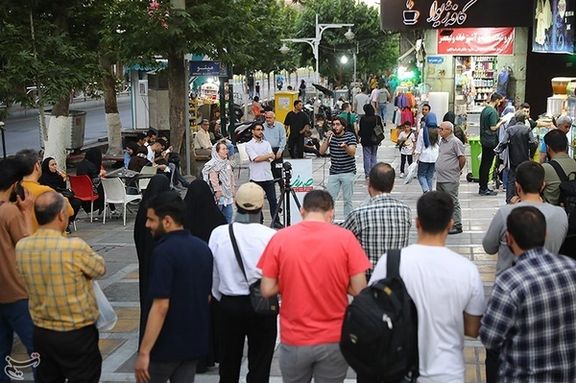
A group of Iranians talking about presidential candidates in an open mic session in Tehran

Controversy continues around Massoud Pezeshkian, the only proreform candidate running for president in Iran, as some claim that his chances for the June 28 vote are high, while others dismiss him as another regime pawn.

His interview Monday on state television seems to have disillusioned many who expected Pezeshkian to openly criticize the establishment and its policies or even express defiance against unpopular policies. 

The interview was focused on the economy and general issues. Throughout the interview, no reference was made to sensitive issues such as foreign policy, the nuclear issue, or hijab by the interviewer or Pezeshkian.

The candidate stressed that his government would not introduce any new economic strategies and policies. Instead, he said, he would try to efficiently implement the existing development plan by reforming the administrative system while making it transparent and accountable.

“He spoke 45 minutes about the economy and said nothing about the sanctions. He didn’t even use the word sanction. All he said about the economy was that he would continue the path of Raisi’s administration and the same plans. If so, those closer to Raisi’s administration (other candidates) can do it better,” Arash Sepehri, an economic pundit, tweeted.

UK-based Iranian political analyst Shahir Shahidsaless in a tweet said Pezeshkian revealed that he had no plans and was only going to execute Supreme Leader Ali Khamenei’s slogans, adding that he could not “light any glimmer of hope in the hearts” of Iranians. “I don’t think even subservient [candidates] such as Jalili and Ghalibaf would say such things,” he argued.

Some also allege that he is a ‘Pan-Turk’. This is based on his defense of teaching Turki, a sister language of Turkish and Azerbaijani, which is spoken by around 20 million in several provinces. Pezeshkian who was among the founders of a Turki-speaking faction in the parliament in 2016 is also known for advocating federalism.

“Who is the best candidate? A separatist [and] Pan-Turk who supports the Woman, Life, Freedom rebels:),” one of hardliner Saeed Jalili’s supporters alleged in a tweet.

Similar views have been expressed by some pro-monarchy and nationalist users on X.

“Precarious view of Pan-Turk Pezeshkian: the country must be administered federally!!” Armin1991 wrote on X.

A user who appears to adhere to ultra-nationalistic views argued that in these elections ‘reformists’ have resorted to playing the “Pan-Turk, separatist Pezeshkian card” and hardliners have rallied behind Saeed Jalili whose ideology is focused on the concept of Islamic ummah (nation).

Whereas Pezeshkian’s rivals including Saeed Jalili and Mohammad-Bagher Ghalibaf have bigger support in domestic social networks such as Eitaa and Rubika, Pezeshkian seems to be much more popular on X.

“Ghalibaf is president in Rubika, Jalili in Eitaa, and Pezeshkian in Twitter. On the street, however, no one knows the date of the elections,” Sina Sarmadi, a businessman, said in a tweet.

The supporters of the 69-year-old former lawmaker and minister of health praise him for having a down-to-earth lifestyle, being honest and outspoken, and say he is not corrupt like Ghalibaf and some of his other rivals.

Pezeshkian supported the 2015 nuclear deal. He has opposed the government’s plans of hijab enforcement and advocates freedom of speech and free access to the internet.

“They say Dr. Pezeshkian did not appear strong in last night’s interview. They are right. They have been accustomed to hearing [other candidates’] lies…and astronomical promises (four million housing units). They are not used to honest, implementable, and realistic statements,” Seyed Morteza Mir, a Pezeshkian supporter tweeted.

Pezeshkian tried not to make promises, and not take people for fools, Ali Ahmadnia, a reformist journalist, tweeted in Pezeshkian’s defense. “He knows due to his presence in the parliament the non-implementation of past development plans is caused by inefficient executives and governments having created plans after plans.”

Babak Majidi, a political reporter with the reformist Iranian Labour News Agency (ILNA), in a tweet, too, praised Pezeshkian for saying it is him who must listen to experts, not vice versa. “This was a real golden sentence,” he wrote.


Most Viewed

US blockade enters murky phase as tankers spoof signals and buyers hesitate
1
ANALYSIS

US blockade enters murky phase as tankers spoof signals and buyers hesitate

2
INSIGHT

Ideology may be fading in Iran, but not in Kashmir's ‘Mini Iran'

3
INSIGHT

Hardliners push Hormuz ‘red line’ as US blockade tests Iran’s leverage

4
VOICES FROM IRAN

Hope and anger in Iran as fragile ceasefire persists

5

US sanctions oil network tied to Iranian tycoon Shamkhani

Banner
Banner

Spotlight

  • Hardliners push Hormuz ‘red line’ as US blockade tests Iran’s leverage
    INSIGHT

    Hardliners push Hormuz ‘red line’ as US blockade tests Iran’s leverage

  • Ideology may be fading in Iran, but not in Kashmir's ‘Mini Iran'
    INSIGHT

    Ideology may be fading in Iran, but not in Kashmir's ‘Mini Iran'

  • War damage amounts to $3,000 per Iranian, with blockade set to add to losses
    INSIGHT

    War damage amounts to $3,000 per Iranian, with blockade set to add to losses

  • Why the $100 billion Hormuz toll revenue is a myth
    ANALYSIS

    Why the $100 billion Hormuz toll revenue is a myth

  • US blockade targets Iran oil boom amid regional disruption
    ANALYSIS

    US blockade targets Iran oil boom amid regional disruption

  • Iran's digital economy battered by prolonged blackout
    INSIGHT

    Iran's digital economy battered by prolonged blackout

•
•
•

More Stories

Iran Denies Faltering of Iran-Russia Cooperation Agreement

Jun 12, 2024, 18:57 GMT+1

Denying claims of a halt in the recent Iran-Russia cooperation agreement, Ali Bagheri Kani, the acting head of Iran's Ministry of Foreign Affairs, has attempted to dismiss reports.

Claiming the agreement is merely "under expert review by both sides", his assertion contrasts with statements from Russian officials.

Russian Foreign Minister Sergey Lavrov acknowledged that although the agreement's text has been coordinated, it cannot yet be signed due to pending "procedural legislative actions," further complicating the process.

Tehran and Moscow established a partnership in March 2001 through the signing of a long-term agreement. Originally set to expire after ten years, the treaty has seen two five-year extensions, with the most recent extension in 2021 pushing its expiration to 2026.

In 2023, emerging difficulties threatened the development of a new agreement between Iran and Russia. The challenges stemmed from Iran's objections to a joint statement released after the Russia-Gulf Cooperation Council (GCC) Strategic Dialogue. A particular point of contention for Iranian officials was a statement they interpreted as Moscow aligning with the UAE's stance in a territorial dispute over three islands in the Persian Gulf, which Tehran claims as its own.

The explanations provided by Moscow were deemed inadequate by the Iranian authorities, raising concerns over the solidity of their bilateral relations in spite of Tehran's dependence on Moscow which has been a key partner in the wake of deepening sanctions. 

Ex-Iranian President Says Government's Top Priority Must Be Lifting Sanctions

Jun 12, 2024, 17:34 GMT+1
•
Niloufar Goudarzi

Former Iranian President Hassan Rouhani has stated that the most crucial task for the upcoming president will be to help lift sanctions.

“It is clear that the task of lifting sanctions is not a simple one, but it can be achieved with a balanced approach that neither leans towards Eastern nor Western policy,” Rouhani said in a statement published on Wednesday. “And with a global collaboration strategy and the utilization of competent, dedicated, and fearless personnel.”

Rouhani advocated for a foreign policy stance transcending the dichotomy of East versus West, contrasting with Khamenei's prominent "Looking East" strategy, underpinning the hardliners' push for a "revolutionary economy."

Major decisions concerning Iran’s foreign policy originate from Khamenei's headquarters.

“At present, the primary concern of the populace revolves around the soaring cost of living and the stagnant employment growth witnessed in recent years, as reflected in the escalating ‘Misery Index,’” Rouhani said, in what seems like a direct message to Khamenei.

The Misery Index, which measures combined unemployment and inflation rates, consistently ranks Iran among the top countries in the region with high misery scores.

The foreign policy decisions of the Islamic Republic have significantly worsened the economic situation. Sanctions, imposed due to Iran's ongoing nuclear weapons program and support for terrorist groups, have intensified economic strain. However, the Supreme Leader and his loyalists have been reticent in acknowledging economic hardships.

There will be a snap election on June 28 following the sudden death of President Ebrahim Raisi in a helicopter crash last month with the six handpicked presidential candidates having begun airing recorded interviews.
None have addressed foreign policy except for hardliner former nuclear negotiator Saeed Jalili, who explicitly stated his opposition to the nuclear talks and deal.

Khamenei demonstrated flexibility during Rouhani's tenure by accepting the Joint Comprehensive Plan of Action (JCPOA), signed in 2015 between China, France, Russia, the United Kingdom, the United States, and Germany. The agreement was considered a landmark achievement in curbing Iran's nuclear program. Then-President Donald Trump subsequently withdrew the United States from the deal in 2018, citing its purported ineffectiveness in combating Iran's missile program and regional influence.

“Some officials made us wait for three or four countries and made Iranians suffer for years. They followed a path that yielded no results”, the ultraconservative said on Tuesday.

Praising Raisi's hardline administration, Jalili stated, "The same officials claimed that without the deal [JCPOA], the country’s economy would collapse. However, over the past three years, we have managed to sustain a strong economy and export to various countries."

This is while over the past three years, numerous observers, ranging from hardliners to 'reformists,' have also blamed the current situation on the failings of late President Ebrahim Raisi's economic team. Despite this, Raisi had adhered to Khamenei’s policy of strengthening ties with Russia and China and reducing ties with the West.

Meanwhile, Iran remains dependent on its allies, China and Russia. Russia’s suspending a new comprehensive cooperation agreement has put Iran’s dependency on the world stage. Some analysts, including former Iranian diplomat Hossein Alizadeh, believe Russia is leveraging Iran's global isolation to extract more favorable terms akin to the 25-year deal with China.

Also, tensions persist as both Russia and China support the territorial claims of Arab Persian Gulf countries against Iran such as in the United Arab Emirates’ claim over three disputed islands.

Iran Again Claims Success in Barrage Against Israel Despite Interception

Jun 12, 2024, 16:23 GMT+1

Yahya Rahim Safavi, a senior military advisor to Iran's Supreme Leader Ali Khamenei, praised Iran’s April aerial bombardment of Israel in spite of the majority being intercepted.

"We launched one missile per second, totaling over 100 missiles within 100 seconds," he said if the attack which was Iran’s first direct attack against Israel. He further boasted that over 100 drones among the 350 drones, missiles and rockets, were also deployed in the assault, suggesting that the precision and scale of the attack were underestimated by both Israel and the United States.

The April 13 offensive, which Iran says was in retaliation for an Israeli strike on its consulate in Damascus that killed seven IRGC officers, involved the launch of hundreds of missiles and explosive drones. In a countermove, the United States led an international coalition, including the UK, to intercept the majority of the projectiles.

Observers have noted that the successful interception of the missiles and drones represents a significant defensive victory for Israel, casting a shadow over Iran's aggressive tactics.

Despite this, Iranian officials continue to portray the attack as a military success, using state media and public statements to amplify their military capabilities and project power against adversaries as the shadow war with Iran’s archenemy reached a historical climax.


Swedish Officials Raise Alarm Over Threats to Iran International Reporter

Jun 12, 2024, 15:57 GMT+1

The Swedish Journalists' Association has voiced concern over the safety of Mehran Abbasian, a journalist with Iran International TV, highlighting the threats against him as a blatant attempt to suppress journalistic freedom.

"Iran's dictatorship should not control journalism in Sweden," stated the head of the association, emphasizing the risks posed to freedom of the press.

In response to the growing threats, Swedish parliament members Alireza Akhondi and Azadeh Rojhan, both of Iranian descent, have addressed the Swedish Minister of Culture and the Minister of Foreign Affairs in written pleas for enhanced protection for journalists.

Abbasian, who has reported critically on the Iranian government, has been relocated to a secure facility following credible threats to his life.

The situation escalated amid Swedish police reports describing the threats as "serious and real" and follows disturbing disclosures that Iran may be engaging local Swedish gangs to execute its vendettas abroad.

This includes planned attacks on Jewish and Israeli targets. Confirming the reports, the Israeli intelligence service, Mossad, indicated that these gangs were part of a broader, Tehran-coordinated scheme targeting Israeli embassies across Europe.

The persistence of threats against Iran International's staff traces back to 2022, with the London Metropolitan Police uncovering several plots against the channel's journalists. The severity of the threats peaked last year when UK intelligence service MI5 announced it could no longer ensure the safety of the channel's staff, prompting a temporary relocation of some team members to the United States.

Dissident Director Allegedly Killed by Iran’s Security Forces in Custody

Jun 12, 2024, 14:31 GMT+1
•
Niloufar Goudarzi

Dissident director and screenwriter Bahare Lelahi was allegedly killed by Iran’s security forces and buried in secret.

A source close to her family informed Iran International that security forces demanded money to disclose her burial location and ordered them to keep her death private.

While the exact circumstances surrounding her death remain unclear, human rights activists believe it is a state-backed killing based on the actions of state agents, such as the cover-up and secret burial.

Lelahi, 40, who was briefly detained during the 2022 nationwide protest, went missing in March 2023. In September 2022, the death in police custody of Mahsa Amini, which the UN’s fact-finding mission pinned on state authorities, ignited nationwide demonstrations, during which more than 550 protesters were killed.

Dissident journalist Masih Alinejad wrote on Instagram: “After extensive inquiries, her family was informed through the police that Lelahi had died and was interred at Bibi Sakineh Cemetery in Karaj, near Tehran.

“Despite having killed Bahareh and inscribing her name on the burial site, authorities withheld this information from her family for three months.”

The online Institute for Iranian Civil Society (Tavaana) also cited sources close to her family claiming they are trying to bring her body back to their hometown of Amol, in northern Iran, to bury her.

Tavaana also reported that security forces are summoning citizens via phone. When individuals comply without informing anyone, they can be held with no legal representation and nobody has knowledge of their whereabouts.

Amnesty International has highlighted the Iranian authorities have failed to provide accountability for tens of deaths in custody, despite credible reports that they resulted from torture or other ill-treatment or the lethal use of firearms and tear gas by officials when rounding up protestors.

Judiciary officials, who have consistently denied international investigations into Iranian prisons and detention centers, assert that conditions in these facilities are adequate. However, the experiences of numerous prisoners shared by rights groups reveal that prisons and detention centers operated by security forces have effectively become "killing grounds," particularly for dissidents.