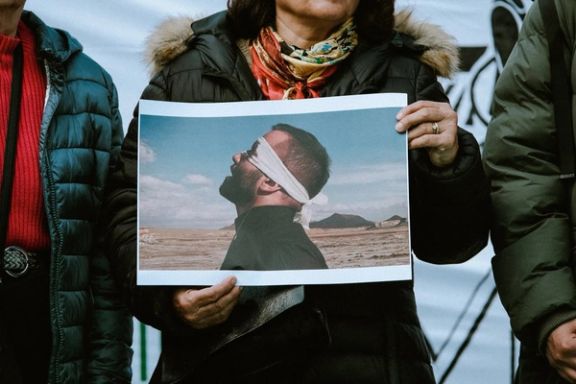
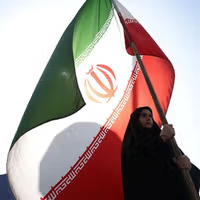
Iranian protesters in France demanding the release of the rapper Toomaj Salehi.
The repression of rappers in Iran continues unabated, with at least three individuals recently arrested, underscoring the ongoing suppression of artistic expression and dissent in Iran.
Iranian rappers have faced continuous suppression by authorities since the genre first emerged in the 2000s. The crackdowns intensified following Iran's 2009 Green Movement protests and have reached new heights in the aftermath of the 2022 "Woman, Life, Freedom" protests, ignited by the killing of 22-year-old Mahsa Amini while in morality police custody.
On Sunday, reports emerged of the arrest of Iranian rapper and blogger Vahid Nemati on election day, Friday.
Vahid Nemati, Iranian Rapper and Blogger
Nemati had published a satirical music video on Instagram about one of the Guardian Council's 6 handpicked Iranian Presidential candidates, Mohammad Bagher Ghalibaf’s daughter. The viral video was released amidst ongoing public backlash against Ghalibaf, following fresh revelations about the "layette-gate" scandal involving his daughter.
Following reports of Nemati's arrest on June 28, coinciding with Iran’s snap presidential election, all the posts on his Instagram page, including the video, were taken down. A notice was posted stating, "This page has been blocked by the order of the respected judicial authority." Such notices are common following the arrests of influencers in Iran. A similar notice was posted on Iranian rapper Dorcci's Instagram page when he was arrested in August 2023following the release of a viral song.
However, shortly after news of his arrest surfaced, a video of Nemati was released in which he claimed he was at home and had not been detained, explaining that his Instagram account was merely being "assessed." Forcing individuals to record videos of themselves is a common tactic used by Iranian authorities to suppress news, particularly as the government seeks to control the narrative during the widely boycotted election season.
Additionally, on Sunday, the Human Rights Activist Network in Iran (HRANA) reported that Iranian pop singer, Mohammad Fathi, was summoned to the Evin courthouse for publishing a song on his Instagram page in support of Iran’s Woman Life Freedom uprising. He was charged with “propaganda against the state” and later released on bail.
In April, Iranian rapper Toomaj Salehi was given a death sentence for publishing music in support of the Woman Life Freedom uprising.
His death sentence was eventually overturned in the Supreme Court and he awaits retrial. Salehi alongside rappers Saman Yasin and Behrad Ali Konari were all arrested during the Woman Life Freedom uprising.
Yasin who was also facing a death sentence verdict, recently received a reduced sentence of 5 years imprisonment. According to an audio message from Yasin from prison published by Kurdistan Human Rights group, Yasin was subject to severe torture while in prison.
Konari who was facing a “corruption on Earth” charge which carries the death sentence was eventually released on bail.
In light of these events, Iran International spoke to Iranian rappers in Iran to get their perspective on the increased crackdowns. Their identities cannot be disclosed for their safety.
“They don’t have a problem with rap. They have a problem with anti-government content that becomes viral - be it a song, video, film, photograph and it just so happens that dissident rap is well received among Iranians reflecting the anti-Islamic Republic sentiment among Iranians,” a rapper based in Tehran said.
In Iran, all artists must obtain a permit from the Ministry of Guidance and Culture to be able to release and perform music.
“The truth is we have never even applied for the permit because we are against art being subject to such levels of censorship and the whole system. We release our music on Instagram and SoundCloud and self-publish through distribution companies,” another Tehran-based rapper said when asked about how music is released in the absence of permits in light of the genre being banned and viewed as Western decadence by the authorities.
“They sentenced Toomaj Salehi to death because they want to use him as an example to warn us against releasing music in support of the people, but their fear tactics only drive us to release more music. The truth is when you decide to release socio-political rap in this country, you have to accept that any minute they will come to raid your house and you are prepared for everything including prison. I do not fear them,” the rapper continued.
“The IRGC [Islamic Revolutionary Guards Corps] intelligence ministry agents arrested me and two of my friends a few years ago. Our music wasn’t even viral. Even so, they held us under detention for a day. They beat us and told us that if we released political music, they would put us in a sack next time and throw our corpses in a place where no one could find them,” another rapper based in Tehran added after being asked about threats he had faced regarding his music.
A rapper who has worked with pro-regime artists, said “It is the law. Just like it is the law to wear hijab, you can't sing songs against the government. If you rap against the government, of course, you get arrested. If you look at North Korea and China it's the same. It’s the law. If people don’t like it they can go to another country.”
However, it isn’t as simple as the rapper puts it. Iranian rappers aren’t safe even in Western countries and face threats and pressure from the authorities.
In 2022, London-based Iranian rapper Hichkas received death threats including a direct death threat on X at the peak of the nationwide uprising as he published content in support of the Iranian people.
He was further subject to a large-scale smear campaign widely circulated in state media including IRGC-affiliated news agencies Tasnim and Fars aimed at discrediting him to reduce his influence among Iranian youth.
Similarly in the past, Iranian rapper Shahin Najafi living in Germany was threatened with a death sentence Fatwa with a $100,000 bounty to anyone who would kill him. Despite the threats, Najafi and Hichkas continue to use their platforms in support of the Iranian people. As such transnational repression of dissident artists is rife even outside Iran.
A female rapper based in Tehran says the challenges are multidimensional for female rappers.
“I don’t think the Iranian society has an issue with female rappers. It is the Islamic Republic that has waged a war on women…being a woman and rapper considering that women are banned from singing solo, in general, increases the risks of arrest in Iran and this is why many studios refuse to have you as a client for recording songs… several female rappers use home studios for recording songs,” she said.
When asked about the influence of pro-regime rappers on Iranian youth, almost all the rappers interviewed stated that they don’t have much influence because their content doesn’t resonate with the struggles of the Iranian people.
“Nobody listens to their music...that's why many of these rappers have opened up burger joints and restaurants…they have been canceled in the hip hop scene because they were silent during the Mahsa Amini protests…” said one rapper.
“The Islamic Republic no longer views rap as Satanistic…they are trying to capitalize on it but their efforts have failed… the Iranian youth who listens to rap is the same youth who bravely went to the frontlines of the protests in 2022 and were shot at by government security forces…and we sing for them despite facing arrests. How could we not when they gave their lives for this land?” the rapper added.
Four Iranian prisoners died under unclear circumstances at Sheiban Prison in the southern city of Ahvaz, while fifteen others were transferred to hospital.
The incident occurred in ward three, a section housing inmates charged with theft and drug-related offenses, Karoon human rights organization reported Monday.
Reports suggest that the deaths may have been caused by incorrect medication, leading to potential poisoning, although the claims have not yet been confirmed.
The report has sparked outrage and demands for a transparent and independent investigation into the mysterious deaths from prisoners' families and human rights advocates.
This incident further tarnishes Iran's already contentious human rights record, particularly regarding drug offenses. A recent report by Amnesty International revealed a disturbing rise in executions for such crimes, with over half of Iran's 853 executions in 2023 linked to drugs.
The increase in executions has not only caused domestic upheaval but has also drawn international criticism. In his November 2023 address to the United Nations General Assembly, UN Secretary-General Antonio Guterres described the rise in executions in Iran as “alarming.”
People walking in downtown Tehran where a giant electoral banner featuring portraits of Iran's presidential elections candidates is hanging on a governmental building (June 2024)
Even without trusting government-controlled election figures over the years, turnout has steadily decreased in Iran. The rulers of the Islamic Republic cannot deny the statistics from their own Ministry of Interior.
This decrease in participation has numerous economic, political, and social causes. Chief among them are livelihood difficulties, declining purchasing power, and increasing poverty and unemployment, which leave most Iranians with little incentive to vote. The current state of the country affects over 90% of the population, contributing to a broader social context for this decline in voter turnout.
Schism between the Islamic government and the people
Over the last fifteen years, particularly after the 2009 crackdown on the Green Movement and the "Where Is My Vote?" protests, the masses have distanced themselves from the government in large numbers. This growing divide is evident in the differing lifestyles of the people compared to their rulers, the process of de-ideologization, the increasing belief in the separation of religion and state, the rising use of non-governmental media, and the sexual revolution in society. The government's plan to engineer people's lives based on its Islamist ideology through the education system and by reducing culture, art, sports, and media to government propaganda has failed.
National memory exists
According to government officials, Iranians quickly forget repressions. Hassan Rouhani's advisor, Hesamoddin Ashna, once remarked, "Our sweet people are hard to conquer but easy to reconcile." Similarly, the Minister of Communications under the Raisi administration dismissed complaints about the killings of thousands of protesters in 2017, 2019, and 2022 as mere grumblings, urging people to forget themand vote. Mohammad Reza Aref, Khatami's former VP, also advised not to "tie Iran's future to hatred of the past" to encourage voter turnout.
Contrary to these expectations, Iranian society neither wants to nor can forget the recent repressions. The motto of those who have lost loved ones or been injured, shared by the majority, is "we do not forgive, and we do not forget." As a result, calls from reformists to forget have largely been ignored. The Iranian people are developing a strong political memory and cannot simply move on. It's unrealistic to think they will reconcile with the system just because Pezeshkian is brought into the picture.
Change of reference groups
In the past decades, intellectuals, clerics, and academics were considered influential reference groups in Iran, with a significant portion of the population following their guidance. However, this changed in 2017. Despite opposition from these groups that year, people rose against the regime in more than 100 cities and small towns. Since then, three other groups have gained more influence on society: the families of slain protesters, political prisoners, and union and civic groups. In the 2024 elections, these three groups effectively boycotted the elections, and their boycott had a significant impact.
While celebrities, public figures loyal to the regime, and former and current officials turned some main polling stations in Tehran into social gatherings on June 28, portraying themselves as elites on voting day, the people advised by the new reference groups stayed at home. Government agents often accompany foreign journalists to these central polling stations to create an impression of higher turnout. Consequently, domestic and foreign journalists obtained most of their photos and reports from these locations.
Non-participation has no gender, class, or ethnicity
The non-participation or boycott by the majority of voters, officially reported at 60% last week, cannot be attributed solely to the abstention of women, ethnic groups (Kurds, Baluchs, Arabs), and the poor. This widespread decision to abstain and show resentment towards the government is a cross-class, cross-gender, and cross-ethnic phenomenon. The majority of Iranians do not see a light at the end of tunnel for their future if the Islamist government remains in place.
The participation of Kurds and Baluchis has decreased similarly to others, and the deprived classes have distanced themselves from the ballot boxes in the same manner as the prosperous classes. "No Vote at All" was a national campaign.
A group of Iranian cross-border porters, known as Kolbars
At least 10 Iranian Kurdish Kolbars, or cross-border porters, were killed or injured on the Iraqi border in June, with 90% of the incidents resulting from direct fire by Iranian border guards.
Three Kolbars were killed and seven were injured as reported by the Hengaw Human Rights Organization on Sunday, with two of the deaths caused by direct fire from border patrol forces.
The majority of the incidents, 8 out of the 10 cases, were reported along the borders of Iran’s Kordestan Province.
Kolbars often carry smuggled goods on their backs across Iran’s borders, journeying long distances through mountainous regions into Iraq as an attempt to escape the dire conditions they live in. They carry household appliances and similar merchandise restricted by Iran's stringent import processes.
According to Kolbar News, from March 2023 to March 2024, 444 Kolbars were killed or injured along the border areas and interprovincial routes between West Azarbaijan, Kordestan, and Kermanshah provinces. Such incidents were caused by various factors, including direct shootings by military forces, avalanches, frostbite, stepping on mines, and falls from mountains and heights.
Direct shootings by military forces accounted for 373 of the 444 casualties. Often, Kolbars are involved in smuggling goods such as illegal fuel in some of Iran's poorest provinces, and many of them are under the age of 18.
The Iranian government's treatment of the laborers underscores the realities faced by those struggling to survive in one of the country's most marginalized communities.
Politicians close to Iran's 'reformists' have begun warning voters about hardliner presidential candidate Saeed Jalili, as they argue that his ideological rigidity will hurt the country.
Hamid Abutalebi, former advisor to ‘reformist’ Iranian President, Hassan Rouhani took to X to warn against Jalili labeling him as a ‘fanatical extremist’ who he has known for “more than 3 decades.” whose policies would increase chances of conflict with the West and intensified sanctions.
Reformists including Abutalebi insist that Jalili is a danger to the country with his hardline foreign policy and ideology.
"Trump has pledged to bring back the sanctions in a paralyzing form if he wins," Abutalebi stated, "Jalili has also said in the debates that if he wins, he wants to make the West regret the sanctions. Therefore, if Mr. Jalili and his faction are elected, not only will there be no negotiation to solve the people's problems,” Abutalebi warned.
Although Abutalebi says that he didn’t vote in the elections, he stated that he believes presidential candidate Masoud Pezeshkian’s commitment to his “reformist policies will not bring the country to the valley of destruction.”
A large majority of voters who boycotted the first round of the election on June 28, were not swayed by the mutual smearing campaigns of the reformists and hardliners.
Ship-to-Ship transfer of illicit oil exports to hide origin. July 2023
Iran’s crude oil and gas condensate exports surged to 1.7 million barrels per day (mb/d) in May, hitting a 5-year high point, since the imposition of full US sanctions in May 2019.
The country’s oil and gas condensate exports reached 1.65 mb/d in the first five months of 2024, according to oil analytics firm Vortexa, as the Middle East experienced its worst violence in decades, triggered by the October 7 attack on Israel.
Iran’s custom statistics also indicate increasing oil revenues by 34.8% year-on-year to $12 billion during the first three months of current Iranian fiscal year, started March 21.
According to the data intelligence firm, Kpler, Iran exported 1.194 mb/d of crude oil and gas condensate in spring 2023. Therefore, the country’s oil export increased 30% in the second quarter of 2024, while oil prices in international markets also rose about 7% during the mentioned period.
Iran had also about 240,000 barrels per day of mazut exports, remained almost unchanged year-on-year.
Vortexa says that an increase in Iran’s crude production, higher demand from China and a net increase in the size of Islamic Republic’s dark fleet have helped facilitate its oil export growth.
The United Against Nuclear Iran (UANI) has identified 383 vessels suspected to be part of a clandestine “ghost fleet.” So-called ghost ships are vessels that disguise their ownership and movements in order to facilitate breaches of sanctions.
Considering Iran's export volumes of oil, gas condensate, and mazut, along with higher prices in the international oil markets, the country’s revenues should have exceeded $14.5 billion in spring 2024. However, it only garnered $12 billion.
The 20% shortfall indicates Iran’s lower selling price to secure buyers who take a risk in the face of US sanctions. Chinese refineries are the main buyers of Iran’s illicit oil shipments that middlemen mix with cargos from other countries and unload in China as imports from Singapore and other sources.
Devaluation crisis
Despite 18.6% growth in oil and non-oil export revenues and only 1.4% increase in imports, Iran’s national currency, rial, has remained near its all-time lows after a 15-fold depreciation since 2018. The rial has been trading around 600,000 per US dollar for weeks, while in early 2018 it stood at around 40,000 to the dollar.
The ongoing presidential race had hurt the rial more. The prospect of Saeed Jalili, an ultra-hardliner winning the race in Iran's July 5 runoff, pushed Iranian currency down to around 620,000 per dollar since the result the first round of voting on June 28.
The snap election was called after former President Ebrahim Raisi and his entourage died in a mysterious helicopter crash in May.
During Raisi’s 3- year presidency, the rial has lost about 65% of its value despite ever-increasing oil exports. Inflation rose to almost 50% as prices of essential commodities such as food increased at even a faster pace. With every drop in the value of rial imports become more expensive and fuel higher inflation, and public dissatisfaction.
Already, market watchers in Iran complain of foreign currency shortages for importers of consumer and industrial goods. It is unclear why with more oil exports the country suffers from a lack of hard currencies. One explanation is that China does not necessarily pay cash for the oil and offers barter to Iran.