• العربية
  • فارسی
Brand
  • Iran Insight
  • Politics
  • Economy
  • Analysis
  • Special Report
  • Opinion
  • Podcast
  • Iran Insight
  • Politics
  • Economy
  • Analysis
  • Special Report
  • Opinion
  • Podcast
  • Theme
  • Language
    • العربية
    • فارسی
  • Iran Insight
  • Politics
  • Economy
  • Analysis
  • Special Report
  • Opinion
  • Podcast
All rights reserved for Volant Media UK Limited
volant media logo

Iranian people 'losing their patience', top Sunni cleric warns Pezeshkian

Jul 6, 2024, 19:45 GMT+1
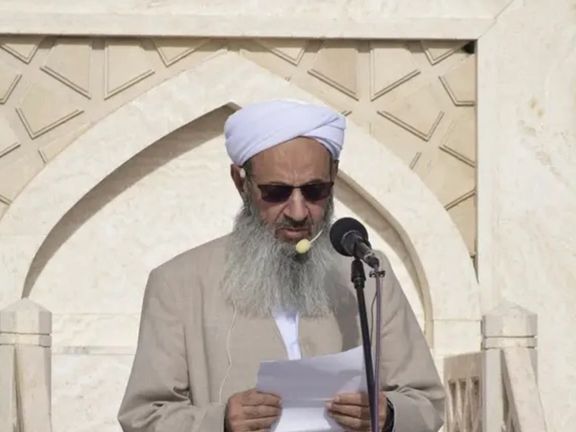
Mowlavi Abdolhamid, the top religious leader of Iran's largely Sunni Baluch population

Iran's top Sunni cleric Mowlavi Abdolhamid has warned president-elect Masoud Pezeshkian that Iranians are "exhausted" and are losing patience with the country's ongoing issues.

Mowlavi Abdolhamid, who abstained from voting in Iran's presidential election this year, highlighted the "disgust" among the public, demonstrated by the record-low turnout in the first round of the votes.

The June 28 presidential election saw a voter turnout of 39.92%, the lowest in the history of the Islamic Republic. In the runoff votes held on July 5, the official figures showed a 10-percent rise in the number of voters, but still over 50 percent of eligible voters boycotted the election.

This significant absence signals a stark "discontent" with unbalanced and inconsistent governmental policies, Abdulhamid said, according to a readout of his speech published by Halvash human rights organization.

The top Sunni cleric said the nation, "overwhelmed" by political, economic, and social pressures, and where the lower classes feel "crushed," will persist in its demands for "justice" and "freedom."

Abdolhamid, expressing deep concern over the political stalemate and lack of representation for the Sunni and Baluch communities, described the situation as a "deadlock," underscoring the need for a profound shift in public sentiment away from traditional conservative and reformist politics. Despite his reservations, he acknowledged Pezeshkian's “victory.”

Known for his forthright opposition to the government, especially after the crackdown in Zahedan on September 30, 2022, Abdolhamid has faced risks and criticism for his stance against the Supreme Leader's policies, especially regarding the treatment of protestors.

His advocacy for ending executions and harsh decrees has positioned him as a contentious figure, facing accusations from conservative factions of aiding the "enemies" of Iran.

Most Viewed

US blockade enters murky phase as tankers spoof signals and buyers hesitate
1
ANALYSIS

US blockade enters murky phase as tankers spoof signals and buyers hesitate

2
INSIGHT

Ideology may be fading in Iran, but not in Kashmir's ‘Mini Iran'

3
INSIGHT

Hardliners push Hormuz ‘red line’ as US blockade tests Iran’s leverage

4
VOICES FROM IRAN

Hope and anger in Iran as fragile ceasefire persists

5

US sanctions oil network tied to Iranian tycoon Shamkhani

Banner
Banner

Spotlight

  • Hardliners push Hormuz ‘red line’ as US blockade tests Iran’s leverage
    INSIGHT

    Hardliners push Hormuz ‘red line’ as US blockade tests Iran’s leverage

  • Ideology may be fading in Iran, but not in Kashmir's ‘Mini Iran'
    INSIGHT

    Ideology may be fading in Iran, but not in Kashmir's ‘Mini Iran'

  • War damage amounts to $3,000 per Iranian, with blockade set to add to losses
    INSIGHT

    War damage amounts to $3,000 per Iranian, with blockade set to add to losses

  • Why the $100 billion Hormuz toll revenue is a myth
    ANALYSIS

    Why the $100 billion Hormuz toll revenue is a myth

  • US blockade targets Iran oil boom amid regional disruption
    ANALYSIS

    US blockade targets Iran oil boom amid regional disruption

  • Iran's digital economy battered by prolonged blackout
    INSIGHT

    Iran's digital economy battered by prolonged blackout

•
•
•

More Stories

Exiled prince warns Western powers against appeasing Khamenei's new 'lackey'

Jul 6, 2024, 18:40 GMT+1

Iran’s exiled prince has warned Western powers against appeasing the Islamic Republic's new president, saying the Iranian people would view it as a betrayal of their struggle for freedom.

"The people of Iran will view any attempts to appease this new lackey (Masoud Pezeshkian) as a treacherous offense to their ongoing movement for liberation and a shameful abdication of moral leadership," Prince Reza Pahlavi said in a post on his X account on Saturday.

Masoud Pezeshkian won the July 5th runoff election with a turnout of less than 50%. In his first post-election speech, he thanked Supreme Leader Ali Khamenei, saying, "If it wasn't for him, I don't think my name would have easily come out of these (ballot) boxes."

Prince Reza Pahlavi referred to the election as a "fraudulent" attempt to legitimize a dictatorship, highlighting the Iranian nation’s rejection of the process.

He said Khamenei’s choice of Pezeshkian as the president and "chief functionary" would not save the Islamic Republic from its "inevitable" collapse and the Iranian people's "certain" victory.

Pahlavi also praised Iranian people for boycotting the election, calling it a "historic" display of national unity and solidarity and a "watershed moment" in the Iranian nation's movement.

He noted that this was the largest display of "nonviolent, civil resistance" against the Islamic Republic in 45 years and emphasized that this is just the beginning of their path to national liberation.

The first round of Iran's snap presidential election saw a voter turnout of 39.92%, the lowest in the history of the Islamic Republic. In the runoff votes, the official figures show a 10-percent rise in the number of voters, but still over 50 percent of eligible voters boycotted the election.

Tehran and Moscow interconnect local payment systems

Jul 6, 2024, 16:57 GMT+1

Iran and Russia have signed their first bilateral monetary agreement that they say is to strengthen financial and economic ties and counter the impacts of US sanctions on their economies.

With Iran having joined the MIR payment system, the Russian alternative to Visa and Mastercard, Iranians will be able to withdraw money from Russian ATMs with Iranian bank cards from late August this year, the Governor of Iran Central Bank (CBI) Mohammadreza Farzin announced on Saturday.

“The second part of the plan was to connect Russia's MIR network to Iran's SHETAB. This is a project that the technical teams of the two countries have been working together for a long time, both in the Central Bank of Iran and in the Central Bank of Russia. Fortunately, this work has also been finalized,” Farzin said.

Farzin stated that Iran’s SHETAB system and Russia’s MIR payment systems are now operational, adding that the deal had been finalized during his with Russian counterparts on the sidelines of the Financial Congress of the Bank of Russia in St. Petersburg on July 4th.

“Iranian cards will be able to be used in Russian ATMs, almost in late August. Every person with an Iranian card can receive their funds in rubles from Russian ATMs,” he added.

He added that the second stage of this connection will be for the benefit of Russian nationals in Iran, and in the third stage, Iran's SHETAB cards will be able to be accepted at the point of sale (POS) terminals in Russian stores.

“This plan has three stages. The next stage is that Russian cards will be usable in Iran, and the third stage is that our SHETAB cards will also be usable in their stores,” Farzin stated.

Iranian Nobel laureate Ebadi criticizes Iran’s new ‘reformist’ president

Jul 6, 2024, 13:50 GMT+1

In the aftermath of Iran’s July 5 presidential runoff and 'reformist' candidate Masoud Pezeshkian's ascent to the presidency, Nobel Peace Prize laureate Shirin Ebadi has voiced strong criticism of 'reformists' in general and the newly elected president.

“Masoud Pezeshkian, a candidate close to reformists, became the President in an election where the majority of people did not participate,” she wrote in a post on Instagram on Saturday, highlighting the historically low voter turnout.

Ebadi asserted that Pezeshkian has assumed office amid a backdrop of political and security puzzles following the death of hardliner President Ebrahim Raisi in a helicopter crash on May 19. She added that Pezeshkian’s presidency is “another step for a third defeat of reformists,” referring to the failures of the two previous 'reformist' presidents, Mohammad Khatami and Hassan Rouhani, to address the country's woes.

She questioned whether the 'reformists' will now address the concerns of Iranians. Ebadi raised issues such as whether internet restrictions would be lifted or further tightened, and addressed the dire working conditions of workers across multiple sectors in Iran struggling to make ends meet. She further asked whether the quality of life, particularly for impoverished ethnic minorities in Iran's eastern Sistan-Baluchestan province and Kurdistan province in the northwest, would improve, and if the country's resources would be better managed to ensure adequate water in southwestern Khuzestan province are addressed.

"The reformists and moderates entered the political arena to salvage the regime," Ebadi concluded underscoring that without fundamental changes, “the will of the people” could become a powerful force that challenges and potentially dismantles the Islamic Republic.

Global leaders congratulate Iran's Pezeshkian on presidential victory

Jul 6, 2024, 13:36 GMT+1

With the announcement of Masoud Pezeshkian as the winner of the July 5th Iranian presidential runoff vote, leaders from around the world have extended their congratulations.

The presidents of China, Russia, Syria, the Republic of Azerbaijan, and Iraq, as well as the prime ministers of India and Pakistan, the foreign minister of Venezuela, and Saudi Arabia’s king and crown prince were among the officials who congratulated the Iranian president-elect on his victory.

Saudi Arabia has called for bolstering ties following Pezeshkian's election. The kingdom's king and crown prince congratulated Pezeshkian through the official Saudi Press Agency (SPA) on Saturday. "I affirm my keenness on developing and deepening the relations between our countries and people and serve our mutual interests," SPA quoted Saudi Crown Prince Mohammed bin Salman as saying.

According to Chinese state media Xinhua, Chinese President Xi Jinping congratulated Pezeshkian and expressed his willingness to advance the China-Iran comprehensive strategic partnership. "I am willing to work with the President to lead the China-Iran comprehensive strategic partnership towards deeper advancement," Xi stated, as reported by Xinhua.

Russian President Vladimir Putin also extended his congratulations, with the Kremlin releasing a statement on Saturday. "I hope that your activities as president will contribute to further building up constructive bilateral cooperation in all areas for the benefit of our friendly peoples, in the interests of simplifying regional security and stability," Putin said.

Syrian President Bashar Assad sent a congratulatory message, emphasizing the goal of strengthening strategic relations and exploring new avenues for bilateral cooperation between Syria and Iran.

Indian President Narendra Modi congratulated Pezeshkian, expressing his anticipation of working closely to enhance "the warm and long-standing" bilateral relationship. “Looking forward to working closely with you to further strengthen our warm and long-standing bilateral relationship for the benefit of our peoples and the region,” Modi stated.

Pakistan’s Prime Minister Shehbaz Sharif and President Asif Ali Zardari also congratulated Pezeshkian.

“As neighboring countries, Pakistan & Iran enjoy a close & historic relationship. We must ensure a bright future for our two peoples through mutually beneficial cooperation,” Sharif wrote on X on Saturday.

In a post on X, Zardari reiterated that “Pakistan & Iran enjoy fraternal ties” and expressed hope that under Pezeshkian’s leadership, the relations between the two countries would grow.

In a statement on Saturday, the Venezuelan government extended congratulations to Pezeshkian.

“President-elect Pezeshkian and the Iranian nation enjoy the unwavering support of Venezuelan President Nicolás Maduro, whose goal is to deepen fraternal relations between the two nations through a comprehensive strategic alliance, fostering mutually beneficial cooperation and contributing to multiple global consolidations.”
Iran’s ex-Central Bank chief calls for resolving issues with the US

Jul 6, 2024, 11:26 GMT+1

Former chief of Iran’s Central Bank, Abdolnaser Hemmati, told local media that one of the first tasks for the new president should be reaching an agreement with the West to lift sanctions.

In the first 100 days, “it is important to establish a policy of understanding with the United States and the three European powers to reduce sanctions and thus lower inflationary expectations. The government's first step should be to suppress these inflationary expectations,” Hemmati, a critic of Iran’s hardliners stated.

Nuclear negotiations by the Biden administration and Britain, France and Germany, which started in April 2021 failed to forge a new agreement to revive the Obama-era JCPOA nuclear deal. As a result, Trump administration’s oil export and international banking sanctions remained in place seriously impacting Iran’s weak economy.

Hemmati and numerous other experts and analysts in Tehran have long called for a change of course by the Islamic government, which has increasingly adopted a more hardline posture since 2020, not only in foreign policy but also in its repressive measures against social and political freedoms. Many hope that the election of the relatively moderate Masoud Pezeshkian can bring about a measure of change in both foreign and domestic policies.

The former chief banker is considered a ‘reformist’ who was a candidate in the 2021 presidential election when the hardliner candidate Ebrahim Raisi was elected amid heavy-handed engineering of the election process. He registered as a candidate again for the latest presidential elections but the notorious Guardian Council rejected his qualification.

“In the first 100 days, the government must demonstrate that it does not intend to continue the previous erroneous path,” Hemmati said. Although the new president, Masoud Pezeshkian has made many promises, he has offered few concrete plans for change. He has emphasized the need to improve relations with the international community, but when it comes to the United States, everyone believes the key is in Supreme Leader Ali Khamenei’s hand.

However, beyond improving ties with the West and lifting of sanctions, the government needs to open up the state-controlled economy to more market competition, Hemmati emphasized. “It is important to announce the main economic policy of distancing from a command economy and implementing primary policies based on competitive strategies to align and integrate the private sector with the state economy.”

Hemmati also highlighted his concern about Iran’s annual inflation rate hovering around 50 percent. The government must “correct wrong decisions to control the budget deficit and manage variables that lead to increased inflation."

With sanctions stifling oil revenues, the government has resorted to printing money to balance its budget, which has fueled runaway inflation in the past five years.

Calling for the president to be able to exercise his constitutional power, Hemmati said there is no need for a stronger or weaker president, but the constitution should be respected and applied in regards with presidential authority.