• العربية
  • فارسی
Brand
  • Iran Insight
  • Politics
  • Economy
  • Analysis
  • Special Report
  • Opinion
  • Podcast
  • Iran Insight
  • Politics
  • Economy
  • Analysis
  • Special Report
  • Opinion
  • Podcast
  • Theme
  • Language
    • العربية
    • فارسی
  • Iran Insight
  • Politics
  • Economy
  • Analysis
  • Special Report
  • Opinion
  • Podcast
All rights reserved for Volant Media UK Limited
volant media logo

Iran removes statistics to hide 1,500 babies born to girls under 15 last year

Sep 17, 2024, 13:41 GMT+1

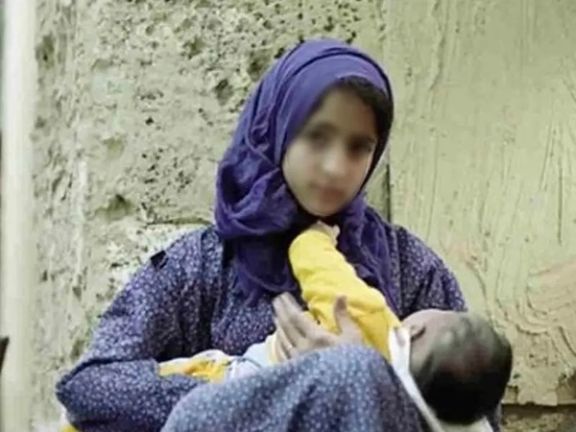
Iran's National Civil Registration Organization’s website has removed statistics which revealed around 1,500 children were born to mothers under the age of 15 in Iran last year as numbers surged from 364 in 2020.

The sudden disappearance of the data has sparked concerns over government transparency, with critics accusing authorities of attempting to downplay the ongoing issue of child marriages in the country.

“Here’s yet another statistic that has become classified! The statistics on newborns from mothers aged 10 to 14 have been removed from the National Organization for Civil Registration’s website. Last year, around 1,500 children were born to mothers under the age of 14,” wrote Iranian journalist Marziyeh Mahmoodi on X Sunday.

Additionally, in a piece published on Etemad earlier this month, Iranian commentator Abbas Abdi also revealed that the organization, which previously provided weekly birth statistics categorized by the mother’s age, has now entirely omitted these figures from public access.

“I anonymously contacted their office and was told, ‘Because a certain newspaper published the statistics and the issue of child marriage became widespread, we were ordered not to publish the data anymore,’” Abdi wrote in a piece published in Etemad.

He added, “I asked, ‘Hasn't there been an order to stop this tragedy of pregnancies among girls under 14?’ They responded, ‘No. The only order is not to publish the statistics!’” He emphasized that access to accurate information is crucial for addressing societal issues, calling the decision both illegal and detrimental to effective policy making.

In 2020, 364 babies were born to girls under the age of 15, according to a report by IranWire citing the Statistical Center of Iran, the latest such figures available. This means that the number of babies born to girls under the age of 15 in Iran has surged by an alarming 312%, rising from 364 in 2020 to around 1,500 in 2023.

Last year, a report from the Research Center of the Iranian Parliament, revealed that 184,000 marriages involving girls under the age of 15 were registered in Iran between 2017 and 2022.

However, Iran's Statistical Center recorded around 25,900 cases of girls under 15 getting married in 2022, less than the 32,000 such cases registered in 2021, suggesting discrepancies in the data released by the government with a significantly lower figure reported by Iran’s government backed Statistical Center.

Despite global standards considering individuals under 18 as "children", child marriages are allowed from the age of 13 for girls and 15 for boys in Iran according to Article 1041 of the Iranian Civil Code.

Supreme Leader Ali Khamenei has consistently emphasized policies promoting population growth, fertility, and early marriages, setting a goal to boost the population to 150 million by 2050.

In line with these goals, the Rejuvenation of the Population and Protection of the Family (RPPF) law, was enacted by Parliament in 2021 under Khamenei’s directive. The law imposes penalties for actions deemed to oppose childbearing and early marriages, placing population growth above concerns for children's rights.

Most Viewed

US blockade enters murky phase as tankers spoof signals and buyers hesitate
1
ANALYSIS

US blockade enters murky phase as tankers spoof signals and buyers hesitate

2
INSIGHT

Ideology may be fading in Iran, but not in Kashmir's ‘Mini Iran'

3
INSIGHT

Hardliners push Hormuz ‘red line’ as US blockade tests Iran’s leverage

4
VOICES FROM IRAN

Hope and anger in Iran as fragile ceasefire persists

5

US sanctions oil network tied to Iranian tycoon Shamkhani

Banner
Banner

Spotlight

  • Hardliners push Hormuz ‘red line’ as US blockade tests Iran’s leverage
    INSIGHT

    Hardliners push Hormuz ‘red line’ as US blockade tests Iran’s leverage

  • Ideology may be fading in Iran, but not in Kashmir's ‘Mini Iran'
    INSIGHT

    Ideology may be fading in Iran, but not in Kashmir's ‘Mini Iran'

  • War damage amounts to $3,000 per Iranian, with blockade set to add to losses
    INSIGHT

    War damage amounts to $3,000 per Iranian, with blockade set to add to losses

  • Why the $100 billion Hormuz toll revenue is a myth
    ANALYSIS

    Why the $100 billion Hormuz toll revenue is a myth

  • US blockade targets Iran oil boom amid regional disruption
    ANALYSIS

    US blockade targets Iran oil boom amid regional disruption

  • Iran's digital economy battered by prolonged blackout
    INSIGHT

    Iran's digital economy battered by prolonged blackout

•
•
•

More Stories

Western nations condemn Iran on second anniversary of Mahsa Amini's death

Sep 17, 2024, 11:00 GMT+1

On the second anniversary of Mahsa Amini's death in Iranian police custody, the United States, United Kingdom, Canada, Australia, and New Zealand issued a joint statement reaffirming their support for Iranian women and human rights defenders.

The statement comes as Iran continues its crackdown on dissent, while global pressure mounts on Tehran to end its repression of civil society.

Two years after Mahsa Amini's death in custody, which sparked the nationwide Woman, Life, Freedom protests, the Iranian government continues to face international criticism for its human rights abuses.

In a joint statement, the foreign ministers of the United States, United Kingdom, Canada, Australia, and New Zealand condemned Iran's violent suppression of women and girls and urged Tehran to halt its use of force to enforce mandatory hijab laws.

"We stand with women and girls in Iran, and Iranian human rights defenders, across all segments of society in their ongoing daily fight for human rights and fundamental freedoms," the ministers declared, emphasizing their ongoing commitment to holding Iranian officials accountable through sanctions and visa restrictions.

Despite international outcry, the so-called Noor plan, which enforces mandatory hijab laws across the country is still on the streets. The plan, which has led to arrest of women protesting for their rights, was criticized during Pezeshkian's presidential campaign. Yet, under his leadership, the measures continue unabated.

The UN Fact-Finding Mission’s March report on the Mahsa movement labeled Iran's repression of protests and discrimination against women as crimes against humanity. The UN has also recently branded it "gender apartheid".

"These acts form part of a widespread and systematic attack directed against the civilian population in Iran, namely against women, girls, boys, and men who have demanded freedom, equality, dignity, and accountability," said Sara Hossain, the chair of the mission.

As Iran continues its crackdown, with reports of extrajudicial killings, torture, and gender-based persecution, the international community has called for more decisive action. The United States Commission on International Religious Freedom (USCIRF) Vice Chair Eric Ueland urged the US government to support efforts to hold Iranian officials accountable, including a Security Council referral to the International Criminal Court for crimes against humanity.

“We urge the Biden administration to continue supporting the United Nations Independent International Fact-Finding Mission on Iran and to support a Security Council referral of the situation in Iran to the International Criminal Court for investigation of crimes against humanity against those asserting freedom of religion or belief.”

“The time is long overdue for Iranian regime officials who repress those seeking freedom of religion or belief to face accountability,” said USCIRF Commissioner Susie Gelman. “The Biden administration should unify a coalition of like-minded countries to impose joint sanctions on Iranian regime officials complicit in restrictions on religious freedom in Iran.”

Iran’s leaders, under the grip of Supreme Leader Ali Khamenei, remain defiant. Pezeshkian's earlier critiques of the harsh policies ring hollow as his government continues to implement such measures.

Western governments have responded with continued sanctions but to no avail as Iran finds ways to bypass them. US lawmakers have also criticized the Biden administration for its failure to fully enforce the MAHSA Act, which mandates sanctions on Iranian officials involved in human rights abuses.

"Two years after the murder of Mahsa Amini, women in Iran still face an oppressive regime every day," said US Senator Jim Banks, highlighting the administration's failure to impose sanctions on Iran’s Supreme Leader.

US Senate Foreign Relations Committee Ranking Member Senator Jim Risch has criticized the Biden admin for its failure to enforce the MAHSA Act sanctions even though the act was passed in April.

"Two years after the murder of Mahsa Amini, women in Iran still face an oppressive regime every day. Congress passed the MAHSA Act in April, but the Biden-Harris Admin still hasn’t enforced its sanctions. We must deny the regime the resources it uses for oppression and terrorism," he said.

The global support for Iranian women and human rights defenders remains strong. The French Ministry of Foreign Affairs, in a statement marking the anniversary, reaffirmed Paris' commitment to standing with Iranian women in their fight for freedom.

UN Special Rapporteur on Human Rights in Iran, Mai Sato echoed the support, noting that “despite Tehran's efforts to silence women, their defiance remains unwavering.”
Iran releases Austrian citizen after 2022 arrest

Sep 17, 2024, 10:47 GMT+1

Iranian authorities have released Austrian citizen Christian Weber, jailed in Iran amid the 2022 protests, and handed over to Austria's ambassador in Tehran.

The news was announced by Iran's judiciary news agency, Mizan, on Tuesday, reporting that Weber was released in a gesture of “Islamic mercy” without specifying the crime for which he was imprisoned.

But, according to Austrian media, citing Foreign Minister Alexander Schallenberg in December of last year, Weber was "abducted and detained" on August 25, 2022, shortly after crossing into Iran, and taken to a state police prison in Urumia in northern Iran.

Initial allegations of espionage, reportedly based on information from the Somali secret service, were later proven false.

Despite the dropped charges, Weber remained in custody for nearly one and a half years, including time at Maku prison in northern Iran. Reports indicated he was subsequently charged with carrying dangerous weapons.

The conditions of Weber’s detention had drawn international criticism against Iran which continues its policy of diplomatic hostage taking. A petition signed by over 700 individuals in Austria advocating for his release detailed the harsh circumstances Weber endured including being confined in a room with 48 other prisoners, without a mattress for the first six months, and suffering from persistent back pain.

It is unknown how many foreign citizens or dual-nationals are imprisoned in Iran. Last year, five US citizens were released in return for the release of $6 billion in Iranian frozen funds, leading to major criticism of the Biden administration for emboldening the Islamic Republic.

Weber's release comes on the heels of the anniversary of Mahsa Amini's death on September 16.

Nationwide protests erupted following the death of the 22-year-old Kurdish-Iranian woman, who died in custody after allegedly violating Iran's Islamic dress code.

Months of protests followed, marking one of the most significant challenges to the Islamic Republic's clerical leadership in decades.

New Delhi slams Khamenei over his remarks about Indian Muslims

Sep 17, 2024, 07:38 GMT+1

The Indian government criticized Iran’s Supreme Leader Ali Khamenei over his remarks about the maltreatment of Muslims in India on Monday, reminding him of his government’s treatment of minorities in Iran.

“We strongly deplore the comments made regarding minorities in India by the Supreme Leader of Iran,” India’s Ministry of External Affairs said in a statement. “These are misinformed and unacceptable. Countries commenting on minorities are advised to look at their own record before making any observations about others.”

The statement appears to be a direct response to a post on Khamenei’s official account on X (formerly Twitter) a few hours earlier. “The enemies of Islam have always tried to make us indifferent with regard to our shared identity as an Islamic Ummah,” the post read. “We cannot consider ourselves to be Muslims if we are oblivious to the suffering that a Muslim is enduring in Myanmar, Gaza, India, or any other place.”

India and Iran have occasionally clashed over Muslim rights, although such instances are relatively rare and the two countries maintain positive relations.

In 2019, Khamenei stirred diplomatic ripples when he urged the Indian government to adopt a “just” approach toward Kashmir, which is a majority-Muslim region disputed by India and Pakistan.

A year later, Iran’s former foreign minister Javad Zarif lamented the violence against Muslims during the Delhi riots. In response, India summoned the Iranian ambassador to convey dismay.

India is home to one of the largest Muslim populations in the world. The current Indian government led by the BJP (Bharatiya Janata Party), has often drawn criticism from Muslim countries over treatment of its Muslim minority, most notably in 2019 when it introduced the Citizenship Amendment Act (CAA), granting fast-track citizenship to refugees from neighboring countries excluding Muslims.

The Islamic Republic, based on Shia Islam, is a major violator of minorities rights, especially non-Muslim religious communities such as Baha'is and smaller offshoots of the Islamic faith. Christian converts also are harassed and imprisoned. Even Iran's Sunnis are heavily discriminated against, including not being allowed to build their own mosques in major cities.

In new crackdown, Canada expands ban on Iranian officials amid rights abuses

Sep 17, 2024, 06:47 GMT+1

The Canadian government has expanded its ban on senior Iranian officials from entering the country, expanding a measure that now blocks tens of thousands of individuals tied to the Islamic Republic.

Announced on Sunday by Public Safety Minister Dominic LeBlanc, the move renders any senior official who has served in Iran's government since June 23 2003 inadmissible to the country. The extension builds on a previous ban introduced in November 2022, which had initially denied entry to officials dating back to 2019.

The significance of the new cutoff is symbolic, marking the arrest of Zahra Kazemi, an Iranian-Canadian photojournalist detained by the Iranian government in Tehran.

After nearly three weeks of imprisonment, Kazemi died in hospital after being subjected to torture and sexual assault.

“We are sending a strong message that those involved in terrorism, human rights violations, and atrocities are not welcome here,” LeBlanc stated. “Canada will always stand up for human rights and fight for justice, at home and around the world.”

Canada’s Public Safety Minister Dominic LeBlanc
100%
Canada’s Public Safety Minister Dominic LeBlanc (2008)

The announcement comes on the eve of the second anniversary of the death of 22-year-old Mahsa Amini, whose killing at the hands of Iran’s morality police triggered mass protests. She was arrested for the inappropriate wearing of her headscarf.

The expanded ban received praise from human rights advocates. Kourosh Doustshenas, a spokesperson for the Association of Families of Flight PS752 Victims, commended the government's decision.

Flight PS752, shot down by the Islamic Revolutionary Guard Corps (IRGC) in January 2020, killed 176 passengers, including 55 Canadian citizens. "Justice for Zahra Kazemi and so many others is long overdue," Doustshenas said in the wake of the news.

In June, following years of pressure from Iranian-Canadians and opposition parties, the Canadian government listed the IRGC as a terrorist organization under the Criminal Code. The IRGC, Iran's military arm, has long been implicated in human rights abuses, including the suppression of protests, crackdowns on dissidents, and interference in the Middle East.

Since Ottawa’s initial designation of the Iranian government as a violator of human rights in 2022, Canada has already revoked 82 visas and deemed 15 individuals inadmissible, including two senior officials who were ordered deported. The expanded measure will likely target many more, although the Canada Border Services Agency has yet to disclose how many additional officials will face repercussions.

The recent move follows incidents in which high-ranking Iranian figures, such as Morteza Talaei — the police chief during Zahra Kazemi's torture — were found living freely in Canada, sparking outrage among Canadians and human rights organizations.

With the latest decision, Canada continues to align itself with the Woman, Life, Freedom movement and signal its dedication to human rights.

Over 550 protesters were killed by Iran's state security forces during the 2022 uprising which has posed the biggest threat to Iran's government since the founding of the Islamic Republic in 1979.

Thousands more Iranians have been arrested and hundreds more executed as the government struggles to quash dissent.

Iran executed nearly 1,500 since 2022 protests began – rights group

Sep 17, 2024, 04:58 GMT+1

At least 1,425 people have been executed in Iran since Mahsa Amini’s death in custody sparked a nationwide protest movement in September 2022, a new report by Norway-based Iran Human Rights Organization said.

Nearly twice as many executions were carried out in the two years following the outbreak of the protests compared to the same period before, according to the Monday report.

The most significant increase was for alleged drug-related crimes, the report added, for which capital punishment jumped 163% from 302 cases to 796.

“The death penalty is the Islamic Republic’s most crucial tool for instilling fear in society, aiming to stifle dissent and preventing future protests," IHR Director Mahmood Amiry-Moghaddam was quoted as saying.

"Drug-related offenders, often denied fair trials by Revolutionary Courts, are the regime’s expendable victims in this relentless cycle of repression."

Iran conducted the most executions of any country in the world besides China last year, Amnesty International said in a report in May, adding that nearly 75% of all executions worldwide in 2023 outside China were in Iran.

Foreign ministers from the United States, United Kingdom, Australia, Canada and New Zealand condemned the uptick in death sentences in a joint statement on Monday.

“The recent surge in executions that have largely occurred without fair trials has been shocking, and we urge the Iranian government to cease its human rights violations now.”

Other harsh sentences like flogging have also been handed down in greater numbers according to another rights group.

Over 100 sentences of flogging have been issued in relation to the protests, the U.S.-based Abdorrahman Boroumand Center for Iran's Human Rights said in a report on Monday, with at least two being conducted on women.

"These inhumane sentences are being carried out despite Article 5 of the Universal Declaration of Human Rights - an agreement that Iran has both accepted and ratified -which states, 'No one shall be subjected to torture or to cruel, inhuman or degrading treatment or punishment'," the rights group said in a statement.